
Industrial IoT Market Size to Attain USD 3,432.96 Billion by 2035, CAGR of 20.4%
Published : 30 Jul 2026
Author : Lucas Hoffmann



What is the Industrial IoT Market Size?
The global industrial IoT market size reached at USD 535 billion in 2025 and is expected to attain at USD 3,432.96 billion by 2035; growing at a CAGR of 20.4% during the forecast period of 2026-2035. The increasing adoption of predictive maintenance and remote monitoring across diverse industries is creating strong growth opportunities for the market. In addition, the growing integration of edge computing and 5G connectivity, particularly in developing economies, is further accelerating the market’s expansion potential.
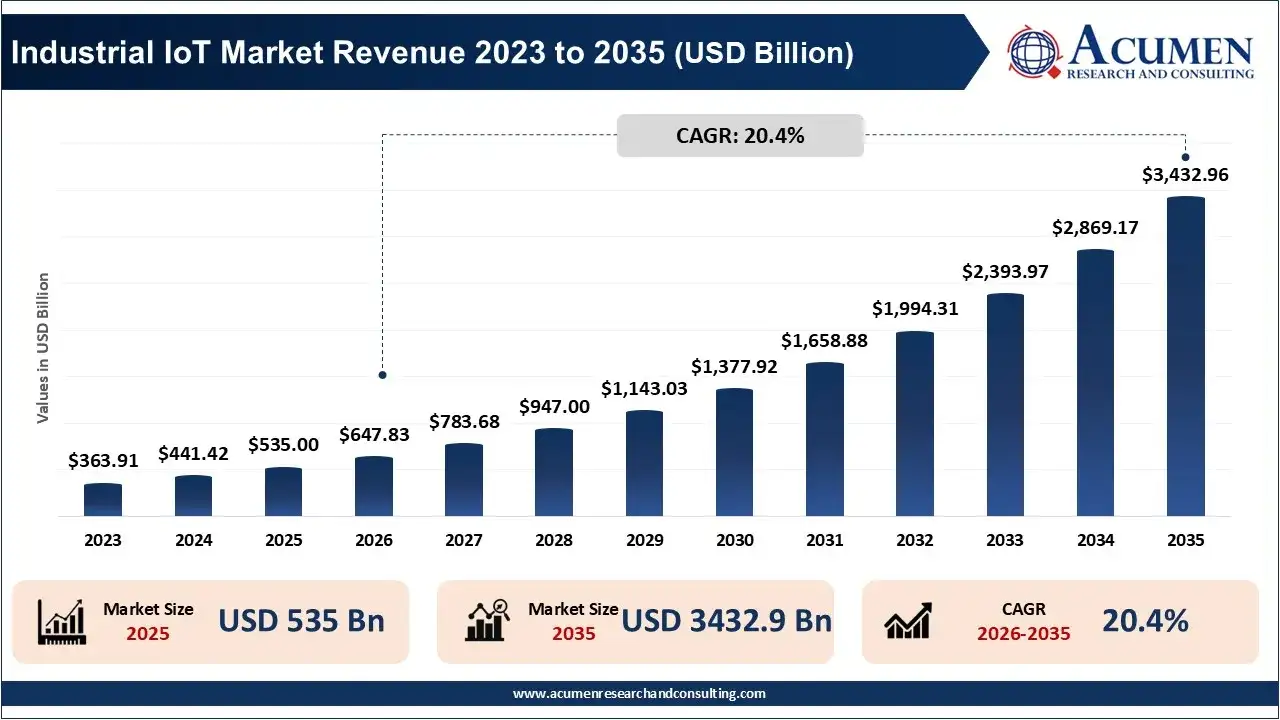
The industrial IoT (IIoT) market is composed of a set of devices such as intelligent and networked sensors and software application that are designed for industrial environments. The focus of IIoT systems is on collecting information, real-time monitoring and analysis of operational data and communicating machine to machine and process communication. The IoT is used in manufacturing, transportation, power, logistics and other key industrial industries to allow for real time and effective machinery operation and efficiency.
IIot allows industrial organizations across industries, from energy to manufacturing to health care, the ability to create value from the data generated in manufacturing settings. Industrial IoT market integrates technologies that comprise hardware, software, connectivity, and cloud systems that form industrial IoT applications and platforms that allow for efficient performance. Artificial intelligence, edge computing, 5G, machine learning as well as other advanced capabilities, are the foundation for IIot market development that contributes to a transformation into Industry 4.0.
Key Takeaways
- By component, the hardware segment held a significant market share in 2025 and represented 46% of the market share. The expanding application of IoT gadgets similar to programmable logic controllers (PLCs), industrial sensors, RFID frameworks, and gateways. This class controls the real-time machine correspondence, information collection, and resource following in any associated modern settings.
- Software accounted for a 32% market share in 2025. Development in request for industrial intelligence solutions together with industrial analytics, cloud based dashboards, cybersecurity solutions, and predictive analysis platforms driving development inside the sector.
- By connectivity technology, the wired connectivity segment captured a 38% market share in 2025. It’s primarily as these enterprises depend on secure, high pace and low delay networks as well as require constant communication in mission-critical functions together with their equipment.
- By connectivity technology, cellular connectivity (4G/5G) is predicted to witness the highest growth. The deployment of non-public 5G networks and growing the breadth of industrial wireless infrastructure permits customers with the ability to get real-time entry to operational details and faraway plant management.
- By deployment, on-premise solutions held the major market share of 52% in 2025 and is estimated to observe massive increase as companies seek higher command and command over their operational knowledge and security measures within regulated industries similar to gas and drug fields.
- Cloud-based deployment is expected to experience the fastest CAGR of 28.1% throughout the forecast period as a consequence of the reduced preliminary investment value, ease of scalability, and straightforward AI integration. As such, the cloud deployment aspect is progressively attracting industrial enterprises and can lead to rapid adoption in several organizations.
- By organization size, large enterprises accounted for a 76% market share as a consequence of the tremendous investment ability that these enterprises possess in their industrial operations. Giant companies are dedicated to reducing device downtime and enhancing efficiency.
- By end-use industry, the manufacturing industry held the major share of 32% of the market share in 2025, attributed to increasing adoption of sensible factory solutions in automation, improved machinery and robotic implementation. IIoT solutions are adopted within factories to extend effectivity and decrease waste by manufacturers.
- The automotive segment represented a 13% market share in 2025, manufacturers embrace the IoT for an expanded automation across robotic assembly strains, supply chain optimization, high quality inspections techniques, and more. Increasing adoption of electrical cars further increases IoT adoption.
Industrial IoT Market Opportunity
Rising Smart Factory Investments and Predictive Maintenance Adoption
Companies worldwide are pouring more into predictive maintenance and smart factories. Global figures suggest that industries lose more than $50 billion each year due to unscheduled downtime, and predictive maintenance can actually lower maintenance spending by between 25-30% and cut the number of equipment breakdowns in almost two-thirds. That’s driving industries to step up their industrial IoT usage to keep watch on their machinery’s condition and improve productivity.
More 5G and edge technologies fuel more opportunity: global industrial connections running over 5G are forecast to exceed 68 million by 2025, and will allow companies to establish low-latency robot or even autonomous-driving machine communication.
By 2030, more than 75% of the data generated at industries is expected to be managed at the edge, up from just under 20% in 2020, making room for edge-enabled IIoT platforms that facilitate on-site analytics, distributed decision-making, and the ability for industrial sites to be run from remote locations.
Industrial IoT Market Regional Analysis
Why does North America lead the industrial IoT market?
The market was led by North America with a share of 34% in 2025, mainly due to high adoption rate of automation in both the United States and Canada. The industrial infrastructure is matured within the region coupled with adoption of the latest manufacturing technologies. It has a comprehensive ecosystem with effective deployment of Artificial Intelligence and higher investment in the digital landscape.
The industries involved include aerospace, automotive, energy, etc., and they are the leading adopters of IIoT solutions to ensure the smooth operation, efficiency, and overall productivity.
The U.S. is projected to become the biggest contributor owing to the proliferation of advanced technology providers as well as swift development of privately owned industrial networks. High investment in semiconductor manufacturing and modernization of smart grids is another important driver to boost the demand for IIoT across North America.
Why is Asia Pacific anticipated to exhibit a strong CAGR in the industrial IoT market?
The Asia Pacific is anticipated to exhibit a strong CAGR of 22.9% by 2035, driven by massive industrial growth, digitization in factories, etc. China and India are the leading economies where industrial robots, connected devices, and automation technology are widely being deployed across the manufacturing, electronics and automobile industries.
China’s manufacturing output exceeds USD 4 trillion annually, making it one of the largest IIoT adopters globally. Meanwhile, India’s “Make in India” initiatives and rising smart manufacturing investments are increasing IIoT demand across industrial parks and logistics hubs.
Why Europe hits robust growth in the industrial IoT market?
Europe is a robust market in the industrial IoT market due to its strength in industry 4.0 with Germany, France and Italy taking lead in the region and highlighting on energy efficiency, industrial automation, as well as green manufacturing. Germany’s automotive and machinery sectors also continue to expand and are the fastest in implementing IIoT-enabled smart manufacturing processes.
Which are the top companies operating in the industrial IoT market?
The major players active in the industrial IoT market space consists of companies namely Siemens, Honeywell, ABB, Cisco, Schneider Electric, Rockwell Automation, IBM, Intel, and Bosch. They are driving the industrial IoT market by offering innovative industrial automation system solutions, cloud platform, artificial intelligence analytics, industrial cybersecurity services and devices.
Siemens as well as ABB invest significantly in smart manufacturing platforms and digital twins while Cisco and IBM lead in optimizing industrial connectivity and industrial data analytics tools, and Cisco and IBM is actively focused on optimizing industrial connection and also industrial data analytics technology.
While Schneider Electric and Honeywell focuses on increasing the usage of digital process automation technologies, Schneider and Honeywell is also actively in a process of improving energy solutions for smart environments.
Segments Covered
By Component
- Hardware
- Sensors
- RFID Tags
- Industrial Gateways
- Controllers
- Connectivity Modules
- Software
- Device Management Software
- Analytics Software
- Data Management Software
- Security Software
- Application Software
- Services
- Consulting
- System Integration
- Deployment Services
- Support & Maintenance
- Managed Services
By Connectivity Technology
- Wired Connectivity
- Wi-Fi
- Cellular (4G/5G)
- LPWAN (Low-Power Wide-Area Network)
- Satellite Connectivity
- Other Wireless Technologies
By Deployment
- On-Premise
- Cloud-Based
- Hybrid
By Organization Size
- Large Enterprises
- SMEs
By End-use Industry
- Manufacturing
- Automotive
- Aerospace & Defense
- Oil & Gas
- Energy & Utilities
- Healthcare
- Food & Beverage
- Mining & Metals
- Transportation & Logistics
- Others
By Region
- North America
- Europe
- Asia-Pacific
- Latin America
- Middle East & Africa
Contact Us:
Mr. Richard Johnson
Acumen Research and Consulting
India: +91 8983225533