
Automotive Headlamp Reflector Market Size to Reach USD 1,567.50 Million by 2035
Published : 30 Sep 2026
Author : Lucas Hoffmann



What is the Automotive Headlamp Reflector Market Size?
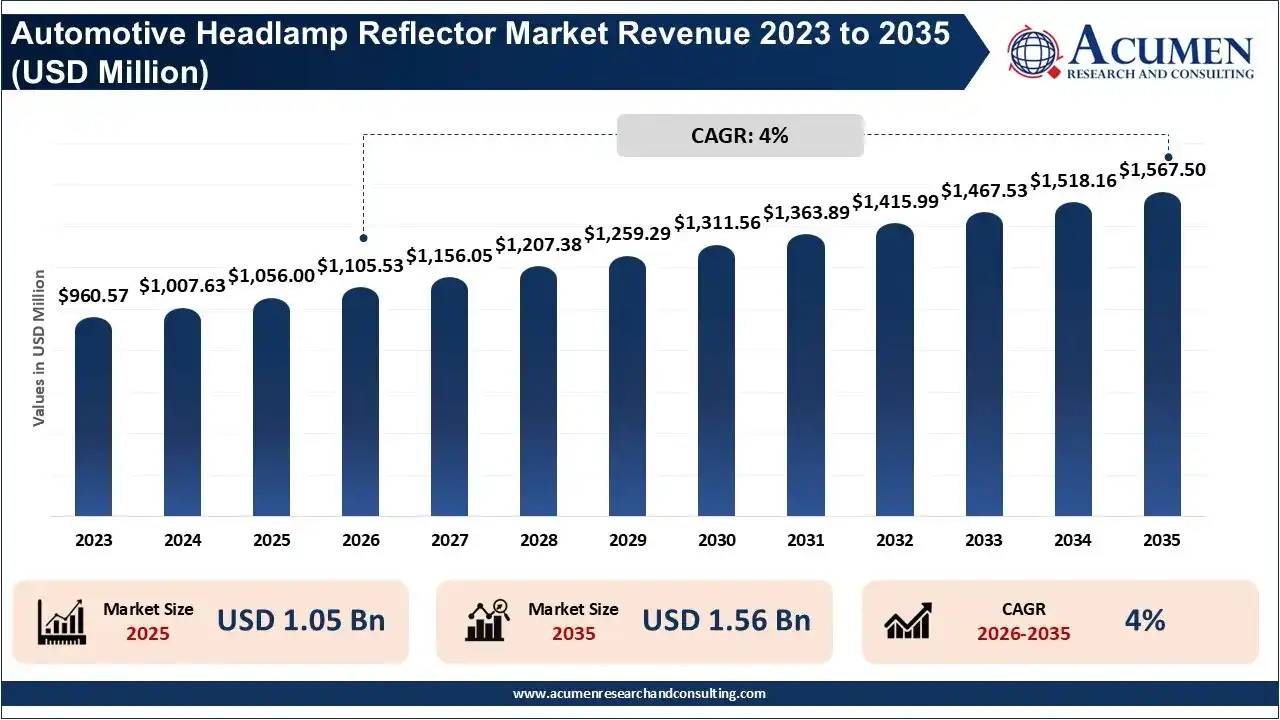
The global automotive headlamp reflector market size was recorded at USD 1,056 million in 2025 and is seen to reach at USD 1,567.50 million by 2035; growing at a CAGR of 4% from 2026 to 2035. The automotive headlamp reflector market is being driven by the shift toward lightweight materials, LED and adaptive lighting, increasingly complex reflector geometries, and high-volume vehicle production.
What Is Driving Growth in the Automotive Headlamp Reflector Market?
The automotive headlamp reflector market is expected to grow on the back of growing vehicle production worldwide, growing application of LED and adaptive headlamps, increasing electrification of vehicles and demand for small and light-weighted headlamp architecture. Car manufacturers are focusing on developing lighting solutions that not only are more energy-efficient and provide high-resolution light distribution but also are more flexible in terms of styling and offer better safety capabilities.
Opportunities Across Materials and Manufacturing
As automakers look for ways to enhance headlamp luminance and light distribution while minimizing weight and cost, there are opportunities for advances in lightweight materials, innovative optical designs and high-precision manufacturing of reflector components.
For example, thermoplastics used in headlamps need to be lightweight, able to be formed into complex geometries, and capable of mass production through high-cavitation injection molding. Thermoplastics satisfy all those requirements and can be used for the large, intricately shaped reflector parts needed for contemporary reflector assemblies.
In manufacturing, injection molding is an option for suppliers needing to produce large volumes of complex reflector parts with high repeatability. Innovation in tooling, surface finishes, optical coatings and other finishing steps can help OEMs meet the demands of the small, precise lighting modules used in advanced headlamp architectures using LED or adaptive lighting.
Segmental Outlook
| Market Segment | Dominant Segment | 2025 Market Share | Key Growth Factor |
|---|---|---|---|
| By Material | Thermoplastics | 42% | Lightweighting, complex optical geometries, cost efficiency, and high-volume injection molding |
| By Vehicle Type | Passenger Cars | 57% | High global vehicle production and increasing integration of LED and adaptive lighting |
| By Light Source/Technology | LED | 36% | Energy efficiency, longer operating life, compact packaging, and adaptive lighting capabilities |
| By Reflector Design | Parabolic Reflectors | 45% | Established optical design, cost-effectiveness, and widespread vehicle application |
| By Beam Function/Application | Low Beam | 42% | Everyday driving requirements, regulatory compliance, forward illumination, and glare control |
| By Sales Channel/Installation Type | OEM | 72% | Factory-installed assemblies, long-term vehicle programs, and automaker-supplier relationships |
| By Manufacturing Process | Injection Molding | 68% | Precision, repeatability, complex geometry production, and large-scale manufacturing |
Regional Outlook
Asia-Pacific Automotive Headlamp Reflector Market Analysis
Asia-Pacific made up the largest share of the automotive headlamp reflector market in 2025 at 40%, with 5.1% CAGR from 2026 to 2035, due to the region's unusually large automotive manufacturing base across China, Japan, India and South Korea. China remains a dominant production base while the established automotive technology and component ecosystems from Japan and Korea have contributed to the region's early gains.
The shift from traditional halogen illumination to LED and adaptive headlighting systems is also raising the technological content of headlamp assemblies. LED systems necessitate reflectors and optical elements that are designed to manage the distribution of light with improved efficiency and lighting quality and to fit into compact headlamp packages.
In Asia-Pacific, this trend is being further reinforced by rising EV manufacturing which offers a distinctive lighting signature, adaptive beam functions and electronically controlled light systems. China's large EV manufacturing base and increasing EV manufacturing in Japan and South Korea therefore provides an important demand base for complex reflector systems.
China: Large-Scale Vehicle Production Supports Reflector Demand
- High vehicle production: China's enormous automotive manufacturing base generates substantial OEM demand for headlamp reflector assemblies and related optical components.
- EV manufacturing expansion: China accounted for 70% of global electric-car production in 2025, strengthening demand for advanced lighting systems used in new-energy vehicles.
- Rapid LED adoption: The migration from halogen toward LED headlamps is increasing demand for precision optical components, including reflectors designed for improved beam control.
- Advanced lighting integration: Matrix LED, adaptive-beam, and pixel-based lighting architectures are increasing the complexity and value of headlamp assemblies.
- Domestic supplier development: Growing local manufacturing of LED packages and optical components is supporting shorter supply chains and greater localization.
Latin America Automotive Headlamp Reflector Market Analysis
Latin America held 7% of the global headlamp reflector market in 2025 and is expected to grow at a CAGR of 4.1% in the forecasted period 2026-2035. Its market share is nowhere near what the continents of Asia-Pacific, Europe, and North America hold, but the region is still a vital market for growth with its growing vehicle fleet, current automotive manufacturing hubs, and light component replacement market.
Regional market, automotive production and assembly activity in Brazil and Mexico, which is integrated with North American automotive supply chains and manufacturing value chain, sustains the regional market for all types of vehicles and components. The output of Mexico's automotive manufacturing creates a demand for lighting and optical components; some of which are produced domestically – while Brazil offers a large vehicle market and significant vehicle fleet.
Brazil: Large Vehicle Fleet Supports Aftermarket and OEM Demand
- Large domestic automotive market: Brazil's sizeable installed vehicle base supports recurring demand for replacement headlamp assemblies and reflector components.
- Vehicle manufacturing: Domestic production creates OEM opportunities for automotive lighting and optical-component suppliers.
- LED transition: Increasing availability of vehicles equipped with LED lighting is gradually shifting demand toward more sophisticated reflector and optical designs.
- Aftermarket opportunity: Replacement demand remains relevant because of vehicle aging, road conditions, accidents, and headlamp deterioration.
- Localization: Domestic component manufacturing can help suppliers serve automakers while reducing logistics dependence on imported lighting components.
Supply Chain Transformation
- Greater localization of automotive lighting production: Lighting suppliers are expanding regional manufacturing capabilities closer to major vehicle-production hubs, helping reduce logistics costs, improve delivery responsiveness, and support OEM localization strategies.
- Shift toward integrated lighting supply chains: The supply chain is moving beyond standalone reflector manufacturing toward integrated optical, electronic, lighting, and control-system development as headlamps become more sophisticated.
- Rising importance of precision tooling: Increasingly complex optical geometries are creating greater demand for specialized tooling, high-precision injection molding, metallization, coating, and automated assembly capabilities.
- Regional manufacturing expansion: Suppliers are increasing production capacity in high-growth automotive markets. For example, Marelli and Motherson opened a new automotive-lighting facility in Sanand, India, in 2026, including high-tonnage injection-molding capabilities and localized advanced lighting technologies.
- Closer OEM-supplier collaboration: Lighting manufacturers are becoming involved earlier in vehicle development programs to co-develop optical architectures, lighting electronics, and styling solutions with automakers.
How Companies Can Help Automotive Headlamp Reflector Market’s Expansion?
Outside the light itself, companies across the ecosystem-such as through the development of a systems business-have an opportunity to drive market growth through the integration of advanced optics, locally made components, new materials and local OEM collaboration. For example, Valeo can leverage its portfolio of front and adaptive lighting, sensing, and software-enabled lighting, as well as its large India engineering and manufacturing presence to support local OEM programs.
Koito Manufacturing can utilize its skills in headlamp technology, freeform reflector development and so on, while its recent India expansion-including the India Japan Lighting facility in Gujarat-can support local headlamp and other lighting production. Marelli and Motherson can combine resources to produce advanced lighting solutions locally, with capabilities such as high-tonnage injection molding, tooling and adaptive driving beam and high-beam technology, at Marelli's local operations.
Segments Covered
By Material
- Thermoplastics
- Composites
- Aluminum
- Sheet Steel
- Other Materials
By Vehicle Type
- Passenger Cars
- Light Commercial Vehicles
- Medium & Heavy Commercial Vehicles
By Light Source / Technology
- Halogen
- Xenon/HID
- LED
- Laser
By Reflector Design
- Parabolic
- Ellipsoidal
- Freeform
- Multifaceted/Segmented Reflectors
By Beam Function / Application
- Low Beam
- High Beam
- Low + High Beam
- Fog / Cornering
By Sales Channel / Installation Type
- Original Equipment Manufacturer (OEM)
- Aftermarket
By Manufacturing Process
- Injection Molding
- Compression Molding
- Other Processes
By Region
- North America
- Europe
- Asia-Pacific
- Latin America
- Middle East & Africa
Contact Us:
Mr. Richard Johnson
Acumen Research and Consulting
India: +91 8983225533