
Automotive Headlamp Reflector Market Size, Share, Growth, Report 2026 To 2035
Automotive Headlamp Reflector Market (By Material: Thermoplastics, Composites, Aluminum, Sheet Steel, Others; By Vehicle Type: Passenger Cars, Light Commercial Vehicles, Medium & Heavy Commercial Vehicles; By Light Source / Technology: Halogen, Xenon/HID, LED, Laser; By Reflector Design: Parabolic, Ellipsoidal, Freeform, Multifaceted/Segmented Reflectors; By Beam Function / Application: Low Beam, High Beam, Low + High Beam, Fog / Cornering; By Sales Channel / Installation Type: OEM, Aftermarket; By Manufacturing Process: Injection Molding, Compression Molding, Other Processes) - Global Industry Analysis, Size, Share, Regional Analysis, Trends and Forecast 2026 - 2035
- Last Updated: 23 Sep 2026
- Report Code: ARC3985
- Category: Automotive And Transportation
Automotive Headlamp Reflector Market Size, Forecast Report 2026 To 2035
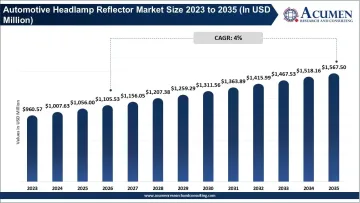
The global automotive headlamp reflector market size was valued at USD 1,056 million in 2025 and is projected to surpass USD 1,567.50 million by 2035; growing at a CAGR of 4.0% during the forecast period from 2026 to 2035. The growth of the automotive headlamp reflector market is driven by the increasing adoption of LED and adaptive lighting technologies, which require advanced reflector designs for improved beam control and increasing demand for lightweight materials are further supporting the use of advanced thermoplastic and composite reflectors.
Report Highlights
- By region, Asia-Pacific dominated the automotive headlamp reflector market in 2025 with a revenue share of 40%, supported by high automotive production in China, Japan, India, and South Korea, along with rising LED adoption and EV production.
- By region, Asia-Pacific is expected to register the fastest growth with a CAGR of 5.1% from 2026 to 2035, driven by expanding vehicle production, increasing adoption of advanced lighting technologies, and growing EV manufacturing.
- By material, thermoplastics dominated the market in 2025 with a revenue share of 42%, supported by lightweighting requirements, complex optical geometries, cost efficiency, and suitability for high-volume injection molding.
- By material, composites accounted for the second-largest revenue share of 38% in 2025, supported by their high strength-to-weight ratio, heat resistance, dimensional stability, and design flexibility.
- By vehicle type, passenger cars dominated the market in 2025 with a revenue share of 57%, supported by high global vehicle production volumes and increasing integration of LED and adaptive lighting systems.
- By light source/technology, LED is expected to register the fastest growth, with its share projected to increase from 36% in 2025 to 57% by 2035, driven by higher energy efficiency, longer operating life, compact packaging, and advanced adaptive lighting capabilities.
- By reflector design, parabolic reflectors dominated the market in 2025 with a revenue share of 45%, supported by their established optical design, cost-effectiveness, and widespread use across vehicle applications.
- By reflector design, freeform reflectors accounted for the second-largest revenue share of 27% in 2025 and are expected to register the fastest growth, driven by precise beam shaping, glare control, and greater flexibility for modern compact headlamp designs.
- By beam function/application, low beam dominated the market in 2025 with a revenue share of 42%, supported by its essential role in everyday driving, regulatory compliance, forward illumination, and glare control.
- By beam function/application, low + high beam is expected to register the fastest growth with a CAGR of 6.1% from 2026 to 2035, driven by integrated dual-function headlamps, improved packaging efficiency, and increased use of controlled LED light sources.
- By sales channel/installation type, OEM dominated the market in 2025 with a revenue share of 72%, supported by factory-installed headlamp assemblies, long-term vehicle programs, and established relationships between automakers and lighting suppliers.
- By manufacturing process, injection molding dominated the market in 2025 with a revenue share of 68%, supported by high precision, repeatability, complex geometry production, and suitability for large-scale manufacturing.
What Is the Automotive Headlamp Reflector Market & How Does It Work?
The scope of the automotive headlamp reflector market covers all the optics used inside a vehicle headlamp assembly for capturing, redirecting, and projecting light onto the road to deliver the required beam pattern with minimized glare for approaching drivers. The market also covers reflector manufacturing using thermoplastics, composites, aluminum, and sheet steel and reflector design around LED, adaptive, matrix, and other advanced light sources. Reflector designs range from traditional parabolic and ellipsoidal shapes to segmented and freeform shapes for increased control over beam distribution, packaging, and styling.
Why Is Aftermarket Demand Increasing for Automotive Lighting Components? Know from Our Experts:
Our analysts at Acumen Research & Consulting, believe that aftermarket demand for automotive lighting components will expand as the global vehicle parc matures, existing vehicles remain on the road for a longer duration, and car owners tend to replace deteriorated or damaged lighting components rather than the entire vehicle.
Automotive lighting aftermarket demand will also be driven by LED retrofit upgrades, conventional lamp replacement, higher vehicle usage, distribution through online channels, and improved consumer understanding of the impact of the lighting system and road safety. The Indian automotive aftermarket value is estimated to have been around 99,500 crore in FY2025, supported by a growing number of older vehicles and the higher use of vehicles.
| Automotive Lighting Component | Representative Country | 2025/2026 Market Highlight |
|---|---|---|
| Headlamps | China | China represents a major automotive production and lighting demand center, supported by its large vehicle manufacturing base and rapid adoption of LED and intelligent lighting. |
| Rear lamps | China | High vehicle production volumes and increasing adoption of LED rear lighting make China a key market for rear-lamp components. |
| LED headlamp modules | India | India is emerging as a major production and technology expansion market, with global suppliers increasing local manufacturing and engineering capabilities. |
| Fog lamps/cornering lamps | United States | Strong vehicle ownership and replacement demand support continued aftermarket requirements for auxiliary lighting components. |
| Adaptive/matrix lighting modules | Germany | Germany remains an important market for advanced lighting systems because of its premium automotive manufacturing base and strong adoption of sophisticated vehicle technologies. |
Market Dynamics
Driver
Increasing adoption of LED and adaptive lighting technologies
Growing use of LED and adaptive lighting technology. Moving away from traditional halogen and HID illumination, automakers are adopting LED, matrix LED, adaptive driving beam, and high-resolution lighting systems. These new technologies require more precise reflector surfaces that are capable of providing multiple functions within single headlamp packages, and can also provide improved light control, beam intensity, and maximum illumination coverage. LED lighting provides an increased lifetime, improved efficiency, and more design freedom that enables more passenger and commercial vehicle applications.
Restraint
Increasing complexity and cost of advanced lighting systems
Increasing complexity and cost of advanced lighting systems: The growing integration of high-resolution LEDs, sensors, cameras, electronic control units, optics, and software is increasing the technical complexity and overall cost of automotive headlamp systems. Advanced lighting architectures require precise optical engineering, thermal management, electronic controls, calibration, and validation, which can increase development and manufacturing expenses for automakers and component suppliers.
Opportunity
Expansion of EVs and intelligent vehicle lighting
The rapid adoption of electric vehicles is providing an avenue for automotive headlamp reflector manufacturers as auto OEMs are evolving front end architecture to allow for the new vehicle platforms and exotic styling. EV OEMs are using more compact LED, matrix, adaptive and high-resolution lighting systems, such as laser, which utilize specialty optical elements that enable the tight light packaging space.
Software-defined vehicles are also enabling various lighting functions to become programmable and responsive, such as adaptive beam control, dynamic light distribution, and communication-enabled lighting.
Where Are Companies Investing in Automotive Headlamp Reflector Technology?
- India manufacturing expansion: Valeo announced in February 2026 that it plans to invest more than €200 million in India to expand its industrial footprint, engineering capabilities, and technology capacity, with the objective of increasing Indian sales to around €700 million by 2028.
- High-resolution LED headlamps: FORVIA HELLA is expanding investment in high-resolution SSL|HD technology, including systems with around 25,000 individually controllable LED pixels per headlamp, supporting more precise beam control and advanced lighting functions.
- India production capacity: Koito expanded its Indian manufacturing footprint through its Gujarat plant, which was designed for annual production capacity of 500,000 headlamps and 500,000 rear combination lamps.
- Advanced adaptive lighting: HELLA has secured multiple headlamp programs incorporating adaptive lighting technology for North American OEM applications, with series production scheduled for 2028 and 2029, indicating continued investment in intelligent headlamp architectures.
- Next-generation lighting manufacturing in India: Marelli-Motherson opened a specialized exterior-lighting facility in Sanand, Gujarat, in February 2026, expanding production capabilities for high-performance exterior lighting and new lighting technologies.
Regional Insights
Asia-Pacific: The Manufacturing Powerhouse Is Becoming the Center of Automotive Reflector Demand
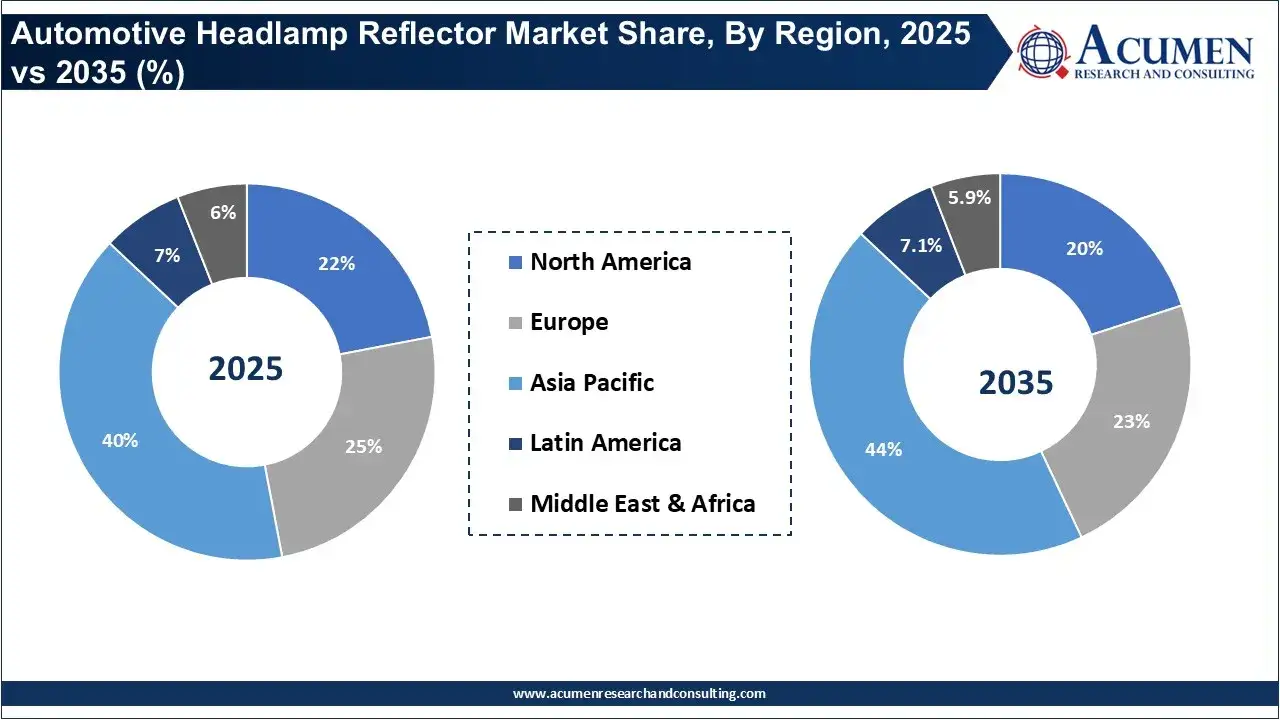
Asia-Pacific accounted for the lion's share 40% of the automotive headlamp reflector market in 2025, ahead of Europe at 25% and North America at 22%. It is also forecast to be the fastest growing large regional headlamp reflector market, with 44% share at a 5.1% CAGR from 2026 to 2035. Asia-Pacific's high share is due to the region's high volume automotive production in China, Japan, India and South Korea along with increasing LED use, EV production and greater vehicle production volumes.
Chinese automakers are also increasingly using distinctive lighting designs as a vehicle-branding element. This is encouraging greater use of compact, multi-element and electronically controlled headlamps, creating opportunities for freeform and segmented reflector technologies.
The expansion of domestic automotive manufacturing, EV platforms, intelligent vehicles, and premium lighting systems therefore supports both volume demand and technology upgrading in the Chinese reflector market.
Japan & India: Mature Automotive Manufacturing Supports High-Value Demand
Japan remains an important automotive lighting market due to its established passenger-vehicle manufacturing industry and sophisticated automotive component ecosystem. Major Japanese automakers have historically placed strong emphasis on vehicle safety, reliability, engineering precision, and advanced lighting technologies.
The country's mature automotive market means volume growth is comparatively constrained, but technology intensity remains significant. Increasing adoption of LED and advanced headlamp systems supports demand for precision reflector components and complex optical designs.
India is becoming increasingly important for automotive headlamp reflector manufacturers because of expanding vehicle production, rising passenger-car ownership, commercial-vehicle demand, and increasing adoption of LED lighting.
The Indian automotive market also has a broad mix of entry-level, mid-range, premium, and commercial vehicles. This creates demand for multiple reflector technologies, from cost-efficient conventional systems to increasingly sophisticated LED-based assemblies.
Europe: Regulation and Premium Lighting Technology Support High-Value Reflector Demand
Europe was 25% of the automotive headlamp reflector market in 2025 and will be 23% by 2035. The region will grow at a CAGR of 3.0% from 2026 to 2035. OEM reflector growth is driven by the region's strong vehicle manufacturing base and passenger vehicle manufacturing industry, high-end production, and increased markets for adaptive lighting and advanced lighting.
Supporting factors include a mature passenger car manufacturer base and automotive supplier network; support for reflector demand through both domestic vehicle production and aftermarket replacement markets; and a gradual shift towards LED headlamps creating opportunities for newer reflector designs, against a backdrop of LED headlamp adoption in older vehicles and in value-sensitive applications.
Germany: Premium Vehicles and Automotive Engineering Drive Demand
Germany is the most important country-level market in Europe due to its established automotive manufacturing infrastructure and focus on premium vehicles. German automakers have been early and significant implementers of more advanced LED, matrix, adaptive and high-performance headlamp systems, which necessitate the use of highly precise optical surfaces and more sophisticated reflector geometries.
Though vehicle production growth is slower than in emerging markets in Asia, the premium-vehicle focus makes Germany an important market for higher-value reflector technologies including freeform and segmented reflectors.
Latin America: Growing Vehicle Parc Supports Gradual Reflector Market Expansion
Latin America accounted for 7% of the total automotive headlamp reflector market in 2025 and is anticipated to hold 7.1% by 2035 at a 4.1% CAGR; being the fastest growing marketplace.
The region's opportunity is driven primarily by increasing vehicle ownership, expansion of the vehicle parc, automotive production in major economies, and replacement demand. Brazil is the primary country-level market in Latin America due to its significant presence of automotive manufacturing and significantly large amount of vehicles in use domestically.
The country's automotive manufacturing ecosystem drives OEM reflector demand, while the large installed vehicle base creates aftermarket replacement demand. Adoption of LED lighting in new vehicles is growing, which is slowly beginning to change the mix of the technology.
Hence reflector supplier has the opportunity of fulfilling two demand segments: The traditional reflector market for the present vehicle fleet, and demand in the form of vehicle manufacture for lightweight polymer-based reflector technology and LED compatible reflector designs.
Segmental Insights
Material Insights
Why Thermoplastics Are Becoming the Preferred Platform for Next-Generation Reflectors
In 2025, thermoplastics were the dominant material in the automotive headlamp reflector market at 42% share, and we forecast them to make up 45% share of the market in 2035. Automotive headlamp lighting manufacturers are increasingly demanding reflectors made from materials that are able to accommodate complex geometries while helping manage the weight and manufacturing costs of individual components.
Light-weighting is especially crucial when it comes to using thermoplastics, because automakers are finding that reducing weight is key to increasing energy efficiency. In addition to their obvious use in internal-combustion engines, where reducing weight is always critical, lightweight components are also appealing to EV manufacturers, as they strive to offset the weight of vehicle batteries.
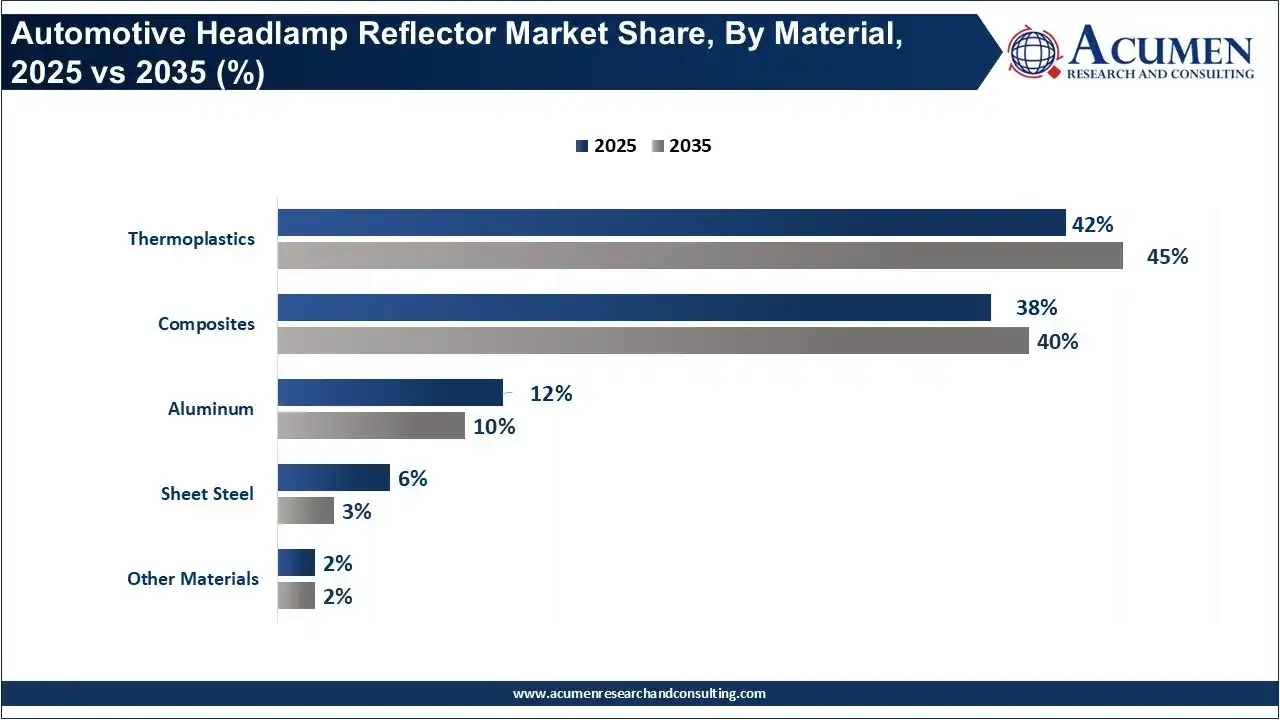
Composites represented the second-largest material segment, with a 38% share in 2025 and a projected 40% share by 2035. Their adoption is supported by their strength-to-weight characteristics, thermal resistance, and design flexibility. Composite materials are particularly relevant where reflector assemblies need to balance structural stability with thermal and optical requirements.
As headlamps become more compact and technologically sophisticated, heat management and dimensional stability become increasingly important. Composite materials can provide manufacturers with additional flexibility when designing components that must withstand temperature variations while maintaining their intended geometry.
Vehicle Type Insights
Passenger Cars Remain the Core Demand Engine
Passenger cars constituted 57% of the overall automotive headlamp reflector market share and is anticipated to grow steadily to 58% by 2035. Light commercial vehicles share stood at 25%, while medium and heavy commercial vehicles stood at 18%. Passenger cars represent the largest reflector demand pool because of their substantially higher global production volumes and the increasing incorporation of advanced lighting systems into new vehicles.
More significantly, the progression of passenger-car lighting from traditional halogen-based lighting towards LED, adaptive-lighting, and electronically actuated beam lights means that the overall requirement for reflector units is becoming more technically demanding.
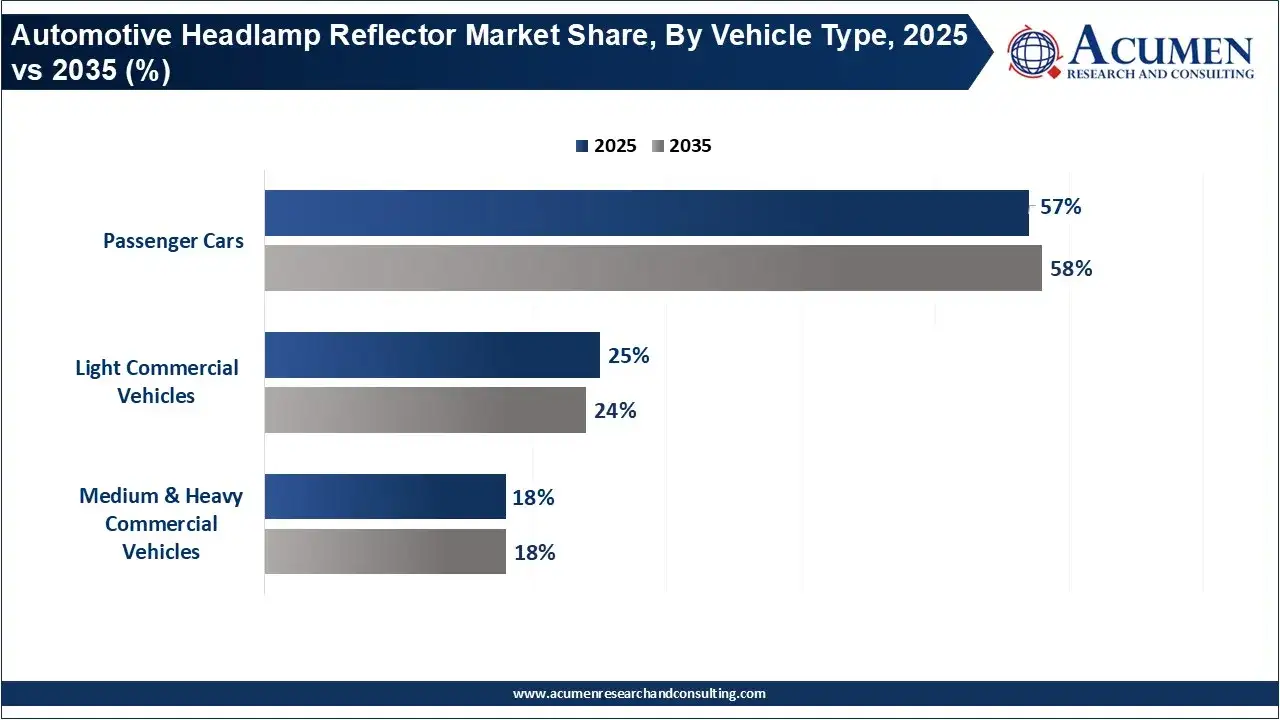
Light commercial vehicles held the second-largest share at 25% in 2025. Growth in urban logistics, e-commerce deliveries, fleet-based transportation, and last-mile distribution is supporting demand for LCVs and consequently for their lighting components.
The segment is also benefiting from increasing fleet utilization. Commercial operators place greater emphasis on visibility, reliability, and operating safety because vehicles may operate for longer hours than privately owned passenger cars. However, reflector content and advanced lighting penetration remain somewhat lower than in many passenger-car applications, limiting its relative share expansion.
Light Source / Technology Insights
LED Is Reshaping the Reflector Opportunity
In 2025, halogen remains a bigger light source with a 42% share, versus LED at 36%. While LED is a primary alternative to halogen, which grew in 2025 supported by its lower cost, larger installed base, and penetration into still-cheaper vehicle programs, halogen has a significant installed base still. There are a number of older vehicles and entry-level models for which users will continue to replace reflector and lens parts.
However, for every high-volume lighting application, LED has a near-insurmountable structural advantage, due to its excellent efficiency, long life, small physical size, and greater opportunities for intelligent light control.
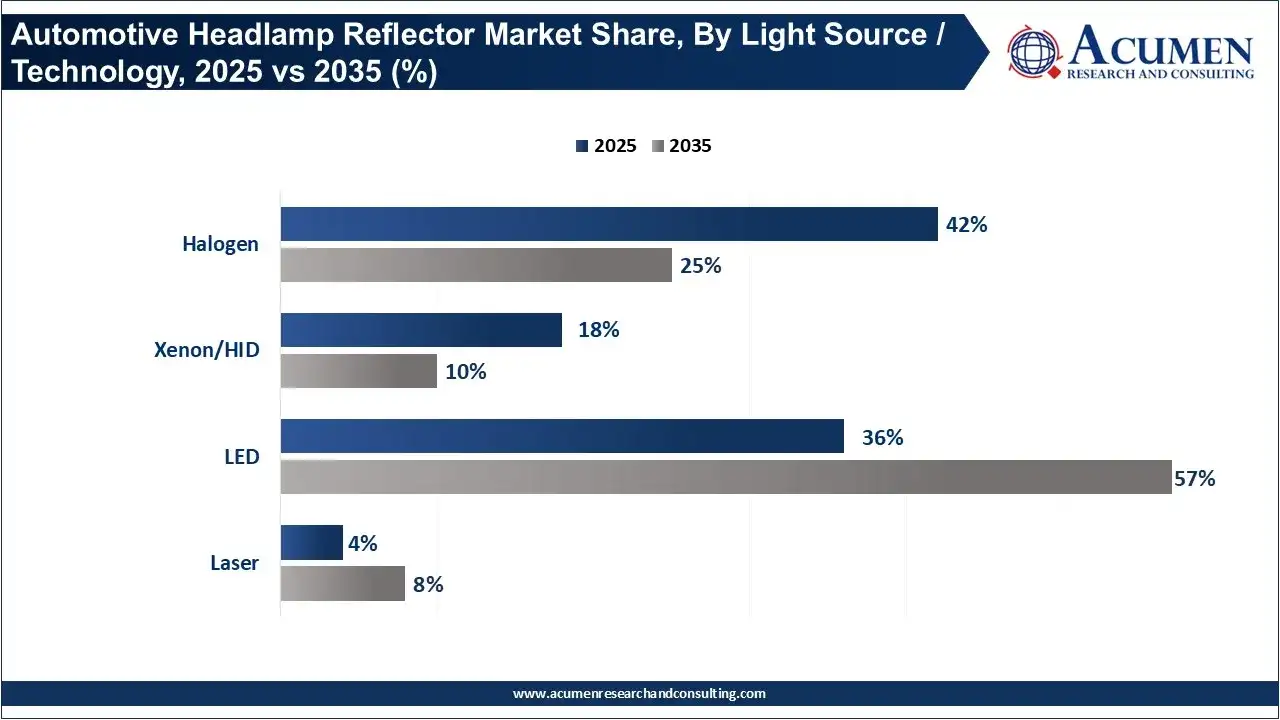
LEDs are also the fastest growing light-source technology and are predicted to be the dominant category by 2035, growing from 36% of the market in 2025 to 57% in 2035. The key benefit of LED is its ability to deliver energy efficiency, small packaging, long life, and advanced optical control, all of which is well aligned to the future trend in automotive headlamp design.
LED also allows manufacturers to consider separating the headlamp into multiple optical segments. This is especially relevant for adaptive and matrix solutions, as each LED element can be individually controlled to produce a suitable illumination pattern. Such architecture drives demand for carefully engineered reflector surfaces and segmented optical packages.
Reflector Design Insights
Freeform Geometry Is Moving Automotive Lighting Beyond Conventional Optics
The reflector-design segment was led by parabolic reflectors, which accounted for 45% of the market in 2025. Freeform reflectors make up the second-largest segment at 27% and are followed by ellipsoidal reflectors at 18% and multifaceted/segmented reflectors at 10%.
Parabolic reflectors dominate the overall reflector-design segment due to their mature manufacturing base, simple optical design, and broad installed base. Due to their efficiency in projecting light into the desired road area, this form has traditionally been the most common form of design used in traditional automotive lighting applications.
Its long history of use on both passenger and commercial vehicles provides manufacturers with significant manufacturing experience and supports continued application on existing and new vehicle programs.
Automotive Headlamp Reflector Market Share, By Reflector Design, 2025 (%)
| By Reflector Design | Revenue Share, 2025 (%) |
|---|---|
| Parabolic | 45% |
| Ellipsoidal | 18% |
| Freeform | 27% |
| Multifaceted/Segmented Reflectors | 10% |
Freeform reflectors are the fastest-growing reflector-design segment, which also held 27% share in 2025; supported by their ability to create complex optical surfaces for precise beam shaping and glare management.
Freeform designs can also support modern vehicle styling because optical performance can be engineered around tighter packaging constraints. Automakers therefore gain greater freedom to create thinner or more distinctive headlamp designs while maintaining required illumination performance.
Beam Function / Application Insights
Integrated Low-and-High Beam Systems Are Gaining Ground
The low beam was the largest application segment in 2025 at 42%. Low beam was the largest beam-function segment in 2025 due to being the most basic backlighting function and meeting most road-lighting requirements for standard driving.
Almost all vehicles will need a low-beam function, meaning it will be the primary way reflector demand is generated. Low-beam reflectors need to provide forward illumination to the driver, all while controlling glare to other drivers, which leads to complex reflector geometry and optical accuracy requirements.
Automotive Headlamp Reflector Market Share, By Beam Function / Application, 2025 (%)
| Beam Function / Application | Revenue Share, 2025 (%) | Revenue Share, 2035 (%) |
|---|---|---|
| Low Beam | 42% | 38% |
| High Beam | 23% | 21% |
| Low + High Beam | 25% | 30% |
| Fog / Cornering | 10% | 11% |
The low + high beam segment is expected to be the fastest-growing application, with a CAGR of 6.1% between 2026 and 2035, while its share rises from 25% in 2025 to 30% in 2035. The growth reflects increasing demand for integrated headlamp architectures that can provide both everyday low-beam illumination and high-beam visibility within a common optical system.
Combining functions can improve packaging efficiency and enable manufacturers to create more compact lighting modules. LED technology further strengthens this opportunity because multiple LED sources can be arranged and controlled within a single headlamp architecture.
Sales Channel / Installation Type Insights
OEMs Control the Market, While Aftermarket Creates a Growth Niche
The OEM segment of the automotive headlamp reflector market in 2025 was 72%, versus 28% for the aftermarket. OEM sales are the largest because reflectors are incorporated into complete headlamp assemblies that are installed as OEM equipment. Creating automotive lighting programs for a vehicle platform takes a number of years, resulting in long-term, collaborative relationships between automakers, lighting suppliers, and component manufacturers.
The advent of sophisticated LED modules, adaptive lighting, integrated beam functions, and electronically controlled optical systems means that reflector components need to be designed as part of the vehicle's entire headlamp system, rather than as one-off replacement items. Despite the relatively small portion of the aftermarket, 28%, vehicles in use are increasing in number, aging, requiring replacements, and forming the basis for LED retrofit sales and distribution by internet-based channels.
The aftermarket opportunity is especially important in countries where the size of the vehicle fleet is large. Damage and deterioration, collisions, reduced optical performance, and replacement of aging components drive the future growth of this sector.
Automotive Headlamp Reflector Market Share, By Sales Channel/Installation Type, 2025 (%)
| By Sales Channel/Installation Type | Revenue Share, 2025 (%) |
|---|---|
| Original Equipment Manufacturer (OEM) | 72% |
| Aftermarket | 28% |
Manufacturing Process Insights
Injection Molding Leads High-Volume Reflector Production
Injection molding is the dominant manufacturing process because automotive reflectors require high dimensional precision, repeatability, complex geometries, and efficient high-volume production. The process is particularly well suited to thermoplastic reflectors, which are becoming increasingly important in the market. Manufacturers can produce complex reflector surfaces at scale while maintaining consistent dimensions across large production runs.
This becomes increasingly important as automakers introduce complex optical surfaces for LED and adaptive lighting systems. Small deviations in optical geometry can affect beam performance, making process consistency critical. The strong position of injection molding therefore reflects both its manufacturing efficiency and its compatibility with the material and technology shifts occurring throughout the reflector market.
Automotive Headlamp Reflector Market Share, By Manufacturing Process, 2025 (%)
| By Manufacturing Process | Revenue Share, 2025 (%) |
|---|---|
| Injection Molding | 68% |
| Compression Molding | 24% |
| Other Processes | 8% |
Compression molding accounted for 24% of the market and remains important for BMC and thermoset reflector applications. However, its relative share is expected to face pressure from improved injection molding and injection-compression technologies. Stamping, machining, and specialized molding processes collectively represented 8%. These processes continue to serve metal-based and specialized reflector applications but face structural pressure as polymer-based production expands.
Leading Companies & Their Product Portfolios
| Company | Headquarters | Product portfolio relevant to automotive headlamp reflectors |
|---|---|---|
| Koito Manufacturing Co., Ltd. | Japan | Automotive headlamps, LED headlamps, adaptive driving beam systems, matrix LED lighting, and other exterior lighting systems. |
| Valeo | France | LED and matrix LED headlamps, adaptive lighting systems, high-definition lighting, laser lighting, and integrated front-lighting solutions. |
| FORVIA HELLA | Germany | LED headlamps, matrix LED systems, high-resolution SSL |
| Marelli | Japan / Italy | LED headlamps, adaptive front lighting, matrix lighting, laser lighting, full-LED systems, and advanced exterior lighting modules. |
| Stanley Electric Co., Ltd. | Japan | LED headlamps, adaptive driving beam systems, optical modules, projector systems, and automotive exterior lighting components. |
| ZKW Group | Austria | Premium LED headlamps, matrix LED systems, laser lighting, adaptive front-lighting systems, and integrated lighting modules for passenger vehicles. |
| OPmobility | France | Front lighting systems, LED headlamps, adaptive lighting technologies, lighting modules, and integrated exterior lighting solutions. |
| Varroc Engineering | India | LED headlamps, halogen headlamps, projector headlamps, adaptive lighting systems, rear lamps, and other automotive lighting components. |
| SL Corporation | South Korea | LED headlamps, adaptive front-lighting systems, matrix lighting, combination lamps, and integrated automotive lighting assemblies. |
Recent News
- May 2026: FORVIA HELLA launched its fully localized SSL|HD high-resolution headlamp system in China for the Zeekr 8X. The system uses around 25,000 individually controllable LED pixels per headlamp and combines high-resolution matrix lighting with adaptive functions.
- March 2026: FORVIA HELLA announced the development of Galaxy Diamond Matrix Headlamps for the Zeekr 8X, marking the first localization of its SSL|HD technology in China. Each headlamp incorporates around 25,000 LED pixels and an additional 16-zone adaptive lighting module for functions such as glare-free high beams and dynamic light projection.
Segments Covered
By Material
- Thermoplastics
- Composites
- Aluminum
- Sheet Steel
- Other Materials
By Vehicle Type
- Passenger Cars
- Light Commercial Vehicles
- Medium & Heavy Commercial Vehicles
By Light Source / Technology
- Halogen
- Xenon/HID
- LED
- Laser
By Reflector Design
- Parabolic
- Ellipsoidal
- Freeform
- Multifaceted/Segmented Reflectors
By Beam Function / Application
- Low Beam
- High Beam
- Low + High Beam
- Fog / Cornering
By Sales Channel / Installation Type
- Original Equipment Manufacturer (OEM)
- Aftermarket
By Manufacturing Process
- Injection Molding
- Compression Molding
- Other Processes
By Region
- North America
- Europe
- Asia-Pacific
- Latin America
- Middle East & Africa
Looking for discounts, bulk pricing, or custom solutions? Contact us today at sales@acumenresearchandconsulting.com
Frequently Asked Questions

Other Automotive And Transportation Reports
October 2024
April 2021
March 2025
September 2021