December 2023

Laser Interferometer Market (By Type: Homodyne, Heterodyne; By Application: Metrology and Quality Control, Measurement and Alignment, Scientific Research and Development, Medical Devices and Diagnostics, Others; By End Use: Automotive, Aerospace and Defense, Medical and Life Sciences, Electronics Manufacturing and Semiconductor, Telecommunication, Others) - Global Industry Analysis, Size, Share, Analysis, Trends and Forecast 2026 - 2035
The global laser interferometer market size was accounted for USD 330.3 million in 2025 and is anticipated to hit around USD 605.1 million by 2035, garnering a CAGR of 6.1% from 2026 to 2035. The growing demand for high-precision manufacturing is boosting the demand for laser interferometers. Furthermore, expansion of semiconductor and electronics industries is creating new growth opportunities for the market.
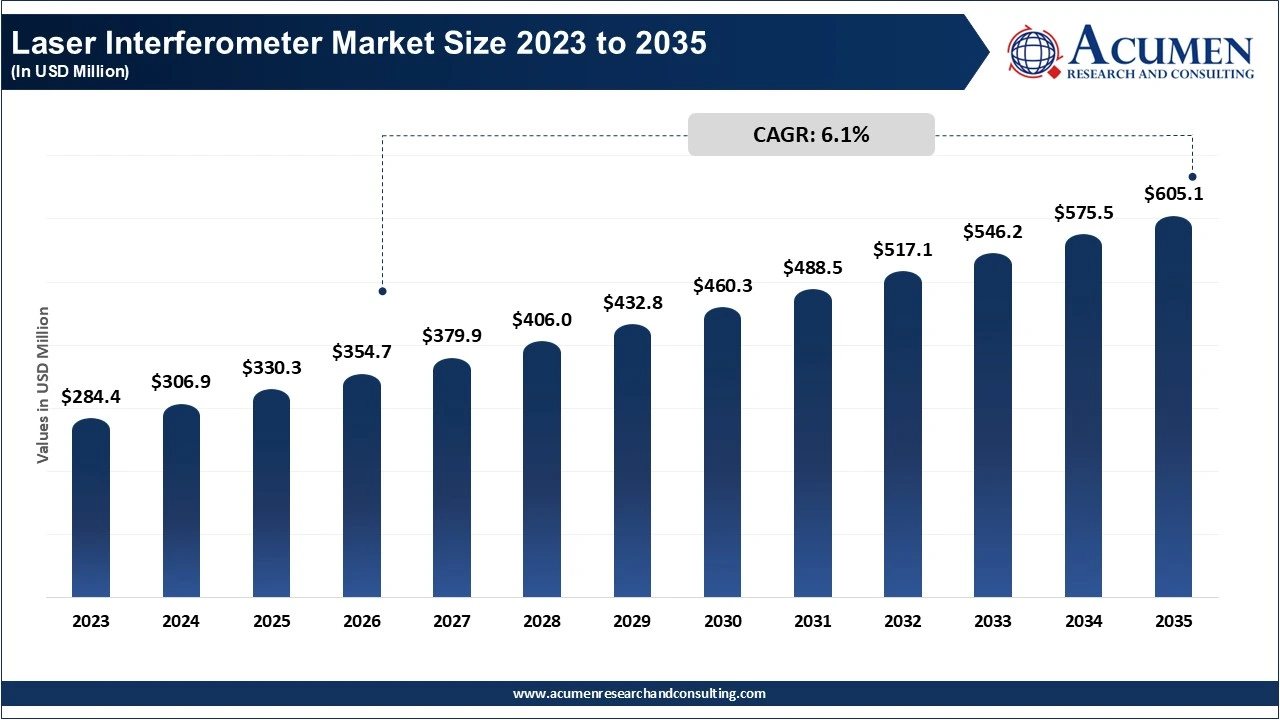
Currently, the laser interferometer market is undergoing a significant transformation. Driven by leaps in research and development related to the technology and its increasing applications in other industries, the market is changing rapidly. This market embraces the use of those tools which work in accordance with the principle of interference. This allows the calculation of distances precisely. Some other industries like aerospace, automotive, and telecommunication are also using these interferometers to a great extent. Increasing demands for precise instruments are also projected to drive the market growth. Additionally, the fusion of digital technology and the laser interferometer has been an important phenomenon based on which the use of software tools may raise the efficiency of the concerned instruments. Many research activities related to the development of the laser interferometer are likely to lead to an era where the standards for measurement may be redefined.
Expansion of Semiconductor Manufacturing
Growing Focus on Quality Assurance
High Cost
Technological Complexities
Advent of Automation in Manufacturing
Expansion in R&D Initiatives
| Attribute | Details |
| Laser Interferometer Market Size 2025 | USD 330.3 Million |
| Laser Interferometer Market Forecast 2035 | USD 605.1 Million |
| Laser Interferometer Market CAGR During 2026 – 2035 | 6.1% |
| Analysis Period | 2023 – 2035 |
| Base Year | 2025 |
| Forecast Data | 2026 – 2035 |
| Segments Covered | By Type, By Application, By End Use, and By Geography |
| Regional Scope | North America, Europe, Asia-Pacific, Latin America, and Middle East & Africa |
| Key Companies Profiled | Zygo Corporation, Keysight Technologies, Inc., Renishaw plc, OptoMetry, Inc., Mahr GmbH, Nikon Metrology, Fizzy Technologies, Häfner GmbH, Laser Design, Inc., and AMETEK, Inc. |
| Report Coverage | Market Trends, Drivers, Restraints, Competitive Analysis, Player Profiling, Covid-19 Analysis, Regulation Analysis |
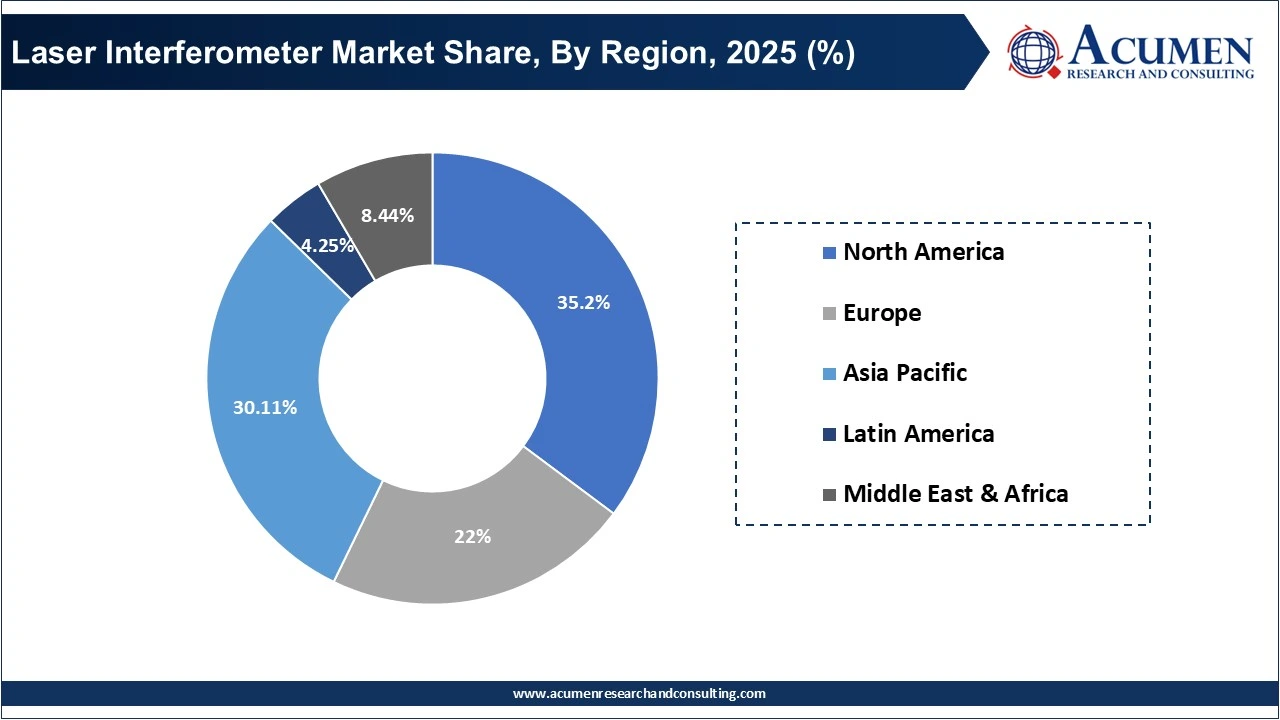
North America dominated the laser interferometer market by garnering a major market share in 2025. The growth of the region can be attributed to the technological advancements, the need for precise measurements in the aerospace and automotive sectors, and the government legislation acts which promote research and development. Development in the region is also aided by the presence of major players such as Zygo Corporation, and Keysight Technologies.
| Region | Market Share, 2025 (%) | Key Highlights |
| North America | 35.2% | Development in the region is aided by the presence of major players such as Zygo Corporation, and Keysight Technologies. |
| Europe | 22% | The Europe market is driven by the region’s strong presence of precision engineering firms, semiconductor R&D hubs, and advanced automation adoption. |
| Asia-Pacific | 30.11% | The development in this market is promoted by the increasing efforts in terms of industrialization, especially in countries such as China and Japan. |
| MEA | 8.44% | Growing investments in aviation maintenance, defense modernization, and precision component manufacturing fuels the growth of the market. |
| Latin America | 4.25% | Active vehicle manufacturing clusters in Brazil, Mexico, and Argentina are driving the market demand. |
The Asia-Pacific market is expected to observe a significant growth throughout the forecast period. Countries such as India, Japan, China, and South Korea are contributing significantly to the growth of the Asia-Pacific market. The development in this market is promoted by the increasing efforts in terms of industrialization, especially in countries such as China and Japan. For example, there is a growing requirement for high-precision measuring instruments. The R&D efforts by governments that further enhance technological developments boost this market significantly. China leads this market due to growing industries and rising R&D investments. Japan ranks second due to advanced innovations in laser interferometry.
The worldwide market for laser interferometer is split based on type, application, end use, and geography.
The homodyne segment dominated the laser interferometer market in 2025 with approximately 69% market share. Homodyne laser interferometer are most widely used for precise measurement and metrology. The reason for this dominance of the homodyne interferometer can be attributed to its capability of accurately measuring data with high stability, making it the most preferable option for industrial use. The heterodyne interferometer, on the other hand, represents the rapidly expanding market. The heterodyne interferometer holds the potential for making precise measurements of the phase difference at a highly refined level of resolution. This requirement for precise measurement of phase difference in scientific experiments/optical experiments thereby leads to a rising demand for heterodyne interferometer, making it the rapidly expanding market.
| Type | Market Share, 2025 (%) | Key Highlights |
| Homodyne | 69% | Dominant due to its capability of accurately measuring data with high stability, making it the most preferable option for industrial use. |
| Heterodyne | 31% | The heterodyne interferometer holds the potential for making precise measurements of the phase difference at a highly refined level of resolution. |
Based on application, the market is segmented into Metrology and Quality Control, Measurement and Alignment, Scientific Research and Development, Medical Devices and Diagnostics, and Others.
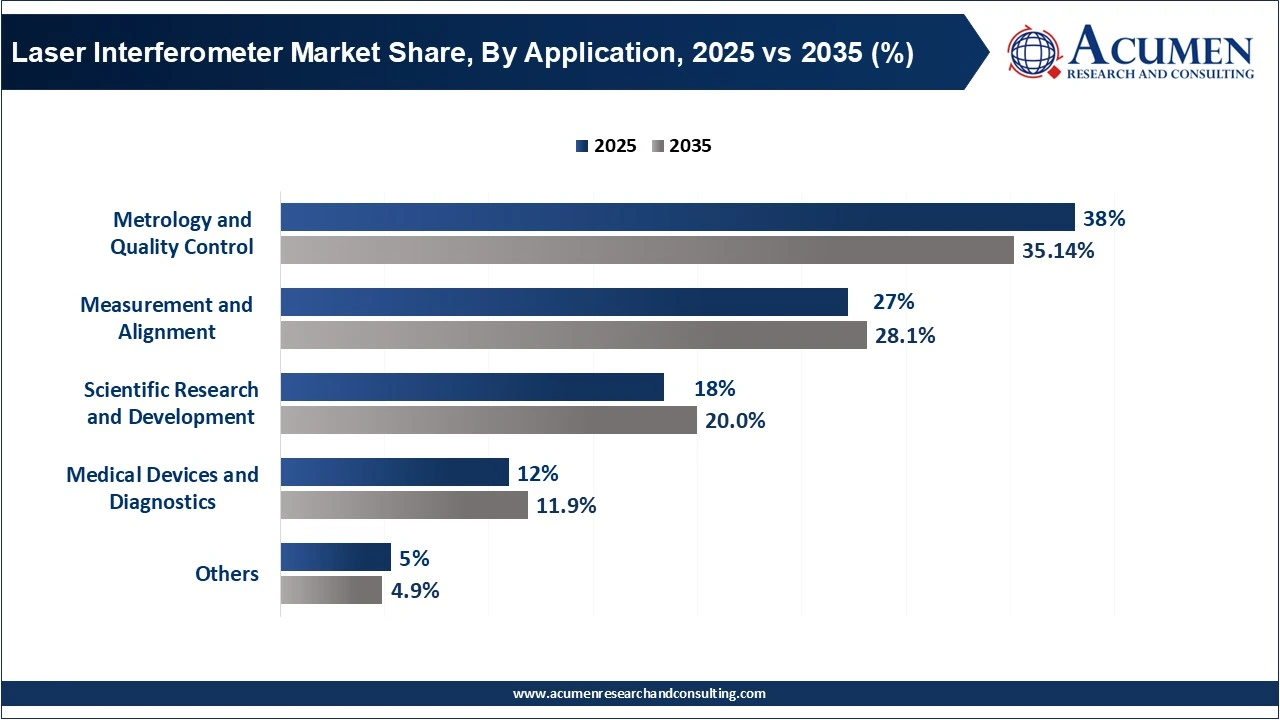
According to the laser interferometer industry analysis, in 2025, the metrology and quality control application dominated the market. The segment has maintained a crucial role in the achievement of precision and accuracy in a wide range of sectors, indicating a high demand for the use of laser technology in measurement instruments. The segment is dominated by its significance with respect to the sectors that require precise measurements in their operations.
| Application | Market Share, 2025 (%) | Key Highlights |
| Metrology and Quality Control | 38% | The segment has maintained a crucial role in the achievement of precision and accuracy in a wide range of sectors, indicating a high demand for the use of laser technology in measurement instruments. |
| Measurement and Alignment | 27% | In R&D, laser interferometers enable fundamental physics experiments, vibration analysis, and advanced materials research requiring extreme measurement sensitivity. |
| Scientific Research and Development | 18% | The development in this market is promoted by the increasing efforts in terms of industrialization, especially in countries such as China and Japan. |
| Medical Devices and Diagnostics | 12% | The technology supports medical device calibration and diagnostic imaging systems that rely on high-resolution, non-contact measurement accuracy. |
| Others | 5% | Additional uses span aerospace testing, robotics calibration, and environmental monitoring, where precise displacement and stability measurements are critical. |
The electronics manufacturing and semiconductor segment led the laser interferometer sector because the need to achieve extremely high precision and accuracy is critical to this industry. Another application area in semiconductors is the inspection and fabrication of wafers. With the use of metrology in interferometers, it is possible to produce faultless performance from the semiconductors. As technology advances and the need to manufacture smaller semiconductors accelerates to meet the growing demand for processors and consumer electronics, the production plants will depend on laser interferometers to produce semiconductors that meet the technology requirements.
| Region | Market Share, 2025 (%) | Key Highlights |
| Automotive | 15.12% | The automotive industry utilizes laser interferometers in the verification of high-precision components in order to develop advanced manufacturing and electric vehicle platforms. |
| Aerospace and Defense | 20.01% | Aerospace and defense industries require interferometers for highly accurate alignment, structural testing, and component calibration wherein tolerance factors have very small margins. |
| Medical and Life Sciences | 12.22% | Interferometers in medical and life sciences allow highly accurate calibration of medical diagnostic instruments, which is critical to micro-measurement requirements in medical imaging and the production of medical instruments. |
| Electronics Manufacturing and Semiconductor | 42.07% | As technology advances and the need to manufacture smaller semiconductors accelerates to meet the growing demand for processors and consumer electronics, the production plants will depend on laser interferometers to produce semiconductors that meet the technology requirements. |
| Telecommunication | 7.13% | In the telecommunication industry, interferometers are used to verify optical components, fiber communications, and stability in high-speed communications. |
| Others | 3.45% | Other end-uses, such as research organizations, robotics, and industrial equipment, utilize the laser interferometer in applications involving precise measurement, vibration analysis, and calibration of their devices. |
By Type
By Application
By End Use
By Region
Looking for discounts, bulk pricing, or custom solutions? Contact us today at [email protected]

December 2023
June 2023
May 2020
December 2023
Trusted Market Intelligence | 2026–2035 Insights | Designed to Support Faster, Smarter Decisions
Thank you! Our team will reach out to you soon.