
Data Analytics Market Size to Hit USD 1,119.64 Billion by 2035, Reflecting a CAGR of 28.9%
Published : 08 Oct 2026
Author : Lucas Hoffmann



What is the Data Analytics Market Size?
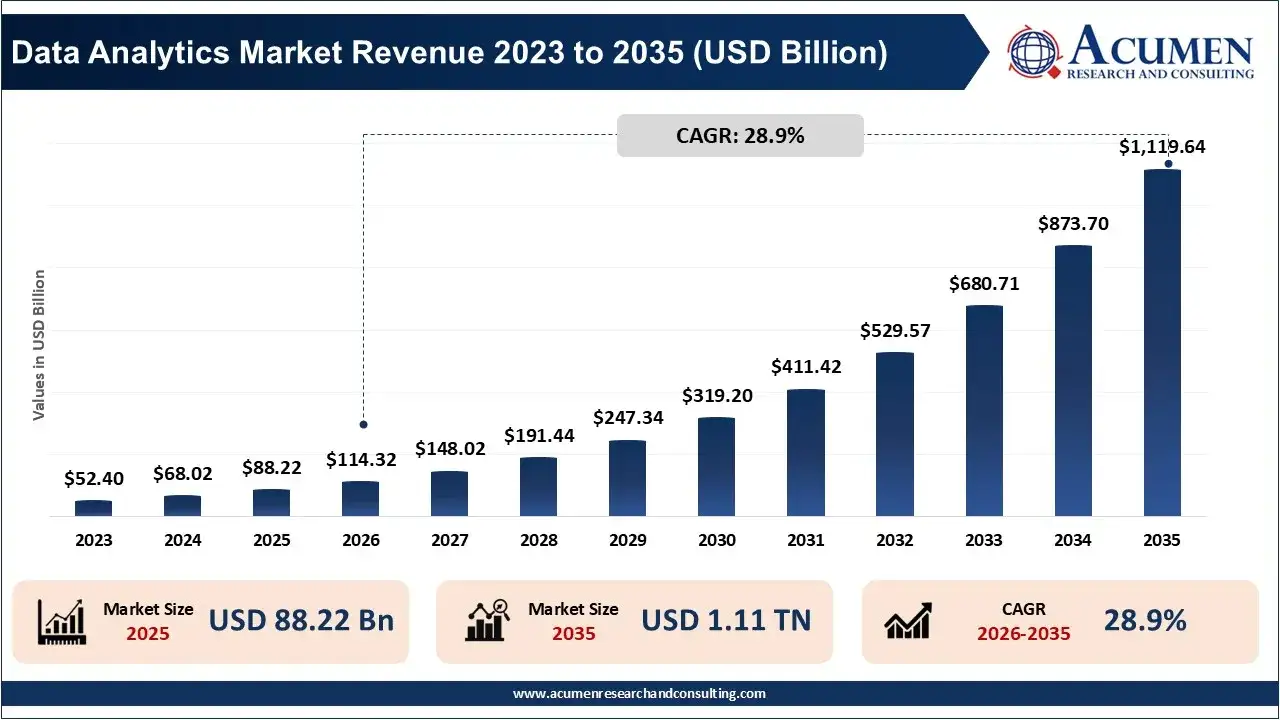
The global data analytics market size was accounted for USD 88.22 billion in 2025 and is expected to hit USD 1,119.64 billion by 2035, growing at a CAGR of 28.9% during the forecast period 2026 to 2035. The data analytics market is experiencing strong growth as organizations increasingly prioritize data-driven decision-making, AI and machine learning adoption, cloud migration, and real-time business intelligence to improve operational efficiency, customer experience, risk management, and competitive positioning.
Data Analytics Market Overview
The data analytics market is experiencing robust growth as organizations are collecting unprecedented amounts of structured and unstructured data from various aspects of the business process. Organizations are now investing in advanced analytics platforms to translate that data into usable information to help them to forecast demand, streamline their operational efficiencies and processes, build smarter customer relationships, detect fraudulent activities, and drive key decisions about their business and its strategy moving forward.
Several trends such as cloud computing, AI and ML adoption, the ease and power of self-service analytics tools, and the desire to process real-time data are contributing to market growth. Moreover, increased accessibility and scale of SaaS-based analytical solutions now empower even small-to-medium businesses to use these technologies to drive strategic initiatives, while large businesses are focused on integrated and enterprise-wide data management and analytics platforms.
Emerging Trends
- Real-Time Analytics: Businesses are increasingly adopting real-time analytics to monitor operations, detect anomalies, respond to customer behavior, and support faster decision-making.
- Augmented Analytics: AI and machine learning are being embedded into analytics platforms to automate data preparation, pattern identification, forecasting, and insight generation.
- Cloud-Based Analytics: Migration toward cloud analytics is accelerating due to its scalability, flexibility, lower infrastructure requirements, and easier access to advanced analytical tools.
- Self-Service Analytics: Organizations are increasingly enabling non-technical employees to independently access dashboards, visualize data, and generate business insights without extensive IT support.
- Predictive and Prescriptive Analytics: Enterprises are moving beyond historical reporting toward predictive forecasting and prescriptive recommendations that support proactive and automated decision-making.
- Embedded Analytics: Analytics capabilities are increasingly being embedded directly into enterprise applications, workflows, and customer-facing platforms to provide insights within existing business processes.
How Will Generative AI Transform the Data Analytics Market?
Generative AI could substantially reshape the data analytics market, by creating opportunities for more accessible, automated and conversational data analysis. It means that, over and beyond the efforts of data analysts with specific expertise in data analytics, enterprises will see increasing use of business users, natural language querying to gain access to enterprise data, automatic generation of reports and visualizations, finding patterns and generating AI explanations of large amounts of data.
Generative AI also appears to enable predictive and prescriptive data analytics where analyses can be generated (e.g., forecasts, recommendations, simulations) based on historical and real-time data. As generative AI integrates with the existing cloud data solutions, BI platforms, and enterprise applications, it is expected that will facilitate analytics adoption, reduce manual data processing requirements and contribute to more faster, data driven decision making by 2035.
Data Analytics Market Segmental Snapshot
| Segmentation | Dominant Segment | 2025 Share | Key Driver |
|---|---|---|---|
| By Analytics Type | Predictive Analytics | 34% | Rising enterprise demand for forecasting, risk prediction, customer behavior analysis, and data-driven decision-making. |
| By Component | Software & Solutions | 68% | Growing adoption of integrated analytics platforms, self-service analytics, data visualization, and AI-enabled analytical capabilities. |
| By Deployment | On-Premise | 64% | Greater preference among enterprises handling sensitive and regulated data for infrastructure control, security, and data governance. |
| By Enterprise Size | Large Enterprises | 68% | Larger data volumes, higher technology investments, dedicated analytics teams, and broader use of enterprise analytics applications. |
| By Industry Vertical | BFSI | 21% | Extensive use of analytics for fraud detection, risk management, credit scoring, regulatory compliance, customer intelligence, and financial decision-making. |
Which Data Analytics Technologies Will Gain the Most Traction by 2035?
- Generative AI and AI-powered analytics: Increased usage of natural language queries, automatic insights, AI-powered report generation, intelligent data interpretation.
- Predictive analytics: Growing usage in areas of forecasting demand, customer behavior, finance risk prediction, equipment failure, market trends, etc.
- Prescriptive analytics: Increased usage of AI recommendations and automated decision-making to provide the right and most optimal action using the analytical findings.
- Real-time analytics: Increased demand for the real-time processing of data over all services viz financial services, retail, telecom, manufacturing, IoT, etc.
- Augmented analytics: Increased integration of Artificial intelligence and machine learning for data preparation, pattern finding, visualization, automated insight generation, etc.
- Cloud native analytics: Continuous trend of using expandable and portable Cloud based analytics platforms.
Data Analytics Market Regional Landscape
North America is a leader among the regions globally, with a share of 33.4% in the global data analytics market in 2025. This dominance is based on their sophisticated and matured enterprise technology infrastructure and vendors who also pioneer in advanced analytics and technologies and adoption of cloud.
Growing Enterprise expenditure towards data-driven decision making, increased spending on AI-powered BI and deployment of analytics solution in BFSI, healthcare, retail, manufacturing and technology industries have further bolster the region's share.
- United States is expected to maintain their top contributor role in the North American data analytics market, due to significant spending on enterprise cloud, faster integration of AI & ML, large and massive volumes of enterprise data generated coupled with top technology players catering analytics solutions.
The fastest-growing region in the data analytics market globally is Asia-Pacific, with their regional share growing from 27.2% in 2025 to 36.5% by 2035. This increasing pace is because of faster ongoing digitization, adoption and generation of enterprise data, cloud initiatives, high spend on AI and adoption across emerging economies.
Many governments & enterprises across the region investing heavily on digital infrastructure, smart manufacturing, Fin Tech & E-commerce and data-driven public services would create significant need for real time and predictive analytics.
- India is emerging as a high-growth market for data analytics, driven by rapid digital transformation, increasing enterprise data generation, expanding cloud adoption, and growing investments in artificial intelligence. Rising analytics adoption across BFSI, IT and telecom, healthcare, retail, and manufacturing is expected to create significant opportunities for analytics providers, particularly as Indian enterprises increasingly focus on real-time insights and data-driven decision-making.
Major Investors
- Microsoft – Investing heavily in Azure, AI, cloud infrastructure, Power BI, and enterprise data platforms to expand AI-powered analytics capabilities.
- Amazon Web Services (AWS) – Expanding investments in cloud, AI, data infrastructure, and analytics services to support enterprise workloads.
- Alphabet (Google) – Investing in Google Cloud, AI infrastructure, BigQuery, and advanced data analytics capabilities.
- Oracle – Increasing investments in cloud infrastructure and AI capabilities that support enterprise data management and analytics.
- IBM – Investing in enterprise AI, hybrid cloud, data management, and AI-powered analytics solutions.
- Salesforce – Expanding its data and AI ecosystem through Data Cloud, Tableau, and AI-driven business intelligence capabilities.
- SAP – Investing in enterprise data platforms, cloud analytics, and AI-enabled business applications.
- Snowflake – Increasing investments in its cloud data platform and AI capabilities to support enterprise analytics and data workloads.
- Databricks – Expanding its lakehouse, data engineering, analytics, and enterprise AI capabilities through strategic partnerships and platform development.
- NVIDIA – Investing across the AI computing ecosystem that enables advanced analytics, machine learning, and accelerated data processing.
Segments Covered in the Report
By Analytics Type
- Descriptive Analytics
- Diagnostic Analytics
- Predictive Analytics
- Prescriptive Analytics
By Component
- Software/Solution
- Services
By Deployment
- On-Premise
- Cloud
- Hybrid
By Enterprise Size
- Large Enterprises
- Small & Medium Enterprises (SMEs)
By Industry Vertical
- BFSI
- IT & Telecom
- Healthcare & Life Sciences
- Retail & E-commerce
- Manufacturing
- Government & Public Sector
- Energy & Utilities
- Others
By Region
- North America
- Europe
- Asia-Pacific
- Latin America
- Middle East & Africa
Contact Us:
Mr. Richard Johnson
Acumen Research and Consulting
India: +91 8983225533