
Published : 11 Jun 2026
Author : Lucas Hoffmann



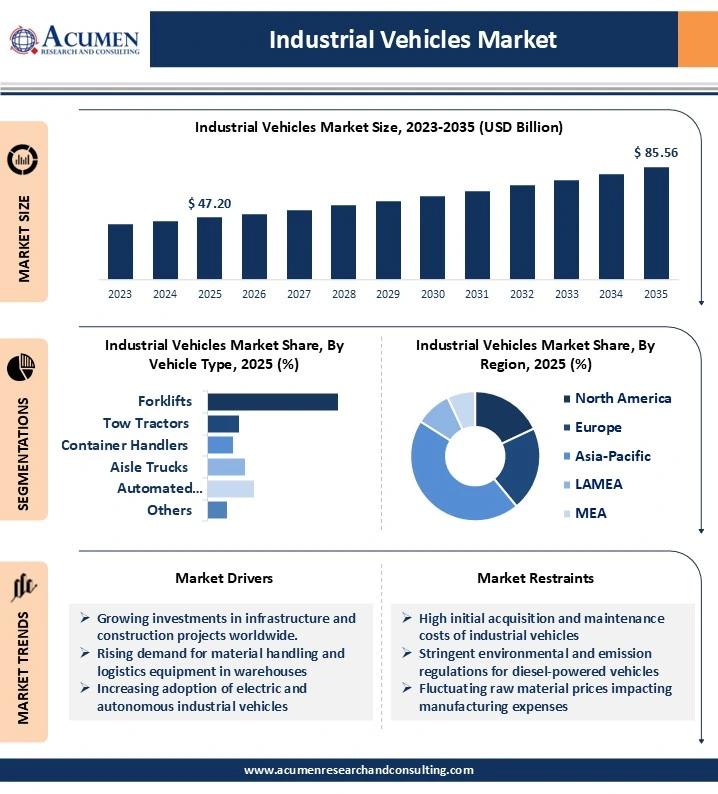
The global industrial vehicles market size was estimated at USD 47.20 billion in 2025 and is estimated to reach around USD 85.56 billion by 2035 growing at a CAGR of 6.1% from 2026 to 2035. The industry is witnessing a rapid shift in leasing/rental services in construction and mining industries across major regions in the world, this promotes the market’s expansion. Additionally, the market is observed to grow with the rapid adoption of warehouse automation and e-commerce logistics along with investments in new-age materials by these industries.
The industrial vehicles market includes vehicles and equipment that carry, lift, move, stack, store and handle material at the industrial settings. They are widely used in warehouse facilities, manufacturing facilities, logistics centers, ports, mining sites, construction sites and distribution facilities. Industrial vehicles offer benefits to enterprises, such as, enhanced productivity, labor saving, improved safety, and material handling convenience.
The industrial vehicles market segment consists of various equipment including forklifts, pallet trucks, reach trucks, tow tractors, automated guided vehicles (AGVs), automated mobile robots (AMRs), container handlers and other industrial transporters. These industrial vehicles use different engines such as internal combustion engines, electric motors and hybrid engines.
Rapid Shift Toward Electric Industrial Vehicles: Market’s Largest Opportunity
One of the significant opportunities lies in the ongoing transition from internal combustion engine (ICE) to electric industrial vehicles. Businesses from across industries are becoming more focused on decreasing their carbon footprints, controlling fuel costs and contributing towards corporate sustainability initiatives which is thus further encouraging a higher demand for electric forklifts, electric pallet trucks, electric tow tractors and other battery operated industrial vehicles.
Electric industrial vehicles boast benefits such as reduced running and maintenance costs, better energy efficiency and quieter operation. With ongoing developments in battery technology, electric vehicles are beginning to become powerful enough to tackle greater workloads and run for longer periods making them efficient for use in a broader range of industrial applications. It is anticipated that the transition from ICE vehicles will accelerate due to rising environmental awareness among corporate bodies.
In 2025, the Asia Pacific had the largest share of 45% in the industrial vehicles market and is predicted to register the highest CAGR of 6.5% during the forecast period. The region has evolved as a global manufacturing and logistics hub and benefits from strong industrial output, and growing supply chains. China, India, Japan, and South Korea continue to heavily invest in industrial infrastructure, warehouse expansion, and upgrading manufacturing facilities.
The booming development of e-commerce channels, the growing acceptance of industrial automation and increasing demand for smart material handling solutions is anticipated to drive the demand of industrial vehicles across the region. Additionally, the increasing government efforts to support the growth of manufacturing sector and logistics infrastructure are likely to further propel the market growth.
Latin America region is expected to witness a promising growth of 6.3% over the forecast period. Investment growth in logistics infrastructure, transportation infrastructure, and industrial development project is growing in the region. Increasing trade relations and expanding warehousing infrastructure is creating a lucrative opportunity for the deployment of industrial vehicles.
Countries such as Brazil and Mexico have been observing significant demand for material handling equipment due to ongoing expansion of manufacturing and distribution operations in the region. Gradually increasing adoption of automated solutions and increasing improvement in supply chain operations is anticipated to foster the market growth in the long-run.
The global industrial vehicles market has many major competitors including Toyota Industries Corporation, KION Group, Jungheinrich AG, Crown Equipment Corporation, Hyster-Yale Materials Handling, Mitsubishi Logisnext, Komatsu Ltd., Doosan Corporation, Anhui Heli Co., Ltd., and Hangcha Group.
The industrial vehicle market can be influenced by each of these corporations by continuing product developments, automation, electrification and growing global distribution channels. As the request for more sustainable and intelligent industrial vehicles increases these corporations expected to leading industry development.
| Segments | Details |
| By Vehicle |
|
| By Propulsion |
|
| By Automation Level |
|
| By Application |
|
| By End-user |
|
| By Region |
|
Contact Us:
Mr. Richard Johnson
Acumen Research and Consulting
India: +91 8983225533
E-mail: [email protected]