
Agentic AI Market Size, Share, Growth and Forecast 2026 - 2035
Agentic AI Market (By Component: Solutions, Services; By Agent Architecture: Multi-Agent Systems, Single-Agent Systems; By Application: Autonomous Process Automation, Predictive Analytics and Decision Support, Intelligent Virtual Assistants, RPA Integration, Smart Manufacturing and IIoT, Others; By End Use: Healthcare, BFSI, IT & Telecom, Manufacturing, Government, Automotive, Retail & E-commerce, Others) - Global Industry Analysis, Size, Share, Analysis, Trends and Forecast 2026 - 2035
- Last Updated: 30 Dec 2025
- Report Code: ARC3881
- Category: ICT
Agentic AI Market Size and Forecast 2026 - 2035
The global agentic AI market accounted for a revenue of USD 7.1 billion in 2025 and is projected to reach USD 260.7 billion by 2035, registering a CAGR of 43.3% from 2026 to 2035. The expansion of AI capabilities is driving the demand for agentic AI. Furthermore, the increasing development of industry-specific solutions is opportunistic for the market growth.
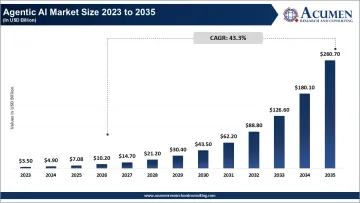
Report Highlights
- By Region, the North America agentic AI market garnered a revenue of USD 2.4 billion in 2025.
- By Region, the Asia-Pacific agentic AI market is projected to grow at a profitable CAGR of over 45.1% from 2026 to 2035.
- By Component, the solutions segment accounted for 61% of the total market share in 2025.
- By Agent Architecture, the multi-agent systems segment accounted for 53% of the market share in 2025.
- By Application, the autonomous process automation led the market, accounting for 24% of the agentic AI market share in 2025.
- By End Use, the IT & telecom segment represented 26% of the total market share in 2025.
Agentic AI Market Overview
Agentic AI is a new generation of advanced systems which can perform adaptive execution and autonomous decision-making across complex and distributed digital ecosystems. Organizations are increasingly adopting these systems to optimize operational efficiency, automate knowledge work, and execute real-time decision-making across multi-cloud, hybrid cloud, and edge environments. Factors that have contributed to a rapid market increase include an uptick in the enterprise data complexity, need for contextual intelligence, and dependence on scalable automation.
Major players such as IBM Corporation, Microsoft, NVIDIA Corporation, and Anthropic lead this space. They have the most advanced research in AI, robust cloud infrastructure, and lay a platform that is highly adaptable to enterprise systems. They continuously advance with the help of strategic investments, innovation, and the delivery of flexible agentic AI solutions to cater to industries such as healthcare, finance, life sciences, and enterprise IT.
Agentic AI Market Dynamics
What is Driving Agentic AI Market Growth?
Expansion of AI Capabilities
- Artificial intelligence is playing a crucial role in the transformation of the agentic AI market by facilitating the development of smart, dynamic, and efficient security systems. It enhances threat detection, response automation, and decision-making in real time and, therefore, is a necessity when handling the dynamics of the IT environment. For instance, in February 2025, OpenText unveiled Core Threat Detection and Response, driven by AI, provided on the Microsoft Azure platform. The solution is integrated into Microsoft Defender, Entra ID, and Security Copilot that power faster threat identification and response. It utilizes adaptive AI, which address threats, thereby empowering businesses to improve their security without affecting existing infrastructure.
Rising Demand for Advanced Automation
- Various business organizations, including finance and healthcare, among others, are rapidly incorporating the use of agentic AI, thus allowing the automation of complex processes that may involve various steps, including human intervention. For instance, current research has shown that intelligent automation is quickly emerging, and the projection is that nearly 80% of business entities will be using the system in the year 2025. These intelligent agents have the capability to know the context, make decisions, and apply the processes without the intervention of humans, thus greatly minimizing the human efforts required by employees.
Market Restraints
Regulatory Uncertainties
- Regulatory uncertainty is one of the significant restraints in the adoption of agentic AI solutions on a wider scale. As various governments and regulatory institutions launch different regulatory guidelines on artificial intelligence, the issue of regulatory uncertainties makes it challenging for businesses that look forward to adopting these AI solutions on an agentic platform. This is particularly important where certain sectors like finance and other public-oriented sectors have stringent regulations on matters of compliance, which are evolving on a regular basis.
Data Security Concerns
- Concerns about data security are holding back the agentic AI market growth due to the required degree of autonomy and data accessibility inherent in these intelligent agents. Agentic AIs are actively working with sensitive data in enterprises, causing them to be increasingly vulnerable to cyber threats, data intrusions, and unauthorized access. Their ability to interoperate with various platforms, combined with their reliance on cloud-based strategies, multiplies data governance complexities and risk management efforts. Leakage, misuse, and interpretability in autonomous decision-making are further increasing data governance complexities related to regulations like GDPR and HIPAA.
What are the Future Opportunities in Agentic AI Market?
Development of Industry-specific Solutions
- AI solutions are being developed to serve specifically to the needs of diverse sectors, including finance, manufacturing, health, and retail, and others. The applications address unique issues encountered in different sectors of the economy regarding compliance, privacy, and operational issues. For example, Causaly unveiled Causaly Agentic Research, a first of a kind AI agentic platform specifically designed for life sciences research and development, in September 2025. The platform uses special AI agents to automate research tasks with a huge amount of biomedical data integrated into a single platform, providing transparent and evidence-based insights to accelerate drug development. The AI agents help improve efficiency and decision-making capabilities with personalized solutions. This would assist a business to address their unique demands.
Enterprise Adoption of Secure Agentic AI Platforms
- There is a rapidly growing focus on the space of data privacy, regulation, and responsible use of AI, which gives vendors a significant opportunity to promote secure and governed agentic AI platforms. Those agentic AI systems and platforms that support advanced encryption, role-based security, and compliance-by-design and secure and transparent agentic systems will propel adoption in the mainstream, while agentic AI vendors with security, transparency, and governance as critical offerings will benefit greatly from mainstream market adoption in terms of growth.
Agentic AI Market Report Scope
| Attributes | Details |
|---|---|
| Agentic AI Market Size 2025 | USD 7.1 Billion |
| Agentic AI Market Forecast 2035 | USD 260.7 Billion |
| Agentic AI Market CAGR During 2026 – 2035 | 43.3% |
| Analysis Period | 2023 – 2035 |
| Base Year | 2025 |
| Forecast Data | 2026 – 2035 |
| Segments Covered | By Component, By Agent Architecture, By Application, By End Use, and By Geography |
| Regional Scope | North America, Europe, Asia-Pacific, Latin America, and Middle East & Africa |
| Key Companies Profiled | Alibaba Group Holding Limited, Amazon Web Services, Inc., Apple Inc., Baidu, Google, IBM Corporation, Meta, Microsoft, NVIDIA Corporation, and Salesforce, Inc. |
| Report Coverage | Market Trends, Drivers, Restraints, Competitive Analysis, Player Profiling, Covid-19 Analysis, Regulation Analysis |
Agentic AI Market Segmental Insights
The worldwide market for agentic AI is split based on component, agent architecture, application, end use, and geography.
Component Insights
The solutions segment dominated the agentic AI market in 2025. The growth is attributed to the fact that they offer pre-deployed AI agents that address specific business needs, thereby providing rapid deployment and value realization. These solutions bring multiple technologies together, including automation, natural language processing, and machine learning. This, in turn, makes them feasible for companies seeking effective and scalable AI adoption.
| Component | Market Share, 2025 (%) | Key Highlights |
|---|---|---|
| Solutions | 61% | Solutions offer pre-deployed AI agents that address specific business needs, thereby providing rapid deployment and value realization. |
| Services | 39% | The demand for consulting, integration, training, and managed services is increasing due to the need for expertise to implement agentic AI and secure the deployment and scalability in the current IT landscape. |
Agent Architecture Insights
According to the agentic AI industry analysis, in 2025, the multi-agent systems dominated the market with around 53% market share. The market is driven by multi-agent systems being able to provide better communication and thereby collaboration among agents for improved coordination in teamwork. For example, Fujitsu Limited announced in December 2025, a newly developed technology to allow AI agents from different companies and vendors to collaborate safely in supply chains. It features global best control even in scenarios where the information is incomplete, using a secure gateway in operation to protect data.
| Agent Architecture | Market Share, 2025 (%) | Key Highlights |
|---|---|---|
| Multi-Agent Systems | 53% | The increasing use of multi-agent systems is opening up possibilities for collaborative, scalable, and decentralized decision-making in complex environments, such as in industries, enterprises, and others. |
| Single-Agent Systems | 47% | Single-agent systems are still in high demand owing to their ease of use and ease of deployment. |
Application Insights
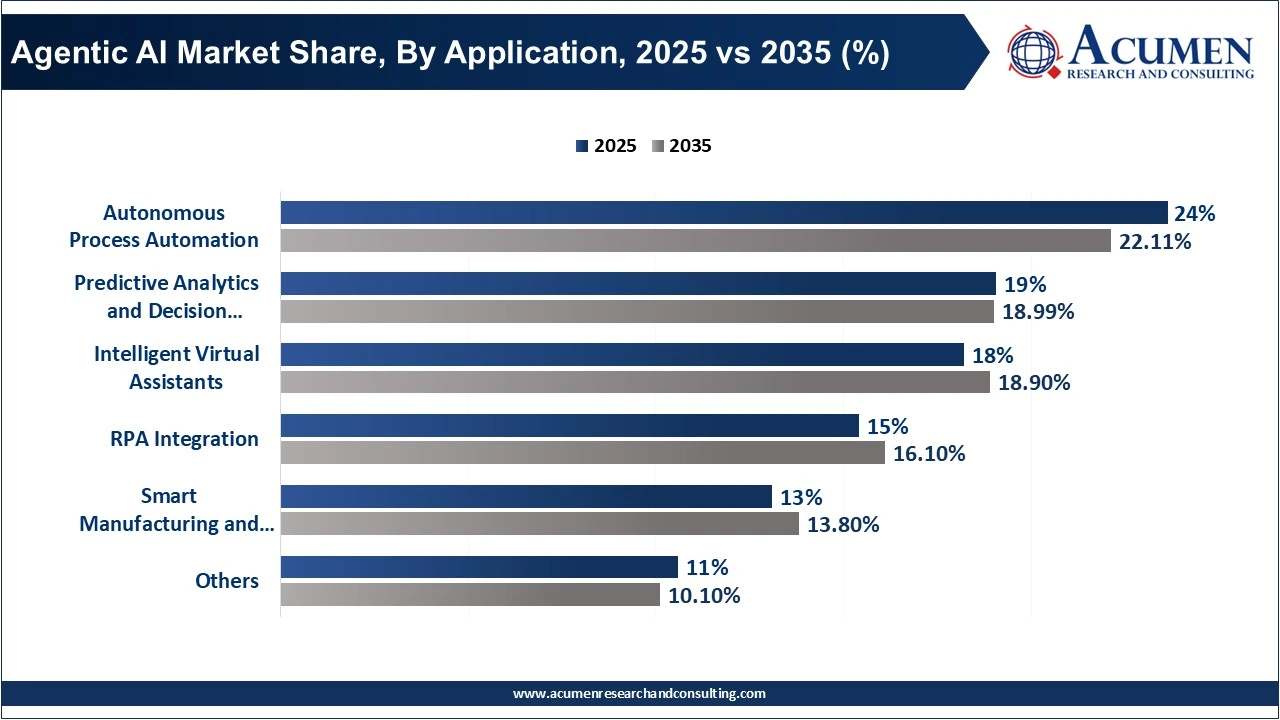
The autonomous process automation segment led the agentic AI sector. The growth is driven by the immediate value that is created from the reduction in costs and improved ROI that it delivers to the business users. Autonomous process automation has the capability to manage complicated business processes independently with the use of RPA investments made by organizations.
| Application | Market Share, 2025 (%) | Key Highlights |
|---|---|---|
| Autonomous Process Automation | 24% | The growth is driven by the immediate value that is created from the reduction in costs and improved ROI that it delivers to the business users. |
| Predictive Analytics and Decision Support | 19% | Agentic AI can be leveraged for real-time, self-learning analytics to facilitate proactive and data-informed decision-making. |
| Intelligent Virtual Assistants | 18% | Advanced assistive agents will move beyond simple query resolution to perform tasks and resolve problems independently. |
| RPA Integration | 15% | Companies are presently enhancing the classical RPA solution by using agentive AI. This will make automation self-optimizing. |
| Smart Manufacturing and IIoT | 13% | Agentic AI deployment is on the rise for autonomous monitoring & optimization, and other IIoT applications in industry. |
| Others | 11% | Increasing adoption of agent-based AI in automating tasks of knowledge work and functions in inter-related tasks is broadening applications in diverse industries. |
End Use Insights
The IT & telecom segment held the largest market share in 2025. IT firms use Agentic AI to automate complex software development, incident management, and network operations, while telecom operators apply it for real-time optimization of their networks, predictive maintenance, and automation of customer service. This has further accelerated the uptake with high investment in digital transformation, extensive cloud and edge infrastructure, and competitive pressure to raise the quality of services and lower the cost.
| End User | Market Share, 2025 (%) | Key Highlights |
|---|---|---|
| Healthcare | 15% | Rising use of agentic AI for clinical decision support and operational automation is enhancing patient care and administrative efficiency. |
| BFSI | 19% | The increasing adoption of agentic AI for risk assessment, fraud detection, and automated customer engagement is transforming financial operations. |
| IT & Telecom | 26% | Integration of Agentic AI for autonomous network management and automation of DevOps is improving service reliability and innovation. |
| Manufacturing | 10% | Agentic AI is being deployed in both predictive maintenance and intelligent automation of the factory floor, driving productivity and reducing downtime. |
| Government | 7% | Governments are increasingly using agentic AI for public service delivery and automating regulatory compliance. |
| Automotive | 5% | Agentic AI is fueling the adoption of autonomous driving systems and connected vehicle intelligence. |
| Retail & E-commerce | 9% | Personalization and automated supply chain orchestration with the help of agentic AI are improving customer experience and operational agility. |
| Others | 8% | Cross-industry adoption of agentic AI for back-office automation and augmentation of knowledge work is increasing market reach. |
Agentic AI Market Regional Analysis
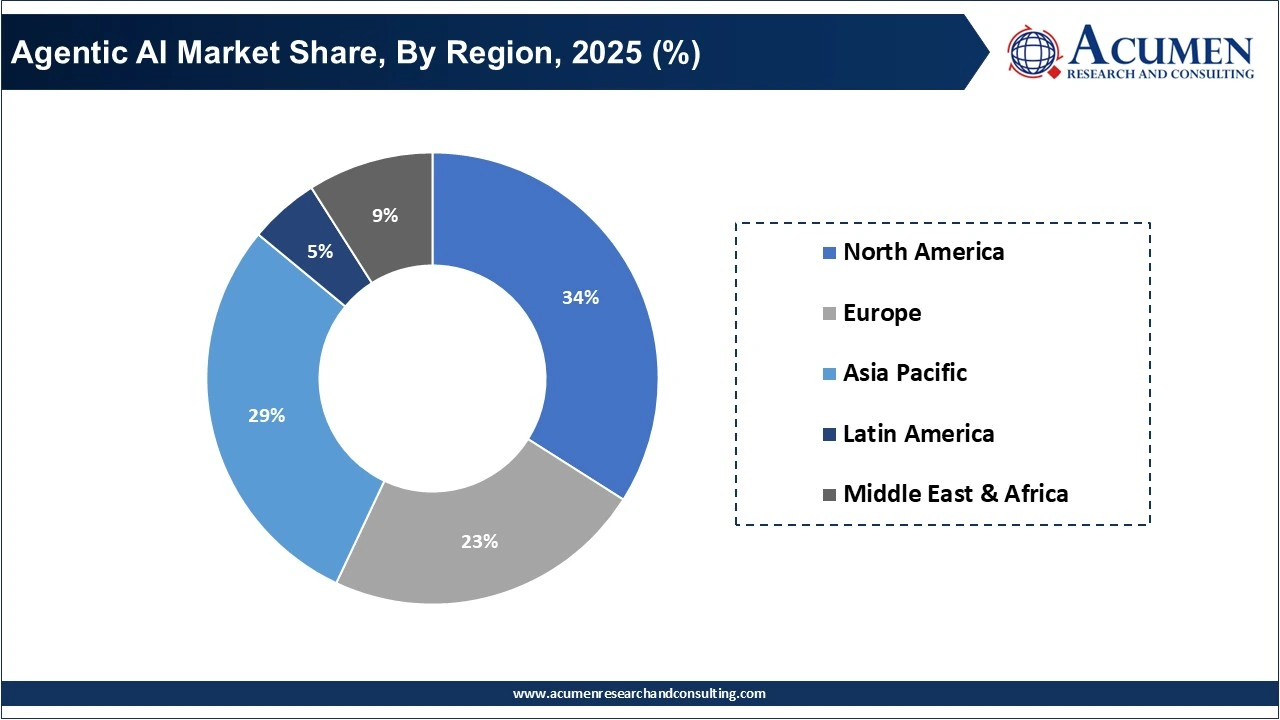
North America dominated the agentic AI market by garnering a major market share in 2025. This is attributed to the well-established presence of prominent technology players, widespread acceptance of new technologies, and well-developed IT infrastructure. Also, a large number of technology firms facilitate a highly competitive market. The early adoption of both generative and agentic AI technologies, the presence of the tech giants such as Microsoft, IBM, and NVIDIA, and the level of investment in the infrastructure of AI within the enterprise, healthcare, and research communities are boosting the market growth. Additionally, the fact that well-structured guidelines exist within the sector of AI ethics has also contributed significantly.
| Region | Market Share, 2025 (%) | Key Highlights |
|---|---|---|
| North America | 34% | Dominant because of the robust presence of key tech players, high adoption of novel technologies, advanced IT infrastructure, and efficient initiatives in digital transformation. |
| Europe | 23% | Strict data protection laws (GDPR) and rapid digital transformation across public and private sectors are driving market growth. |
| Asia-Pacific | 29% | The rapid digitalization of industries leading to the adoption of AI technology, is a major driver for the growth of the agentic AI market. |
| MEA | 8% | Increasing adoption of agentic AI for smart city initiatives and government digital transformation is driving regional market growth. |
| Latin America | 5% | Growing investments in agentic AI for customer service automation and financial services modernization are key trends accelerating market expansion. |
The Asia-Pacific market is expected to observe a significant growth throughout the forecast period. This is due to the rapid digitalization of industries leading to the adoption of AI technology, which proved to be the major driver for the growth of the agentic AI market. Businesses increasingly use AI technologies to optimize operations, engage customers, and integrate innovation into its operations. The internet penetration rate, per capita income, and supportive government policies further ensure growth in the Asia Pacific region.
Agentic AI Market Top Players
- Alibaba Group Holding Limited
- Amazon Web Services, Inc.
- Apple Inc.
- Baidu
- IBM Corporation
- Meta
- Microsoft
- NVIDIA Corporation
- Salesforce, Inc.
Agentic AI Market Segmentation
By Component
- Solutions
- Services
By Agent Architecture
- Multi-Agent Systems
- Single-Agent Systems
By Application
- Autonomous Process Automation
- Predictive Analytics and Decision Support
- Intelligent Virtual Assistants
- RPA Integration
- Smart Manufacturing and IIoT
- Others
By End Use
- Healthcare
- BFSI
- IT & Telecom
- Manufacturing
- Government
- Automotive
- Retail & E-commerce
- Others
By Region
- North America
- U.S.
- Canada
- Europe
- U.K.
- Germany
- France
- Spain
- Rest of Europe
- Asia-Pacific
- India
- Japan
- China
- Australia
- South Korea
- Rest of Asia-Pacific
- Latin America
- Brazil
- Mexico
- Rest of LATAM
- The Middle East & Africa
- South Africa
- GCC Countries
- Rest of the Middle East & Africa (ME&A)
Looking for discounts, bulk pricing, or custom solutions? Contact us today at sales@acumenresearchandconsulting.com
Frequently Asked Questions

Other ICT Reports
October 2022
July 2022
January 2025
July 2023