
Carbon Credit Market Size, Share, Industry Report 2026 to 2035
Carbon Credit Market (By Type: Compliance, Voluntary; By Project Type: Avoidance/Reduction Projects, Removal/Sequestration Projects; By End Use: Power, Energy, Transportation, Industrial, Others) - Global Industry Analysis, Size, Share, Trends and Forecast 2026 to 2035
- Last Updated: 02 Dec 2025
- Report Code: ARC3861
- Category: Energy and Power
Carbon Credit Market Size and Forecast 2026 to 2035
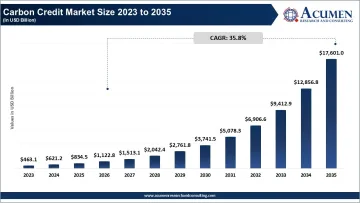
The global carbon credit market size was accounted for USD 834.5 billion in 2025 and is estimated to surpass around USD 17,601.0 billion by 2035 growing at a CAGR of 35.8% from 2026 to 2035. The growth in stringent climate policies and emission reduction targets is driving the growth or the carbon credit market. Further, the growing participation from the private sector and financial institutions continues to support the market demand.
Report Highlights
- By Region, the European carbon credit market is valued at approximately USD 368.9 billion in 2025.
- By Region, the Asia-Pacific carbon credit market is expected to grow at a CAGR of over 38.4% from 2026 to 2035.
- By Type, compliance represents 95% of the total market share in 2025.
- By Project Type, avoidance/reduction projects account for 65% of the total market share.
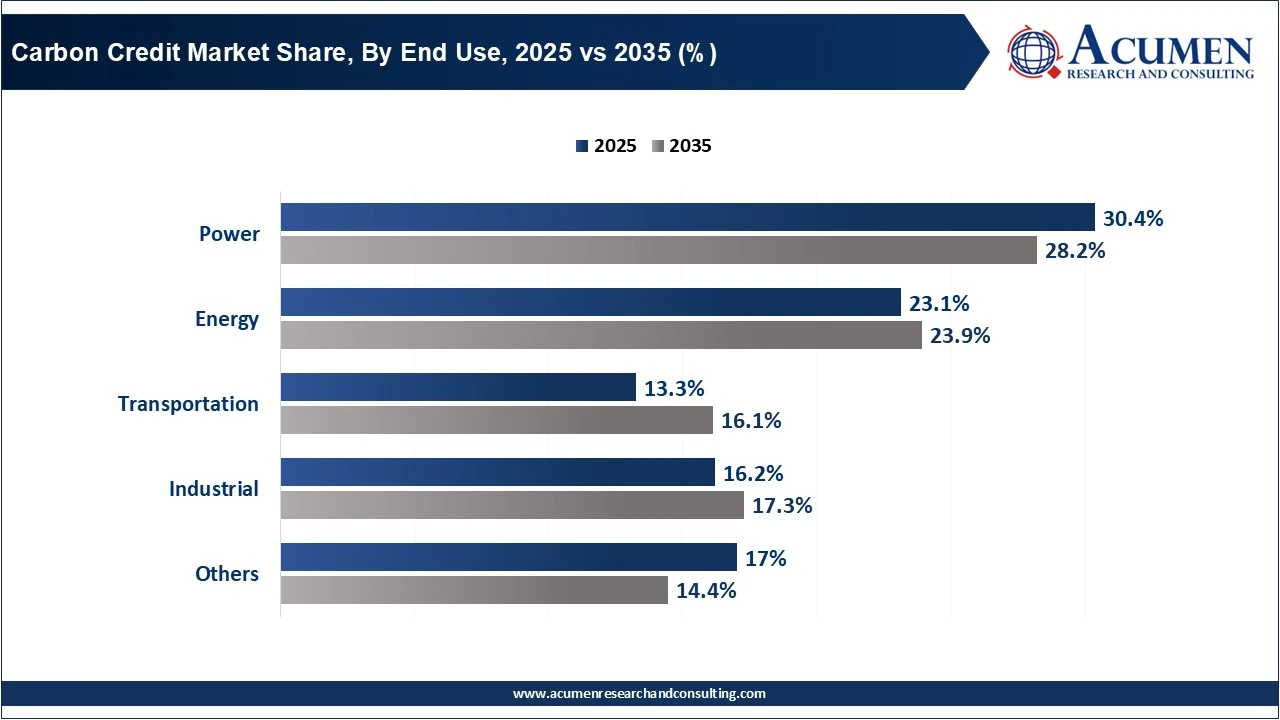
- By End Use, the power sector accounted for 30% of the carbon credit market share in 2025.
Carbon Credit Market Outlook
Over the recent years, carbon credits have emerged as a robust financial incentive for organizations, governments, and NGOs that seek to alleviate their climate footprint. Carbon credit (СС) is a permit for emission for a certain amount of carbon dioxide and other greenhouse gases (GHGs). For every single carbon credit, an organization can release over one metric ton of CO2 or other GHG in the atmosphere. An organization is eligible to get credits if it reduces its emissions below a specific threshold. Organizations often produce removal credits for carbon with the help of their efforts and investments promoting energy conservation, reforestation, and renewable energy. There is also an option to buy carbon credits from organization that haven’t utilized them at all.
There are several advantages of carbon credits. Firstly, they influence businesses to reduce emissions, both immediately and for the long run. This, in turn, helps boost sustainability globally by promoting investments in R&D for exceptional strategies for emission reduction. For organizations that find it challenging to directly limit their emissions, carbon credit trading offers them the option to purchase credits from organizations that alleviate emissions in a more economic way. Additionally, CC development and trading helps bring countries and industries together to tackle climate change.
When discussing issues that are associated with carbon credits, it is crucial to consider the ethical concerns related to the effectiveness of counterbalancing emissions with the help of credit purchases. Adjusting to the credit industry enables some companies, specifically the more profitable ones, to continue emit GHGs. They do not see the need to involve in sustainable practices when they can simply purchase all the credits they require.
Carbon Credit Market Dynamics
Market Drivers
Stringent Climate Policies and Emission Reduction Targets
- The integration of carbon credits within corporate ESG strategies has elevated the strategic importance of credits, supporting consistent market demand. Their ability to meet the target of reduction in emissions cost-effectively has been a continuous strength toward market value. International agreements including the Paris Agreement, the Kyoto Protocol, and the Glasgow Climate Pact have well-established frameworks for countries to alleviate GHG emissions through carbon credit trading systems. The United States is an early adopter of the cap-and-trade system, and since then, many regional and state carbon credit efforts and programs have risen to influence companies to lessen their environmental impact.
Growth in Digital Trading Platforms
- The rapidly expanding suite of digital carbon trading platforms and blockchain-based registries has transformed market accessibility and transparency. Online carbon exchanges and subscription-based offset platforms are facilitating access for large corporations and SMEs alike. These digital channels enhance price discovery, transaction efficiency, and traceability of credits, strengthening buyer confidence. Finally, growing investments in fintech-driven climate platforms and cross-border trading mechanisms expand the market's reach, ultimately enhancing liquidity. The digital transition now under way will be crucial to support steady market growth over the decade ahead.
Market Restraints
Lack of Standardization
- The carbon credit market currently faces inconsistent verification standards, as different registries are validating credits against varying methodologies. This creates uncertainty around the credibility and environmental integrity of some credits. The possibility of ‘greenwashing’ and the risk of double counting of emissions reductions undermine buyer confidence and inhibit market adoption.
Price Volatility and Regulatory Uncertainty
- The prices of carbon credits generally fluctuate due to changes in government policies, changing rules on compliance, and differences between voluntary and compliance markets. This kind of unpredictability makes it difficult for companies to make long-term investment decisions; therefore, it discourages big-scale participation, especially in developing markets.
Market Opportunities
Expansion of Nature-based and Technology-driven Carbon Removal Projects
- Innovation in carbon credit generation creates new growth opportunities, especially due to nature-based solutions, such as reforestation, soil carbon sequestration, and blue carbon projects. Several technological evolutions in direct air capture and carbon storage contribute to diversification of credit types. Greater scrutiny on credit quality pushes the developers to invest in robust verification standards, third-party audits, and transparent reporting frameworks. Companies that focus on high-integrity credits, long-term environmental impact, and traceable project methodologies will have a competitive advantage in both voluntary and compliance carbon markets.
Rising Corporate Net-zero Commitments and ESG-driven Investments
- More companies are committing to targets of net zero and science-based reduction in emissions. This is now driving strong and long-term demand for voluntary carbon credits, enabling project developers, verification agencies, and trading platforms to scale solutions and attract institutional investments. According to Forbes, Lucid Group, an automotive manufacturer is the leading company to make the most progress in achieving net zero targets, followed by Rivian, Tesla, Philip Morris International, and American Airlines Group.
Report Scope
| Area of Focus | Details |
|---|---|
| Carbon Credit Market Size 2025 | USD 834.5 Billion |
| Carbon Credit Market Forecast 2035 | USD 17,601.0 Billion |
| Carbon Credit Market CAGR During 2026 – 2035 | 35.8% |
| Carbon Credit Market Analysis Period | 2023 – 2035 |
| Carbon Credit Market Base Year | 2025 |
| Carbon Credit Market Forecast Data | 2026 – 2035 |
| Segments Covered | By Type, By Project Type, By End Use, and By Geography |
| Regional Scope | North America, Europe, Asia-Pacific, Latin America, and Middle East & Africa |
| Key Companies Profiled | Carbon Care Asia Ltd., CarbonBetter, 3Degrees Group, Inc., ClearSky Climate Solutions, Finite Carbon, EKI Energy Services Ltd., NativeEnergy, Torrent Power Ltd., South Pole Group, and WGL Holdings Inc. |
| Report Coverage | Market Trends, Drivers, Restraints, Competitive Analysis, Player Profiling, Covid-19 Analysis, Regulation Analysis |
Carbon Credit Market Segmental Insight
The worldwide market for carbon credit is split based on type, project type, end use, and geography.
Type Insights
| Type | Market Share (%) | Key Highlights |
|---|---|---|
| Compliance | 95% | Dominant as government-supported emission reduction regulations are mandatory to implement by industries. |
| Voluntary | 5% | Rising corporate net-zero commitments are driving strong growth in the voluntary carbon market, with companies increasingly prioritizing high-integrity, nature-based and technology-backed carbon removal credits. |
The compliance dominated the market as government-backed emission reduction regulations are compulsory in nature, and there is an increasing enforcement of national and international climate policies. Moreover, industries that are regulated have to offset their surplus GHG emissions due to cap-and-trade and emission trading schemes. These regulatory frameworks have driven power generation, manufacturing, oil & gas, and heavy industries into the structured carbon markets, thereby driving higher demand for compliance-based carbon credits compared to mechanisms that are of a voluntary nature.
Project Type Insights
| Project Type | Market Share (%) | Key Highlights |
|---|---|---|
| Avoidance/Reduction Projects | 65% | Dominant as there is a growing shift toward higher-quality avoidance and reduction projects, such as renewable energy, energy efficiency, and methane capture. |
| Removal/Sequestration Projects | 35% | Rising preference for long-term carbon removal solutions, including reforestation, soil carbon sequestration, biochar, and direct air capture, as buyers increasingly seek durable, high-integrity credits with measurable and permanent climate impact. |
The avoidance/reduction segment dominates the carbon credit sector. These projects include the execution of different strategies to avoid or limit carbon emissions by taking proper measures to improve the overall energy efficiency of the system and initiate renewable energy projects. According to the World Meteorological Organization (WMO), the average annual rate of growth in near-surface global temperatures from 2023 to 2027 is projected to be over 1.5 above the pre-industrial levels due to the emissions from greenhouse gases.
End Use Insights
| End Use | Market Share (%) | Key Highlights |
|---|---|---|
| Power | 30% | Dominant as it is the largest emitting industry and experiences increasing integration of renewable energy-based carbon credit projects. |
| Energy | 23% | Growing adoption of carbon capture, utilization, and storage (CCUS) projects to generate carbon credits from hard-to-mitigate energy infrastructure and upstream operations. |
| Transportation | 13% | Rising demand for carbon credits from electric mobility and sustainable fuel projects, including electric vehicle (EV) adoption, biofuels, and sustainable aviation fuel (SAF) initiatives. |
| Industrial | 16% | Expansion of low-carbon manufacturing processes, including green hydrogen use, waste heat recovery, and energy efficiency upgrades are driving the creation of industrial decarbonization credits. |
| Others | 17% | Increasing development of nature-based solutions and waste management–linked carbon credit projects, such as landfill gas capture, composting, and afforestation, to diversify credit supply. |
The power segment is projected to dominate the industry. The power sector is the largest emitting industry and it deploys low GHG mechanisms to adopt carbon-offsetting schemes and projects. Companies across the world are taking efforts to integrate renewable energy sources, including solar energy, geothermal energy, and wind energy, to limit their carbon emissions and make carbon credits. These credits can be bought by other organizations for additional revenue generation. Carbon offsets are used to alleviate GHG emissions in the power sector.
Carbon Credit Market Regional Insights
Geographically, Europe accounts for the largest share of the carbon credit market, mainly because of the early and strong commitment to climate action due to widespread implementation of strict environmental regulations and the presence of the European Union Emissions Trading System (EU ETS), which is the largest and most established carbon trading framework in the world. Aggressive net-zero emission targets set by European governments, besides mandatory emission caps on high-emitting industries, have been driving consistent demand for carbon credits. Secondly, strong corporate sustainability commitments, high awareness of climate risks, and robust monitoring, reporting, and verification systems further support market growth across the region.
| Region | Market Share (%) | Key Highlights |
|---|---|---|
| North America | 26% | Rising corporate participation in the voluntary carbon market is driven by strict ESG reporting requirements and net-zero commitments. |
| Europe | 44% | Dominant because of strong and early commitment to climate action and stringent environmental regulations. |
| Asia-Pacific | 19% | The demand for energy generation with fossil fuels is increasing in the region owing to the increased consumption in countries including China and India. |
| MEA | 6% | Growth is driven by increasing investment in large-scale renewable energy and nature-based carbon credit projects supported by government-backed sustainability programs. |
| Latin America | 4% | Expansion of forest conservation and reforestation-based carbon credit projects, especially in the Amazon region is attracting strong international demand. |
There is expected to be a considerable growth of the carbon credit market in the Asia-Pacific region. The demand for energy generation with fossil fuels is increasing in the region owing to the increased consumption in countries including China and India. This is projected to result in rising carbon emissions in the region, which is boosting the market demand. The growth in building & construction activities in China is opportunistic for the market growth. Moreover, government-led climate initiatives and national carbon trading schemes further strengthen market dynamics in the region. Growing participation from multinational corporations and ESG-focused investment further encourages compulsory and voluntary adoptions of carbon offset mechanisms. In addition, regional carbon exchanges are also expanding their operations, enhancing market transparency and liquidity.
Carbon Credit Market Players
Some of the top carbon credit companies offered in our report include Carbon Care Asia Ltd., CarbonBetter, 3Degrees Group, Inc., ClearSky Climate Solutions, Finite Carbon, EKI Energy Services Ltd., NativeEnergy, Torrent Power Ltd., South Pole Group, and WGL Holdings Inc.
Carbon Credit Market Segmentation
By Type
- Compliance
- Voluntary
By Project Type
- Avoidance/Reduction Projects
- Removal/Sequestration Projects
By End Use
- Power
- Energy
- Transportation
- Industrial
- Others
By Region
- North America
- U.S.
- Canada
- Europe
- U.K.
- Germany
- France
- Spain
- Rest of Europe
- Asia-Pacific
- India
- Japan
- China
- Australia
- South Korea
- Rest of Asia-Pacific
- Latin America
- Brazil
- Mexico
- Rest of LATAM
- The Middle East & Africa
- South Africa
- GCC Countries
- Rest of the Middle East & Africa (ME&A)
Looking for discounts, bulk pricing, or custom solutions? Contact us today at sales@acumenresearchandconsulting.com
Frequently Asked Questions

Other Energy and Power Reports
December 2024
May 2024
March 2024
September 2022