April 2025

Machine Learning Market (By Component: Hardware, Software, Services; By Deployment: On-premise, Cloud-based, Hybrid; By Enterprise Size: Large Enterprises, SMEs; By Technology: Supervised Learning, Unsupervised Learning, Reinforcement Learning, Deep Learning, Others; By Application: Predictive Analytics, Computer Vision, Natural Language Processing , Recommendation Systems, Others; By End User Industries: BFSI, Healthcare & Life Sciences, Retail & E-commerce, Manufacturing, Others) - Global Industry Analysis, Size, Share, Growth, Trends, Regional Analysis And Forecast 2026 To 2035
The machine learning market size was calculated at USD 90 billion in 2025, it is expected to reach at USD 1,573.90 billion by 2035; growing at a CAGR of 33.1% during the forecast period of 2026-2035. The advancements in computing power, specialized GPU and TPU and rise of automated ML solutions to overcome the shortage of skilled AI and ML professionals create significant opportunity for the market to boom.
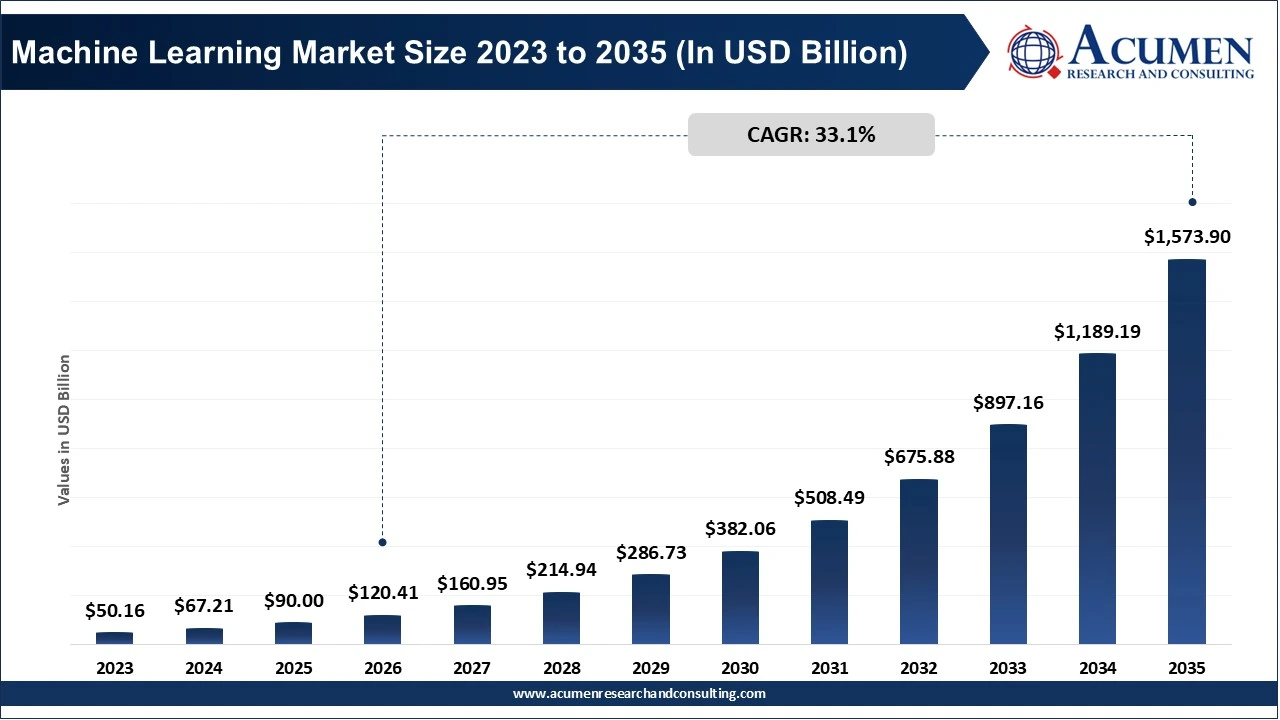
Driving Enterprise Digital Transformation and AI Integration
The widespread deployment of digital transformation across sectors is fueling market expansion for machine learning technology. Organizations now produce more structured and unstructured data than ever before, from the transactions and customer services of businesses, devices connected to networks, user contributions on social platforms, and cloud applications. ML-based applications allow companies to use this massive amount of data to support better decision making, to optimize the efficiency of operations, to automate difficult tasks, and to improve resource allocation. In parallel with increasing awareness of the benefits of artificial intelligence, generative AI, intelligent automation, and predictive analytics is encouraging firms to implement ML technology as a part of the fundamental structure of their businesses. Businesses across banking, retail, telecommunication, logistics, healthcare and manufacturing are more commonly using ML models to support processes like threat detection, customers analytics, demand prediction, predictive maintenance and custom customer support. Since companies are now in pursuit of competitive advantage through decisions supported by data, investments are being made across the world into ML platforms and infrastructure based on AI technology.
Data Privacy Policies & Data Security Challenges
Despite excellent potential, the increasing issues surrounding customer and organizational data privacy and security, and the regulatory constraints for ML use are major hindering factors. Machine learning requires large quantities of personal customer, financial and business data for model training. Restrictions imposed by data privacy legislation such as the GDPR, HIPAA, CCPA, etc., in conjunction with new standards of data protection, have raised the hurdles for AI adoption and increased its cost for the organizations.
Advent of Generative AI
Generative AI, LLMs, multimodal AI systems and intelligent automation agents have presented game-changing possibilities throughout the whole ML ecosystem. Enterprises are increasingly adopting ML technologies to develop auto generation of content, of software, of customer services, of drugs, of financial analyses, of cyber monitoring and business intelligence systems. The accelerated commercial adoption of generative AI technology has broadened the scope of ML applications beyond simple prediction and analytics tools.
The software segment held a dominant market share of 52% in 2025. Machine learning software platforms serve as the bedrock for the development, deployment, monitoring, and optimization of AI models in numerous industries. Businesses are making considerable investments in machine learning development frameworks, automated machine learning (AutoML) platforms, machine learning model management systems, data science tools, and AI powered analytics solutions to speed up their digital transformation efforts.
The robust adoption of cloud computing, big data analytics and generative AI tools has led to a rise in demand for advanced machine learning software. Organizations are employing these platforms to automate business processes, drive better business decisions, enhance customer experiences, and create competitive edges via predicted insights. With AI being embedded into businesses' central functions, the software solution will continue to capture a larger share of enterprise AI spending.
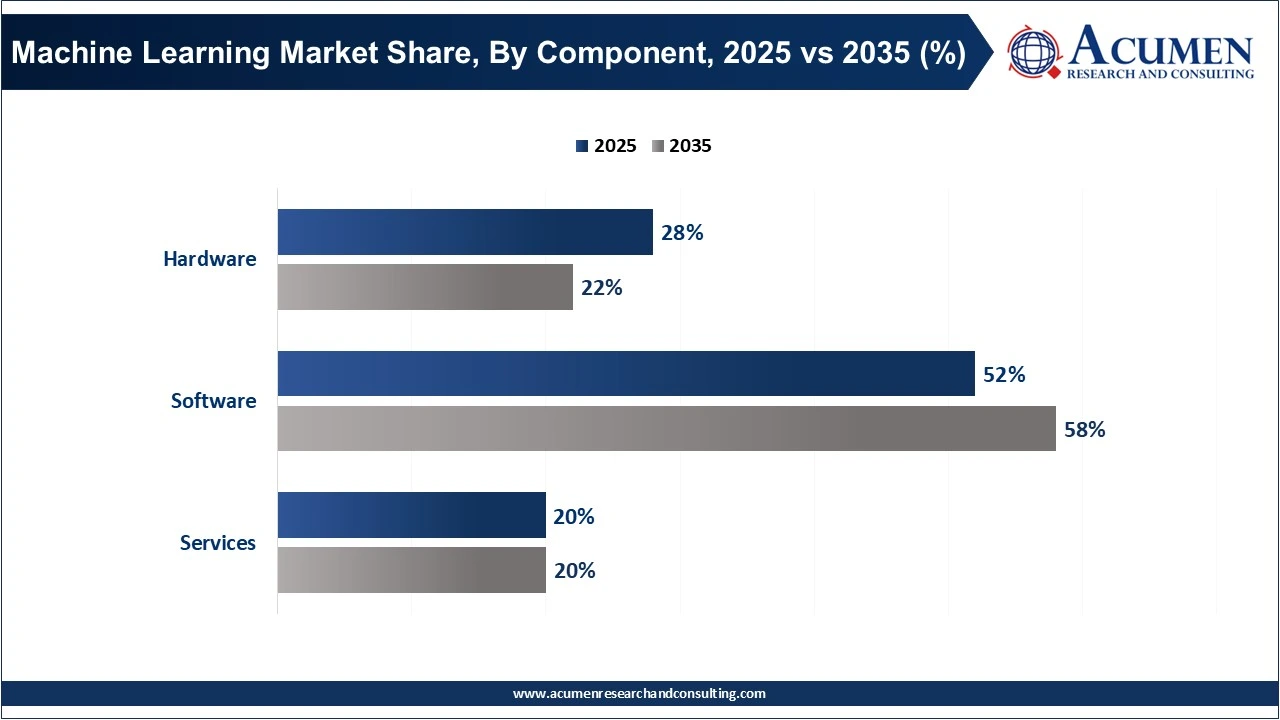
The hardware segment represented 28% of the market share in 2025. ML workloads demand powerful computing capabilities for both training and deployment of complex ML models. High performance processors, graphic processing units (GPUs), AI accelerators, edge computing devices, and sophisticated server infrastructure are indispensable in the ML applications. The expanding demand for generative AI, large language models, computer vision systems, and real time analytics is fueling investment in specialized AI hardware. Enterprises are beefing up their AI infrastructure to process ever larger data sets and support more computationally intensive machine learning workloads.
The cloud-based was the largest segment with 62% market share in 2025, and it is anticipated to exhibit the highest CAGR of 35.9% from the year 2026 to 2035. The cloud computing platforms have made adopting machine learning simpler by delivering elastic computing resources, ML-specific tools and on-demand infrastructure at the fraction of investment compared to on-premise deployment.
Training models quicker, effective handling of big data, and rapid global deployment of ML applications become easy on cloud. Growing adoption of AI-as-a-service platforms, cloud-native analytics tools and generative AI tools are increasingly pushing adoption of cloud platforms across companies of every size.
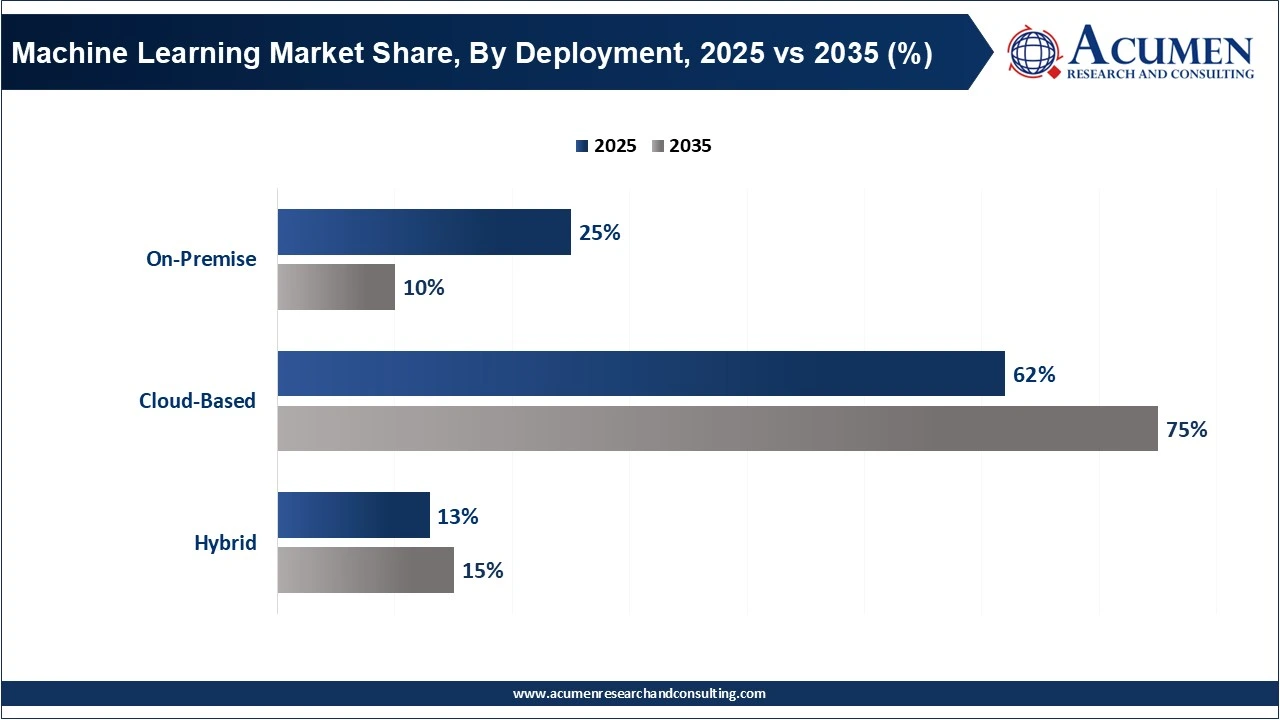
The on-premise segment acquired 25% market share in 2025. Companies involved in highly regulated industries such as banking, government, defense, and healthcare would require full control on their data, computing infrastructure and ML environment due to critical data and sensitive regulations. Such deployments provide enhanced security, privacy and compliance regulations while limiting exposure to external threats. Organizations also prefer on-premise systems while working with intellectual property, protected customer information, or mission-critical application processing.
In 2025, large enterprises constituted the majority of market revenue at 74%. Since such organizations produce high volumes of both structured and unstructured data, they use machine learning for increasing operational efficiency, customer engagement and for enhanced decision-making processes. Also, they have substantial finances, technical expertise, and required infrastructure to incorporate AI across the organization.
Machine Learning Market Share, By Enterprise Size, 2025 (%)
| Enterprise Size | Revenue Share, 2025 (%) |
| Large Enterprises | 74% |
| SMEs | 26% |
In 2025, small and medium sized enterprises had a market share of 26%. The ease of access for cloud-based AI tools, automated machine learning, and pay-as-you-go analytics systems has made machine learning more accessible for smaller organizations. SMEs are rapidly adopting machine learning for the purpose of automating simple and repetitive tasks, for targeting customers more precisely, for optimization of inventory management, and for gaining practical insights to run their businesses.
Supervised learning accounted for the largest market share of 42% in 2025. This supervised learning technology continues to be the most prevalent machine learning methodology used because supervised learning offers high accuracy predictions after being trained on labelled data sets. Industries widely use supervised learning technologies for classifying and forecasting; used for recommendation systems, fraud detection, risk assessment and customer analytics application.
Machine Learning Market Share, By Technology, 2025 (%)
| Technology | Revenue Share, 2025 (%) |
| Supervised Learning | 42% |
| Unsupervised Learning | 18% |
| Reinforcement Learning | 5% |
| Deep Learning | 28% |
| Other Machine Learning Technologies | 7% |
Deep Learning accounted for a market share of 28% in the year 2025. These technologies have observed tremendous growth due to the advancement in neural networks, GPU computation and large-scale AI models. This deep learning technology holds an imperative place in computer vision, speech recognition, natural language processing (NLP), autonomous vehicles and generative AI.
The predictive analytics segment held the largest share of 24% in 2025. Businesses across various industries are utilizing machine learning models to predict customer behavior, market trends, equipment failure, financial risk, business outcomes, etc. Predictive analytics assist organizations in transitioning from reactive decision-making to proactive data-driven approaches.
Availability of real-time data, and availability of sophisticated analytics tools expanded the usage of predictive models in finance, healthcare, retail, manufacturing and telecommunications. Industries view predictive analytics as an important skill to enhance the operational efficiency and stay competitive in business.
Machine Learning Market Share, By Application, 2025 (%)
| Application | Revenue Share, 2025 (%) |
| Predictive Analytics | 24% |
| Computer Vision | 16% |
| Natural Language Processing (NLP) | 18% |
| Recommendation Systems | 12% |
| Fraud Detection & Risk Analytics | 11% |
| Predictive Maintenance | 8% |
| Customer Analytics | 7% |
| Others | 4% |
Natural language processing represented the second largest segment at 18% in 2025. NLP tools make machines understand, process and generate human language, leading to the development of virtual assistants, chatbots, sentiment analysis, document processing, generative AI, etc. The exponential growth of conversational AI, large language models, and automated content creation solutions fueled the usage of NLP technologies globally. Industries adopt NLP tools to enhance customer experience, streamline communication processes, and analyze large amounts of text data.
BFSI segment was largest sector with 23% in 2025. Financial institutions have large volume of transactional, customer and operational data that can be utilized with machine learning techniques. Banks, insurance and investment firms are increasingly employing ML for fraud detection, credit scoring, risk management, algorithmic trading, regulatory compliance, customer segmentation and so on.
The expansion of online banking, mobile payments, and fintech services has fueled the growth of these AI powered analytics solutions. These financial services organizations are continually investing in machine learning for increased efficiency, security and enhanced customer service.
Machine Learning Market Share, By End User Industry, 2025 (%)
| End User Industry | Revenue Share, 2025 (%) |
| Banking, Financial Services & Insurance (BFSI) | 23% |
| Healthcare & Life Sciences | 12% |
| Retail & E-commerce | 16% |
| Manufacturing | 11% |
| Telecommunications & IT | 13% |
| Government & Defense | 6% |
| Automotive & Transportation | 7% |
| Energy & Utilities | 5% |
| Media & Entertainment | 4% |
| Others | 3% |
Retail and e-commerce was second largest segment with 16% in the year 2025. Retailers employ machine learning for customer analysis, optimized pricing, personalized recommendations, improved inventory and supply chain management, and more effective marketing.
The surge of e-commerce and omnichannel shopping have resulted in large volumes of customer data that machine learning can convert into valuable insights, boosting customer satisfaction and loyalty, and improving conversion rates.
In 2025, North America held the largest market share of 33% as a result of having sophisticated AI research ecosystems, cloud computing facilities, heavy expenditure on enterprise technology and leading machine learning firms in the world. The institutions from financial, health care, retail, information technology (IT), and other segments are continually applying AI based services in the industry to optimize business intelligence and operational efficiency.
U.S. Machine Learning Market Insights:
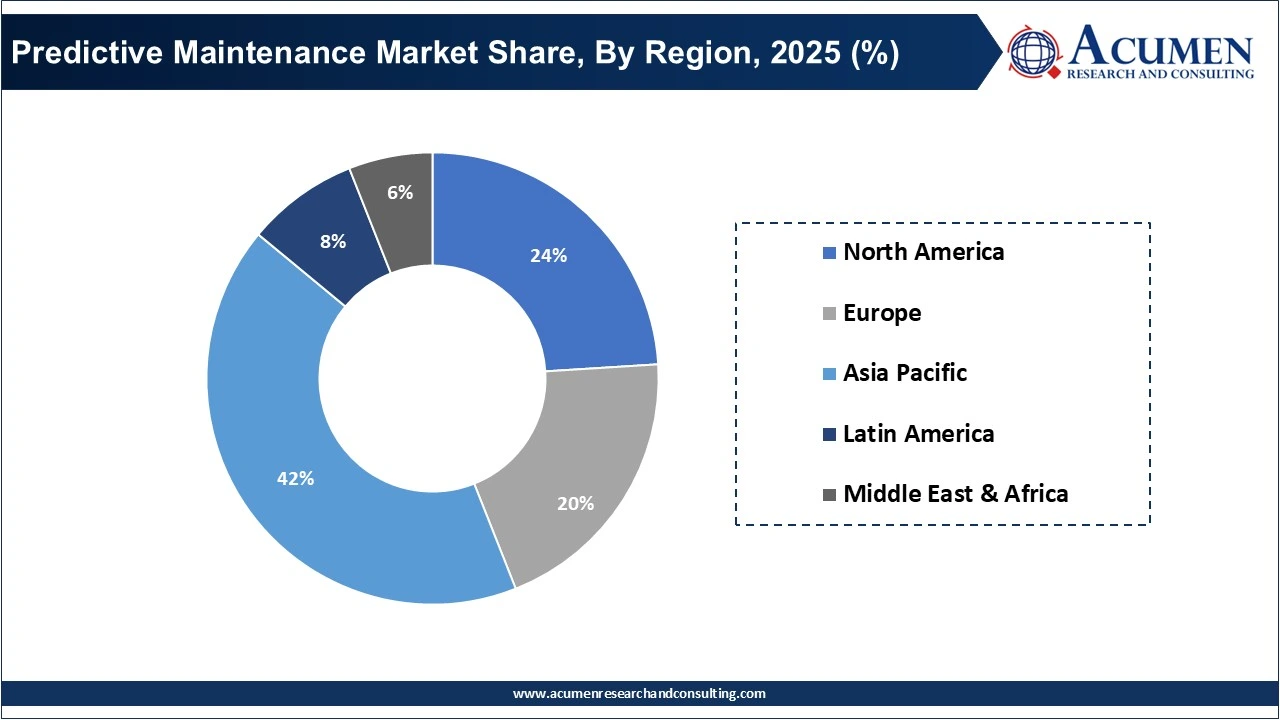
Asia Pacific is expected to grow at a robust CAGR of 36% over the forecast period, due to the rapid digital transformation taking place across the region, increased internet penetration, and the surging popularity of cloud computing technologies. This, along with growing government support, is driving rapid adoption of machine learning in industries. Countries like China, India, Japan, South Korea and Singapore are aggressively investing in building AI infrastructure and promoting research programs.
India Machine Learning Market Insights:
By Component
By Deployment
By Enterprise Size
By Technology
By Application
By End User Industries
By Region
Looking for discounts, bulk pricing, or custom solutions? Contact us today at [email protected]

April 2025
January 2026
May 2020
December 2024
Trusted Market Intelligence | 2026–2035 Insights | Designed to Support Faster, Smarter Decisions
Thank you! Our team will reach out to you soon.