
Agentic AI in Retail and E-Commerce Market Size, Share, Industry Report 2026 - 2035
Agentic AI in Retail and E-Commerce Market (By Offering: Solutions, Services; By Business Type: B2C, B2B; By Sales Channel: Online Marketplace, Online Retail Stores / brand Websites; By Application: Autonomous Customer Support, Personalized Marketing and Shopping Assistance, Inventory and Supply Chain Optimization, Dynamic Pricing and Promotion, New Product Launch Optimization, Others) - Global Industry Analysis, Size, Share, Analysis, Trends and Forecast 2026 - 2035
- Last Updated: 16 Jan 2026
- Report Code: ARC3895
- Category: ICT
Agentic AI in Retail and E-Commerce Market Size and Forecast 2026 - 2035
The global agentic AI in retail and e-commerce market is valued at USD 688.79 Million in 2025 and is projected to reach USD 25323.40 Million by 2035, expanding at a compound annual growth rate (CAGR) of 43.4% during the forecast period from 2026 to 2035.
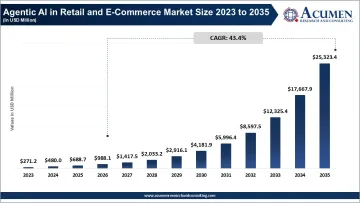
Report Highlights
- In 2025, North America was the largest regional market accounting for more than 35%.
- Asia Pacific is projected to be the fastest growing market registering a CAGR of 46.5% from 2026 to 2035..
- By Offering, solutions segment held the largest market share, representing 63% of the total market.
- By Business Type, the B2C (Business-to-Consumer) dominate the market, holding 72% market share, while B2B (Business-to-Business) represents 28% share.
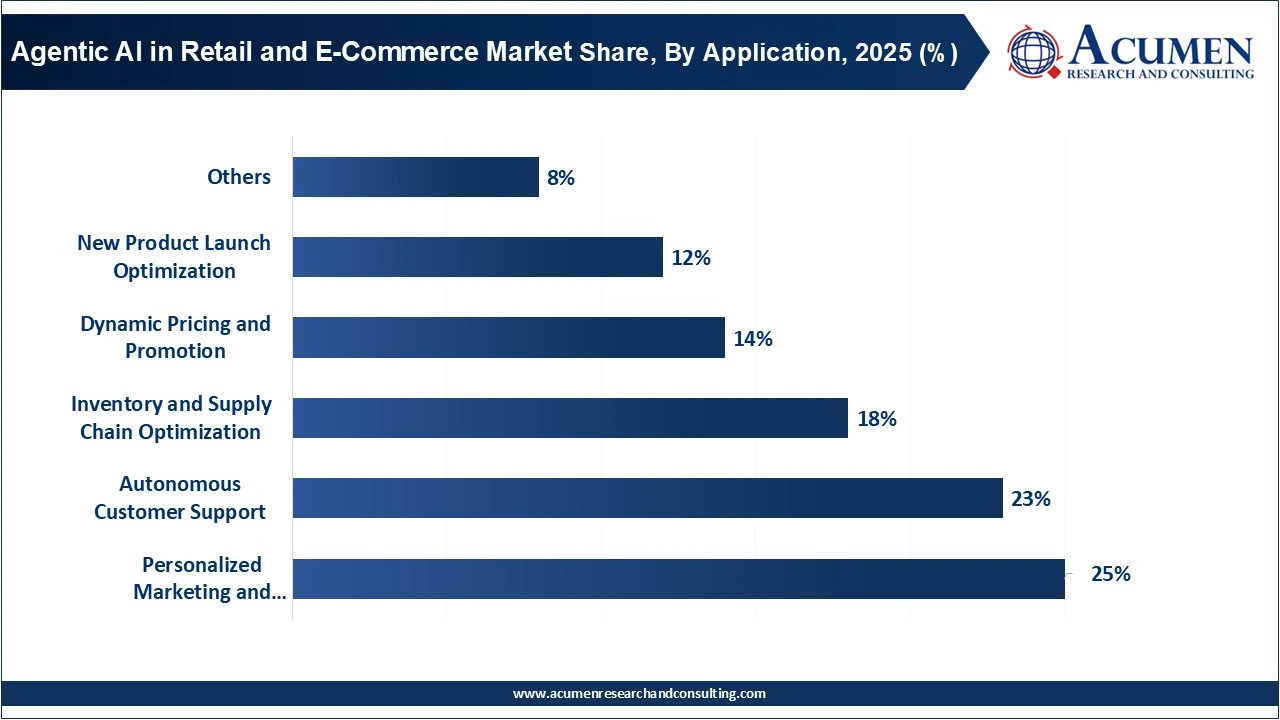
- By Application, the personalized marketing and shopping assistance led the application segment with around 25% share, followed by autonomous customer support with approximately 23% share in 2025.
Agentic AI in Retail and E-Commerce Market Overview
The agentic AI in retail and e-commerce is transforming the way how retailers interact with customers for managing their services. Unlike traditional AI tools that respond only when triggered with inputs by customer, agentic AI system can self-act by making real time decisions and constantly improve their outcomes to assist customers in better way. In retail, AI agents that can handle customer conversations, adjust cost, recommend products, manage inventory, and support marketing campaigns without constant human input. Due to high degree of competition among the e-commerce market players, e-commerce platforms are increasingly adopting agent AI to deliver quickly, highly personalized, and continuous shopping experience with decreased human efforts and operational difficulties.
The significant factor that helps market growth is the high return on investment (ROI) that agentic AI delivers. Businesses or consumer are seeking immediate benefit from reduced costs, improved customer satisfaction, and increased conversion rates in a highly competitive digital environment. Agentic AI can help businesses to respond quickly for customer needs, automate repetitive operations, and optimize cost and promotions in real time, which directly affects growth and margins. Additionally, the expansion of e-commerce, ease of handling large amount of customer data, and access to cloud-based AI platforms are making adoption faster and more affordable. As consumers highly demand for smarter, faster, and more personalized shopping journeys, retailers are increasingly turning to agentic AI as a long-term growth and differentiation strategy.
Agentic AI in Retail and E-Commerce Market Dynamics
Market Drivers
Rising Demand for Personalized and Real-Time Customer Experiences
- The retailers are increasingly adopting agentic AI to meet growing consumer expectations such as personalized experience, instant conversations, and seamless shopping experiences. Agentic AI systems analyze consumer behavior in real time and automatically adjust their recommendations, pricing, and interactions. This solution of capability significantly improves customer engagement, conversion rate, and trust. As competition intensifies in digital retail, personalization powered by agentic AI has become essential driver for differentiation and strong revenue growth.
Operational Cost Reduction through Intelligent Automation
- Agentic AI enables retailers to automate complex workflows such as customer support, inventory replenishment, and promotional optimization. The use of agentic AI solutions helps in reducing dependence on human involvement, decreases labor costs & business costs, eliminates human errors, and enables smooth operation. It allows retailers to quickly adjust to demand fluctuations and operational issues. The cost-efficiency and faster ROI of agentic AI solutions make them an attractive investment for the large enterprises and fast growing e-commerce platforms.
Market Restraints
Implementation Complexity and System Integration Challenges
- Agentic AI systems are much more complex than traditional AI tools because they need to connect and work smoothly across many retail functions at the same time. These systems depend on real-time data from customer platforms, online stores, inventory systems, pricing tools, and supply chains to make autonomous decisions. However, many retailers still use outdated or disconnected IT systems, which make integration difficult and slow. As a result, businesses face difficulties in longer implementation timelines, and for such tasks they need skilled technical teams. These factors that can delay and limit the adoption of agentic AI, especially for smaller retailers.
Data Privacy, Regulatory Compliance, and Cybersecurity Risks
- Agentic AI system is highly dependent on large volume of customer and transactional data, raising concerns about data privacy, compliance, and cybersecurity. Retailers must adhere to strong data regulations such as GDPR (General Data Protection Regulation) and evolving data protection laws, which can slow down the adoption of agentic AI solutions. Additionally, abuse or breach of sensitive customer data, which can damage brand trust, and result in financial penalties is further restricting the widespread adoption of agentic AIs.
Market Opportunities
Expansion of AI-Driven Dynamic Pricing and Promotion Strategies
- Agentic AI presents strong opportunities in dynamic pricing and promotion optimizations. It continuously tracks and analyzes competitor pricing structures and consumer behavior. This allows retailers to maximize the margins while remaining competitive in real time. As pricing intelligence directly impacts profitability, retailers are increasingly investing in agentic AI solutions that can autonomously execute pricing decision, creating a high-growth opportunity within the retail and e-commerce ecosystem.
Growing Adoption of Autonomous Commerce and AI Shopping Agents
- The autonomous shopping agent that can search, compare, and complete purchases in place of consumers is creating new growth opportunities. For instance, a personal AI agent can communicate with a retailer platform’s AI agent to negotiate a discount on the bundled purchase across different shopping departments. As AI-driven commerce become more conversational and focused on task, the retailers can engage customers through voice, chat, and virtual assistants. This shift towards autonomous commerce is expected to redefine digital shopping experiences, opening new revenue platforms and accelerating agentic AI adoption across retail channels.
Agentic AI in Retail and E-Commerce Market Report Scope
| Attribute | Details |
|---|---|
| Agentic AI in Retail and E-Commerce Market Size 2025 | USD 688.73 Million |
| Agentic AI in Retail and E-Commerce Market Forecast 2035 | USD 25,323.40 Million |
| Agentic AI in Retail and E-Commerce Market CAGR During 2026 - 2035 | 43.4% |
| Analysis Period | 2023 - 2035 |
| Base Year | 2025 |
| Forecast Data | 2026 - 2035 |
| Segments Covered | By Offering, By Business Type, By Sales Channel, By Application, and By Geography |
| Regional Scope | North America, Europe, Asia Pacific, Latin America, and Middle East & Africa |
| Key Companies Profiled | Amazon (AWS & Retail AI), Microsoft Corporation (Azure AI), Google LLC (Vertex AI), International Business Machines Corporation, NVIDIA Corporation, EDITED, Walmart, Oracle Corporation, Alibaba Cloud Computing Co. Ltd., Snowflake Inc., Shopify, and Caper AI (Instacart). |
| Report Coverage | Market Trends, Drivers, Restraints, Competitive Analysis, Player Profiling, Covid-19 Analysis, Regulation Analysis |
Agentic AI in Retail and E-Commerce Market Regional Analysis
North America dominated the global market because of advanced technology infrastructure, deep AI investments, and strong presence of major AI and cloud-based solution providers. Retailers are increasingly adopting AI solutions such as autonomous customer support and personalized shopping agents to offer improved and personalized customer experience. Europe also displays high growth, driven by digital transformation initiatives and omnichannel process, despite strict data privacy regulations like GDPR, which encourage responsible and secure AI deployments.
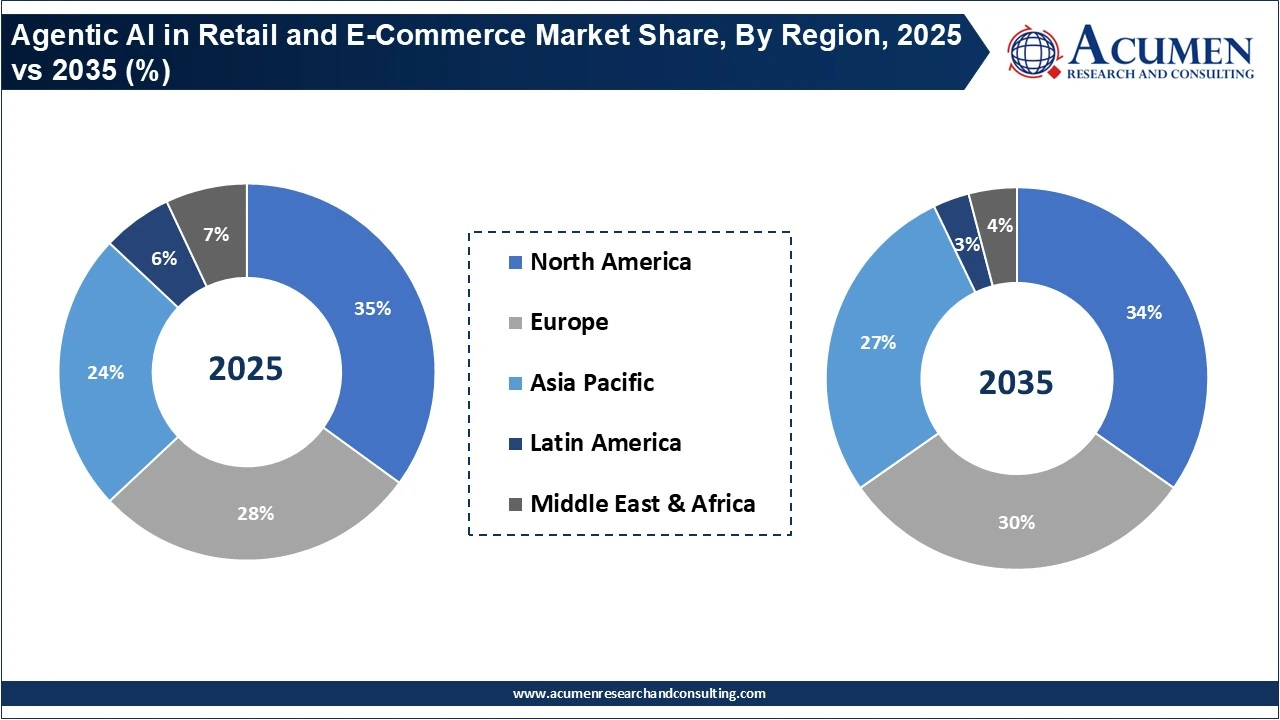
The Asia Pacific region is emerging rapidly, powered by integration of advance technologies within e-commerce platforms, high smartphone penetration, and strong AI ecosystem development in countries like China, India, and Southeast Asia. Retailers are exploring cloud-based agentic AI solutions to improve operational efficiency and compete in online marketplaces.
Agentic AI in Retail and E-Commerce Market Segmental Insights
The worldwide market for agentic AI in retail and e-commerce is split based on offering, business type, sales channel, application, and geography.
Offering Insights
Solutions segments account for the share of around 63% and dominated the global agentic AI market in 2025, driven by their high adoption across enterprise and consumer environments. Agentic AI solution contains integrated software platforms that implement end-to-end functionality, reducing the dependence on human intervention thus enabling faster time-to-value (TTV). Enterprise continues to offer agentic AI solution for consistent performance, scalability, and centralized management, which translates into high revenue and retention metrics. The maturity of solution also promote broader partner ecosystem, reinforcing market leadership through reliability, depth of features, and customers confidence in long term support.
| Offering | Market Share, 2025 (%) | Key Highlights |
|---|---|---|
| Solutions | 63% | Higher adoption due to ready-to-deploy AI tools that quickly deliver value. |
| Services | 37% | Strong demand for customization and ongoing AI maintenance and strategy support. |
The service segment, on the other hand, is expected to grow at a fast pace as compared to solutions segment, as businesses increasingly invests in consulting, customization, and manages agentic AI services. The agentic AI service helps in enhancing client outcome by customizing the AI platforms to industry-specific requirements and driving digital transformation initiatives. This growth reflects a shift from transactional software purchases towards outcome-oriented engagements, where expertise and advisory functions command premium pricing. With complex integrations and evolving business needs, demand for services is accelerating, and creating new revenue streams and deeper client relationship that extends beyond traditional product delivery.
Business Type Insights
Business-to-Consumer (B2C) segment leads the market with around 72% market share. The high penetration of mobile commerce, and preference for enhanced consumer experience when shopping on online marketplaces is one of the primary factors driving the growth of agentic AI market in B2C segment in retail and e-commerce application. B2C models benefits from large customer base, high transaction volume, and extensive data insights that increase personalization and repeat purchase behavior. Consumer facing brands invest strongly in customer experience and digital storefronts, which continue to strengthen B2C segment’s dominance in the market. High consumer demand and easy access across digital platforms support consistent sales growth and revenue generation. In the event of growing competition, organizations maintain steady investment for customer acquisition in areas such as digital marketing, mobile apps, and loyalty programs. These efforts help attract and retain customers, and improve brand trust & reinforce B2C leadership through continuous engagement and scalable market growth.
| Business Type | Market Share, 2025 (%) | Key Highlights |
|---|---|---|
| B2C (Business-to-Consumer) | 72% | Growth driven by consumer personalization and direct engagement needs. |
| B2B (Business-to-Business) | 28% | Investment in supply chain and enterprise solutions increases adoption. |
B2B segment is expected to grow at rapid pace, due to penetration of digital transformation across industries such as manufacturing, healthcare, and logistics. The growth in this segment reflects increasing enterprises spending on automation, advanced analytics, and cloud-based platforms, positioning it as a rapid expansion area amid enterprise modernization imperatives.
Sales Channel Insights
Online marketplaces currently dominate the market, holding around 70% of the market share in 2025. The growth of this segment is primarily driven by the presence of larger customer base, diverse product availability, and growing consumer trust towards online marketplaces. This enables to analyze customer behavior, purchase patterns, browsing history, pricing response, and inventory movement. In addition Agentic AI performs complex tasks, such as identifying the best deals across multiple platforms, much faster and more efficient than humans. It delivers real-time services, resolves issues instantly, and ensures a seamless and personalized experience for customers, while making business operations more efficient, responsive, and effective.
| Sales Channel | Market Share, 2025 (%) | Key Highlights |
|---|---|---|
| Online Marketplace | 70% | High traffic platforms use AI for recommendations, pricing, and search. |
| Online Retail Stores / Brand Websites | 30% | Brands adopt AI to enhance customer journey and direct sales experiences. |
Agentic AI adoption is growing rapidly across online retails stores and brand-owned websites as companies focus on building direct-to-consumer (D2C) relationship and personalized shopping journeys. Agentic AI autonomously manages complex, multi-step task such as product discovery, recommendations, and checkout flows, much faster than humans. It analyze live customer data in real time, and adapts contextually, providing instant, hyper-personalized experiences while improving operational efficiency and boosting conversions.
Application Insights
Personalized marketing and shopping assistance lead the market because retailers are heavily reliant on Agentic AI to understand customer preferences, browsing behavior, and purchase history. Agentic AI analyzes this data in real time to provide product recommendations, target offers, and curated shopping experience. Agentic AI not only boosts customer engagement and conversion rates but also strengthens loyalty, which is making the largest and most widely adopted application segments in the agentic AI in retails market.
| Application | Market Share, 2025 (%) | Key Highlights |
|---|---|---|
| Autonomous Customer Support | 23% | Widely adopted to reduce support costs and deliver fast, 24/7 customer engagement. |
| Personalized Marketing & Shopping Assistance | 25% | High demand for tailored shopping experiences that boost conversions and loyalty. |
| Inventory & Supply Chain Optimization | 18% | Enables real-time stock visibility and efficient logistics, reducing costs and errors. |
| Dynamic Pricing & Promotion | 14% | Drives competitive pricing and margin improvements with real-time AI adjustments. |
| New Product Launch Optimization | 12% | Used to forecast trends and plan launches with minimal risk and better market fit. |
| Others | 8% | Includes fraud detection, returns management, and analytics, supporting broader retail functions. |
Autonomous customer support is expected to be the fastest growing segment as AI agents can handle large volumes of customer inquiries quickly and operate 24*7 without human involvement. Agentic AI empowers organizations to maintain high-quality service delivery even during period of high demand or operational stress. By automating complex tasks, managing workflows autonomously, and response in real time, it ensure both resilience and scalability, allowing business to efficiently handle increased volumes while maintaining customer satisfaction and operational efficiencies.
Agentic AI in Retail and E-Commerce Market Players
- Amazon (AWS & Retail AI)
- Microsoft Corporation (Azure AI)
- Google LLC (Vertex AI)
- International Business Machines Corporation
- NVIDIA Corporation
- EDITED
- Walmart
- Oracle Corporation
- Alibaba Cloud Computing Co. Ltd.
- Snowflake Inc.
- Shopify
- Caper AI (Instacart)
Agentic AI in Retail and E-Commerce Market Recent Developments
- In January 2026, Amazon (AWS) entered a strategic partnership with Infosys to increase enterprise adoption of Generative AI by integrating Infosys Topaz with Amazon Q Developer, targeting automation and analytics use cases across multiple industries.
- In November 2025, Microsoft Corporation formed a strategic partnership with NVIDIA and Anthropic as part of a multi-billion-dollar AI infrastructure initiative. This collaboration focuses on expanding Azure’s computing power and AI capabilities, enabling faster training and more efficient deployment of advanced, next-generation AI models.
Agentic AI in Retail and E-Commerce Market Segmentation
By Offering
- Solutions
- Services
By Business Type
- B2C (Business-to-Consumer)
- B2B (Business-to-Business)
By Sales Channel
- Online Marketplace
- Online Retail Stores / brand Websites
By Application
- Autonomous Customer Support
- Personalized Marketing and Shopping Assistance
- Inventory and Supply Chain Optimization
- Dynamic Pricing and Promotion
- New Product Launch Optimization
- Others
By Region
- North America
- U.S.
- Canada
- Europe
- U.K.
- Germany
- France
- Spain
- Rest of Europe
- Asia-Pacific
- India
- Japan
- China
- Australia
- South Korea
- Rest of Asia-Pacific
- Latin America
- Brazil
- Mexico
- Rest of LATAM
- The Middle East & Africa
- South Africa
- GCC Countries
- Rest of the Middle East & Africa (ME&A)
Looking for discounts, bulk pricing, or custom solutions? Contact us today at sales@acumenresearchandconsulting.com
Frequently Asked Questions

Other ICT Reports
October 2022
January 2025
October 2023
June 2026