
Oil Condition Monitoring Market Size, Share, Industry Report 2026 - 2035
Oil Condition Monitoring Market (By Offering: Hardware, Software & Services; By End Use: Turbines, Engines, Hydraulic System, Compressor, Other System; By Industry: Automotive & Transportation, Oil & Gas, Energy & Power, Metal & Mining, Chemicals, Food & Beverages, Pharmaceuticals, Others) - Global Industry Analysis, Size, Share, Analysis, Trends and Forecast 2026 - 2035
- Last Updated: 02 Jan 2026
- Report Code: ARC3885
- Category: Process Control and Automation
Oil Condition Monitoring Market Size and Forecast 2026 - 2035
The global oil condition monitoring market is valued at USD 1,256 million in 2025 and is projected to reach USD 2,614 million by 2035, expanding at a compound annual growth rate (CAGR) of 7.7% during the forecast period from 2026 to 2035.
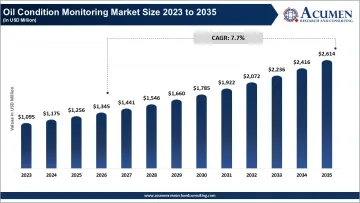
Market Highlights
- In 2025, North America leads the oil condition monitoring market with over 40% revenue share.
- Asia Pacific region is expected to have the fastest-growing CAGR of 10.3% from 2026 to 2035 for oil condition monitoring market.
- By offering, hardware segment accounts for nearly 59.9% share of the total oil condition monitoring market.
- By end use, turbines hold around 37.3% of market share in 2025.
- By industry, the automotive & transportation segment holds 27.1% market share, followed by oil & gas with 22.5%.
Oil Condition Monitoring Market Overview
The oil condition monitoring market is driven by the growing need for predictive maintenance capabilities. In addition, it is driven by increasing operational efficiencies in areas such as manufacturing, automotive, energy, and aerospace. Reducing unplanned equipment failures and increasing machine life is one of the main drivers for companies. By providing near real-time access to lubricants status, contamination levels, and particles of wear, oil condition monitoring solutions are used by customers. The incorporation of IoT sensors, AI analytical tools, and cloud solutions coupled with strict regulatory safety and environmental regulations enhances the growth of this market.
Another key growth factor for the market is the move to digitalization and Industry 4.0 initiatives, including remote monitoring, cloud integration, and AI-driven diagnostics. Advanced oil monitoring systems provide trend analyses, predictive maintenance, and resource optimization, which many enterprises are now investigating to lower total cost of ownership (TCO) and convert from a reactive to a predictive discipline. Increasingly, new sensors with enhanced accuracy, greater connectivity, and miniaturized form factors are enabling the oil monitoring industry to achieve sustained long-term growth across all types of existing and new industrial sectors.
Oil Condition Monitoring Market Dynamics
Market Drivers
Technological Advancements in Oil Condition Monitoring System
- The rapid advancement of oil condition monitoring technology is a key driver of market growth. The innovations, such as IoT-enabled sensors, real-time oil analysis, artificial intelligence (AI)-based diagnostic capabilities, and cloud-based platforms, enable continuous monitoring of lubricants' condition, contamination levels, and equipment deterioration. These innovations add predictive maintenance functionality, reduce equipment failure or unplanned outages, and extend the usable life of assets. As digital forms of maintenance become more widely used across various sectors of industry, there is a growing need for more advanced systems for monitoring oil conditions.
Increasing Focus on Equipment Reliability and Preventive Maintenance
- Throughout the world, industrial companies are working to improve equipment reliability and reduce unplanned failures, which are driving the market's growth. Oil Condition Monitoring (OCM) plays an important role in early identification of lubricant degradation and mechanical wear on equipment. Additionally, with the help of OCM, companies can perform maintenance before equipment failure occurs. This will reduce repair costs while maximizing equipment efficiency. In addition to the power generation industry, other sectors such as manufacturing and transportation, and oil and gas have also begun to adopt these proactive measures. This is to improve the functionality of their equipment and ensure the continuity of their operations.
Market Restraints
High Installation and Operational Costs
- A major constraint on growth in this industry is the high initial capital outlay required to purchase oil condition monitoring systems. The expense of sourcing advanced sensor solutions, implementing monitoring hardware solutions, using analytical software platforms and employing highly-skilled employees to monitor system performance can be a financial burden for small to mid-sized organizations. In addition, customization of existing and legacy equipment typically requires an investment of both time and money for both the customer and the product developer. This increases the total cost of ownership, resulting in slower acceptance of products by cost-sensitive industries.
Limited Skilled Workforce and Data Interpretation Complexity
- A serious lack of trained personnel has affected the growth of the oil conditioning monitoring industry. Despite advanced technologies that provide precise information about the oil, skilled workers are still needed to perform the necessary analyses and provide maintenance recommendations. Insufficient trained personnel will prevent the monitoring system from working effectively and the results of the oil analysis could be misinterpreted. Consequently, potential barriers to adoption will result in a decrease in the confidence users have in the results of oil condition monitoring and ultimately slow the adoption rate in regions without local technical expertise or training.
Market Opportunities
Expanding Industrialization in Emerging Economies
- The rapid development of many emerging industrial economies will create an abundant opportunity for the oil condition monitoring market. As these economies increase their investment in manufacturing, energy, mining, and infrastructure, they will require more effective solutions for maintaining and servicing their equipment. So there will be a huge need for oil condition monitoring (OCM) systems in these regions, as well as a massive increase in demand for OCM. As industries in Asia Pacific, Latin America, and the Middle East are concentrating on minimizing operational losses and improving their asset management capabilities, OCM systems will continue to experience an explosive rate of adoption.
Integration of AI and Cloud-Based Monitoring Platforms
- The oil condition monitoring market sees a significant opportunity for growth based on AI and cloud technologies. Connecting with a cloud allows for centralized condition monitoring of several facilities simultaneously. In addition, artificial intelligence analytics improve the accuracy of fault prediction and maintenance planning. As a result, companies have access to scalable, cost-effective solutions to provide them with greater insight into equipment performance history as well as allow them to optimize maintenance schedules.
Oil Condition Monitoring Market Report Scope
| Attribute | Details |
|---|---|
| Oil Condition Monitoring Market Size 2025 | USD 1,256 Million |
| Oil Condition Monitoring Market Forecast 2035 | USD 2,614 Million |
| Oil Condition Monitoring Market CAGR During 2026 - 2035 | 7.7% |
| Analysis Period | 2023 - 2035 |
| Base Year | 2025 |
| Forecast Data | 2026 - 2035 |
| Segments Covered | By Offering, By End Use, By Industry and By Geography |
| Regional Scope | North America, Europe, Asia Pacific, Latin America, and Middle East & Africa |
| Key Companies Profiled | Parker Hannifin Corporation, General Electric Company, Shell plc, Chevron Corporation, BP plc, Bureau Veritas S.A., SGS SA, Intertek Group plc, Spectro Scientific Inc., TotalEnergies SE, Eaton Corporation plc, and Avenisense S.A. |
| Report Coverage | Market Trends, Drivers, Restraints, Competitive Analysis, Player Profiling, Covid-19 Analysis, Regulation Analysis |
Oil Condition Monitoring Market Regional Analysis
- The North America oil condition monitoring market size is calculated at USD 502.51 million in 2025 and is projected to hit USD 915.02 million by 2035, expanding at a compound annual growth rate (CAGR) of 6.1% from 2026 to 2035.
- The Asia-Pacific oil condition monitoring market size was valued at USD 314.07 million in 2025 and is forecasted to reach USD 810.45 million by 2035, expanding at a compound annual growth rate (CAGR) of 10.3% during the forecast period from 2026 to 2035.
- The Europe oil condition monitoring market size was estimated at USD 351.76 million in 2025 and is predicted to surpass USD 705.87 million by 2035, expanding at a compound annual growth rate (CAGR) of 7.2% during the forecast period from 2026 to 2035.
The market for oil condition monitoring is dominated by North America, driven by increasing early utilization of predictive maintenance technologies across several industry sectors, including oil & gas, energy & power, automotive, and manufacturing. North America benefits from the advanced level of industrial infrastructure, the number of major oil condition monitoring companies located there, and the high level of understanding regarding equipment reliability and reduction of downtime, which provides an environment that supports leadership in this market. North America also has strict safety regulations, as well as high levels of investment in digital asset management and Industry 4.0 initiatives. These factors will continue to provide support for maintaining a leadership position in the oil monitoring market.
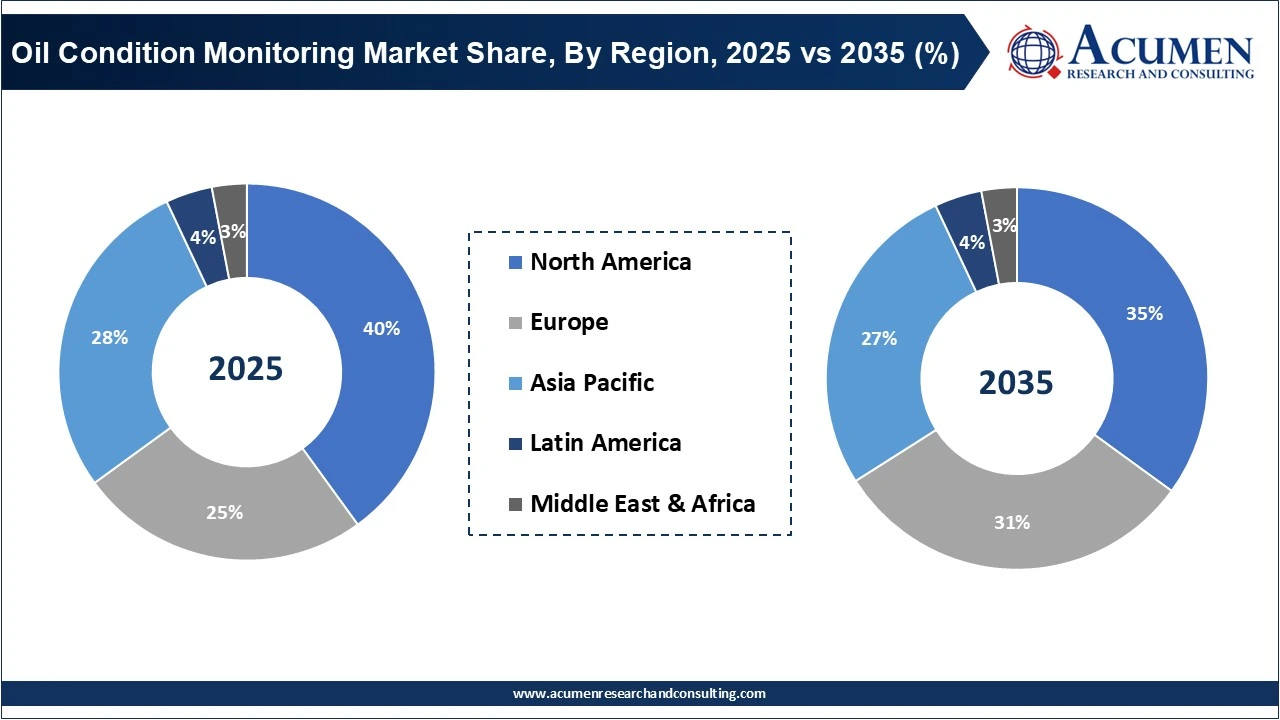
The Asia Pacific region is currently the fastest-growing region in terms of growth rates as a result of the rapid industrialization and the increase in the number of manufacturing sites within this area of countries such as China and India and Southeast Asian countries. As the mining, energy production, and automobile industries continue to grow, there will be an increased demand for condition-based maintenance solutions. In Europe, however, the growth is more stable due primarily to the implementation of industrial automation and sustainability programs. Conversely, while the regions of Latin America and the Middle East & Africa are experiencing a more gradual increase in market uptake, the rise is occurring largely through the development of the oil & gas and mining segments.
Oil Condition Monitoring Market Segmental Insights
The worldwide market for oil condition monitoring is split based on offering, end use, industry and geography.
Offering Insights
Hardware segment dominates the oil condition monitoring market due to its popularity among businesses that utilize sensors, probes, and sampling devices on their machinery as part of routine maintenance. The equipment enables companies to monitor oil contamination levels, determine when the viscosity has changed, and identify worn parts. The high volumes of adoption by companies owning critical machines from the energy, manufacturing, and transportation industries also contribute to the large number of hardware monitoring systems.
| Offering | Market Share, 2025 (%) | Key Highlights |
|---|---|---|
| Hardware | 59.90% | Leads due to high adoption of sensors and oil analyzers for real-time equipment monitoring. |
| Software & Services | 40.10% | Fastest-growing, driven by predictive analytics, AI tools, and remote monitoring demand. |
Software and services represent the fastest-growing segment of the market, because of increasing adoption of predictive maintenance and the growing use of digital asset management systems. New technologies such as advanced analytics platforms, cloud-based dashboards, and AI-assisted diagnostics make it easier to interpret data and provide more accurate information when making maintenance decisions. The increased need for remote monitoring and condition-based maintenance, as well as outsourced monitoring services, is contributing to the increased growth of industrial applications.
End Use Insights
Turbines are a significant segment of the market, as they play a major role in generating electric power, oil and gas exploration and extraction, and manufacturing processes. Therefore, continuous monitoring of the oil condition is critical in detecting premature bearing failure accidents, lubricant failure, and high costs associated with lost production due to turbines going down. Thus, because there is a high financial risk due to the expensive operation and maintenance costs caused by turbine failures, there is a consistent demand for these oil condition monitor systems.
| End Use | Market Share, 2025 (%) | Key Highlights |
|---|---|---|
| Turbines | 37.30% | Dominates the market due to continuous operation and high failure risks, making oil condition monitoring critical for preventing costly downtime. |
| Engines | 31.50% | Widely adopted across automotive, marine, and industrial sectors to improve engine reliability and extend oil drain intervals. |
| Hydraulic Systems | 18.20% | Fastest-growing segment driven by rising use of heavy machinery and automated equipment in construction, mining, and manufacturing. |
| Compressors | 8.50% | Growth supported by increasing demand for reliable compressor performance in oil & gas, chemicals, and industrial processing plants. |
| Other Systems | 4.50% | Includes gearboxes and bearings, where monitoring adoption is rising for specialized and critical equipment. |
Hydraulic systems are the fastest-growing segment of the market for oil condition monitoring, due to expanding use in manufacturing, construction, and mobile equipment. Oil condition monitoring is essential in ensuring optimal performance of these hydraulic systems because hydraulic systems are very sensitive to contamination from oils. The growth of automation and the increased utilization of hydraulic equipment have further increased the adoption of oil condition monitoring in hydrostatic applications.
Industry Insights
The automotive and transportation segments represent a large share of the market because they use engines, gearboxes, and hydraulic components that need to be monitored for oil on a regular basis. Fleet owners are beginning to adopt oil condition monitoring systems to reduce their overall maintenance expenses, increase the amount of time their vehicles remain on the road, and increase the longevity of the parts that comprise their vehicles. Production of large volumes of vehicles and strict maintenance requirements have maintained this segment's dominance.
| Industry | Market Share, 2025 (%) | Key Highlights |
|---|---|---|
| Automotive & Transportation | 27.10% | Leads the market due to growing fleet sizes and increasing focus on predictive maintenance and vehicle uptime optimization. |
| Oil & Gas | 22.50% | Strong demand driven by the need to monitor high-value assets operating under extreme conditions and prevent unplanned shutdowns. |
| Energy & Power | 16.80% | Adoption is fueled by oil monitoring of turbines, generators, and transformers to enhance operational efficiency. |
| Metal & Mining | 11.40% | Fastest-growing industry segment as harsh environments accelerate equipment wear and increase maintenance complexity. |
| Chemicals | 7.50% | Focuses on maintaining equipment reliability and meeting safety standards in continuous production environments. |
| Food & Beverages | 5.20% | Increasing adoption to ensure equipment cleanliness, compliance, and uninterrupted production processes. |
| Pharmaceuticals | 4.10% | Limited but growing usage in high-precision and contamination-sensitive manufacturing systems. |
| Others | 5.40% | Includes cement, marine, and pulp & paper industries adopting monitoring for niche applications |
Metal and mining is the fastest-growing industry segment, due to the extremely demanding working conditions for heavy-duty machines. Equipment like crushers, conveyors, and excavators experiences significant amounts of wear and is at high risk of contamination. Therefore, there is a greater need for continuous oil monitoring systems to track the wear of the equipment. In addition, the growth of mining activity and interest in minimizing equipment failure are driving rapid adoption rates of this technology.
Oil Condition Monitoring Market Players
- Parker Hannifin Corporation
- General Electric Company
- Shell plc
- Chevron Corporation
- BP plc
- Bureau Veritas S.A.
- SGS SA
- Intertek Group plc
- Spectro Scientific Inc.
- TotalEnergies SE
- Eaton Corporation plc
- Avenisense S.A.
Oil Condition Monitoring Market Recent Developments
- In June 27, 2024, SGS announced the opening of a new downstream and marine bunker fuels laboratory in Nea Peramos, Megara, Greece. This ISO 17025 accredited facility is equipped for advanced bunker fuel testing in compliance with the latest ISO 8217 standards, directly supporting the marine sector to address off-spec fuel challenges.
- In January 2024, Spectro Scientific Inc. released a next-generation portable oil analysis instrument, enabling on-site contamination and wear metal detection for predictive maintenance programs across mining and manufacturing industries.
Oil Condition Monitoring Market Segmentation
By Offering
- Hardware
- Software & Services
By End Use
- Turbines
- Engines
- Hydraulic System
- Compressor
- Other System
By Industry
- Automotive & Transportation
- Oil & Gas
- Energy & Power
- Metal & Mining
- Chemicals
- Food & Beverages
- Pharmaceuticals
- Others
By Region
- North America
- U.S.
- Canada
- Europe
- U.K.
- Germany
- France
- Spain
- Rest of Europe
- Asia-Pacific
- India
- Japan
- China
- Australia
- South Korea
- Rest of Asia-Pacific
- Latin America
- Brazil
- Mexico
- Rest of LATAM
- The Middle East & Africa
- South Africa
- GCC Countries
- Rest of the Middle East & Africa (ME&A)
Looking for discounts, bulk pricing, or custom solutions? Contact us today at sales@acumenresearchandconsulting.com
Frequently Asked Questions

Other Process Control and Automation Reports
June 2023
April 2024
October 2024
November 2018