
Industry 4.0 Market Size, Share, Growth, Report 2026 To 2035
Industry 4.0 Market (By Technology: IIoT, AI, Big Data & Analytics, Cloud Computing, Digital Twin, Robotics & Automation, AR, Cybersecurity: By Deployment: On-Premise, Cloud-Based, Hybrid; By Enterprise Size: Large Enterprises, Small & Medium Enterprises (SMEs); By Application: Smart Manufacturing, Predictive Maintenance, Asset Management, Supply Chain Optimization, Others; By End User: Manufacturing, Automotive, Aerospace & Defense, Oil & Gas, Others) - Global Industry Analysis, Size, Share, Growth, Trends, Regional Analysis And Forecast 2026 To 2035
- Last Updated: 25 Jun 2026
- Report Code: ARC2178
- Category: ICT
Industry 4.0 Market Size, Forecast 2026 To 2035
The global industry 4.0 market size was calculated at USD 243.50 billion in 2025, it is expected to reach at USD 1,562.48 billion by 2035; growing at a CAGR of 20.4% during the forecast period of 2026-2035. The Industry 4.0 market is supported by the overall integration of cobots, digital twins, additive manufacturing and AR/VR technologies across multiple sectors. Additionally, the market holds potential of expansion with the necessity of automation and interconnecting digital enterprises.
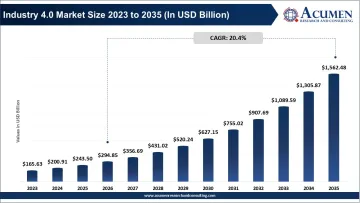
Report Highlights
- North America held the largest share in the Industry 4.0 market by holding 32% in 2025, this can be attributed to the rapid adoption of industrial automation, smart manufacturing solutions, and a strong digital infrastructure in the region.
- Asia-Pacific is expected to witness the highest CAGR of 23.9% throughout the forecast period, driven by factors such as increasing industrialization, rising factory automation investments, and growing support for smart manufacturing initiatives from the government.
- By technology, the industrial internet of things segment dominated the market and held the largest share of 24% in 2025, as the adoption of connected devices and real-time industrial data flow constitute the backbone of the industry.
- The Artificial Intelligence (AI) segment is expected to grow at the fastest pace through 2035, on account of increasing demand for predictive analytics, intelligent automation, and the rise of AI powered operation optimization.
- By deployment, the on-premise segment held the largest market share and accounted for 52% of the market revenue in 2025 due to the fact that numerous industrial organizations prefer maintaining data security and operational control while ensuring compliance with the relevant regulations.
- The cloud based deployment market segment is expected to grow at the highest CAGR of 26.6% over the forecast period ranging from 2026 to 2035, due to its increased scalability, cost-effectiveness and enhanced support for smart analytics and connectivity based industrial applications.
- By enterprise size, large enterprises commanded the highest share of 75% in the market in 2025 owing to high technology spending coupled with large scale digital transformation programs across industries.
- Small and medium sized enterprises held a share of 25% in the market in 2025, as increasing adoption of cloud based industrial technology solutions make them highly accessible in terms of cost.
- By application, the smart manufacturing segment led the market and held the largest share of 28% in 2025, manufacturers are steadily adopting automated and connected production systems to enhance productivity and efficiency.
- Predictive maintenance accounted for 18% market share in 2025 and emerged as the second largest application segment owing to growing need to minimize equipment downtime, reduce maintenance costs, and extend equipment lifespan.
- By end user, the manufacturing industry led the market by holding the largest share of 35% in 2025, manufacturers are major adopters of industry 4.0 technologies around the globe.
- The automotive industry accounted for a notable market share of 14% in 2025, on account of increasing investments in smart factories, robots, digital twins and artificial intelligence based manufacturing solutions.
Government Initiatives Supporting Industry 4.0
| Country | Initiative | Key Focus Areas |
|---|---|---|
| Germany | Industrie 4.0 / Manufacturing-X | Smart factories, industrial data ecosystems, interoperability, secure data sharing |
| India | SAMARTH Udyog Bharat 4.0 | Smart manufacturing, Industry 4.0 demonstration centers, MSME modernization, skill development |
| United States | Manufacturing USA Program | Advanced manufacturing, industrial innovation, workforce development, digital manufacturing |
| China | Made in China 2025 | Robotics, AI, smart manufacturing, industrial automation, advanced technologies |
| Japan | Society 5.0 | AI integration, cyber-physical systems, smart industries, digital transformation |
| South Korea | Manufacturing Innovation 3.0 | Smart factories, industrial automation, SME digitalization |
| Singapore | Smart Nation Initiative | Industrial IoT, digital manufacturing, AI adoption, innovation ecosystems |
| European Union | Digital Europe Programme | Artificial intelligence, cloud infrastructure, industrial digitalization, cybersecurity |
Market Dynamics
Driver
Increased adoption of smart manufacturing and industrial automation
The growing demand for high productivity, operational efficiency, and reduced cost is a key driver for the Industry 4.0 market. Manufacturers are increasing their deployment of industrial internet of things (IIoT), artificial intelligence (AI), robotics, cloud computing, and advanced analytics in order to achieve connected, intelligent manufacturing. This enables real-time equipment monitoring, predictive maintenance, automated quality inspection, and data-driven decision making. Manufacturers are continually investing in smart factories and digital manufacturing in order to combat rising labor costs, supply chain disruption and the pressure to be competitive.
Restraint
High implementation costs and challenges associated with legacy infrastructure
While industry 4.0 offers many benefits, it also requires a large investment in connected machinery, industrial software, cloud infrastructure, cybersecurity infrastructure and training. Most manufacturing plants today rely on older, legacy machinery which cannot connect with modern digital technology. The integration of older systems with advanced technology increases deployment complexity and can drive up project costs. Small and medium sized manufacturing businesses, often working with a limited budget, limited technical knowledge, and uncertainty in ROI may have difficulty in investing, hindering market growth.
Opportunity
Growing utilization of AI, digital twin and cloud-based manufacturing platforms
The rising adoption of AI, digital twin and cloud-enabled industrial platforms represent large growth opportunities within the industry 4.0 market. Industry 4.0 is slowly moving towards predictive, automated, and autonomous operations which leverage machine intelligence for decision making in an attempt to maximize operational efficiency, minimize cost, and improve productivity. Digital twin technology, allowing manufacturers to run simulations of production processes and minimize operational risks by predicting outcomes before physical execution is increasing adoption. As manufacturers become more concerned with efficiency, sustainability and the reliability of the supply chain, the demand for advanced industry 4.0 platforms will skyrocket.
Regional Insights
- The North America industry 4.0 market is expected to skyrocket from USD 77.92 billion in 2025 to over USD 437.49 billion by 2035; growing at a CAGR of 18.6% over the forecast period of 2026-2035.
- The Europe industry 4.0 market size forecasted to grow from USD 70.62 billion in 2025 to around USD 390.62 billion by 2035 with a CAGR of 18.4% from 2026 to 2035.
- The Asia-Pacific industry 4.0 market is projected to surge from USD 73.05 billion in 2025 ro over USD 609.37 billion by 2035; accelerating a CAGR of 23.9% from 2026 to 2035.
Rapid Rate of Automation to Sustain the Dominance of North America in Industry 4.0 Sector
North America had a share of 32% in the Industry 4.0 market in the year 2025. This was attributable to the region’s extensive industrial sector, the most robust digital infrastructure as well as the earliest acceptance of Industry 4.0 trends, such as those driven by the digital factory technologies and other smart manufacturing. In abid to boost efficiency and reduce the total production costs of their operations, factories of different sizes throughout the U.S. and Canada, among others, have been deploying industrial robotics, the integration of industrial IoT, the use of robotics, AI-powered analytics solutions, and the integration of connected factories.
With the concentration of top technology suppliers, industrial software companies, as well as automation providers as well as continuous investments by companies of different sizes in digital transformation trends, North America is predicted to stay in pole position in the global market.
Enhanced interest in industrial cyber-security as well as the deployment of cloud-based factories have facilitated industry 4.0 adoption, due to extensive governmental help for superior manufacturing. Real-time data, for example, has been increasingly utilized by several organizations, as connected machines help them improve production process efficiency, decrease downtime and offer enhanced visibility to their customers.

Asian Countries to Witness Boom; Industrialization and Digital Programs to Support the Industry 4.0 Expansion
Asia Pacific is predicted to grow at a CAGR of 23.9% through the analysis period. The large industrial sector of the region and the focus towards automation and smarter facilities are expected to play a major role in boosting demand for the Industry 4.0 technologies. Rapid industrialization of several Asian economies, together with an upswing in electronics output, robots adoption, as well as government-driven digital programs are also driving Industry 4.0 adoption.
Organizations are extensively employing cloud based platforms for industrial IoT, connected machines as well as analytics for boosting the manufacturing output as well as increasing competitiveness worldwide. As manufacturing sector becomes increasingly modern, efficient and automated, Asia Pacific’s share of the worldwide market will inevitably grow in the coming years.
Segmental Insights
Technology Insights
The Industrial Internet of Things (IIoT) segment held the largest market share of 24% in 2025. IIoT serves as a backbone of Industry 4.0 as it connects machines, sensors, production processes, and industrial assets through a network of smart systems. Through these networks, the interconnected systems are constantly collecting operational data, allowing enterprises to make significant improvements, such as optimizing operations, maintaining asset conditions, improving workflow, and streamlining decisions.
The number of manufacturers that require the capabilities to access real-time operational data of the factories and supply chain operations with the IIoT platform is growing. They have identified that with thousands of connected assets, they can improve uptime, asset utilization, and overall productivity. Digital transformation of industries continues to push for efficient data analysis, making IIoT a critical backbone technology in the implementation of smart factories and Industry 4.0.

Artificial Intelligence is forecast to be the fastest growing technology segment, moving from 12% of the market share in 2025 to 20% in 2035. Companies are moving towards adopting artificial intelligence enabled solutions to automate decisions, enhance predictive maintenance, optimize production scheduling, and improve quality inspection. Artificial intelligence enables industrial systems to learn from operational data in order to reduce the operational losses through identification of inefficient procedures, predicting machinery failures, and providing recommendations for appropriate actions.
Driven by higher operational intelligence and need for increasing productivity, artificial intelligence is increasingly adopted worldwide. Growing adoption of generative AI, machine learning, and industrial analytics platforms, will push demand for artificial intelligence driven Industry 4.0 solution further.
Deployment Insights
In 2025, the on-premise deployment held the dominant market share and captured about 52% of the industrial IoT market size. On-premise deployment is the most widely used by the organizations in industrial sector, as it offers optimum control over the data, industrial systems, and key infrastructure within the factory and helps to achieve operational efficiency. High security requirements within the aerospace & defense, automobile, energy, oil & gas sector and large amount of critical manufacturing data necessitates keeping it on-premise. These industries also required highest reliability of their systems as any break in the process can cause major losses.
On-premise deployment helps in obtaining very low latency required in the systems handling real time industrial processes and allows for high degree of customization, which are vital for the factories aiming at high efficiency operations.

Cloud-based deployment will grow at the highest CAGR during the 2026 to 2035. Increased adoption of the cloud based platforms for various industrial operations across multiple regions will be driven by factors such as scalability, flexibility, reduced cost of investment, and ease of remote access to various data & systems. Cloud platform enables the manufacturers to process bulk industrial data, applications utilizing AI/ML algorithms, connected devices etc.
Enterprise Size Insights
The large enterprises segment dominated the industry 4.0 market, holding 75% share in 2025. They are better equipped to adopt the advanced automation technologies across various plants and production lines, as they have ample financial resources, the right technical capabilities, and an organization of adequate size to manage production across multiple locations and manufacturing processes. Large scale manufacturers produce enormous amounts of operational data and are hence well-positioned to benefit from industrial analytics, AI, robotics, and connected manufacturing systems.
Many multi-national corporations have now initiated and are in the midst of large scale digital transformation projects, aiming at the improvement of overall productivity and profitability, significant reduction of operational expenses, enhancement of quality control, and increased supply chain reliability. Continuous investments in smart factory architecture and other smart manufacturing technologies has kept them at the top tier in this industry.
Industry 4.0 Market Share, By Enterprise Size, 2025 (%)
| By Enterprise Size | Revenue Share, 2025 (%) |
|---|---|
| Large Enterprises | 75% |
| SMEs | 2% |
The SME's held the 25% share in 2025 in this market. Adoption is slow compared to the large enterprises but is now progressively picking up as SMES are also increasingly investing in affordable cloud-based automation technologies and digital manufacturing platforms. Lower implementation costs, widespread availability of subscription based software, Industrial IoT platforms, and cloud scalable infrastructure are facilitating SMES into adopting these technologies and the numbers are expected to rise further.
Application Insights
The smart manufacturing segment had the largest market share with 28% in 2025. Manufacturers are adopting connected production systems, real-time monitoring, industrial automation, AI and analytics solutions to achieve effective manufacturing operations. Smart manufacturing supports to enhancing production efficiency, reducing waste, improving product quality and adapting to changing market requirements quickly. With the increased focus on agility and cost reduction, intelligent manufacturing systems have become essential in across different industries. Companies are using the digital transformation to develop and build the adaptive, data-driven, and efficient production systems.
Industry 4.0 Market Share, By Application, 2025 (%)
| By Application | Revenue Share, 2025 (%) |
|---|---|
| Smart Manufacturing | 28% |
| Predictive Maintenance | 18% |
| Asset Management | 12% |
| Supply Chain Optimization | 14% |
| Quality Management | 10% |
| Energy Management | 8% |
| Workforce Management | 5.2% |
| Others | 4.8% |
Predictive maintenance held 18% share in 2025 as second leading application area. The connected sensors, AI and analytics solutions are increasingly utilized by organizations for monitoring the industrial equipment, and predict the maintenance needs and failure. Such approach of maintenance helps the organizations reduce the unplanned downtime of production machinery, extend the life cycle of equipment and save costs related to maintenance and other factors, which has made predictive maintenance a vital element for the Industry 4.0 solutions.
End User Insights
Manufacturing accounted for largest market share of 35% in the year 2025. Various technologies of Industry 4.0 are enabling intelligence systems, automation of workflows and processes, interconnectivity between machinery, and data-driven decisions which manufacturers adopt, with a rise in investments on robotic technologies, AI, IIoT, digital twins, and sophisticated analytics. Enhanced efficiency in manufacturing, product quality, and supply chain optimization have fueled up technology adoption across manufacturing industries globally and have driven manufacturing to account for the largest end-user segment.
Industry 4.0 Market Share, By End User, 2025 (%)
| By End User | Revenue Share, 2025 (%) |
|---|---|
| Manufacturing | 35% |
| Automotive | 14% |
| Aerospace & Defense | 8.2% |
| Oil & Gas | 9% |
| Energy & Utilities | 7.8% |
| Healthcare | 7% |
| Food & Beverages | 6% |
| Logistics & Warehousing | 8% |
| Others | 5% |
Automotive constituted for the second-largest share of 14% share 2025. Automotive industries continue to be among the strongest industries with the adoption of various Industry 4.0 technologies. Automotive manufacturers implement robotic applications, predictive analyses, digital twins and AI enabled quality check systems for improved production efficiency and vehicle production process. The rise in number of electric vehicles, connected automobiles and self-driving capabilities require sophisticated and intelligent manufacturing industries which increases the demand for Industry 4.0 technologies.
Key Companies
- ABB LTD.
- Cisco Systems Inc.
- Cognex Corporation
- Denso Corporation
- Emerson Electric
- Fanuc Corporation
- General Electric Company
- Honeywell International Inc.
- Intel Corporation
- Johnson Controls International
- Kuka Group
- Robert Bosch GmbH
- Rockwell Automation Inc.
- Schneider Electric SE
- Siemens AG
Recent News
- May 2026, DoT introduced an initiative to promote Micro Small and Medium Enterprises (MSMEs) as well as Startups in industry 4.0 transition. It has invited proposals for 'Industry 4.0 Baseline Survey among MSMEs'. The intent of such a survey, as per its announcement, should align with the spirit of bringing about a digital transformation among the industries in line with their readiness towards the future of 5G, and 6G. Five sectors each in northern and southern India are to be included in the scope of the survey.
- March 2026, Bosch Software and Digital Solutions (SDS) and NxtGen signed a strategic partnership for the introduction of an Indian sovereign Industrial AI cloud to foster Industry 4.0 among Indian Enterprises. According to the two, the initiative allows Enterprises to put artificial intelligence workloads without compromising the data locality and regulatory constraints in the Indian economy
Segments Covered
By Technology
- Industrial Internet of Things (IIoT)
- Artificial Intelligence (AI)
- Big Data & Analytics
- Cloud Computing
- Digital Twin
- Robotics & Automation
- Augmented Reality (AR)
- Cybersecurity
By Deployment
- On-Premise
- Cloud-Based
- Hybrid
- By Enterprise Size
- Large Enterprises
- Small & Medium Enterprises (SMEs)
By Application
- Smart Manufacturing
- Predictive Maintenance
- Asset Management
- Supply Chain Optimization
- Quality Management
- Energy Management
- Workforce Management
- Others
By End User
- Manufacturing
- Automotive
- Aerospace & Defense
- Oil & Gas
- Energy & Utilities
- Healthcare
- Food & Beverage
- Logistics & Warehousing
- Others
By Region
- North America
- Europe
- Asia-Pacific
- Latin America
- Middle East & Africa
Looking for discounts, bulk pricing, or custom solutions? Contact us today at sales@acumenresearchandconsulting.com
Frequently Asked Questions

Other ICT Reports
September 2023
November 2023
November 2023
April 2025