
Advanced Process Control Market Size, Share, Trends, Report 2026 To 2035
Advanced Process Control Market (By Component: Software, Service, Hardware; By Technology: Model Predictive Control (MPC), Advanced Regulatory Control (ARC), Sequential control, Inferential control, Other Specialized APC; By Solution: Asset Equipment Optimization, Energy Optimization, Process & Production Optimization, Environmental & Emissions Optimization, Feedstock & Material Optimization, Others; By Application: Oil and Gas, Chemicals & Petrochemicals, Pharmaceuticals, Energy & Power, Paper & Pulp, Mining, Minerals, and Metals, Food & Beverages, Others) - Global Industry Analysis, Size, Share, Growth, Regional Analysis, Trends and Forecast 2026 - 2035
- Last Updated: 21 Aug 2026
- Report Code: ARC3967
- Category: Semiconductor and Electronics
Advanced Process Control Market Size, Forecast 2026 To 2035
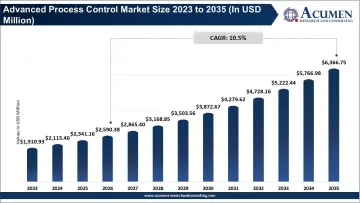
The global advanced process control market size was estimated at USD 2,341.16 million in 2025 and is projected to reach USD 6,366.75 million by 2035, expanding at a compound annual growth rate (CAGR) of 10.5% during the forecast period from 2026 to 2035.
Report Highlights
- By Region: Asia Pacific dominated the market with a 35% share in 2025, supported by rapid industrialization, manufacturing expansion, and large-scale investments in automation and smart manufacturing.
- By Region: Latin America is expected to be the fastest-growing region, registering a CAGR of 11.7% during the forecast period, supported by nearshoring, electronics manufacturing, industrial automation, and expanding manufacturing investments.
- By Component: Software segment dominated the market with a 43% share in 2025, driven by the high value of proprietary control algorithms and advanced modeling capabilities.
- By Component: Services segment is expected to be the fastest-growing segment, supported by increasing demand for system maintenance, model tuning, performance monitoring, and optimization expertise.
- By Technology: Advanced regulator control segment dominated the market with a 33% share in 2025, owing to its compatibility with existing control systems and ability to improve process stability without major infrastructure replacement.
- By Technology: Model predictive control segment is expected to be the fastest-growing segment, driven by its ability to manage complex multivariable processes and optimize operating conditions in real time.
- By Solution: Process & product optimization segment dominated the market with a 42% share in 2025, supported by demand for improved production efficiency, product consistency, throughput, and process stability.
- By Solution: Energy optimization segment is expected to be the fastest-growing segment, driven by rising energy costs, emission-reduction targets, and increasing industrial focus on energy efficiency.
- By Application: Oil and gas segment dominated the market with a 43% share in 2025, supported by the industry's complex operations and strong need for process stability, throughput optimization, and energy efficiency.
- By Application: Chemicals and petrochemicals segment is expected to be the fastest-growing segment, supported by investments in plant modernization, process efficiency, automation, and energy optimization.
What is Advanced Process Control Market?
The advanced process control (APC) market represents a critical segment being used in the industrial automation ecosystem focused on improving process stability, efficiency, and profitability through advanced control algorithms and real-time optimization techniques. ACP solutions use methods such as mathematical models, predictive analytics, and multivariable control to manage complex industrial processes more effectively than traditional control systems. These solutions are widely adopted across industries such as oil and gas, chemicals, pharmaceuticals, energy and power, food and beverages, and metals and mining, where even small improvements in efficiency and yield can generate significant economic value.
Another major driver of the ACP market is the global focus on energy efficiency and sustainability, ACP helps organizations run their processes efficiently by keeping them near optimal levels, which reduces energy use, lowers emissions, minimizes waste, and makes better use of raw materials. In addition, Eco-friendly components such as aluminum used in ACP sheets is 100% recyclable, and many manufacturers are adopting recycled materials for the core, which reduces waste and supports a circular economy, reflecting the broader industrial shift towards sustainable manufacturing practices.
Major Government Initiatives Supporting Advanced Process Control Demand
| Country/Region | Government Initiative | Key Focus | Relevance to Advanced Process Control |
|---|---|---|---|
| United States | CHIPS and Science Act | Semiconductor manufacturing, R&D, and workforce development | New semiconductor fabs and expansion projects increase demand for process monitoring, optimization, metrology, and automated manufacturing control. |
| European Union | European Chips Act | Semiconductor manufacturing, research, and supply-chain resilience | Expansion of European semiconductor capacity supports demand for advanced process control across fabrication, packaging, testing, and related manufacturing processes. |
| India | Semicon India Programme | Semiconductor and display manufacturing ecosystem | Government support for fabs, discrete semiconductors, packaging, testing, and design is creating new manufacturing environments requiring process control and optimization systems. |
| China | Made in China 2025 and semiconductor localization programs | Semiconductor manufacturing, industrial automation, and domestic technology development | Expansion of domestic semiconductor and advanced manufacturing capacity supports adoption of automated process control and optimization technologies. |
| Japan | Semiconductor manufacturing support programs | Domestic semiconductor production and supply-chain resilience | New and expanded semiconductor facilities increase requirements for precise process monitoring, production control, and manufacturing optimization. |
Advanced Process Control Market Dynamics
Market Drivers
1. Increasing Demand for Energy Optimization and Sustainable Industrial Operation
The growth of the advanced process control market is primarily driven by the global focus on energy efficiency and sustainability. International climate accords and national carbon reduction goals have effectively forced energy-intense industries to be as efficient as possible in terms of resource consumption. APC helps enable process operations with the least amount of waste in order to minimize emissions from industrial activity. With precise control over combustion or heat exchange systems, APC allows a facility to export as many emissions as possible without exceeding capacity constraints or violating any permit requirements, ultimately representing a consistent approach to meeting corporate Environmental, Social, and Governance (ESG) objectives.
2. Acceleration of Industry 4.0 and Digital Transformation in Manufacturing
The widespread deployment of industrial Internet of Things (IIOT) sensors has led to an unprecedented increase in the volume of real-time operational data generated in the industry. While traditional control systems are capable of handling basic inputs and predefined logic, they lack the analytical sophistication required to interpret and act on this complex, high-frequency data effectively. ACP systems serve as the analytical decision-making engine that converts raw industrial data into actionable control strategies, enabling improvements in operational efficiency, energy recovery, throughout, and process stability.
Market Restraints
1. High Capital Investment and Implementation Complexity
A major restraint affecting the growth of the advanced process control markets is the high initial capital expenditure required for system implementation. Beyond software licensing costs, ACP deployment often involves comprehensive process audits, upgrades to existing instrumentation and sensors, integration with legacy control systems, and the engagement of highly specialized engineering consultants. These requirements significantly increase upfront investment levels. For many small and medium-sized enterprises (SMEs), such costs can be prohibitive, particularly when the expected return on investment is extended or uncertain.
2. Cyber security Risks and Data Security Concerns
Cybersecurity vulnerabilities represent another critical restraint to the expansion of the advanced process control market. According to Statista, the global cost of cybercrime is projected to rise from $9.22 trillion in 2024 to $13.82 by 2028. As ACP platforms become increasingly integrated with cloud-based analytics, industrial IoT, and enterprise systems, this connectivity between operational technology and IT environments creates multiple new access points, which substantially elevate the risk of cyber intrusions across industrial control environments. This shift moves the control environment away from traditionally isolated, air-gapped networks toward more connected digital architectures.
Market Opportunities
1. AI-Driven Process Optimization and Intelligent Control Systems
The integration of Artificial Intelligence (AI) and Machine Learning (ML) into advanced process control frameworks represents one of the most significant growth opportunities within the ACP market. Traditional APC systems are highly effective for relatively stable and linear processes, but often face limitations when dealing with complex, nonlinear, or non-stationary industrial environments. By embedding ML algorithms into ACP platforms, control systems can continuously learn from historical and real-time process data, adapt to changing operating conditions, and optimize performance without the need for frequent manual model recalibration. This evolution towards Cognitive APC enables more accurate predictive control, faster decision-making, and enhanced process resilience.
2. Adoption of Continuous Production Models in Drug Manufacturing
Another major opportunity for the advanced process control market lies in the growing demand from the pharmaceutical and life science sectors, particularly as manufacturers transition from traditional batch processing to continuous manufacturing models. Continuous production process offers significant advantages in terms of product consistency, faster production cycles, and reduced operational costs, however, they also require extremely precise and stable control mechanisms. ACP solutions are essential for maintaining the tight process tolerances required in pharmaceutical manufacturing while ensuring compliance with strength regulatory standards.
Segmentation Insights
Component Insights
Software segment accounted for the largest share 43% of the advanced process control market, primarily due to the high capital and licensing costs associated with proprietary control algorithms, particularly those used in multivariable model predicative control (MPC) applications. These software solutions are developed specially for complex industrial environments and require sophisticated mathematical modeling, which significantly increases their commercial value. Recent industry trends indicated that ACP software is increasingly being delivered through cloud-native and hybrid architectures, enabling scalable, flexible deployments across multiple plant locations.
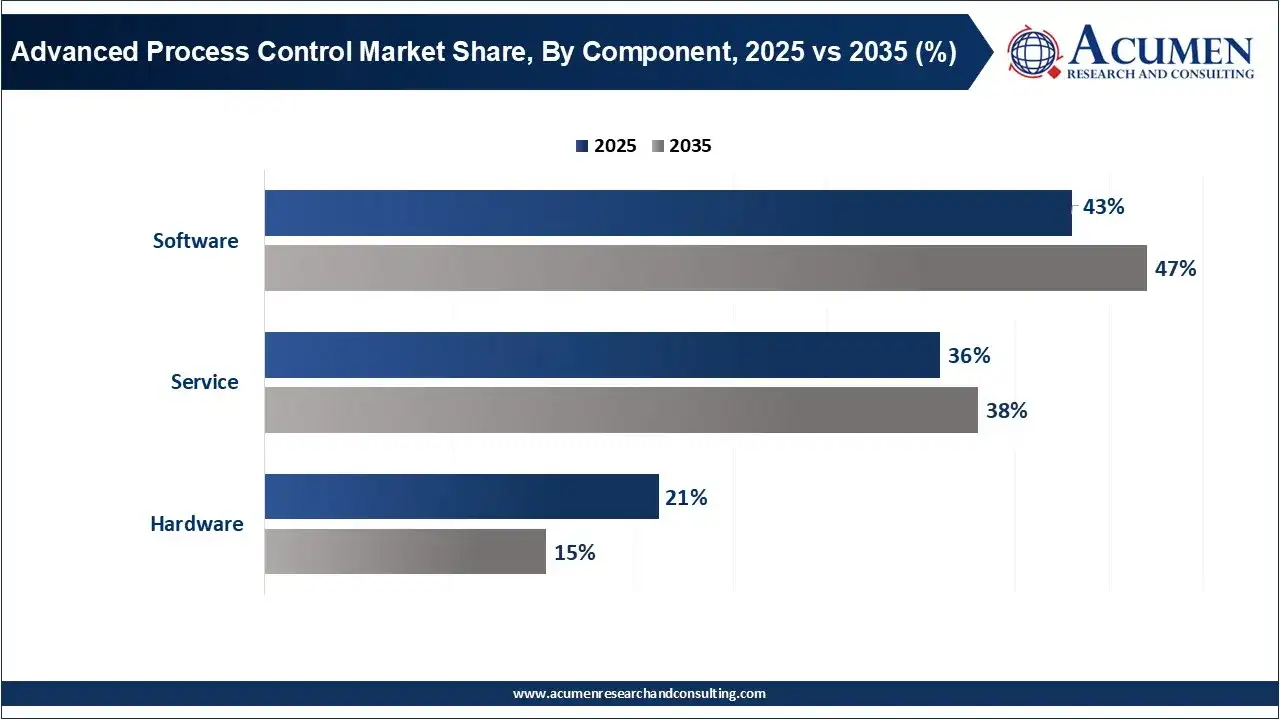
Services are the fastest-growing segment of the advanced process control market which also held 36% share in 2025; because modern industrial operations are increasingly complex and dynamic, requiring continuous expertise to maintain optimal system performance. APC systems need regular model tuning, performance monitoring, and updates to account for changes in equipment conditions, degradation variability, and evolving production targets. Additionally, the global shortage of skilled control engineers has led many organizations to outsource the management, maintenance, and optimization of APC systems to specialized service providers or original equipment manufacturers.
Technology Insights
Advanced regulator control segment was the largest segment with 33% share in 2025; because it focuses on enhancing the performance of existing control loops and improving process stability without requiring complete system overhauls. ARC solutions are cost-effective, relatively easy to implement, and compatible with legacy systems, making them attractive to mid-size plants and new adapters seeking incremental efficiency gains. Rising demand for energy optimization, emission reduction, and improved operational reliability is accelerating the adoption of ARC systems globally.
| Technology | Revenue Share, 2025 (%) |
|---|---|
| Model Predictive Control (MPC) | 30% |
| Advanced Regulatory Control (ARC) | 33% |
| Sequential Control | 13% |
| Inferential Control | 14% |
| Other Specialized APC | 10% |
Model Predictive Control (MPC) segment held second largest share of 30%, due to its ability to handle complex, multivariable processes with interdependent variables, which are common in industries like oil and gas, chemicals, and power. MPC provides precise predictive control and real-time optimization, enabling higher efficiency, better yield, and improved stability in industrial operations. Its proven effectiveness and extensive adoption in large-scale process plants make it the largest technology segment by market share.
Solution Insights
Process & product optimization segment led the market with the largest share of 42% in 2025. Its leading position reflects the growing use of APC systems to improve production efficiency, maintain consistent product quality, reduce process variability, and optimize operating conditions across continuous and batch manufacturing environments.
Process and product optimization solutions are particularly important in refining, chemicals, petrochemicals, pharmaceuticals, food and beverage, pulp and paper, and other process-intensive industries, where changes in temperature, pressure, flow rate, composition, and material properties can directly affect production output and product specifications. APC systems use real-time process information to identify deviations and adjust operating parameters, helping plants maintain production closer to their optimal operating conditions.
| Solution | Revenue Share, 2025 (%) |
|---|---|
| Process & Production Optimization | 42% |
| Energy Optimization | 24% |
| Feedstock & Material Optimization | 12% |
| Asset & Equipment Optimization | 14% |
| Environmental & Emissions Optimization | 8% |
Energy optimization segment is the fastest-growing solution category, which also held second largest share of 24% in 2025; due to increasing regulatory pressure to reduce carbon emissions and rising energy costs. ACP system in this segment enables plants to optimize energy-intensive processes, reduce waste, and improve overall energy efficiency. The focus on sustainability, ESG compliance, and operational cost reduction is driving rapid adoption of energy optimization solutions across multiple industries, particularly in energy-intensive sectors.
Application Insights
The oil and gas industry continues to dominate which also held 43% share in 2025; the advanced process control market due to its highly capital-intensive and extreme sensitivity to process inefficiencies. Upstream, midstream, and downstream facilities operate under volatile operating conditions, where fluctuations in pressure, temperature, and flow can directly impact safety, yield, and profitability. APC systems are widely deployed to stabilize complex refining and processing units, optimize throughout, and manage energy-intensive operations while complying with strict environmental and safety regulations. Additionally, the long operational life of oil and gas assets supports and sustains investments in APC upgrade and lifecycle optimizations, reinforcing the sector's leading market share.
| Application | Revenue Share, 2025 (%) |
|---|---|
| Oil and Gas | 30% |
| Chemicals & Petrochemicals | 25% |
| Pharmaceuticals | 10% |
| Energy & Power | 12% |
| Paper & Pulp | 5% |
| Mining, Minerals, and Metals | 6% |
| Food & Beverages | 5.50% |
| Others | 6.50% |
Chemicals and petrochemicals segment held the second largest share of the market with 25% in 2025, The segment's strong position is supported by the high level of process complexity across refineries, petrochemical plants, chemical processing facilities, and specialty chemical production units. These operations involve continuous production, multiple reaction stages, temperature and pressure-sensitive processes, and strict requirements for product consistency, making advanced process control an important tool for improving process stability and production efficiency.
Regional Analysis
The Asia Pacific region dominated the market with 35% share in global advanced process control market, driven by rapid industrialization and a high volume of large-scale Greenfield industrial projects. Countries such as China and India are making substantial investments in new energy, chemical, and manufacturing facilities. In addition, private-sector investment, string government support, is accelerating ACP adoption in the Asia Pacific. The national initiatives such as "Made in China 2025", along with similar manufacturing modernization programs across Southeast Asia and India, promote the adoption of advanced automation, digital manufacturing, and smart factory technologies through policy support and, in some cases finial incentives. The combination of Greenfield development, favorable policy frameworks, and rapid technology adoption is accelerating the market growth.
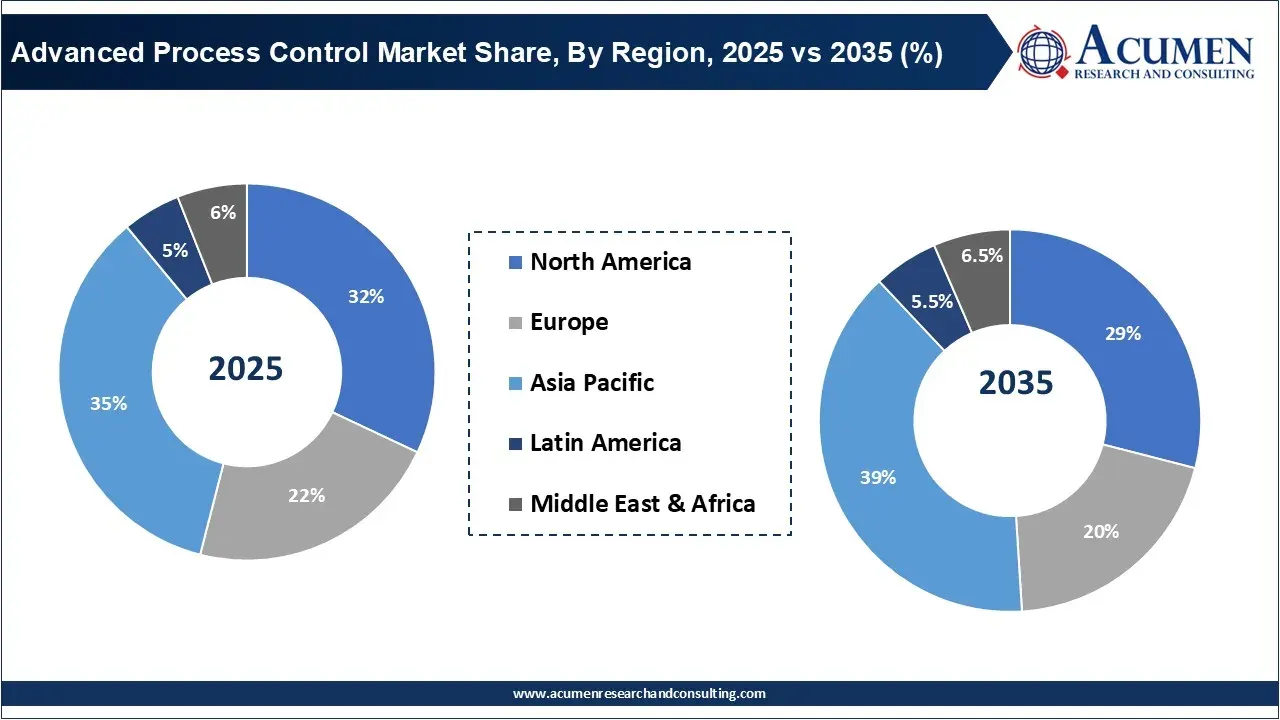
North America held the second largest position with 32% share in the global advanced process control market, supported by the strong presence of major automation technology providers and early adopters of industrial digitalization. Growth in North America is largely driven by brownfield modernization, where industrial operators enhance existing infrastructure rather than build new facilities. Many refineries, chemical plants, and energy facilities are upgrading legacy Distributed Control Systems (DCS) by integrating advanced APC layers powered by Artificial Intelligence (AI) and Machine Learning, enabling improved efficiency, stability, and predictive optimization without full system replacement.
Advanced Process Control Market Top Leading Countries
| Country | Key Strength in Advanced Process Control | Major Industry Drivers |
|---|---|---|
| United States | Process control equipment, metrology, inspection, semiconductor R&D | Advanced semiconductor manufacturing, AI chips, domestic fab expansion, equipment leadership |
| Taiwan | Advanced-node semiconductor manufacturing and process optimization | TSMC, leading-edge logic production, high fab utilization |
| South Korea | Advanced memory and logic manufacturing | Samsung, SK hynix, HBM, AI semiconductor demand |
| Japan | Semiconductor equipment, materials, metrology and process technologies | Tokyo Electron, materials manufacturing, advanced packaging |
| China | Large-scale semiconductor manufacturing and mature-node capacity | Domestic semiconductor production, fab expansion, localization |
| Germany | Automotive and industrial semiconductor manufacturing | Automotive electronics, power semiconductors, industrial automation |
| India | Emerging semiconductor manufacturing and electronics ecosystem | New fabs, semiconductor incentives, electronics manufacturing |
Latin America is seen to grow at the fastest rate of 11.7% CAGR during the forecast period in the advanced process control market. The region's growth is supported by increasing semiconductor and electronics manufacturing activity, nearshoring of production, investments in industrial automation, and the gradual development of local semiconductor supply chains.
Mexico is expected to remain a key contributor to regional growth. The country's electronics manufacturing industry has expanded considerably, supported by its proximity to the U.S. market and the relocation of manufacturing activities closer to North American customers. According to Mexico's government data, the semiconductor and other electronic component manufacturing industry recorded 527 economic units in May 2026, with Baja California, Sonora, and Jalisco accounting for the largest concentrations. The sector also attracted approximately $539 million in foreign direct investment during January to September 2024.
Advanced Process Control Market Key Players
- ABB Ltd.
- Aspen Technology, Inc. (Emerson Electric Co.)
- AVEVA Group Limited (Schneider Electric Group)
- General Electric Company / GE Vernova
- Honeywell International Inc.
- Mitsubishi Electric Corporation
- Panasonic Corporation
- Rockwell Automation, Inc.
- Rudolph Technologies, Inc. (Onto Innovation Inc.)
- SAP SE
- Siemens AG
- Yokogawa Electric Corporation
Recent Developments
- In March 2025, ABB expanded its collaboration with Södra Cell to implement advanced process control (APC) at the Mörrum pulp mill, enhancing efficiency with digitalized process control integration.
- In February 2024, GE Vernova (a GE subsidiary) introduced Proficy, an innovative AI-powered software to help manufacturers optimize operations and sustainability.
Segments Covered
By Component
- Software
- Service
- Hardware
By Technology
- Model Predictive Control (MPC)
- Advanced Regulatory Control (ARC)
- Sequential control
- Inferential control
- Other Specialized APC
By Solution
- Asset Equipment Optimization
- Energy Optimization
- Process & Production Optimization
- Environmental & Emissions Optimization
- Feedstock & Material Optimization
- Others
By Application
- Oil and Gas
- Chemicals & Petrochemicals
- Pharmaceuticals
- Energy & Power
- Paper & Pulp
- Mining, Minerals, and Metals
- Food & Beverages
- Others
By Region
- North America
- U.S.
- Canada
- Europe
- U.K.
- Germany
- France
- Spain
- Rest of Europe
- Asia-Pacific
- India
- Japan
- China
- Australia
- South Korea
- Rest of Asia-Pacific
- Latin America
- Brazil
- Mexico
- Rest of LATAM
- The Middle East & Africa
- South Africa
- GCC Countries
- Rest of the Middle East & Africa (ME&A)
Looking for discounts, bulk pricing, or custom solutions? Contact us today at sales@acumenresearchandconsulting.com
Frequently Asked Questions

Other Semiconductor and Electronics Reports
July 2024
February 2023
May 2025
June 2020