
AI in Packaging Market Size, Share, Trends and Forecast to 2035
AI in Packaging Market (By Component: Software, Hardware, Services; By AI Technology: Machine Vision and Computer Vision, Machine Learning and Predictive Analytics, Intelligent Automation and Optimization, Generative AI, Natural Language Processing, Others; By Application: Quality Inspection and Defect Detection, Packaging Design and Customization, Predictive Maintenance, Process and Production Optimization, Supply Chain and Inventory Optimization, Sustainability and Recycling Optimization, Others; By Deployment Mode: Cloud-Based, On-Premises and Edge-Based, Hybrid; By End-Use Industry: Food and Beverages, Healthcare and Pharmaceuticals, Personal Care and Cosmetics, Household and Home Care Products, Industrial and Manufacturing, Consumer Electronics and Electrical Products, Agriculture and Horticulture) - Global Industry Analysis, Size, Share, Regional Analysis, Trends and Forecast 2026 - 2035
- Last Updated: 23 Oct 2026
- Report Code: ARC4001
- Category: Packaging
AI in Packaging Market Size, Forecast 2025 to 2035
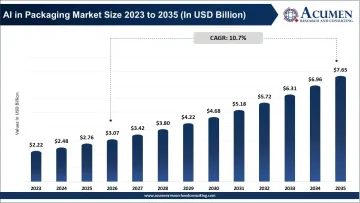
The global AI in packaging market size was valued at USD 2.76 billion in 2025 and is expected to reach USD 7.65 billion by 2035; expanding at a CAGR of 10.7% during the forecast period of 2026-2035.
- Base Year Market Size (2025): $2.76 billion
- Current Year Market Size (2026): $3.07 billion
- Estimated Year Market Size (2035): $7.65 billion
- Forecast Period CAGR (2026-2035): 10.7%
AI in Packaging Market Overview
AI in packaging market is expanding as the packaging manufacturers are increasingly adopting AI in quality inspection, packaging designing, production planning, predictive maintenance, and supply chain management. Machine vision and computer vision enable detection of defects and aid to achieve higher quality and consistency; ML is used for demand forecasting, process optimization, and monitoring of equipment health. Generative AI is creating opportunities for developing packaging artwork, customization, commercial planning and customer engagement.
The ongoing extensive manufacturing processes, expanding packaged food and beverage industries, and growing electronics and pharmaceutical production create opportunities for AI-enabled inspection and process optimization. Manufacturers in China, Japan, United States, South Korea, and India have advanced adoption priorities, ranging from advanced robotics and machine vision to cost-effective automation and production monitoring.
Key Takeaways
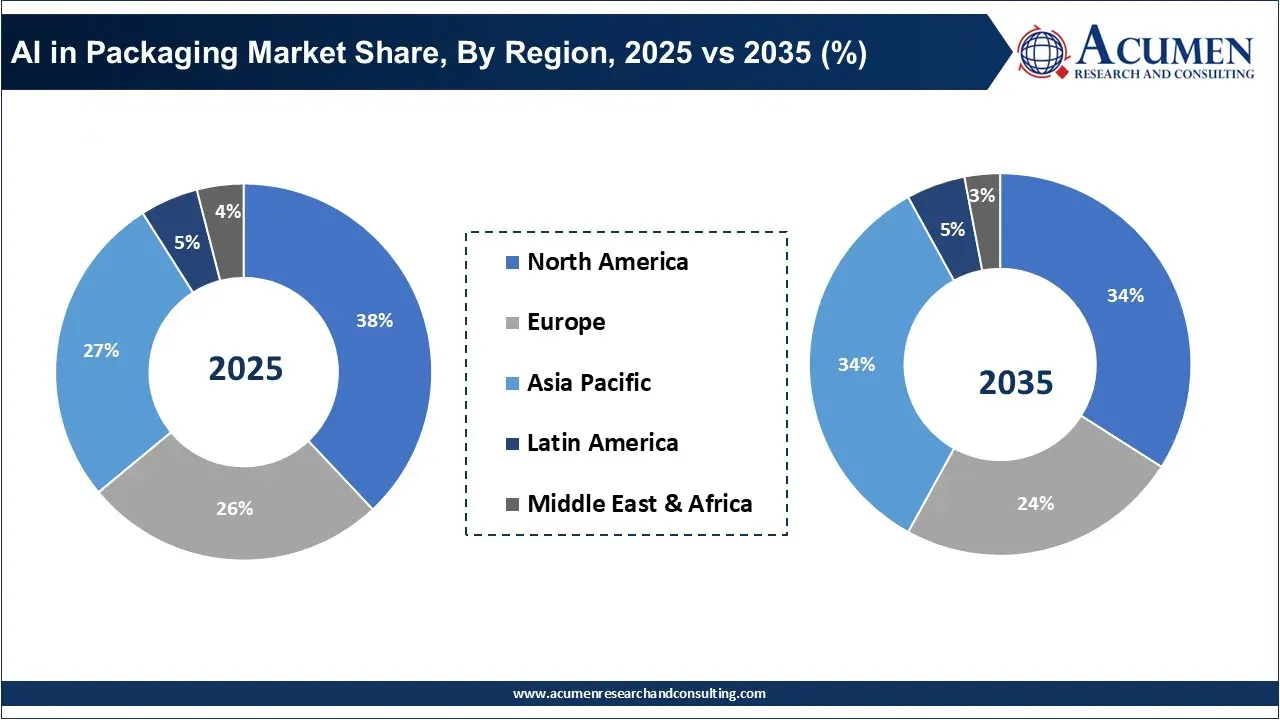
- By region: North America dominated the AI in Packaging Market with a 38.0% share in 2025. However, Asia-Pacific is projected to be the fastest-growing region, with a 13.5% CAGR from 2026 to 2035, reaching $2.60 billion by 2035 and matching North America’s projected regional share of 34.0%.
- By component: Software dominated the component segment with a 43.0% share in 2025, and its share is projected to increase to 47.0% by 2035, supported by demand for AI-powered inspection, predictive analytics, production optimization, and packaging design applications.
- By AI technology: Machine vision and computer vision dominated the AI technology segment with a 30.0% share in 2025. Generative AI is projected to be the fastest-growing technology segment, with a 17.1% CAGR from 2026 to 2035, reaching $1.53 billion by 2035.
- By application: Quality inspection and defect detection dominated the application segment with a 28.0% share in 2025, driven by demand for automated defect identification, label verification, packaging consistency, and production quality control.
- By deployment mode: On-premises and edge-based deployment dominated the segment with a 42.0% share in 2025, supported by the need for real-time inspection, low-latency processing, production-line reliability, and local control over manufacturing data.
- By end-use industry: Food and beverages dominated the end-use industry segment with a 30.0% share in 2025, driven by high-volume packaging operations, product quality requirements, label verification, seal inspection, and the need to reduce production waste.
AI in Packaging Technology Landscape
| AI Technology | Core Function in Packaging | Key Applications |
|---|---|---|
| Machine Vision and Computer Vision | Analyzes images and video to identify defects, irregularities, and packaging errors | Label inspection, seal verification, fill-level checks, barcode reading, defect detection |
| Machine Learning and Predictive Analytics | Uses historical and real-time data to identify patterns and forecast outcomes | Predictive maintenance, demand forecasting, defect prediction, production planning |
| Intelligent Automation and Optimization | Coordinates automated equipment and adjusts operational parameters | Packaging line control, robotic handling, production scheduling, process optimization |
| Generative AI | Generates and refines content, concepts, and recommendations | Packaging artwork concepts, product descriptions, design ideation, commercial planning |
| Natural Language Processing | Processes written and spoken language to extract information and automate communication | Compliance documentation, customer feedback analysis, technical support, knowledge retrieval |
Emerging Trends
- Generative AI: Packaging companies are increasingly evaluating generative AI for commercial planning, design development, customer engagement, and sales processes. More than 80% of packaging and paper industry leaders surveyed in 2025 reported having generative AI solutions under consideration, in development, or being launched.
- AI-Powered Quality Inspection: Manufacturers are expanding the use of computer vision to detect printing errors, incorrect labels, defective seals, and inconsistencies in packaging materials.
- Predictive Maintenance Gains Attention: AI-based monitoring helps identify equipment-performance abnormalities before they cause production interruptions, supporting higher equipment availability and more proactive maintenance.
- Edge AI Supports Real-Time Decisions: Processing data near packaging equipment can help manufacturers make rapid inspection and control decisions while reducing dependence on continuous cloud connectivity.
Market Dynamics
Growth Drivers
- Accelerated Biologics Discovery: Pharmaceutical companies are adopting AI-driven protein engineering to identify and optimize therapeutic proteins, antibodies, and biologics more efficiently, supporting faster candidate screening and reducing reliance on conventional experimental workflows.
- Advancements in Generative AI: Improvements in generative models and protein language models are enabling researchers to design novel protein sequences with targeted structural and functional properties, expanding the possibilities for engineering proteins beyond naturally occurring biological systems.
- Growing Demand for High-Performance Enzymes: Increasing requirements for enzymes with improved stability, selectivity, and catalytic efficiency are driving the use of AI in industrial biotechnology, pharmaceutical manufacturing, food processing, and specialty chemical production.
Restraints
- Data Quality and Availability Limitations: Incomplete protein annotations, inconsistent experimental measurements, and limited datasets for certain protein families can constrain model training and reduce the reliability of AI-generated protein designs.
- High Computational Infrastructure Costs: Developing and operating advanced protein engineering models requires substantial computing power, specialized software, and skilled personnel, potentially limiting adoption among startups, smaller biotechnology companies, and academic laboratories.
- Dependence on Laboratory Validation: AI predictions require experimental confirmation to establish protein stability, expression, biological activity, and safety. Laboratory testing can remain expensive and time-consuming, reducing the efficiency gains expected from computational design.
Opportunities
- AI-Designed Therapeutic Proteins: Growing interest in targeted biologics, engineered antibodies, and next-generation protein therapeutics creates opportunities for AI platforms that optimize binding affinity, molecular stability, and biological activity for specific therapeutic applications.
- Sustainable Industrial Biotechnology: AI-designed enzymes can support lower-energy manufacturing, biological waste conversion, and more efficient production of chemicals and materials, creating opportunities across biofuels, bioplastics, agriculture, and sustainable industrial processing.
- Integrated AI and Automated Laboratories: Combining computational protein design with robotic experimentation and automated analysis can enable continuous design-test-learn cycles, helping biotechnology companies accelerate optimization and improve the reproducibility of protein engineering workflows.
Challenges
- Predicting Real-World Protein Behavior: Computationally designed proteins may behave differently under actual biological or industrial conditions because of folding instability, interactions with other molecules, and environmental sensitivity, requiring extensive testing and iterative refinement.
- Scaling from Design to Manufacturing: Promising protein candidates must meet production requirements for yield, purity, stability, and cost. Translating successful computational designs into scalable manufacturing processes remains a significant technical and operational challenge.
- Reproducibility and Model Reliability: Differences in training datasets, prediction methods, and validation standards can produce inconsistent results across AI platforms. Establishing reliable benchmarks and demonstrating experimental reproducibility are essential for broader commercial adoption.
Segmentation and Segment-Level Forecasts
Component Insights
Software: Software dominated the component segment with a 43.0% share in 2025, projected to increase to 47.0% by 2035. Demand is supported by machine-vision platforms, predictive analytics, production optimization tools, AI-assisted design applications, and software that connects packaging equipment with manufacturing execution systems. As packaging manufacturers seek to improve inspection, scheduling, and operational visibility, software can extend the capabilities of existing machinery without requiring every asset to be replaced.
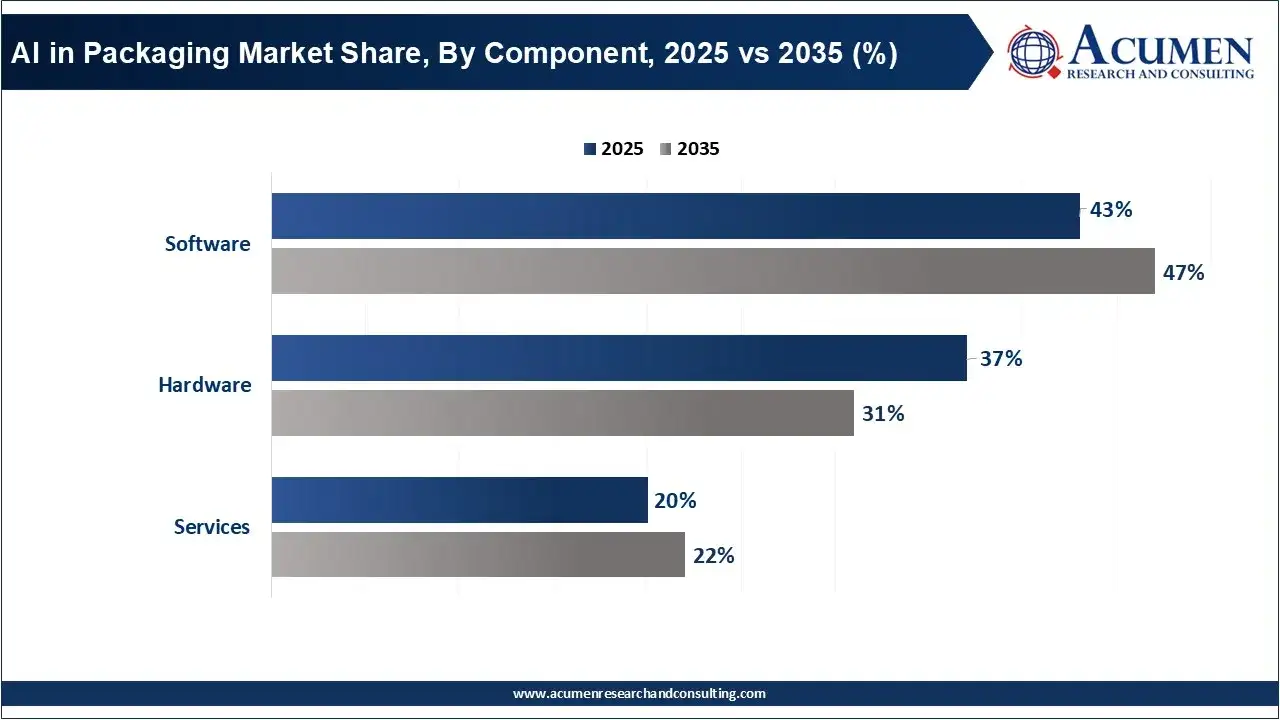
Services: Services accounted for 20.0% of the component segment in 2025 and are projected to reach 22.0% by 2035. This segment includes AI implementation, system integration, consulting, model customization, maintenance, training, and technical support. Demand is supported by manufacturers that lack the internal expertise to connect AI systems with legacy production equipment and existing quality-management workflows. Service providers can help define use cases, prepare production data, validate inspection models, and train employees. Their role becomes particularly important when AI deployments move beyond a single production line and require consistent performance across multiple facilities.
AI Technology Insights
Machine Vision and Computer Vision: Machine vision and computer vision dominated the AI technology segment with a 30.0% share in 2025. The segment is forecast to grow from approximately $0.92 billion in 2026 to $2.06 billion by 2035, at a CAGR of 9.4%. These technologies are widely suited to checking labels, detecting defects, verifying package dimensions, reading codes, inspecting seals, and identifying inconsistencies in packaging materials.
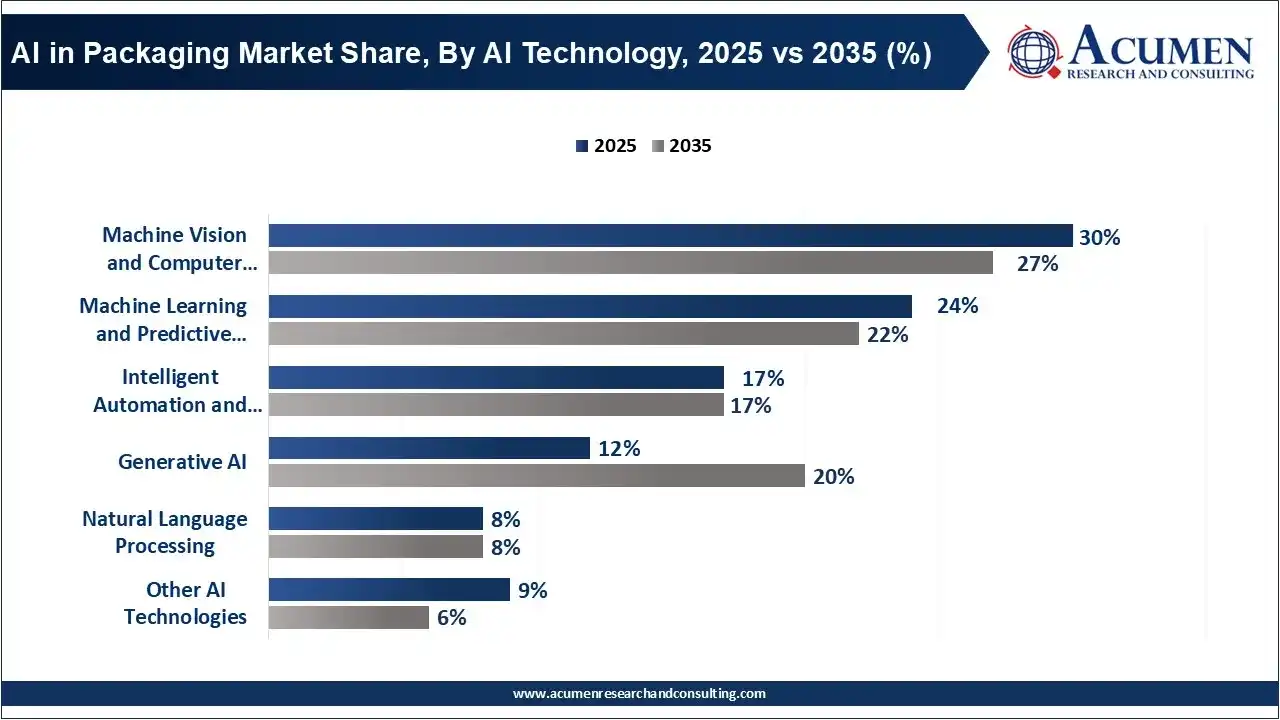
Machine Learning and Predictive Analytics: Machine learning and predictive analytics represented 24.0% of the AI technology segment in 2025, making it the second-largest segment. The market is projected to increase from $0.74 billion in 2026 to $1.68 billion by 2035, registering a CAGR of 9.6%. These systems use production histories, sensor readings, defect records, and operating conditions to identify patterns and support forecasting. Applications include predicting equipment failures, identifying process drift, estimating material requirements, and improving production scheduling.
Application Insights
Quality Inspection and Defect Detection: Quality inspection and defect detection dominated the application segment with a 28.0% share in 2025. Demand is driven by the need to identify printing errors, incorrect labels, damaged packaging, seal defects, dimensional inconsistencies, and other quality problems during production. AI-enabled inspection systems can evaluate products at production speed and flag defects that may be difficult to identify consistently through manual checks.
Packaging Design and Customization: Packaging design and customization held an 18.0% share in 2025, making it the second-largest application. AI tools can assist with artwork variations, structural concepts, product personalization, packaging visualization, and design iteration. Generative AI can accelerate concept development, while designers remain responsible for checking dimensions, print specifications, brand standards, and mandatory product information.
Predictive Maintenance: Predictive maintenance accounted for 17.0% of the application segment in 2025, making it the third-largest application. AI models can analyze equipment temperatures, vibration, operating cycles, error logs, and other machine data to identify patterns associated with potential failures. In packaging facilities, this can help maintenance teams prioritize interventions and reduce unexpected stoppages affecting filling, labeling, sealing, and carton-forming equipment.
Deployment Mode Insights
On-Premises and Edge-Based: On-premises and edge-based deployment led the segment with a 42.0% share in 2025. These configurations allow manufacturers to process production data close to packaging equipment, supporting rapid inspection decisions and reducing reliance on continuous cloud connectivity. They are useful where production-line responsiveness, operational continuity, and control over sensitive manufacturing data are important.
Cloud-Based: Cloud-based deployment accounted for 36.0% of the segment in 2025, making it the second-largest deployment mode. Cloud platforms can support centralized analytics, multi-site monitoring, model updates, production reporting, and integration across geographically dispersed facilities. They may also reduce the need for manufacturers to maintain all computing infrastructure internally.
End-Use Industry Insights
Food and Beverages: Food and beverages dominated the end-use segment with a 30.0% share in 2025. High production volumes, frequent packaging changes, strict quality requirements, and the need to verify labels and seals create demand for AI-enabled inspection and production optimization. AI can help detect packaging defects, check date codes, monitor filling processes, and identify recurring sources of waste.
Healthcare and Pharmaceuticals: Healthcare and pharmaceuticals accounted for 17.0% of the market in 2025, making this the second-largest end-use segment. Packaging operations require consistent labeling, batch identification, serialization where applicable, and reliable inspection. AI-assisted vision systems can flag incorrect labels, missing information, packaging damage, and print inconsistencies.
AI in Packaging Market Regional Insights
North America: Can an Established Packaging Industry Turn AI Investment into Measurable Production Gains?
North America added up to 38.0% of the market in 2025, which from the given regional estimate of 2026 is around $1.17B. The market is liable to reach at an expected value of $2.60B in 2035 at a CAGR of 9.3 % between 2026 and 2035. North America is an activity space for developing AI computer software, machine vision, mechanical assembly, and bundling gear.
Canada executes fresh areas for creating bundling gear and food handling. The more attractive proposition is to link AI to the legacy production capabilities. A packaging firm might apply computer vision to identify label and seal defects, use predictive analytics to prevent system downtime, or leverage production optimization solutions to optimize line performance.
Public investments are also driving the broader manufacturing AI ecosystem. In December 2025, the U.S. National Institute of Standards and Technology announced a $20 million investment to set up two AI centers dedicated to manufacturing and critical infrastructure.
Asia-Pacific: Will Manufacturing Scale Make This the Next Center of AI Packaging Growth?
Asia-Pacific's share of the overall AI in packaging market was 27.0% in 2025. Its share of the market is expected to be 34.0% in 2035. There is a diverse range of opportunities in the region, including the following China has a large manufacturing ecosystem and high levels of automation activity.
Japan and South Korea have mature robotics, industrial equipment and precision manufacturing businesses. Opportunities in India relate to the growth of packaged food production, pharmaceuticals, consumer goods and factory modernization.
AI-supported inspection can aid the handling of high volumes of production, product variation and quality. AI-driven predictive maintenance and smart automation can further foster improved use of the machinery. The application of generative AI may grow more relevant for packaging design, artwork localization and multiple product variants.
Europe: Can AI Help Packaging Manufacturers Balance Production Efficiency and Sustainability Requirements?
Europe accounted for 26.0% of the AI in packaging market in 2025, with a projected market value of $1.84 billion by 2035. Its forecast CAGR of 9.7% indicates continued expansion, even as its regional share is expected to decrease from 26.0% to 24.0%. Germany, France, Italy, the Netherlands, and other manufacturing centers offer opportunities across packaging machinery, pharmaceuticals, food processing, and industrial automation.
AI adoption is particularly relevant where manufacturers need reliable inspection, traceability, efficient material use, and better production planning. Computer vision can identify packaging defects, while analytics can help manufacturers investigate waste, process variability, and equipment downtime. AI-assisted design may also help teams compare packaging configurations and assess material requirements, although environmental claims require appropriate testing and evidence.
Government and Private-Sector Initiatives Supporting AI in Packaging
| Region | Government Initiatives | Private-Sector Initiatives |
|---|---|---|
| North America | U.S. National Institute of Standards and Technology (NIST) initiatives supporting AI research in manufacturing and critical infrastructure. | Packaging machinery manufacturers, machine-vision providers, industrial software companies, and automation integrators are developing AI-enabled inspection and production optimization solutions. |
| Europe | European Union AI initiatives, including AI factories, AI infrastructure investment plans, and the AI Act framework. | Packaging equipment manufacturers, industrial automation providers, AI software developers, and research institutions are advancing AI applications for packaging production. |
| Asia-Pacific | Government-led AI development and smart manufacturing programs across China, Japan, South Korea, and India. | Robotics manufacturers, machine-vision providers, packaging machinery companies, and industrial technology suppliers are expanding AI-enabled factory solutions. |
| Latin America | Brazil's national AI strategy and manufacturing modernization initiatives, alongside Mexico's Plan México and industrial development programs. | Packaging equipment suppliers, automation integrators, and manufacturing technology providers are helping businesses modernize production facilities. |
| Middle East and Africa | UAE AI development initiatives, including the AI for Development program, alongside Saudi Arabia's industrial transformation and AI development programs. | Industrial automation suppliers, technology companies, and local systems integrators are supporting smart manufacturing and digital transformation projects. |
Competitive Landscape, Vendor Ecosystem and Strategic Positioning
- Amcor: Focuses on combining packaging innovation, manufacturing efficiency, and sustainability initiatives to strengthen its position in consumer and healthcare packaging markets.
- Tetra Pak: Positions itself through integrated food-processing and packaging lines, with opportunities to apply AI to production monitoring, quality control, and predictive maintenance.
- Sealed Air: Emphasizes automated packaging systems and intelligent packaging operations to improve productivity, product protection, and material efficiency.
- Berry Global: Leverages its broad packaging manufacturing footprint to pursue production optimization, process automation, and improved operational performance.
- Mondi Group: Differentiates through paper-based and flexible packaging expertise, with strategic opportunities in AI-assisted design, manufacturing analytics, and material optimization.
- Ranpak: Builds its competitive position around sustainable protective packaging and AI-enabled packing automation, including partnerships that improve packing accuracy and reduce waste.
- Esko: Specializes in packaging design, artwork management, and workflow automation, positioning software and digital tools as ways to streamline packaging development.
- Cognex: Competes through machine vision and AI-powered inspection technologies that help manufacturers detect defects and verify packaging quality at production-line speeds.
Industry Developments
- May 2026: Amtech Software Acquires Clarico Systems to Expand AI Capabilities in Packaging. Amtech Software introduced Amtech Intelligence and announced the acquisition of Clarico Systems, an AI-powered estimating and quoting software provider for packaging manufacturers.
- May 2026: Mespack and Spookfish Partner on AI-Powered Packaging Inspection. Mespack and Spookfish formalized a strategic partnership to integrate thermal cameras and AI-based process monitoring into flexible packaging machinery. The solution combines Spookfish's inspection technology with Mespack's Athena digital platform to support in-line thermographic inspection and quality control.
Segments Covered
By Component
- Software
- Hardware
- Services
By AI Technology
- Machine Vision and Computer Vision
- Machine Learning and Predictive Analytics
- Intelligent Automation and Optimization
- Generative AI
- Natural Language Processing
- Other AI Technologies
By Application
- Quality Inspection and Defect Detection
- Packaging Design and Customization
- Predictive Maintenance
- Process and Production Optimization
- Supply Chain and Inventory Optimization
- Sustainability and Recycling Optimization
- Other Applications
By Deployment Mode
- Cloud-Based
- On-Premises and Edge-Based
- Hybrid
By End-Use Industry
- Food and Beverages
- Healthcare and Pharmaceuticals
- Personal Care and Cosmetics
- Household and Home Care Products
- Industrial and Manufacturing
- Consumer Electronics and Electrical Products
- Agriculture and Horticulture
- Other End-Use Industries
By Region
- North America
- Europe
- Asia-Pacific
- Latin America
- Middle East and Africa
Looking for discounts, bulk pricing, or custom solutions? Contact us today at sales@acumenresearchandconsulting.com
Frequently Asked Questions

Other Packaging Reports
March 2024
April 2025
July 2021
June 2023