
Artificial Intelligence in Drug Discovery Market Size, Share, Trends, Report 2026 To 2035
AI in Drug Discovery Market (By Drug Type: Small-Molecule Drugs, Large-Molecule / Biologics, Other Therapeutic Modalities; By Component: Software/AI Platforms, Services; By Technology: Traditional Machine Learning, Deep Learning, Generative AI, Natural Language Processing, Other AI Technologies; By Deployment: On-Premise, Cloud-Based, Hybrid; By Organization Size: Large Pharmaceutical / Biotechnology Companies, Small & Medium Biotechnology Companies, Academic / Research Organizations; By End User: Pharmaceutical Companies, Biotechnology Companies, Contract Research Organizations (CROs), Academic & Research Institutes, Other End Users; By Application: Target Identification & Validation, Drug Screening, Drug Design & Optimization, Drug Repurposing, Preclinical Testing, Others; By Therapeutic Area: Oncology, Neurology / Neurodegenerative, Cardiovascular, Metabolic, Infectious, Others) - Global Industry Analysis, Size, Share, Regional Analysis, Trends and Forecast 2026 - 2035
- Last Updated: 10 Sep 2026
- Report Code: ARC1621
- Category: Healthcare and Pharmaceuticals
Artificial Intelligence for Drug Discovery Market Size and Forecast 2026 To 2035
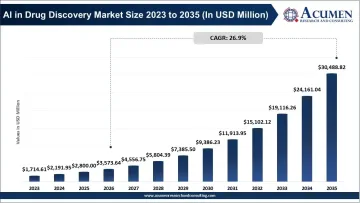
The global artificial intelligence for drug discovery market size was valued at USD 2,800 million in 2025. The market is observed to reach at USD 30,488.82 million by 2035; growing at a CAGR of 26.9% during the forecast period of 2026-2035. Pharmaceutical companies are increasingly evaluating AI based on measurable improvements in development timelines, experimental throughput, candidate quality and R&D economics, making the transition from proof-of-concept projects to scalable enterprise deployment a key determinant of future market growth.
Report Highlights
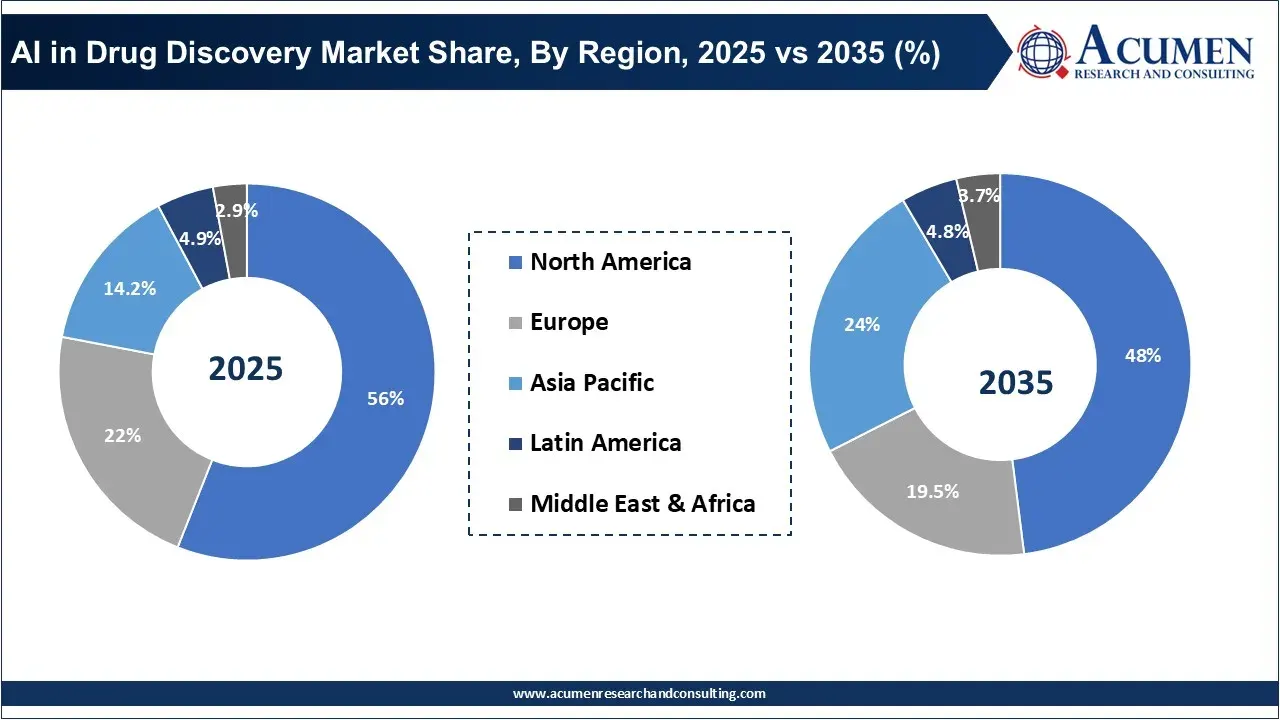
- By region, North America dominated the market with a 56.0% share in 2025, supported by its established pharmaceutical and biotechnology ecosystem, concentration of AI companies, research infrastructure and large-scale biomedical datasets.
- By region, Asia-Pacific was the second-largest regional market with a 14.2% share in 2025 and is expected to expand significantly through 2035, supported by increasing pharmaceutical R&D, biotechnology development and AI investment.
- By drug type, small-molecule drugs dominated the market with a 55.0% share in 2025, supported by extensive AI adoption across virtual screening, molecular property prediction, hit identification, structure-based drug design, toxicity prediction and lead optimization.
- By drug type, large-molecule drugs and biologics were the second-largest segment with a 32.0% share in 2025, driven by increasing AI applications in protein structure prediction, antibody engineering, protein design and molecular interaction analysis.
- By component, software and AI platforms dominated the market with a 72.0% share in 2025, driven by the commercialization of scalable and reusable AI applications across multiple stages of the drug discovery workflow.
- By component, services were the second-largest segment with a 28.0% share in 2025, supported by demand for AI implementation, customization, data integration, model development, validation and specialized drug discovery services.
- By technology, deep learning dominated the market with a 34.0% share in 2025, supported by its ability to process complex chemical and biological datasets for molecular modeling, protein structure prediction and drug-target interaction analysis.
- By technology, generative AI was the second-largest segment with an 18.0% share in 2025, driven by increasing applications in de novo molecule design, molecular optimization and protein engineering.
- By deployment, cloud deployment dominated the market with a 52.0% share in 2025, supported by the high computing and storage requirements of generative AI, deep learning, virtual screening and large-scale biological data analysis.
- By deployment, hybrid deployment was the second-largest segment with an 18.0% share in 2025, reflecting pharmaceutical and biotechnology companies' need to protect proprietary research data while accessing scalable cloud computing resources.
- By organization size, large pharmaceutical and biotechnology companies dominated the market with a 54.0% share in 2025, supported by larger R&D budgets, proprietary datasets, established drug development pipelines and advanced computational infrastructure.
- By organization size, small and medium biotechnology companies were the second-largest segment with a 32.0% share in 2025, supported by increasing access to cloud-based AI platforms that reduce infrastructure requirements and enable faster computational discovery.
- By end user, pharmaceutical companies dominated the market with a 43.0% share in 2025, driven by extensive R&D programs, large proprietary databases and broad AI adoption across drug discovery workflows.
- By end user, biotechnology companies were the second-largest segment with a 30.0% share in 2025, supported by the growing use of AI to accelerate target discovery, virtual screening and candidate prioritization.
- By application, drug design and optimization dominated the market with a 39.0% share in 2025, driven by increasing use of AI for de novo molecule generation, lead optimization, protein design and candidate refinement.
- By application, drug screening was the second-largest segment with a 25.0% share in 2025, supported by increasing use of AI-powered virtual screening to evaluate large compound libraries and prioritize promising candidates.
- By therapeutic area, oncology dominated the market with a 34.0% share in 2025, supported by complex disease biology, extensive genomic and proteomic datasets and significant unmet medical needs.
- By therapeutic area, neurology and neurodegenerative diseases were the second-largest segment with an 18.0% share in 2025, driven by the ability of AI to analyze complex genetic, molecular and multi-omics datasets.
Artificial Intelligence for Drug Discovery Market Outlook
The artificial intelligence for drug discovery market is transitioning from experimentation to scaled implementation with pharma and biotech firms actively adopting AI for target identification, virtual screening, molecular design, lead optimization, protein engineering and preclinical discovery. The future of the AI in drug discovery market is predicted to be driven by a greater reliance on generative AI and foundation models over purely predictive algorithms and integrated AI-driven drug development platforms rather than individual tools.
Regulatory acceptance is also progressing, with the U.S. FDA reporting more than 500 drug and biological product submissions containing AI components between 2016 and 2023 and publishing a risk-based framework for establishing AI model credibility in January 2025.
Investment & Adoption Ecosystem
- In 2025, global venture capital investment in AI companies reached approximately $258.7 billion, representing 61% of total global investment of $427.1 billion, highlighting the broader capital environment supporting AI-enabled life sciences innovation.
- U.S. raised $194.4 billion of AI venture capital deal value in 2025, at 75% of global AI venture capital deal value, largest pool of AI capital funding innovation in this area.
- While AI venture capital investments to abroad by American investor, it was $124 billion, around 56% of global AI venture capital investment flows, followed by $20.7 billion (UK), $17.2 billion (China) and $14.5 billion (EU27) in 2025.
- Generative AI companies received approximately $35.3 billion in investment in 2025, representing around 14% of total AI VC investment globally.
- AI infrastructure and hosting companies attracted $109.3 billion in 2025, showcasing sheer scale of computing infrastructure being constructed and deployed around the world, able to handle massive computations required by advanced AI algorithms.
Does AI Actually Reduce the Cost of Drug Discovery? Know from Our Healthcare Experts
From the viewpoint of healthcare and life-sciences consulting experts at Acumen Research & Consulting, drug discovery and development cannot rely solely on a single technology, like that of AI, for the entire cost reduction during the lifecycle of a drug. The more significant economic contributions at this time are associated with the early or more computationally demanding stages.
Its contribution is more meaningful when paired with the existence of, or access to, proprietary databases of high quality; automated laboratory execution; and human scientific expertise. Current industry sentiment anticipates reductions in early drug discovery and development cost and timing by potentially 50% in the next 3–5 years-a stated anticipation, not an experienced fact for all drug programs.
| Drug Discovery Activity | Traditional Cost/time Pressure | AI-enabled Intervention |
|---|---|---|
| Target identification | Large-scale literature, omics and biological-data analysis | AI-based target–disease association and knowledge analysis |
| Virtual screening | Testing large compound libraries | AI-based compound ranking and virtual screening |
| Hit identification | Repeated experimental screening | Predictive models and virtual prioritization |
| Molecular design | Multiple design-test-redesign cycles | Generative AI and multi-parameter molecular design |
| Lead optimization | Iterative synthesis and experimental testing | AI prediction of molecular properties and optimization |
| ADMET prediction | Laboratory and animal testing for safety properties | Predictive toxicity, pharmacokinetic and ADMET models |
Market Dynamics
Driver
Growing Need to Compress Drug Discovery Timelines and R&D Costs
Rising cost, duration and failure rates associated with traditional drug discovery is greatly incentivizing the adoption of AI by biopharmaceutical and biotechnology firms in computation-heavy aspects of discovery. With the ability to screen large chemical, genomic, proteomic and clinical data sets and then to identify the top candidate compounds and avoid futile experiments, researchers will now be able to spend lab work on better quality compounds. Pharmaceutical industry belief that within 3-5 years, early-stage R&D spending and timeline could shrink by up to 50% fueled even more investing interests.
Restraint
Data Quality, Model Validation and Regulatory Uncertainty
The effectiveness of AI drug discovery depends heavily on the quality, consistency and biological relevance of training data, while inaccurate or poorly validated models can produce misleading candidates and increase rather than reduce research costs. Regulatory agencies are therefore placing greater emphasis on model credibility, context of use, validation and risk-based assessment, creating additional requirements for pharmaceutical companies deploying AI in regulated development workflows.
Opportunity
Generative AI and Autonomous Drug Discovery Workflows
The expansion of generative AI creates an opportunity to move beyond prediction toward active generation and optimization of drug candidates, including novel small molecules, proteins and other therapeutic modalities. The opportunity is expanding further through integration with automated laboratories, multimodal biological datasets and AI agents capable of coordinating multiple stages of computational discovery. With generative AI investment reaching $35.3 billion globally in 2025, the broader capital ecosystem is providing substantial financial support for technologies that can be adapted to life-science applications.
Segmental Analysis
Drug Type Insights
Small-molecule drugs represented the largest drug-type segment in 2025, accounting for 55.0% of the artificial intelligence for drug discovery market. This is majorly attributed to the widespread application of AI through the entire small molecules discovery process from predicting molecular properties, virtual screening, lead identification, structure-based design to Toxicity estimation and lead optimization.
Large volumes of historical chemical structures, biological activity data and drug actions data are available, benefiting the training inputs to AI systems and therefore enhancing prediction accuracy and reducing efforts in small molecule drug discoveries.
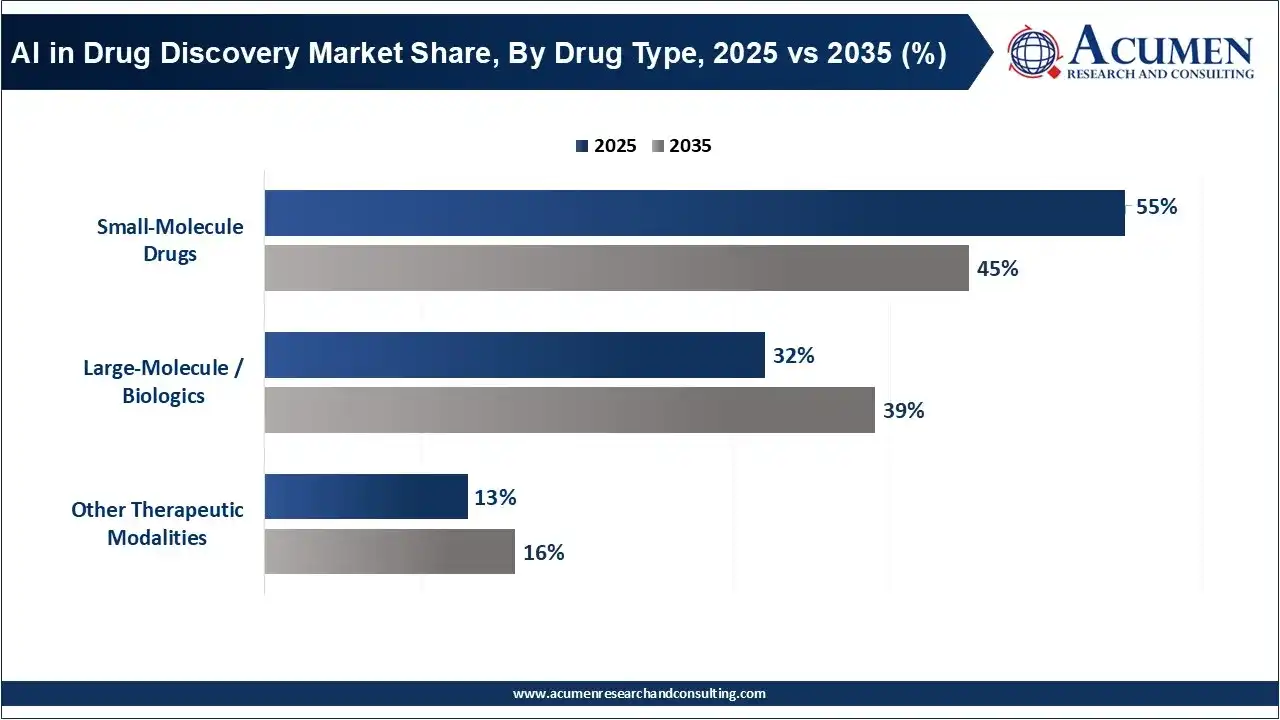
The second largest segment was large molecules drugs and biologics, accounting for 32.0% in 2025. Increasingly this segment is dominated by the application of AI as they are capable of handling and analyzing complex data such as protein sequence data, genomic data, structural data for applications in protein structure prediction, antibody engineering, protein designing, molecular interaction prediction and optimization of candidates. The segment is expected to grow up to 39.0% in 2035.
Component Insights
Software and AI platforms led the market in 2025 with 72%. Growing commercialization of the computational drug discovery workflow through a platform of re-usable applications, rather than through individual custom research efforts, accounts for the leadership of this segment.
The software and AI platforms integrate, among other capabilities; virtual screening, generative molecular design, protein-structure prediction, target identification and ADMET prediction in a discovery pipeline. This segment is expected to gain further prominence and account for 77% share of the AI for drug discovery market in 2035 as pharma & biotech companies increase their use of scalable AI capabilities in R&D.
AI in Drug Discovery Market Share, By Component, 2025 (%)
| Component | Revenue Share, 2025 (%) | Revenue Share, 2035 (%) |
|---|---|---|
| Software/AI Platforms | 72% | 77% |
| Services | 28% | 23% |
Services accounted for 28.0% of the artificial intelligence for drug discovery market in 2025, making them the second-largest component segment after software/AI platforms. AI-enabled drug discovery services include implementation, customization, data integration, model development, validation, computational drug-discovery projects and specialized research support.
These services are particularly important for pharmaceutical and biotechnology organizations that want to adopt AI without developing every capability internally. Service providers can help integrate AI models with existing research workflows, curate and prepare complex biological datasets, validate model outputs and support specialized discovery activities.
Technology Insights
Deep learning was the largest technology segment of the artificial intelligence for drug discovery market at 34% of market value in 2025. Deep learning is well positioned in the market due to its power in identifying and utilizing complex and high-dimensional sets of biological and chemical data, and these algorithms find applications in protein structure, molecular property and drug-target interaction prediction, biological image analysis, and sequence and molecular modeling.
The segment, though it is projected to grow at a reduced relative share down to 30.0% by 2035 due to rapid rise of a new commercial technology category(see, below), it is expected that that its overall value may actually continue grow due to increase adoption of AI technologies throughout pharmaceutical R&D.
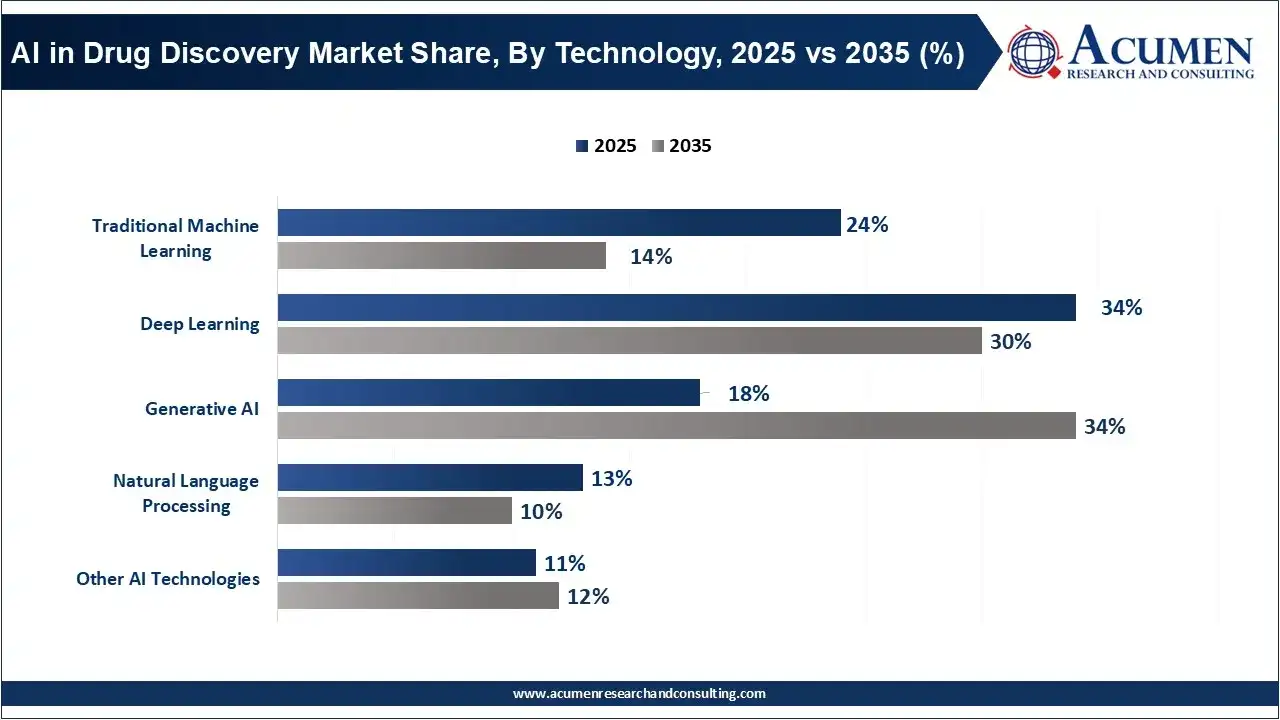
Generative AI is projected to hold the largest value share expansion of the tech-based AI for drug discovery market, growing from 18.0% in 2025 to 34.0% by 2035; up by 16%, making it one of the largest structural tech markets in the future.
This reflects a growth from exploratory use cases to production use cases and commercial adoption. Generative AI applications offer support for designing molecules de novo, and optimizing existing molecules, while its applications in proteins allows researchers to design new protein structures and candidate proteins that were unimaginable by traditional methods.
Deployment Insights
Cloud deployment had the largest market share in 2025, accounting for 52% of the market. The major share attributed to cloud deployment is primarily driven by the data-intensive nature of AI-driven drug discovery applications such as simulations of molecules, models related to deep learning and generative AI, virtual screening and biological data at a large scale where companies require significant processing power.
Through cloud platforms, companies get the access to AI technologies without the need to invest the required amount of resources on having specialized computing infrastructure like dedicated supercomputers. By the end of 2035 it is expected to account for 64.0% share and grow at a CAGR of 29.9% during the forecast period from 2026 to 2035 which is the second fastest deployment category during the period.
AI in Drug Discovery Market Share, By Deployment, 2025 (%)
| Deployment | Revenue Share, 2025 (%) | Revenue Share, 2035 (%) |
|---|---|---|
| On-Premise | 30% | 15% |
| Cloud-Based | 52% | 64% |
| Hybrid | 18% | 21% |
Hybrid deployment had 18% of market share in the year 2025 which is expected to reach up to 21% by 2035 and is expected to grow at a CAGR of 29.1% in between 2026 and 2035 after cloud deployment, as these deployment models are majorly deployed in pharmaceutical and biotechnology companies that tend to require data security regarding their sensitive proprietary research data and to retain computational workloads and hardware structure internally while seeking to scale their processing capability through the cloud.
Organization Size Insights
Large pharmaceutical and biotechnology companies represented 54.0% of the market in 2025, making them the dominant organization-size segment. Their leadership is supported by larger R&D budgets, extensive proprietary datasets, established drug-development pipelines and the ability to invest in sophisticated computational infrastructure.
These organizations can deploy AI across multiple stages of drug discovery, including target identification, virtual screening, molecular design, lead optimization and preclinical research. Despite maintaining leadership, their share is expected to decrease to 47.0% by 2035, as smaller biotechnology companies increasingly adopt AI-enabled discovery platforms.
AI in Drug Discovery Market Share, By Organization Size, 2025 (%)
| Organization Size | Revenue Share, 2025 (%) | Revenue Share, 2035 (%) |
|---|---|---|
| Large Pharmaceutical / Biotechnology Companies | 54% | 47% |
| Small & Medium Biotechnology Companies | 32% | 39% |
| Academic / Research Organizations | 14% | 14% |
Small and medium biotechnology companies accounted for 32.0% of the market in 2025, making them the second-largest organization-size segment. The growing availability of cloud-based AI platforms is particularly important for these companies because it reduces the need to build extensive computational infrastructure internally. AI can also help smaller biotech firms accelerate target discovery, virtual screening and candidate prioritization while operating with comparatively constrained R&D resources.
End User Insights
The pharmaceutical segment accounted for 43% market share in 2025, thus being largest among all end users. Pharmaceutical end users dominated the end-users share by the virtue of heavy R&D spending, vast data proprietary databases, and several drug-development programs simultaneously running.
Pharmaceutical end users started to apply AI in different stage of the drug discovery workflow such as target identification, virtual screening, molecular designing, lead optimization etc. Though they are expected to lose their hold over the period owing to increased adoption of AI by the biotechnology end-users in addition to their expanded use of computational drug-discovery capabilities.
AI in Drug Discovery Market Share, By End User, 2025 (%)
| End User | Revenue Share, 2025 (%) |
|---|---|
| Pharmaceutical Companies | 43% |
| Biotechnology Companies | 30% |
| Contract Research Organizations (CROs) | 13% |
| Academic & Research Institutes | 10% |
| Other End Users | 4% |
Biotechnology companies represented the 30% market share among other end-users. Biotechnology end users are extremely in need of AI because the capabilities to discover in a computational approach may help them overcome their limitations on infrastructure and other resources which in turn may help to fasten their discovery process at an early stage.
Application Insights
Drug design and optimization accounted for 39.0% of the artificial intelligence for drug discovery market in 2025, making it the largest application segment. AI is increasingly being incorporated into de novo molecule generation, lead optimization, molecular property optimization, protein and antibody design, structure-based drug design and candidate optimization. The growing adoption of generative AI is particularly significant for this segment because generative models can propose and refine candidate molecules according to multiple desired characteristics.
AI in Drug Discovery Market Share, By Application, 2025 (%)
| Application | Revenue Share, 2025 (%) |
|---|---|
| Target Identification & Validation | 17% |
| Drug Screening | 25% |
| Drug Design & Optimization | 39% |
| Drug Repurposing | 10% |
| Preclinical Testing | 6% |
| Others | 3% |
Drug screening represented 25.0% of the market in 2025, ranking second among applications. AI-powered virtual screening has become one of the more established commercial applications because algorithms can evaluate large compound libraries and prioritize candidates according to predicted interactions and molecular properties. AI-assisted screening can therefore reduce the number of compounds requiring experimental evaluation and support more efficient hit identification.
Therapeutic Area Insights
Oncology constituted 34% share and proved to be the premier therapeutic area in the AI enabled drug discovery market of 2025. Extremely rich and complex data are generated as part of cancer studies of varying categories, which range from genomics to proteomics, clinical and tumor biology, molecular, biomarker profiles, etc.
AI analysis of such vast and multifaceted datasets can enable efficient identification of drug targets and biomarkers, virtual screening, molecular designing and prediction of possible treatment response.
Oncology represents a good area for development of AI enabled approaches due to high unmet medical needs, complicated disease biology and massive amount of biomedical data generated and gathered.
AI in Drug Discovery Market Share, By Therapeutic Area, 2025 (%)
| Therapeutic Area | Revenue Share, 2025 (%) |
|---|---|
| Oncology | 34% |
| Neurology / Neurodegenerative | 18% |
| Cardiovascular | 12% |
| Metabolic | 11% |
| Infectious | 10% |
| Others | 15% |
With the market share of 18%, the neurology & neurodegenerative disease segment stood as second premier therapeutic area. AI can aid discovery of drugs in neurobiology by processing and analyzing different multi-omics data including, but not restricted to genetic and molecular data, as also data relating to various neurological diseases for complex network generation which may be elusive with conventional methods.
Complex neurodegenerative pathology and requirement to enhance and expedite identification of drug targets and potential candidates create good potential for computational techniques.
Artificial Intelligence for Drug Discovery Market Regional Analysis
Why Does North America Dominate the Artificial Intelligence for Drug Discovery Market?
North America accounted for 56.0% of the global artificial intelligence for drug discovery market in 2025, making it the leading regional market by a significant margin. The region generated approximately $1.57 billion in 2025, increasing to approximately $2.00 billion in 2026, and is projected to reach nearly $14.63 billion by 2035. The supremacy of North America is supported by a rich pharmaceutical and biotechnological ecosystem, accumulation of AI technology firms, developed research institutions and intelligent computing facilities.
North America serves as an ideal region for commercializing AI in drug discovery as a strong R&D need and accumulation of proprietary molecular, genomic, proteomic and clinical data can be found at pharmaceutical and biotechnology firms. These firms employ the integration of AI in various steps for drug discovery at various applications including target identification, virtual screening, molecule design, lead optimization, analysis of proteins and pre-clinical study.
- The United States is the principal country market within North America, supported by its extensive pharmaceutical and biotechnology industry, concentration of AI developers and strong life-sciences research ecosystem.
- The country's combination of pharmaceutical R&D activity, advanced computational infrastructure and large-scale biomedical datasets provides significant opportunities for AI applications in target discovery, virtual screening, molecular design and drug candidate optimization.
Why Is Asia-Pacific the Fastest-Growing Region in the AI Drug Discovery Market?
Asia-Pacific is expected to achieve the fastest regional market growth from 2026 to 2035 with a CAGR of 34.5% in the market value which ranks the first out of the other four regions covered in this report. Asia-Pacific captured 14.2% of global market in 2025 and will gain up to 24.0% in 2035 by increasing its dominance from 2026 to 2035 respectively.
Several underlying structure are fueling this aggressive growth. First, Asia-Pacific has a large, maturing and highly complex pharmaceutical and biotechnological infrastructure that provides a huge base of potential users of AI-enabled discovery technologies.
The development of AI-supported infrastructure in this area also gives research and drug developers a powerful means to analyze and apply huge biological and chemical databases, and thus enable AI-driven biological discovery that integrates genomic and proteomic, molecular and clinical databases.
Secondly, increased investment in biotechnological and computational research is providing opportunities for AI to become integrated across various levels of discovery. For instance, AI can be applied from target identification, through to virtual screening, molecule design and the optimization of a candidate.
Moreover, the emergence of cloud-based AI platforms will reduce overall infrastructure requirements so that nascent companies can exploit its capabilities without investing in building and maintaining it all in-house.
- China represents an important growth market within Asia-Pacific because of its expanding pharmaceutical and biotechnology ecosystem and increasing integration of artificial intelligence into biomedical research.
- The country's large-scale scientific and healthcare data environment creates opportunities for AI applications spanning molecular discovery, target identification, virtual screening and drug candidate optimization.
- Its expanding AI capabilities and biotechnology research base can further support adoption of AI-enabled drug discovery platforms.
AI Drug Discovery Startup Ecosystem
| Startup | Country | Core AI Drug Discovery Focus |
|---|---|---|
| Isomorphic Labs | UK | AI-powered drug design and molecular modeling |
| Insilico Medicine | U.S./Global | Generative AI, target discovery and molecule design |
| Recursion | U.S. | Phenotypic screening, AI and biological data |
| Xaira Therapeutics | U.S. | AI-native drug discovery and biological foundation models |
| insitr | U.S. | Machine learning, multi-omics and drug development |
| XtalPi | China/ U.S. | AI-driven molecular design and computational chemistry |
| Genesis Therapeutics | U.S. | Generative AI and molecular design |
| Chai Discovery | U.S. | AI protein and molecular modeling |
| Atomwise | U.S. | AI-powered virtual screening |
| Iambic Therapeutics | U.S. | AI-enabled molecular design and drug discovery |
Competitive Landscape
- Isomorphic Labs – Isomorphic Labs is positioning AI as a core drug-design engine, leveraging technology derived from Google DeepMind and expanding its pharmaceutical partnerships and investment base.
- Insilico Medicine – Insilico Medicine operates an end-to-end generative AI drug discovery platform spanning target identification, molecular design and clinical development, strengthening its position through large pharmaceutical collaborations.
- Recursion – Recursion combines large-scale biological experimentation, phenotypic data and machine learning through its Recursion OS platform to discover and develop potential therapeutics.
- Xaira Therapeutics – Xaira is building an AI-native drug discovery platform around advanced machine learning, biological data and experimental capabilities, placing it among the sector's most heavily funded emerging players.
- insitro – insitro integrates machine learning with human biology, multi-omics and experimental platforms to identify disease mechanisms and develop therapeutic candidates.
- XtalPi – XtalPi combines artificial intelligence, robotics and computational chemistry to support molecular design, pharmaceutical research and automated experimentation.
- Genesis Therapeutics – Genesis Therapeutics applies deep-learning technology to molecular discovery and optimization, with its platform focused on improving the design of novel small-molecule therapeutics.
Recent Breakthroughs
- In July 2026, Takeda and Insilico Medicine announced a strategic AI drug-discovery collaboration valued at up to $600 million, with Insilico using its Pharma. AI platform to identify and design potential drug candidates. The agreement strengthens the emerging model in which pharmaceutical companies combine their development and commercialization capabilities with AI-native biotech platforms for early-stage discovery.
- In July 2026, Chai Discovery raised $400 million in Series C funding, bringing its reported total funding to roughly $630 million and reinforcing investor interest in AI-powered molecular design. The company has also established partnerships with pharmaceutical companies including Lilly, Pfizer and Novartis, giving it access to commercial validation opportunities alongside its technology development.
Segments Covered in the Report
By Drug Type
- Small-Molecule Drugs
- Large-Molecule / Biologics
- Other Therapeutic Modalities
By Component
- Software/AI Platforms
- Services
By Technology
- Traditional Machine Learning
- Deep Learning
- Generative AI
- Natural Language Processing
- Other AI Technologies
By Deployment
- On-Premise
- Cloud-Based
- Hybrid
By Organization Size
- Large Pharmaceutical / Biotechnology Companies
- Small & Medium Biotechnology Companies
- Academic / Research Organizations
By End User
- Pharmaceutical Companies
- Biotechnology Companies
- Contract Research Organizations (CROs)
- Academic & Research Institutes
- Other End Users
By Application
- Target Identification & Validation
- Drug Screening
- Drug Design & Optimization
- Drug Repurposing
- Preclinical Testing
- Others
By Therapeutic Area
- Oncology
- Neurology / Neurodegenerative
- Cardiovascular
- Metabolic
- Infectious
- Others
By Region
- North America
- Europe
- Asia-Pacific
- Latin America
- Middle East & Africa
Looking for discounts, bulk pricing, or custom solutions? Contact us today at sales@acumenresearchandconsulting.com
Frequently Asked Questions

Other Healthcare and Pharmaceuticals Reports
February 2021
February 2025
February 2025
October 2024