
Aseptic Packaging Market Size, Share, Trends, Forecast Report 2026 To 2035
Aseptic Packaging Market (By Product Type: Cartons, Bottles & Cans, Bags & Pouches, Vials & Ampoules, Prefilled Syringes, Other; By Material Type: Plastics, Paper & Paperboard, Glass, Metal, Others; By Application: Beverages, Food, Pharmaceuticals, Others) - Global Industry Analysis, Size, Share, Regional Analysis, Trends and Forecast 2026 - 2035
- Last Updated: 03 Nov 2026
- Report Code: ARC1745
- Category: Chemicals And Materials
Aseptic Packaging Market Size and Forecast 2026 to 2035
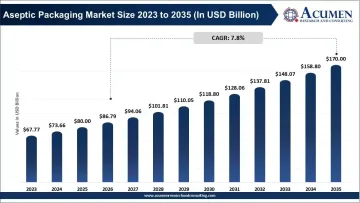
The global aseptic packaging market size was valued at USD 80 billion in 2025 and is expected to reach at USD 170 billion by 2035, while expanding at a CAGR of 7.8% during the forecast period 2026 to 2035. Rising demand for shelf-stable dairy products, beverages and ready-to-consume foods is supporting aseptic packaging adoption. Improvements in sterilization, filling automation and barrier materials help manufacturers maintain product safety, extend shelf life and reduce dependence on refrigerated distribution across diverse markets.
Aseptic Packaging Market Key Metrics
- Base Year Market Size (2025): $80 billion
- Current Year Market Size (2026): $86.79 billion
- Estimated Year Market Size (2035): $170 billion
- Forecast Period CAGR (2026-2035): 7.8%
Key Takeaways
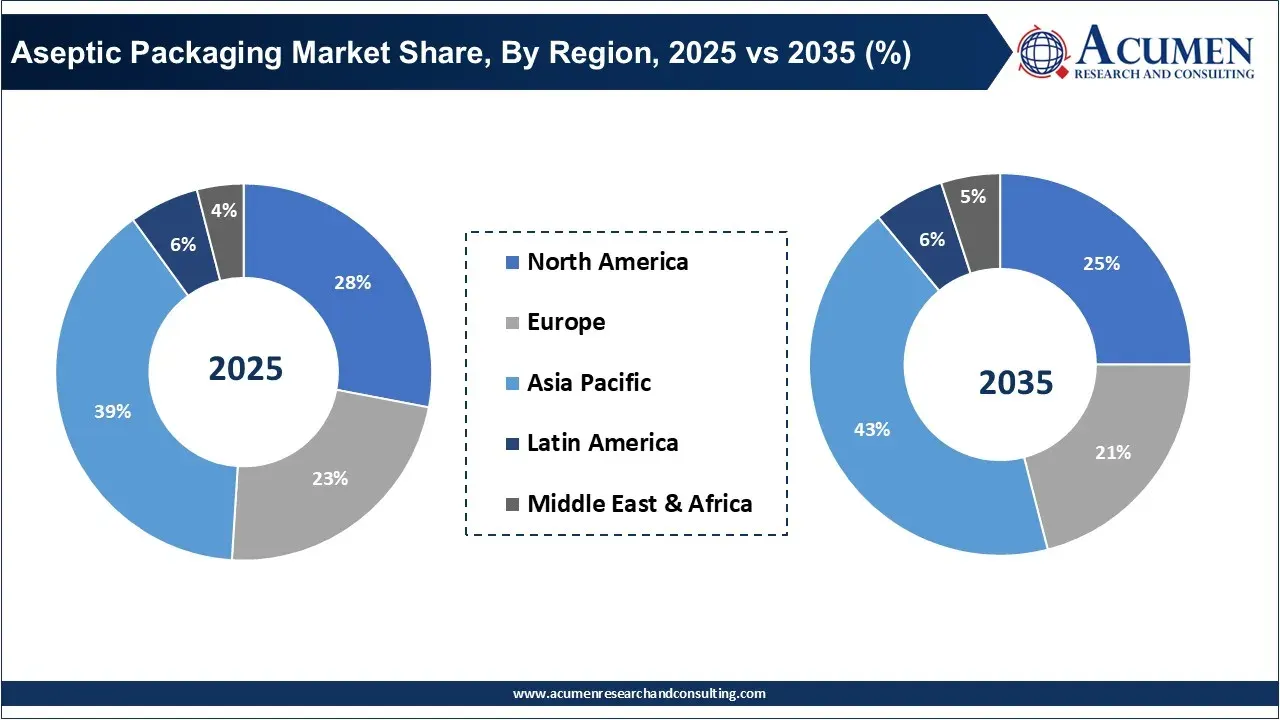
- By region: Asia-Pacific dominated the aseptic packaging market with a 39.0% share in 2025, generating USD 31.20 billion in revenue. The Middle East & Africa is the fastest-growing region, with a projected CAGR of 10.5% from 2026 to 2035, and is expected to reach USD 8.50 billion by 2035.
- By product type: Cartons dominated the aseptic packaging market with a 39.0% share in 2025. Bottles & cans ranked second with a 22.0% share, while other product formats include bags & pouches, vials & ampoules, prefilled syringes, and other aseptic packaging formats.
- By material type: Plastics dominated the aseptic packaging market with a 46.0% share in 2025. Paper & paperboard ranked second with a 32.0% share, while other materials represent the fastest-growing material segment, with a projected CAGR of 16.4% from 2026 to 2035.
- By application: Beverages dominated the Aseptic packaging market with a 42.0% share in 2025. Food ranked second with a 31.0% share, followed by pharmaceuticals at 19.0%.
What Is Aseptic Packaging Market?
The aseptic packaging market includes packaging goods, containers, and accessories and integrated systems for packaging commercial sterile items. Usually, both the container and the product are sterilized before filling and sealing in a sterile surroundings. Food products packaged in an aseptic environment contain liquid food products, plant drinks, liquid foods, dairy products, nutritional goods, and medicines applications. When used appropriately, aseptic packaging maintains the goods' freshness and shelf stability and can significantly lower refrigeration requirements before use.
Aseptic Packaging Production Statistics
- SIG produced 53.9 billion packs in 2025, compared with 56.5 billion in 2024, across its carton, bag-in-box and spouted-pouch portfolio.
- Tetra Pak reported 174 billion packages sold in 2025, supported by operations across more than 160 countries. Its portfolio includes multiple packaging formats, so this figure should not be interpreted as aseptic-carton production alone.
- UFlex reported an annual aseptic packaging capacity of 7 billion packs at its Sanand, Gujarat facility in its FY2024–25 annual report.
- SIG's Ahmedabad aseptic carton plant, which began production in 2025, has an initial annual capacity of up to 4 billion packs.
- UFlex reported integrated manufacturing capacity of 60,000 metric tonnes, equivalent to approximately 7 billion packs, at its Sanand facility in FY2024–25.
- SIG reported that its alu-layer-free aseptic carton sales grew by approximately 24% in 2025 compared with 2024, indicating increased adoption of alternative barrier structures within its portfolio.
Key Trends
- Shift toward recyclable and aluminum-free cartons: Packaging manufacturers are developing alternative barrier technologies that reduce dependence on aluminum while maintaining oxygen, moisture and light protection. These innovations aim to improve material recovery and reduce packaging-related environmental impacts without compromising product safety.
- Automation of aseptic filling operations: Food and beverage manufacturers are adopting high-speed filling lines, automated inspection and integrated sterilization systems to improve throughput, maintain consistent product quality and reduce operational interruptions. Flexible equipment that accommodates multiple package sizes is particularly relevant to manufacturers with diverse product portfolios.
- Growing demand for shelf-stable dairy and beverages: Milk, flavored dairy drinks, fruit juices and plant-based beverages are important applications for aseptic packaging. Manufacturers use these formats to extend shelf life and simplify distribution, particularly where refrigerated storage and transport can increase costs.
- Development of flexible aseptic packaging formats: Spouted pouches and bag-in-box systems are being used for selected liquid foods, nutritional products, sauces and beverage applications. Their potential advantages include convenient dispensing, efficient storage and reduced packaging weight, depending on the format and application.
Aseptic Packaging Market Dynamics
Growth Drivers
- Rising Demand for Shelf-Stable Food and Beverages: Increasing consumption of packaged milk, plant-based beverages, juices, soups, and ready-to-drink products is driving demand for aseptic packaging that preserves product quality without requiring refrigeration before opening.
- Expansion of Pharmaceutical and Healthcare Applications: Growing demand for sterile injectable medicines, biological products, and liquid pharmaceutical formulations is supporting the adoption of aseptic packaging solutions that help maintain product sterility and reduce contamination risks.
- Growing Preference for Extended Shelf Life: Food and beverage manufacturers are adopting aseptic processing and packaging technologies to extend product shelf life, reduce spoilage, simplify distribution, and expand access to markets with limited refrigerated storage infrastructure.
Restraints
- High Initial Investment Requirements: Aseptic packaging operations require specialized filling equipment, sterilization systems, controlled production environments, and validation procedures, creating substantial capital expenditure requirements for manufacturers.
- Complex Manufacturing and Sterilization Processes: Maintaining sterile conditions throughout product processing, packaging material treatment, filling, and sealing requires precise process control. Equipment failures or contamination events can result in product losses and production interruptions.
- Recycling and Material Recovery Limitations: Multilayer aseptic cartons often combine paperboard, polymers, and aluminum, making material separation and recycling more complex than for single-material packaging formats in regions with limited recovery infrastructure.
Key Opportunities
- Expansion of Plant-Based and Functional Beverages: Growing demand for oat, soy, almond, protein-enriched, and functional beverages creates opportunities for aseptic packaging manufacturers to supply formats that preserve product quality and support ambient distribution.
- Emerging Market Penetration: Improvements in food processing infrastructure, packaged beverage consumption, and distribution networks across emerging economies create opportunities for aseptic packaging suppliers to serve manufacturers seeking longer shelf life and reduced dependence on cold chains.
- Sustainable Aseptic Packaging Innovation: Development of paper-based packaging, reduced-aluminum structures, renewable polymers, and improved recycling technologies creates opportunities to lower material impact while maintaining essential barrier and product protection properties.
Challenges
- Maintaining Sterility and Product Safety: Manufacturers must control microbial contamination throughout processing, filling, and sealing. Maintaining consistent sterile conditions requires stringent hygiene practices, equipment monitoring, process validation, and quality assurance.
- Balancing Barrier Performance with Sustainability: Reducing packaging material complexity while preserving protection against oxygen, moisture, light, and microorganisms remains challenging, particularly for products requiring extended shelf life under ambient conditions.
- Adapting to Changing Consumer and Regulatory Expectations: Packaging manufacturers must respond to evolving food safety requirements, recyclability targets, labeling rules, and consumer preferences while maintaining production efficiency and compatibility with existing filling infrastructure.
Aseptic Packaging Market Segmentation Insights
Product Type Insights
Cartons: Cartons dominated the aseptic packaging market in 2025, accounting for 39.0% of the market and generating US$31.20 billion in revenue. Their widespread use in milk, juice, dairy beverages and liquid food products is supported by their lightweight construction, efficient storage and suitability for high-volume filling operations. Multilayer structures provide the barrier properties required to protect products from oxygen, light and contamination.
Bottles & Cans: Bottles and cans represented the second-largest product segment in 2025, accounting for 22.0% of the market, equivalent to US$17.60 billion. These formats serve beverages, nutritional products and selected liquid food applications. Their convenience, familiar consumer handling and compatibility with automated production systems support adoption.
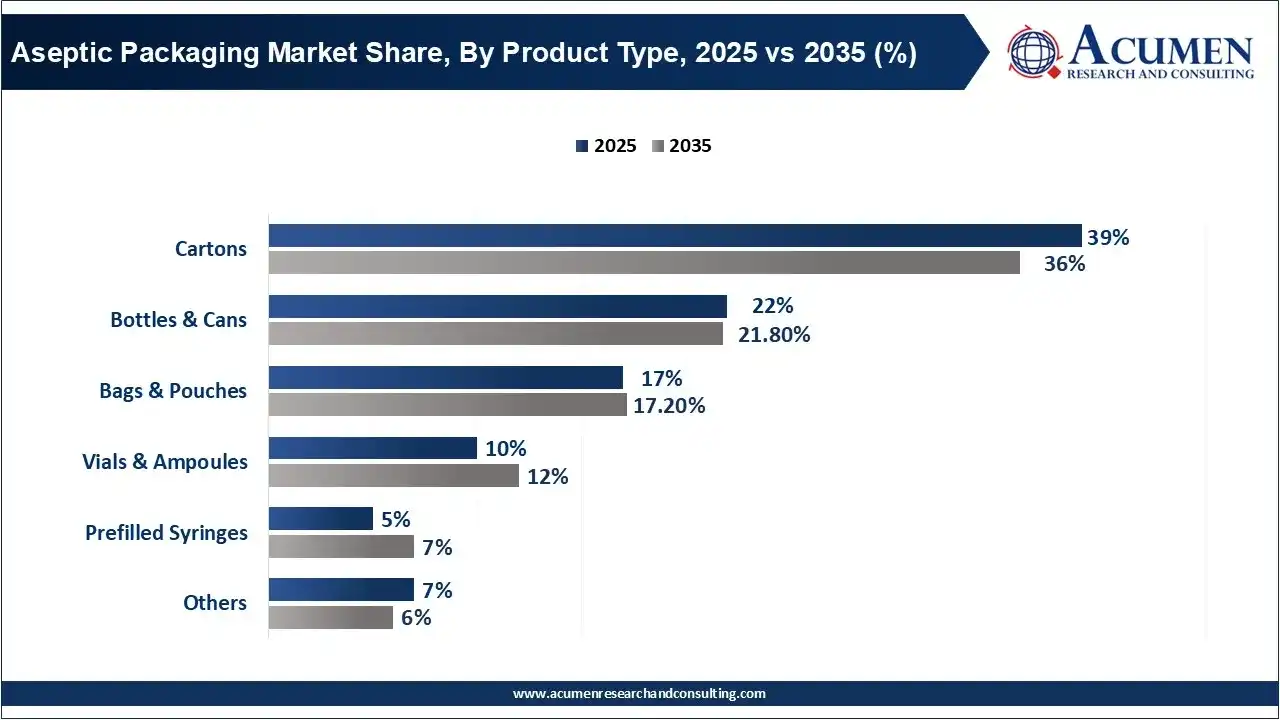
Bags & Pouches: Bags and pouches accounted for 17.0% of the market in 2025, generating US$13.60 billion in revenue. Flexible formats can offer lower packaging weight, efficient transportation and convenient dispensing for selected liquid foods, beverages and nutritional products. Their adoption depends on seal integrity, barrier performance, filling compatibility and the requirements of the packaged product.
Material Type Insights
Plastics: Plastics dominated the aseptic packaging market in 2025, accounting for 46.0% of the market and generating US$36.80 billion in revenue. Their flexibility, lightweight construction, sealing performance and compatibility with different packaging formats support applications across food, beverages and pharmaceuticals. Plastics are used in bottles, pouches, caps, closures and multilayer barrier structures.
Glass: Glass accounted for 12.0% of the market in 2025, generating US$9.60 billion in revenue. It is used in selected aseptic food, beverage and pharmaceutical applications because of its chemical stability and strong barrier properties. Pharmaceutical glass containers are particularly important for products requiring controlled storage and stringent packaging standards.
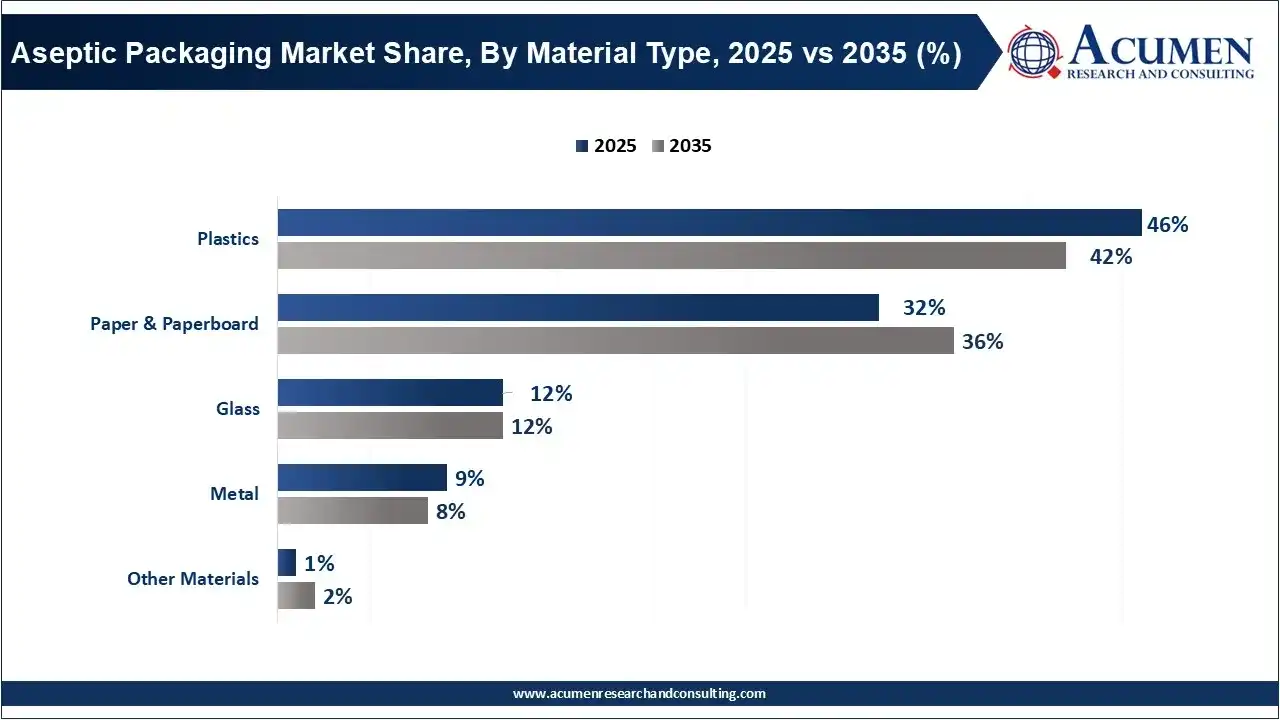
Other Materials: Other materials are projected to be the fastest-growing material segment, with a CAGR of 16.4% from 2026 to 2035. The segment accounted for 1.0% of the market in 2025 and is projected to reach 2.0% by 2035, reflecting an increase in its relative contribution from a small base. Growth opportunities may arise from alternative barrier materials and emerging packaging structures designed to improve recyclability or reduce dependence on conventional materials.
Application Insights
Beverages: Beverages dominated the aseptic packaging market in 2025, accounting for 42.0% of the market and generating US$33.60 billion in revenue. Demand is supported by milk, flavored dairy drinks, fruit juices, plant-based beverages and nutritional drinks. Aseptic packaging enables suitable products to maintain shelf stability without continuous refrigeration before opening, reducing distribution constraints. Growth opportunities include convenient single-serve formats, shelf-stable functional beverages and packaging innovations that improve material efficiency.
Food: Food represented the second-largest application segment in 2025, accounting for 31.0% of the market, equivalent to US$24.80 billion. Applications include soups, sauces, liquid foods, dairy-based preparations and other processed products that benefit from controlled sterilization and packaging. Manufacturers use aseptic systems to support product safety, maintain quality and expand distribution.
Aseptic Packaging Market Regional Analysis
Which Region Dominates the Aseptic Packaging Market?
The Asia-Pacific held a major share in 2025, accounting for 39.0% of revenue (US$31.20 billion). The industry is driven by demand for beverage and processed-food products from the rapidly expanding middle-class population, demand from dairy manufacturers, and increased consumption of packaged products, along with investments in automated filling machinery. China, India, and Japan are significant markets, with each country having unique manufacturing abilities and economies of scale for packaged goods.
Which Region Is Expected to Grow the Fastest?
Middle East and Africa is predicted to grow at the highest CAGR of 10.5% during 2026-2035 while revenue is likely to grow from US$ 3.47 bn in 2026 to US$ 8.50 bn in 2035. The growing demand for shelf-stable dairy products and beverages, availability of investment opportunities and regulatory mandates in the countries with insufficient cold-chain infrastructure can propel this industry. Asia-Pacific is also expected to grow at a significant CAGR of 8.9% and reach a revenue of US$73.10bn by 2035.
Country-Level Outlook
United States
- Demand from food and beverage manufacturers: The United States is an important market for aseptic packaging, supported by demand for shelf-stable dairy products, plant-based beverages, nutritional drinks, soups and ready-to-consume products. Aseptic formats help manufacturers distribute products without continuous refrigeration before opening, depending on the product and packaging system.
- Advanced food processing infrastructure: Established food and beverage manufacturing facilities, automated filling lines and investments in processing technologies support adoption. Demand is also influenced by manufacturers seeking to extend product shelf life, reduce distribution complexity and serve retail and institutional customers.
- Regulatory emphasis on food safety: FDA requirements for low-acid aseptically processed foods in hermetically sealed containers, including applicable filing and processing requirements, influence equipment design, validation and quality assurance.
- Growth opportunities: Recyclable packaging structures, lightweight cartons, aseptic bottles and packaging for high-protein beverages provide potential growth avenues. Suppliers that can demonstrate product safety, operational efficiency and material recovery compatibility are well positioned to address changing customer requirements.
China
- Large-scale food and beverage manufacturing: China's extensive dairy, beverage and processed-food industries create demand for high-volume aseptic packaging systems. Domestic consumption, organized retail and the distribution of packaged beverages across geographically dispersed markets support adoption.
- Investment in automated production: Manufacturers are investing in high-speed filling, processing automation and production-line efficiency. These investments can increase demand for aseptic filling equipment, carton materials, sterile packaging components and integrated packaging solutions.
- Growth opportunities: Dairy beverages, plant-based drinks, nutritional products and shelf-stable foods offer potential opportunities. Sustainable packaging and improvements in carton collection and recycling infrastructure will also influence the development of the market.
India
- Expansion of packaged dairy and beverages: India's large dairy industry creates a substantial addressable market for aseptic cartons, bottles and pouches. The Department of Animal Husbandry and Dairying reported approximately 239.3 million tonnes of milk production in 2023–24, illustrating the scale of the country's dairy supply base. This is a demand indicator, not a direct measure of aseptic packaging consumption.
- Manufacturing and distribution opportunities: Investments in food processing, automated filling systems and packaging conversion can support market development. Local sourcing of packaging materials and technical services may help reduce costs and improve supply reliability.
- Growth opportunities: Affordable single-serve formats, shelf-stable dairy products, fortified beverages and recyclable packaging structures represent potential opportunities. Adoption will depend on consumer affordability, packaging collection infrastructure and manufacturers' ability to justify equipment and material costs.
Germany
- Strong food processing and dairy sector: Germany's established dairy, juice, liquid food and processed-food industries support demand for aseptic cartons, bottles and specialized packaging systems. Manufacturers prioritize reliable product protection, shelf-life performance and efficient distribution across domestic and European markets.
- High standards for packaging safety: Food-contact material requirements and European packaging legislation influence material selection, product design, labeling and recycling strategies. Packaging suppliers must balance barrier performance with compliance and environmental objectives.
- Sustainability-led innovation: Germany's emphasis on packaging waste reduction and recycling creates opportunities for paper-based barrier technologies, recyclable structures and improved carton recovery systems.
- Growth opportunities: Manufacturers can target premium dairy products, plant-based beverages, functional drinks and pharmaceutical applications. Automated filling systems and packaging designs compatible with recycling infrastructure are important areas for innovation.
Japan
- Demand for high-quality packaged products: Japan's established food processing industry and demand for convenient, portion-controlled beverages create opportunities for aseptic cartons, bottles and pouches. Applications include dairy beverages, teas, nutritional products and shelf-stable foods.
- Focus on manufacturing precision: Food safety, production reliability and consistent packaging quality support investment in advanced sterilization, filling and inspection technologies. Equipment suppliers can benefit from demand for efficient, high-performance production lines.
- Food-contact compliance: Japan's positive-list system for synthetic resin food-contact materials requires relevant substances to meet applicable requirements. This influences packaging material formulation, supplier qualification and compliance documentation.
Government Regulations and Policy Analysis
| Country / region | Major regulations or policy framework | Impact on the aseptic packaging market |
|---|---|---|
| United States | FDA requirements under 21 CFR Parts 108 and 113 for applicable acidified and low-acid foods processed and packaged in hermetically sealed containers | Manufacturers may need establishment registration, scheduled-process filings and appropriate process controls. Compliance affects aseptic processing, packaging validation and quality assurance. |
| China | National food safety standards, including applicable standards for food-contact materials and packaging, alongside food safety legislation | Packaging materials must satisfy applicable safety and migration requirements. Compliance influences material selection, testing, production quality and access to food and beverage customers. |
| India | FSSAI Food Safety and Standards (Packaging) Regulations, 2018, as amended; Plastic Waste Management Rules and applicable extended producer responsibility requirements | Food-contact materials must meet applicable safety requirements. Plastic packaging obligations can influence material selection, waste management, recycling and producer compliance costs. |
| Germany / European Union | EU Packaging and Packaging Waste Regulation (PPWR), Regulation (EU) 2025/40, alongside applicable food-contact material legislation | The PPWR generally applies from 12 August 2026, with additional obligations phased in on specific timelines. Recyclability, packaging minimization, labeling and producer responsibility can influence packaging design and investment decisions. |
| Japan | Food Sanitation Act and the positive-list system for relevant synthetic resin food-contact materials | Applicable materials must comply with permitted-substance and other relevant food-contact requirements. This affects formulation, supplier qualification, traceability and product compliance. |
Aseptic Packaging Market Competitive Landscape
- Tetra Pak International S.A. (Switzerland) – A major provider of aseptic carton packaging, food processing equipment and integrated filling solutions.
- SIG Group AG (Switzerland) – Supplies aseptic carton packaging, filling systems and packaging solutions for food and beverages.
- Elopak ASA (Norway) – Specializes in liquid packaging cartons, including cartons designed for fresh and aseptic products.
- Greatview Aseptic Packaging Company Limited (China) – Manufactures aseptic carton packaging materials for liquid food and beverage applications.
- UFlex Limited (India) – Offers flexible packaging materials, packaging technologies and aseptic liquid packaging solutions through its Asepto business.
- Amcor plc (Switzerland) – Supplies flexible and rigid packaging solutions, including packaging for food, beverages and healthcare applications.
- Mondi plc (United Kingdom) – Provides paper-based and flexible packaging materials, including solutions relevant to liquid food packaging.
- Smurfit Westrock plc (Ireland) – A major paper and packaging group with capabilities in fiber-based packaging and packaging systems.
- TOPPAN Holdings Inc. (Japan) – Develops packaging materials and barrier technologies for food and other applications.
- Nippon Paper Industries Co., Ltd. (Japan) – Manufactures paper-based packaging materials, including liquid packaging carton products.
- Dai Nippon Printing Co., Ltd. (Japan) – Provides packaging materials and barrier technologies for food, beverages and other industries.
- Huhtamäki Oyj (Finland) – Supplies food packaging solutions and packaging materials across multiple end-use categories.
Recent Developments
- In April 2026, Tetra Pak and Italian dairy company Sterilgarda Alimenti introduced a 1-liter Tetra Brik Aseptic carton featuring a paper-based barrier. The company reported that the packaging could achieve 90% renewable content when combined with plant-based polymers and a carbon footprint reduction of up to 50% compared with the specified conventional carton configuration.
- In September 2026, SIG opened an aseptic carton manufacturing facility in Ahmedabad, Gujarat, following an investment of approximately €90 million. The plant has an initial reported capacity of up to 4 billion packs annually and employs more than 300 people. The company has also approved a further €50 million investment in a local extrusion line planned for operation by 2027.
Segments Covered
By Product Type
- Cartons
- Bottles & Cans
- Bags & Pouches
- Vials & Ampoules
- Prefilled Syringes
- Other Aseptic Packaging Formats
By Material Type
- Plastics
- Paper & Paperboard
- Glass
- Metal
- Other Materials
By Application
- Beverages
- Food
- Pharmaceuticals
- Other Applications
By Region
- North America
- Europe
- Asia-Pacific
- Latin America
- Middle East & Africa
Looking for discounts, bulk pricing, or custom solutions? Contact us today at sales@acumenresearchandconsulting.com
Frequently Asked Questions

Related Market Research Reports
June 2023
April 2020
February 2020
January 2020
January 2020
March 2025
March 2024
September 2024