
Biofuels Market Size, Share, Trends and Forecast 2026 To 2035
Biofuels Market (By Fuel Type: Ethanol, Biodiesel, Renewable Diesel, Biojets; By Basis of Generation: First Generation, Second Generation, Third Generation; By End-Use: Transportation, Aviation, Others) - Global Industry Analysis, Size, Share, Analysis, Trends and Forecast 2026 - 2035
- Last Updated: 30 Dec 2025
- Report Code: ARC3878
- Category: Energy and Power
Biofuels Market Size and Forecast 2026 - 2035
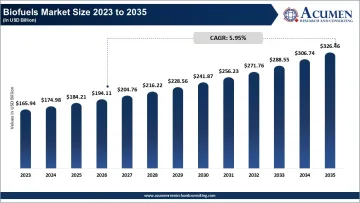
The global biofuels market size accounted for USD 184.21 billion in 2025 and is estimated to attain around USD 326.46 billion by 2035, growing at a CAGR of 5.95% from 2026 to 2035.
Report Highlights
- By Region, North America holds approximately 38% of the global biofuels market share in 2025.
- By Region, Asia Pacific region accounts for about 28% market share and is projected to grow at a CAGR of 7.5% from 2026 to 2035.
- By fuel type, the ethanol segment represents 54% of the total biofuels market share in 2025.
- By end-use, transportation account for 71% of the total market share, while aviation hold 17%.
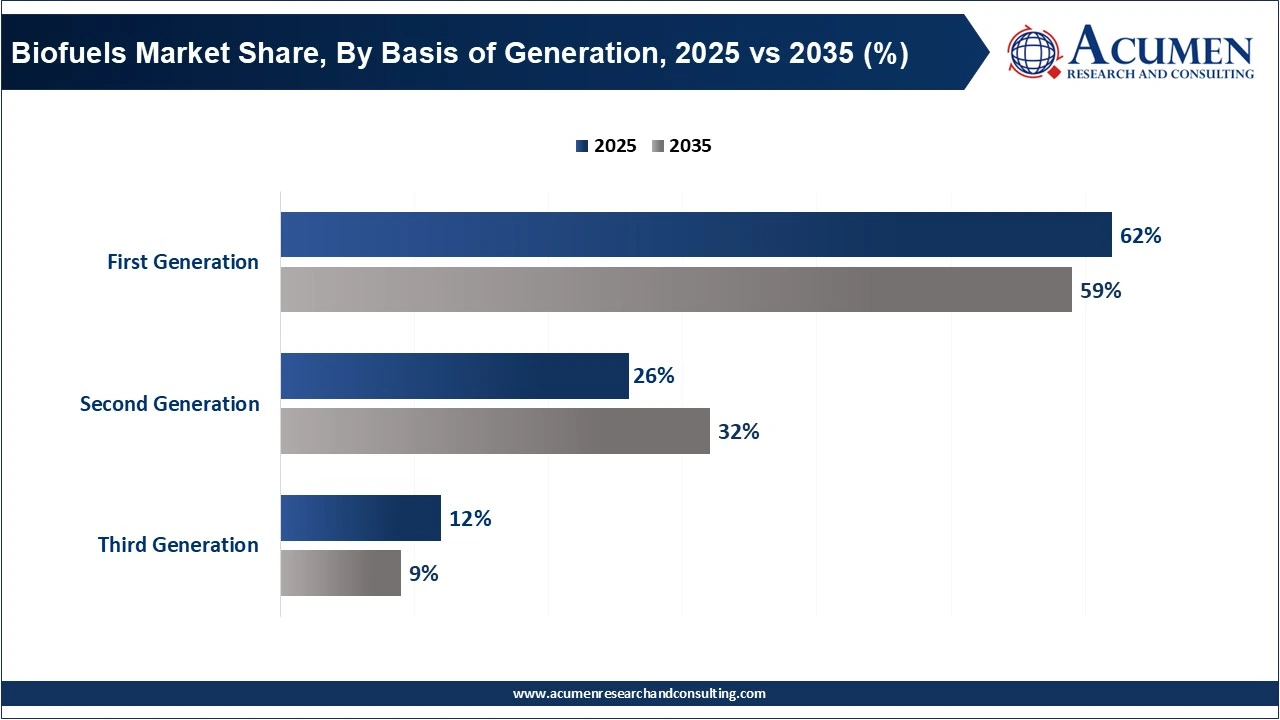
- By basis of generation, the first generation segment holds 62% market share, followed by second generation with 26%, and third generation with 12%.
Biofuels Market Overview
The significant growth of the biofuels market is due to the increase in global concern to reduce greenhouse gas emissions and shift towards clean, renewable energy sources. Across the region North America, Europe, and Asia-Pacific are actively implementing mandates for renewable energy, carbon neutrality and biofuel blending objectives. These governments have developed many supporting programs, such as increased ethanol blending and incentives for biodiesel production and advanced generation biofuels which are creating an environment for biofuels to experience significant growth. The growth of the biofuels market is also being driven by the increasing demand for low emissions transportation fuels in particular, road transportation and commercial fleets which is driving increased demand for ethanol and biodiesel.
Another major growth factor is the next-generation biofuel production technologies are rapidly advancing, resulting in improved production efficiencies and lower costs. The second and third generations of biofuels are developed from biomass feedstocks, algae, and waste materials helps to reducing the issues associated with land and food security. Global adoption of sustainable aviation fuel (SAF) is rapidly increasing which offers significant opportunities for biojet fuel producers due to the goals of reducing airline emissions and international regulations concerning aviation emissions. Increasing energy company investment, developing biorefinery infrastructure, and increasing consumer demand for environmentally friendly fuel will further drive the growth of the market.
Biofuels market is the business of producing, distributing and using renewable fuels made from organic material made from crops, agricultural waste and biomass. The fuels including ethanol, biodiesel, renewable diesel, and biojet fuel also offer opportunities to reduce carbon emissions while simultaneously meeting the goals of global sustainability.
Biofuels Market Dynamics
Market Drivers
Rising Energy Security & Need to Reduce Fossil Fuel Dependence
- The global emphasis placed on securing energy security has significantly contributed to the growth of biofuels market. Countries throughout the world are trying to lessen their dependency on imported crude oil and diversify their energy portfolios with domestically produced biofuels such as ethanol, biodiesel and renewable diesel to help limit exposure to supply chain interruptions and political uncertainty. Additionally, federal governments promote biofuel use by requiring or offering blending requirements, subsidies, or tax benefits that incentivize widespread biofuel adoption by farmers and processors. Consequently, as governments look toward achieving energy independence, the demand for renewable and domestically sourced fuels will only increase.
Strong Environmental Regulations & Decarbonization Targets
- The increasing in carbon neutrality and the drive towards stringent greenhouse gas (GHG) reduction commitments has resulted in massive growth for the biofuels market. The use of biofuels significantly reduces the lifecycle emissions produced by conventional petroleum fuels throughout their entire lifecycle such as transport, aviation. Thus, providing an opportunity for biofuels to create more environmentally friendly alternatives to petroleum products. Government regulations, including the U.S. Renewable Fuel Standard (RFS), EU Renewable Energy Directive (RED II), and many of the different national biofuels blending mandates, are allowing faster implementation of biofuels, while the continued movement of the majority of industries toward net-zero emissions is also creating a greater need for sustainable fuels (biofuels) within these industries.
Market Restraints
Feedstock Availability & Competition with Food Resources
- A major challenge in the biofuel marketplace is that it relies heavily on agricultural feedstocks such as corn, sugarcane, soybeans, and vegetable oils. The large-scale production of biofuels must compete directly with food and livestock production for those same feedstocks which creates concerns about food security, and fluctuating markets. The stability of biofuel production can be impacted by the same weather conditions, droughts, and land utilization constraints that create unstable crop yields. These limitations increase feedstock prices and restrict scalability, preventing biofuels from becoming a consistent source of affordable and sustainable fuel.
High Production Costs & Technology Limitations for Advanced Biofuels
- The advanced technologies such as enzymatic hydrolysis, gasification, and algae-based cultivation are required to produce second and third generation biofuels. These technologies are expensive and not commercially available. Emerging refinery facilities need very large capital investments to construct and to utilize costly processing methods to create either renewable diesel or sustainable aviation fuels (SAF) which also continue to present challenges concerning economic competitiveness against fossil fuels. The current technology divide between conventional versus advanced biofuels is causing slow market expansion, especially where local infrastructure and financial support are inadequate.
Market Opportunities
Expansion of Sustainable Aviation Fuel (SAF) Demand
- The rapid decarbonization initiatives within the aviation industry present tremendous growth opportunities for the biofuels market. Airlines across the globe are responding to increasing regulatory requirements for compliance with carbon limits (or taxes) and net-zero developments through increased demand for the use of sustainable aviation fuels (SAF) that are generated from biomass, waste oils, and other variable feedstocks. SAF funding incentives, blending mandates, and large-scale procurement contracts with many major airlines are leading to a large increase in investment in new SAF production plants. Rapid growth in the demand for air travel around the world will continue to increase the importance of SAF as a long-term growth factor in the biofuels industry.
Technological Advancements & Growth of Second/Third-Generation Biofuels
- Emerging new technologies in developing biofuels from cellulosic ethanol, converting waste into energy, fermenting microbes for fuel, and growing algae to produce growth opportunities for next-generation biofuels. Instead, these fuels are produced from agricultural byproducts, municipal solid wastes, wood biomass, and CO2-based feedstocks. As continuous research and development occur along with increased government funding and private sector investments in biofuel production, these innovations will continue to become more efficient and lower in cost. As the world moves towards tighter sustainability policies, the need for low-carbon and higher-performing biofuels will continue to grow and thus advanced biofuels will become increasingly important in terms of innovation and long-term commercial viability.
Biofuels Market Report Scope
| Attribute | Details |
|---|---|
| Biofuels Market Size 2025 | USD 184.21 Billion |
| Biofuels Market Forecast 2035 | USD 326.46 Billion |
| Biofuels Market CAGR During 2026 - 2035 | 5.95% |
| Analysis Period | 2023 - 2035 |
| Base Year | 2025 |
| Forecast Data | 2026 - 2035 |
| Segments Covered | By Fuel Type, By Basis of Generation, By End-Use, and By Geography |
| Regional Scope | North America, Europe, Asia Pacific, Latin America, and Middle East & Africa |
| Key Companies Profiled | ADM, Valero, POET LLC, Neste, Green Plains Inc., Chevron Corporation (Chevron Renewable Energy Group), Cargill Incorporated, Wilmar International Ltd, The Andersons Inc., Verbio AG, Borregaard AS, and Aemetis Inc. |
Biofuels Market Regional Analysis
- The North America biofuels market size was valued at USD 70 billion in 2025 and is estimated to reach around USD 111 billion by 2035, growing at a CAGR of 4.6% from 2026 to 2035.
- The Europe biofuels market size estimated at USD 51.58 billion in 2025 and is projected to hit around USD 104.47 billion by 2035, growing at a CAGR of 7.5% from 2026 to 2035.
- The Asia-Pacific biofuels market size was reached at USD 36.84 billion in 2025 and is projected to surpass around USD 62.03 billion by 2035, growing at a CAGR of 5.3% from 2026 to 2035.
North America holds the dominant share in the biofuels market due to an established bioethanol and biodiesel production framework, along with strong agricultural resources and regulations, including the U.S. Renewable Fuel Standard (RFS). North America benefits from a large-scale corn-based ethanol supply chain and has well-developed refining capacity and established government policies mandating blending requirements. Major biofuels producers currently exist in the region, along with investments in next-generation fuels. With increased integration of renewable fuels into road transportation and aviation, North America continues to lead in both production and consumption of biofuels globally.
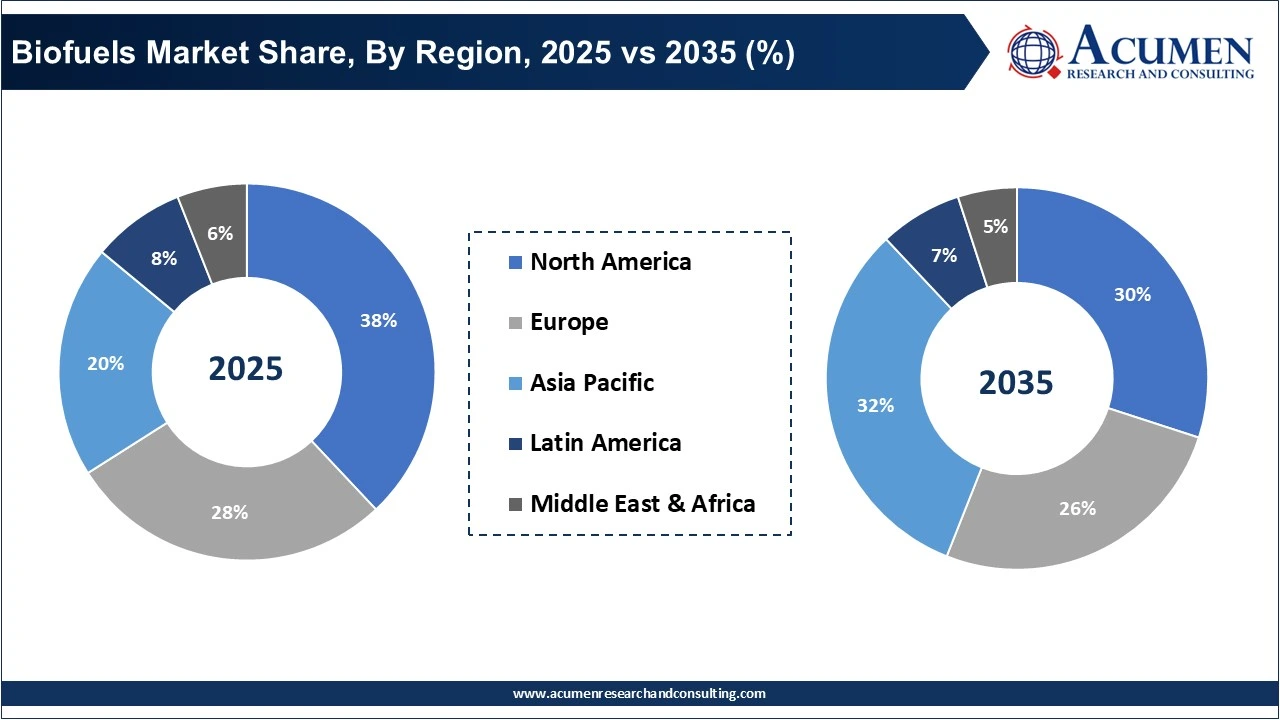
Asia Pacific is the fastest-growing region, due to the growing demand for energy and the need to meet rising energy usage through renewable fuels in the form of emissions reduction and, as such governments are providing incentives to promote blending. As a result of this drive for renewable fuels, the Asia Pacific region is experiencing rapid growth in the biodiesel market along with emerging interest in sustainable aviation fuel (SAF) to achieve decarbonization targets. Additionally, increasing production of feedstocks used to create biodiesel including sugarcane, palm oil and agricultural waste, along with the increasing amount of investment in second generation technologies indicate that Asia Pacific will become the fastest expanding region in the biofuels market over the next several years.
Biofuels Market Segmental Analysis
The worldwide market for biofuels is split based on fuel type, basis of generation, end-use, and geography.
Fuel Type Insights
Ethanol is currently the dominant the biofuels market because of its large scale production, abundant agricultural feedstock availability (corn and sugarcane), and strong governmental support through regulatory blending mandates in many large markets such as U.S., Brazil, and large portions of Europe. Ethanol can be mixed into gasoline at existing gas stations without requiring new infrastructure to be built. Federal programs in countries like the United States (the Renewable Fuel Standard - (RFS) program) and Brazil (RenovaBio) will continue to establish ethanol as the leader in biofuels with high levels of production and commercial viability and stable demand for its use in the global transportation sector.
| Fuel Type | Market Share (%) | Key Highlights |
|---|---|---|
| Ethanol | 54% | Dominant fuel type due to high adoption in transportation, strong production capacity (U.S., Brazil), and blending mandates (E10–E85). |
| Biodiesel | 22% | Supported by renewable energy policies in Europe and U.S.; widely used for commercial vehicles and industrial engines. |
| Renewable Diesel | 16% | Fastest-growing due to its drop-in compatibility with existing engines and increasing demand in low-carbon fuel programs. |
| Biojets | 8% | Accelerating growth driven by aviation decarbonization goals, CORSIA compliance, and rising SAF production investments. |
Biojet fuel is the fastest-growing fuel type due to increasing decarbonization pressures on aviation and global airlines' ambitious commitments to becoming net-zero. The transition to SAF will be driven by regulations, carbon reduction commitments, and an ongoing rise in the level of investment by governments and aircraft manufacturers. As aviation has few alternative fuels to replace liquid fuel, biojet fuel represents an important means of reducing aviation emissions in the very near term. As such, the expansion of this market is now taking off. As more airlines use SAF for commercial flights, the construction of dedicated SOCs (sustainable oil facilities) at major airports increases, and the development of new production methods such as HEFA (hydroprocessed esters and fatty acids), ATJ (alcohol-to-jet fuel), and FT (Fischer-Tropsch) technologies takes place on a global scale.
Basis of Generation Insights
First-generation biofuels dominate the market because of predicated on the availability of food crops such as corn, sugar cane and vegetable oils. The production technologies are considered to be mature, cost-effective and easily fitted to the existing fuel supply chain. Countries with large agriculture-based economies continue to use large quantities of first-gen fuels as blending agents such as Brazil, U.S., and Indonesia, providing an ongoing input source to first-gen production processes and to keeping these processes mature. The maturing of infrastructure and the growing acceptance of first-gen fuels within the regulatory framework ensures continued dominance in the market share.
| Basis of Generation | Market Share (%) | Key Highlights |
|---|---|---|
| First Generation | 62% | Dominant segment as it uses conventional feedstocks (corn, sugarcane, vegetable oils) with established technology and large-scale production. |
| Second Generation | 26% | Fastest-growing due to focus on waste-based and lignocellulosic feedstocks aligned with carbon-neutral targets. |
| Third Generation | 12% | Emerging category using algae-based technologies, gaining traction but still limited by high production costs. |
Second-generation biofuels are the fastest-growing segment because biofuels can utilize non-food biomass from materials such as agricultural residues, forestry waste, and lignocellulosic feedstocks. These fuels address food versus fuel issues and provide much lower carbon footprints compared to current biofuels. Due to the growing importance of advanced biofuels to meet countries’ long-term climate obligations, governments around the world are focusing on supporting advanced biofuels with tax credits, subsidies, and commercialization programs. In addition, the development of new technologies in enzymatic hydrolysis and gasification will contribute to the rapid growth and implementation of next-generation biofuels.
End-Use Insights
Transportation is the dominant market because road vehicle has the highest number of liquid biofuel users such as ethanol and biodiesel and renewable diesel. There are federal blending requirements and standards for emissions that support or promote the increased use of liquid biofuels within commercial fleets, passenger vehicles and logistics networks. Emerging economies still have a significant dependency on liquid fuels which keep up sustained growth in this area. In addition, Biofuels are compatible with existing engines and infrastructure which will add to their continued increase usage for and reduction of Transportation emissions through decarbonisation.
| End Use | Market Share (%) | Key Highlights |
|---|---|---|
| Transportation | 71% | Dominant end-use due to massive consumption of ethanol and biodiesel for road transport under global biofuel blending mandates. |
| Aviation | 17% | Fastest-growing segment as airlines shift toward Sustainable Aviation Fuel (SAF) to meet net-zero commitments. |
| Others | 12% | Used for industrial heating, power generation, and off-grid applications where renewable alternatives are preferred. |
Aviation is the fastest-growing segment driven by the rising need to reduced CO₂ emissions from aircraft, and by the international mandates issued by both agencies ICAO and IATA. In addition, government incentives, long-term offtake agreements between airlines and SAF producers, and the installation of airport-level infrastructure to blend SAF into existing jet fuel supplies are facilitating airlines' rapid increase in procuring SAF. Increased travel demand, along with commitment from multiple industries to reach net-zero emissions, is driving rapid SAF uptake, rendering aviation as the largest growing application area for biofuels.
Biofuels Market Players
- ADM
- Valero
- POET LLC
- Neste
- Green Plains Inc.
- Chevron Corporation (Chevron Renewable Energy Group)
- Cargill Incorporated
- Wilmar International Ltd
- The Andersons Inc.
- Verbio AG
- Borregaard AS
- Aemetis Inc.
Biofuels Market Segmentation
By Fuel Type
- Ethanol
- Biodiesel
- Renewable Diesel
- Biojets
By Basis of Generation
- First Generation
- Second Generation
- Third Generation
By End-Use
- Transportation
- Aviation
- Others
- Power Generation
- Heating
- Green Chemistry
By Region
- North America
- U.S.
- Canada
- Europe
- U.K.
- Germany
- France
- Spain
- Rest of Europe
- Asia-Pacific
- India
- Japan
- China
- Australia
- South Korea
- Rest of Asia-Pacific
- Latin America
- Brazil
- Mexico
- Rest of LATAM
- The Middle East & Africa
- South Africa
- GCC Countries
- Rest of the Middle East & Africa (ME&A)
Looking for discounts, bulk pricing, or custom solutions? Contact us today at sales@acumenresearchandconsulting.com
Frequently Asked Questions

Other Energy and Power Reports
March 2023
September 2022
May 2024
August 2022