
Blockchain in Energy Market Size, Share, Report 2026 To 2035
Blockchain in Energy Market (By Type: Public, Private; By Application: Grid Management, Energy Trading, Government Risk and Compliance, Supply Chain Management, Others; By End Use: Power, Oil & Gas) - Global Industry Analysis, Size, Share, Trends and Forecast 2026 to 2035
- Last Updated: 14 Dec 2025
- Report Code: ARC3868
- Category: Energy and Power
Blockchain in Energy Market Size and Forecast 2026 - 2035
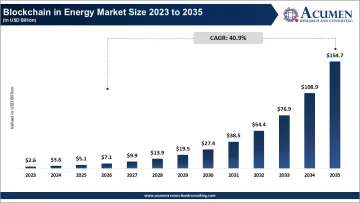
The global blockchain in energy market accounted for the revenue of USD 5.1 billion in 2025 and is estimated to reach around USD 154.7 billion by 2035 growing at a CAGR of 40.9% from 2026 to 2035. The increasing need for traceability and transparency in the energy industry and growth of distributed energy resources is driving the growth of the blockchain in energy market. In addition, the growing adoption of smart contracts and automation projects is projected to create new growth opportunities for the market.
Report Highlights
- By Region, the North America blockchain in energy market accrued a revenue of USD 1.7 billion in 2025.
- By Region, the Asia-Pacific blockchain in energy market is projected to witness a lucrative growth rate of over 42.3% from 2026 to 2035.
- By Type, the public sector represents 66% of the total market share in 2025.
- By Application, grid management segment accounts for 35% of the total market share in 2025.
- By End Use, the power sector represents 70% of the blockchain in energy market share in 2025.
Blockchain in Energy Market Insights
The growth of the blockchain in energy market is driven by the increasing implementation of the technology for preventing failure in different applications of power grid in the energy sector. Furthermore, the blockchain technology is widely being used in the energy sector as it has the potential to transform the industry by providing a secure and transparent platform for data management and transactions.
Blockchain has progressively emerged as a promising solution in the energy sector. The blockchain solution is an evolving technology based on distributed databases. It is an open, immutable, distributed public ledger that can be accessed by a diverse number of entities that are involved in the transaction. The solution acts as a widespread depository of all the transactions among the parties involved. Blockchain records all the transactions and digital events that are executed and shared among different contributing parties. Additionally, each transaction process that is done across the public ledger is verified by a contract between a number of stakeholders in a company. It comprises a specific record of every transaction that is ever executed.
Blockchain in Energy Market Dynamics
Market Drivers
Growing Need for Traceability and Transparency in Energy Trading
The energy sector faces rapid decentralization with increasing integration of renewables and distributed energy resources. This shift makes the process of validation of energy origin, metering, and settlement increasingly complex. Blockchain provides an immutable and auditable ledger that enables real-time verification of energy generation, RECs, and carbon credits. Consequently, utilities, regulators, and corporates are adopting blockchain to minimize disputes, avoid double counting, and enforce compliance across energy supply chains.
Technological Advancements
The growing integration of blockchain technology with IoT devices embedded within energy grids is anticipated to drive automation for feasible and reliable power management. This is projected to spur smart grid operations via automated transactions and secure surveillance. In January 2025, Powerledger's TraceX technology, a blockchain-focused Renewable Energy Certificate (REC) marketspace, traded on an average 1.2 million RECs. This allowed consumers to complete their applications in over 30 minutes and save over 72% on administrative costs.
Market Restraints
Increasing Complexities with Legacy Energy Infrastructure
The majority of utilities still operate on decades-old SCADA systems, centralized databases, and rigid regulatory frameworks. Integrating the blockchain platform with these legacy systems is technically complex and time-consuming. Utilities often lack interoperability standards and the IT capability required to connect real-time metering, billing, and grid management systems with the decentralized blockchain networks. This results in slower wide-scale deployments and increased project risks.
Lack of Standardization
Energy markets are among the most regulated, and many countries have not clearly defined guidelines over blockchain-based energy trading, digital RECs, smart contracts, and peer-to-peer transactions. Due to a lack of standardized compliance rules and data frameworks, utility investments become limited, and the market players remain cautious. The ambiguity in regulation, especially for cross-border renewable trading and carbon credit verification, slows down commercial-scale adoption.
Market Opportunities
Adoption of Carbon Offsets and Sustainability Policies
The blockchain technology is progressively becoming important in providing carbon offsets in the energy industry, which helps in implementing policies on sustainability. The ability of blockchain to offer safe and secure verification and tracking carbon credit for tempering emissions is becoming immensely popular in the offsets sector. For instance, Enel, handles around 49 GW of renewable capacity. The company operates in around 27 countries with over 61 million users and serves on an average 1.8 million km of grid network, implementing blockchain for tracking energy from renewable energy sources and managing EV charging systems.
Rising Usage in Cross-border Trading
The rising implementation of blockchain technology in cross-border energy trading is anticipated to make sharing renewable resources possible across the global energy markets. With countries entering into collaborations to balance the demand and supply of energy, the blockchain technology enables open, safe, and international transactions, limiting costs and barriers.
Report Scope
| Area of Focus | Details |
|---|---|
| Blockchain in Energy Market Size 2025 | USD 5.1 Billion |
| Blockchain in Energy Market Forecast 2035 | USD 154.7 Billion |
| Blockchain in Energy Market CAGR During 2026 – 2035 | 40.9% |
| Segments Covered | By Type, By Application, By End Use, and By Geography |
| Regional Scope | North America, Europe, Asia-Pacific, Latin America, and Middle East & Africa |
| Key Companies Profiled | IBM, SAP, Infosys Limited, Accenture, Greeneum, Kaleido, LO3 Energy, Sun Exchange, Power Ledger, and Electron |
| Report Coverage | Market Trends, Drivers, Restraints, Competitive Analysis, Player Profiling, Covid-19 Analysis, Regulation Analysis |
Blockchain in Energy Market Regional Analysis
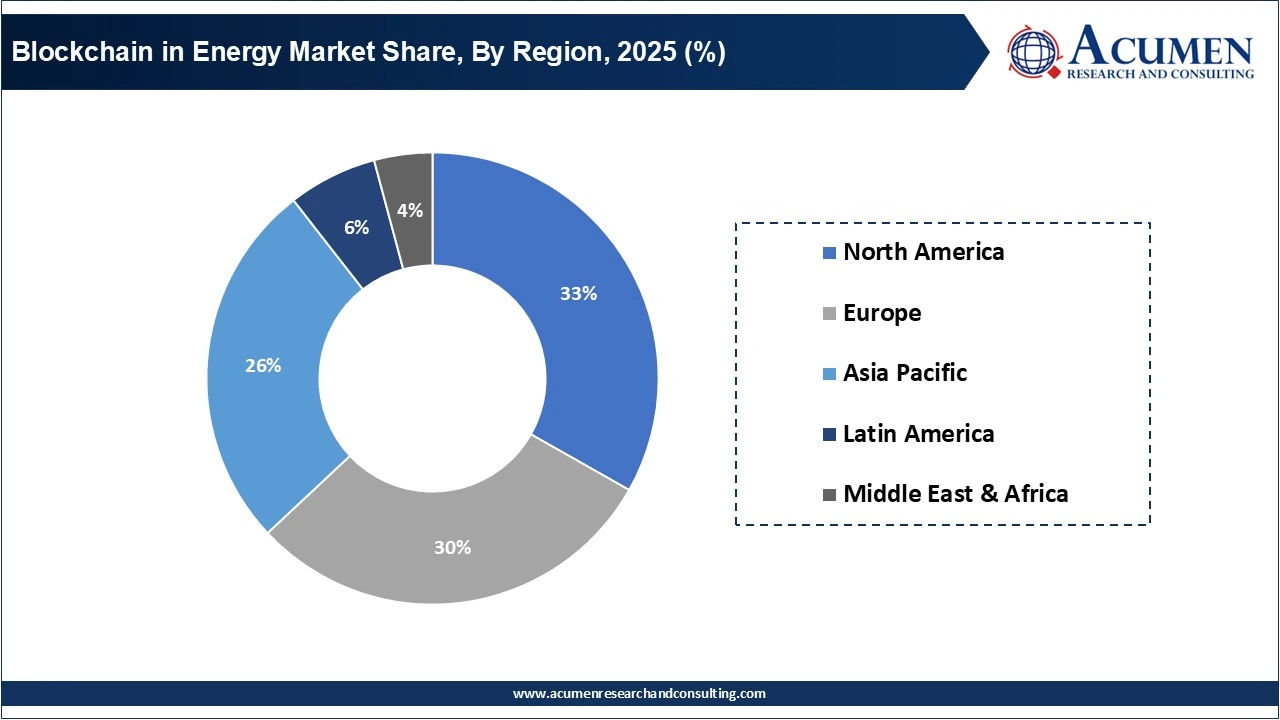
Geographically, North America accounts for the largest share of the blockchain in energy market. The increasing demand for decentralized energy technologies in the North America region is projected to drive the deployment of blockchain solutions. This is because of the growing demand for well-organized and efficient trading platforms for energy. The growing focus toward energy utilities in exploring the advantages of the blockchain solutions for sustainability and low-carbon transition are the major factors fueling the growth of the North America blockchain in energy market. In addition, the increasing potential of the technology to integrate reliability & efficiency to the value chain of a diverse range of end user industries is further projected to drive the market demand during forecast period. Furthermore, the growing emphasis by the government toward enhancing privacy, energy efficiency, cybersecurity, and interoperability is projected to create growth opportunities for the market.
| Region | Market Share, 2025 (%) | Key Highlights |
|---|---|---|
| North America | 33% | The increasing demand for decentralized energy technologies in the North America region will drive the deployment of blockchain solutions. |
| Europe | 30% | The increasing integration of blockchain in renewable energy certification systems is projected to enhance transparency and cross-border clean-energy in the European region. |
| Asia-Pacific | 26% | In Asia Pacific, the market is experiencing rapid urbanization and an increase in state-funded renewable energy drives. |
| MEA | 6% | Rising use of blockchain for smart grid modernization and digital energy management is expected to create new growth opportunities. |
| Latin America | 4% | The increasing adoption of blockchain is anticipated to support distributed solar ecosystems and emerging peer-to-peer energy trading models. |
There is expected to be a considerable growth of the blockchain in energy market in the Asia-Pacific region. In Asia Pacific, the market is experiencing rapid urbanization and an increase in state-funded renewable energy drives. Overall, increasing energy consumption would likely further boost opportunities in industries. Further, integration of blockchain into smart energy infrastructure and a microgrid investment in countries such as China, Singapore, and Japan is set to experience robust growth.
Blockchain in Energy Market Segmental Analysis
The worldwide market for blockchain in energy is split based on type, application, end use, and geography.
Type Insights
According to the blockchain in energy industry analysis, the public segment dominated the market. The governments are progressively turning toward blockchain for achieving energy sustainability and transparency. This expansion is attributed to the renewable energy policies, increasing need for secure energy data management, and increasing focus to limit carbon footprint with the help of decentralized networks. The government driven adoption of blockchain is enhancing the grid efficiency, driven by regulatory and capital schemes.
| Type | Market Share, 2025 (%) | Key Highlights |
|---|---|---|
| Public | 66% | Dominant as the governments are progressively turning toward blockchain for achieving energy sustainability and transparency in the energy sector. |
| Private | 34% | The increasing demand for efficient trading of energy and decarbonization is driving growth in the private sector. |
Application Insights
The grid management segment dominates the blockchain in energy sector. The growing technological advancements is fueling the demand for blockchain in the grid management application. Blockchain in grid management utilizes decentralized ledgers for safe and transparent tracking of energy, allowing efficient renewable integration, peer-to-peer (P2P) trading, and automated billing with the help of smart contracts, augmenting grid resilience, security, and efficiency by eliminating central points of failure and immutably verifying transactions.
| Application | Market Share, 2025 (%) | Key Highlights |
|---|---|---|
| Grid Management | 35% | Dominant owing to the increasing technological innovations in grid management. |
| Energy Trading | 30% | The growing usage of blockchain technology in cross-border energy trading is projected to make sharing renewable resources possible across the global energy markets. |
| Government Risk and Compliance | 17% | Increasing deployment of blockchain for regulatory reporting, tamper-proof energy data, and verification of renewable energy certificates (RECs) is projected to reduce fraud and compliance gaps. |
| Supply Chain Management | 10% | One key trend in supply chain management is the increasing interest in adopting blockchain-based traceability systems to track equipment, fuels, and carbon footprint throughout the entire supply chain in energy. |
| Others | 8% | The expansion of blockchain applications in the field of EV charging, carbon markets, and smart metering for better interoperability and digital energy ecosystem development is a key market trend. |
End Use Insights
According to blockchain in energy market forecast, among these, the power segment is projected to dominate the industry. The rising application areas of decentralized grids, efficient renewable management, and open markets of trade, is projected to get government support and increasing penetration by technology on the basis of power use. LO3’s Brooklyn Microgrid project utilizes blockchain technology for facilitating localized trading of energy among residents. As of 2023, the United States has over 692+ microgrids, which generates a total of 4.4 GW of power, with around 212 microgrids that were commissioned during 2019-2022.
| End Use | Market Share, 2025 (%) | Key Highlights |
|---|---|---|
| Power | 70% | Dominant because of rising application areas of decentralized grids. |
| Oil & Gas | 30% | Improved commodity tracing, cyber-protection against threats, cost savings, and sustainability projects are creating new growth opportunities. |
Blockchain in Energy Market Players
- IBM
- SAP
- Infosys Limited
- Accenture
- Greeneum
- Kaleido
- LO3 Energy
- Sun Exchange
- Power Ledger
- Electron
Market Segmentation
By Type
- Public
- Private
By Application
- Grid Management
- Energy Trading
- Government Risk and Compliance
- Supply Chain Management
- Others
By End Use
- Power
- Oil & Gas
By Region
- North America
- U.S.
- Canada
- Europe
- U.K.
- Germany
- France
- Spain
- Rest of Europe
- Asia-Pacific
- India
- Japan
- China
- Australia
- South Korea
- Rest of Asia-Pacific
- Latin America
- Brazil
- Mexico
- Rest of LATAM
- The Middle East & Africa
- South Africa
- GCC Countries
- Rest of the Middle East & Africa (ME&A)
Looking for discounts, bulk pricing, or custom solutions? Contact us today at sales@acumenresearchandconsulting.com
Frequently Asked Questions

Other Energy and Power Reports
October 2020
March 2023
June 2020
June 2024