August 2024

Clinical Analytics Market (By Type of Analytics: Descriptive Analytics, Predictive Analytics, Prescriptive Analytics; By Deployment Model: Cloud-Based, On-Premise, Hybrid; By Component: Raw Data, Software & Platforms, Services; By End User: Hospitals & Clinics, Healthcare Providers, Healthcare Payers, Pharmaceutical & Biotechnology Companies, Research & Academics, Government Organization, Ambulatory Care Centers) - Global Industry Analysis, Size, Share, Regional Analysis, Trends and Forecast 2026 - 2035
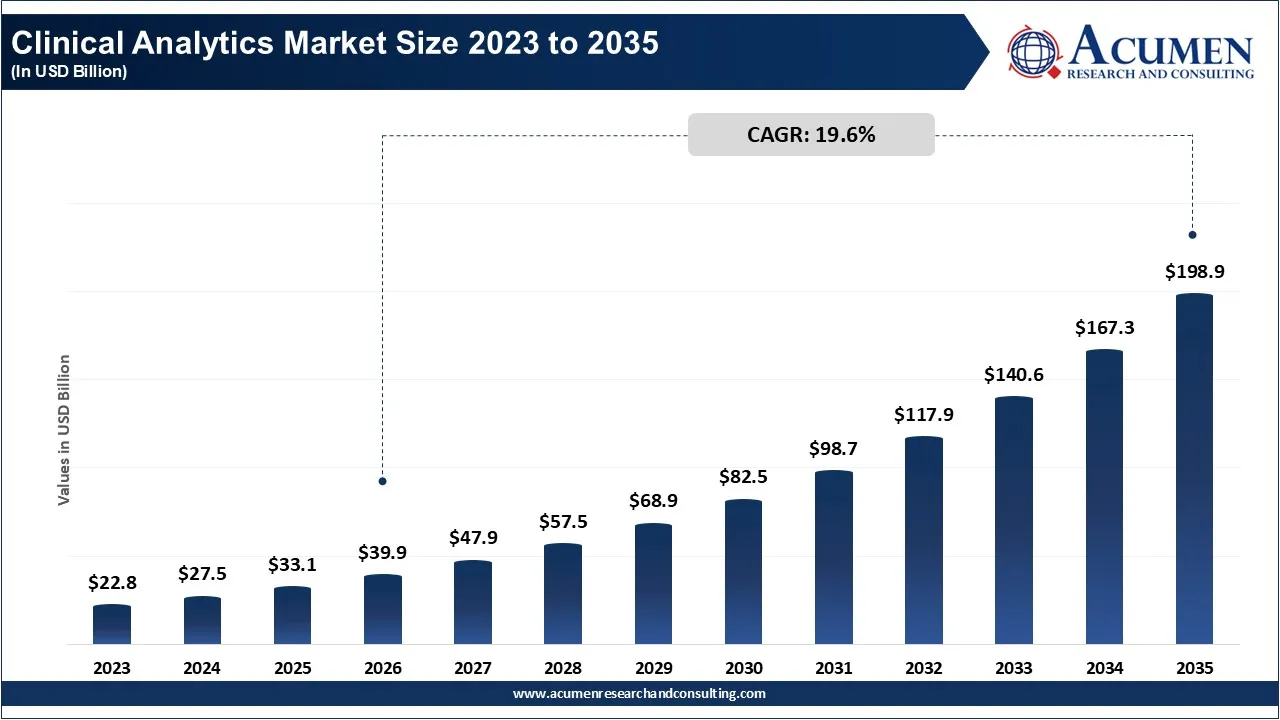
The global clinical analytics market size was valued at USD 33.13 billion in 2025 and is estimated to surpass around USD 198.88 billion by 2035 growing at a CAGR of 19.6% from 2026 to 2035. The overall rise in predictive maintenance of patient records and digitization of hospital/clinical data offers a sustainable opportunity to the clinical analytics market to boom.
The clinical analytics market can be defined as a market comprising industries that are involved in collection, integration, analysis, and interpretation of healthcare data and patient related information in order to improve clinical decision-making, operations efficiency and clinical outcome. Clinical analytics solutions make use of technologies such as artificial intelligence, machine learning, big data analytics, predictive modeling, cloud computing and EMR integration in order to derive actionable insights from large amounts of clinical and administrative data of healthcare payers, providers and organizations.
Clinical analytics solutions can be employed in disease pattern identification, prediction of patient risks, hospital readmission reduction, improvement of clinical workflows, betterment of treatment efficiency, as well as to facilitate evidence-based medical care. Other common use applications of such solutions include betterment of patient safety, medical error reduction, managing patient health and improvement of financial outcomes.
Increased Utilization of Value Based Healthcare System:
Increasing trends of the transformation of volume-based to value-based healthcare system have led to significant growth in the use of clinical analytics solution by hospitals and healthcare systems. Healthcare providers are expected to report higher patient outcomes and better health indicators along with reducing re-admission rates and cost while being value-oriented, all these are dependent on clinical analytics for obtaining clinical insights through various data sources and hence is crucial for modern healthcare delivery system.
Data Privacy, Security, and Regulatory Compliance Issues Constraints:
Strictest healthcare data privacy regulations, such asHIPAA, GDPR, and other regional regulations, impose significant constraints on clinical analytics. Concerns of data breaches, illegal access and hacking drive hesitation among healthcare institutions toward cloud based analytics solutions. This adds operational overhead for multi-regional health care systems and hinders adoption.
Growth in AI-powered Precision Medicine and Personalized Healthcare
There is a significant market opportunity for clinical analytics providers within the shift towards precision medicine. Clinical analytics providers will be the leaders in leveraging AI-based analytical tools for analysis of genetic data, patient history, and real-world evidence to develop personalized recommendations for treatments. This will likely be more significant for treatments involving oncology, cardiology, and rare diseases as customization of treatments will improve outcomes and lower costs for these patient groups.
North America had a leading role with a share of 43% market share in 2025 due to highly mature healthcare infrastructure, high level of acceptance of digital health, significant investment in healthcare spending, and early implementation of AI technology into clinical workflow in the past few years. U.S. Contributes the most to the revenue in this region as there has been a swift growing trend of the acceptance of EHRs, predictive health systems, cloud-based healthcare analytics platforms among hospitals and healthcare networks.
Strong presence of leading healthcare analytics providers and technology vendors boosts this regional dominance. Companies like Oracle Health, IBM, SAS Institute, Optum, and Veradigm are largely investing in AI-driven analytics, interoperability solutions, and predictive healthcare technologies and collaborating with providers and payors to enhance the operational efficiency and the personalization of healthcare delivery.
Government backing plays a significant role too in driving the market. U.S. Federal government digital healthcare programs, interoperability mandates, and value-based care program continuously accelerate the adoption of analytics. The CMS program for example continually emphasis on outcome-based payment reimbursement, which prompts hospital and insurers to implement high-end analytics system to improve the efficiency and enhance quality of care.
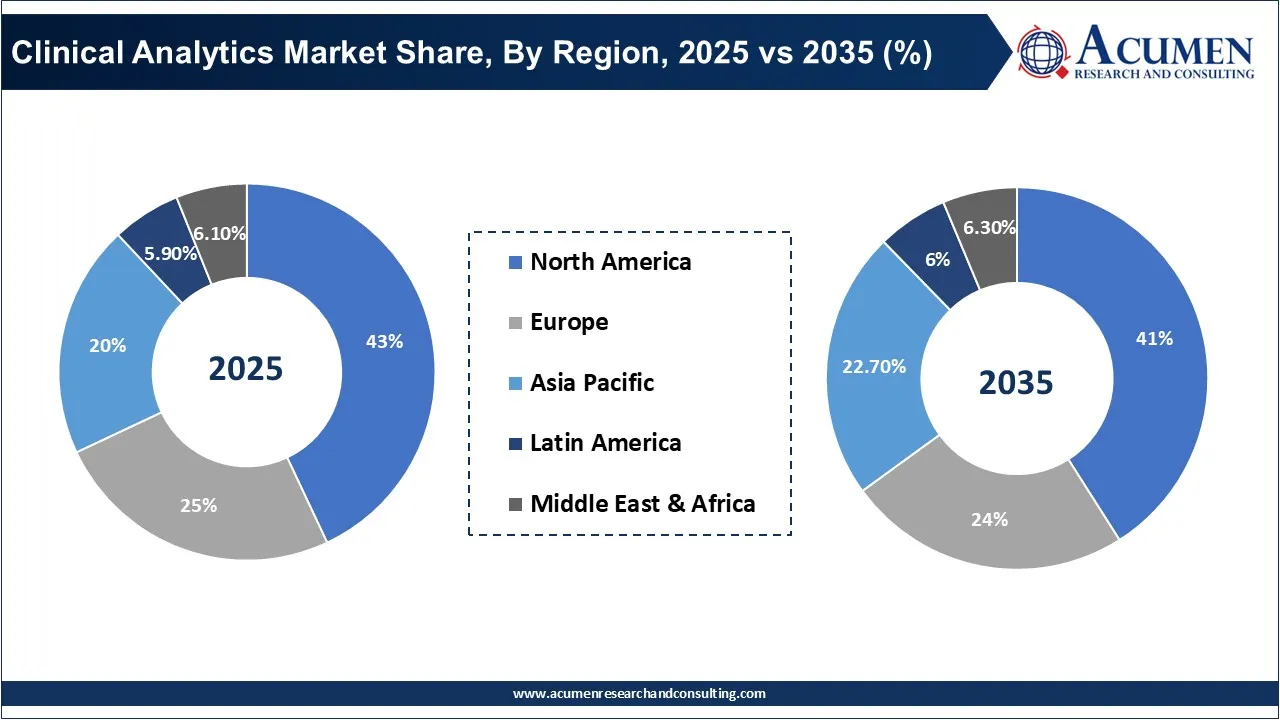
Asia-Pacific is poised to experience the fastest growth at the CAGR of 21.2% over the forecast period owing to factors like rapid digitization of healthcare, expansion of healthcare infrastructure, growing investment in AI, and increasing adoption of EMR among emerging economies. Leading countries like China, India, Japan, South Korea, Singapore, and Australia are heavily investing in modernization of healthcare technologies to accelerate demand for advanced analytics platforms. Growing medical tourism is another driver, across countries like India, Thailand, Singapore, and Malaysia. Hospitals attending international patients are increasingly adopting advanced analytics platforms to enhance patient outcomes, transparency in operations and treatment customization.
China & India Clinical Analytics Market Insights:
The performance of the market in China continues to be one of the significant growth drivers in the region. Chinese authorities are consistently focused on developing healthcare AI and smart hospital projects under national digital transformation policies. China’s prominent urban hospitals are incorporating AI-powered analytical tools for diagnosis, image analysis, disease prognosis, and optimizing hospital resources. With a massive patient base, China generates massive healthcare datasets, making it an imperative market for predictive and population health analytics.
India has emerged as another key growth driver owing to rapid growth in digital health infrastructure and health initiatives from the government, particularly Ayushman Bharat Digital Mission. Initiatives like ABDM are increasing development of digital health records and interoperable healthcare infrastructure. High penetration of private hospitals, telemedicine services and rise of health-tech companies are enhancing demand for patient management systems driven by analytics. Increasing number of chronic diseases along with growing health consciousness are driving health care professionals towards adoptable data-driven clinical solutions.
| Country | Public Initiatives | Private Initiatives |
| United States | AI healthcare policy frameworks, NIH investments in healthcare AI research | Major investments by Oracle Health, IBM, Optum, Microsoft, and Epic Systems in predictive analytics |
| China | Started National AI Development Plan, smart hospital initiatives, healthcare big data integration programs | Tencent Health, Huawei, and Ping An Good Doctor investing heavily in AI diagnostics and cloud healthcare analytics |
| India | Ayushman Bharat Digital Mission, National Digital Health Ecosystem (NDHE), expansion of public digital health records | Rapid growth of health-tech startups, Apollo Hospitals’ AI integration and Tata Digital Health initiatives |
| Japan | Government is supporting and funding for AI-assisted elderly care and smart healthcare systems. | Fujitsu, NEC, Hitachi, and healthcare robotics firms investing in predictive healthcare and precision medicine analytics |
| Germany | EU-backed digital healthcare modernization, electronic patient record mandates, healthcare interoperability initiatives | Siemens Healthineers, SAP, and BioNTech investing in AI-driven healthcare analytics and clinical data platforms |
In the year 2025, the descriptive analytics segment commanded the clinical analytics market with a share of around 45%, owing to the expanding deployment of healthcare BI tools, EHRs, and data-driven decision making systems by organizations across healthcare. The descriptive analytics involves the use of retrospective patient data, treatment, operational workflows and operational performance data to track trends, predict, and improve clinical efficiencies. Hospitals, clinics and healthcare providers increasingly depend on descriptive analytics solutions to improve monitoring of patient outcomes, minimize hospital readmissions, maximize resource management and healthcare provision. Digitization in the healthcare sector, increased uptake of EMRs, have considerably enhanced availability of health data, further fueling growth of descriptive analytics.
| Type of Analytics | Revenue Share, 2025 (%) |
| Descriptive Analytics | 45% |
| Predictive Analytics | 33% |
| Prescriptive Analytics | 22% |
The predictive analytics segment captured nearly 33% market share in 2025 and showed impressive growth because of increasing adoption of AI, ML and predictive modelling tools across the healthcare domain. Predictive analytics allow healthcare providers to predict disease outcomes, manage high risk patients, personalize therapy strategies and adopt proactive prevention measures by utilizing historical and real-time clinical data. Increased incidence of chronic diseases like diabetes, cardiovascular diseases, cancer has generated great demand for predictive healthcare to aid early diagnosis and preventive planning.
In 2025, the cloud segment accounted for a larger share of 49% market share in the clinical analytics market. Factors such as increasing adoption of digital health infrastructure, rise in number of remote patient monitoring devices and rise in popularity of central data repository for healthcare are driving the market for cloud based clinical analytics solutions. Hospitals and healthcare organizations are shifting towards cloud based analytics solutions as they help in expanding data storage capacity, quick data access to real time data, reduce cost on physical infrastructure, allow smooth integration within and among hospitals and other health systems. Cloud solution also allows hospitals to analyze the data gathered from Electronic Medical Record systems (EHR), imaging systems, laboratory systems and wearable sensors.
“As per estimates by healthcare IT industry sources, over 70% of large hospitals in developed countries are in the process of moving some portion of clinical data to cloud based data centers to facilitate workflow processes and enabling predictive solutions.”
| Deployment Mode | Revenue Share, 2025 (%) |
| Cloud-based | 49% |
| On-premise | 36% |
| Hybrid/Web-based Systems | 15% |
By the forecast period, on-premise segment is expected to witness moderate growth in the clinical analytics market; the segment held 36% market share in 2025. The continuing dominance of in house control over data amongst large hospitals, government based hospitals and other health care organizations managing critical patient data continues to favor the on premise clinical analytics solutions market growth due to greater customizability, control over data governance and infrastructure security.
The software segment led the market for clinical analytics in 2025 of 55% and seen to sustain the position at fastest rate of 20.3% during the forecast period; driven by rising need for advanced healthcare data interpretation tools, predictive modeling solutions and AI-driven clinical decision making tools. Healthcare institutions are significantly spending more on analytics software platforms that would allow them to analyze vast volume of patient data and hence enhance clinical treatment outcome, efficiency in operations, and promote evidence based medical practice.
Top healthcare technology companies are introducing advanced analytical software, which are increasingly being accompanied with features such as interoperability, automation, real-time reports to drive segment dominance.
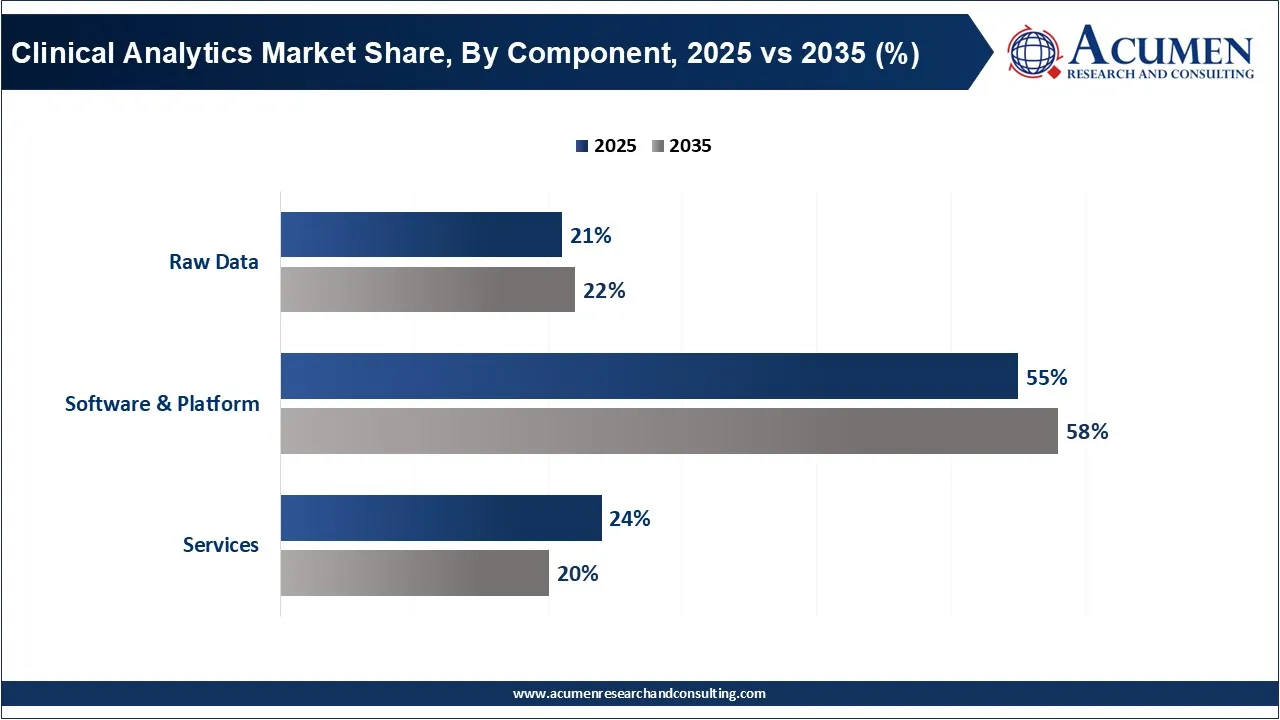
The raw data is expected to be a notably growing segment in the clinical analytics market and register a CAGR of 20.2% during the forecast period. This can be attributed to the increase in generation of large volumes of healthcare data in hospitals, diagnostic labs, wearables, imaging systems and EHRs. The organizations are now focusing on the data collection and storage of unstructured and real-time patient data to enhance prediction analytics and clinical decision making.
Services segment is estimated to be the significantly growing segment at the CAGR of 17.2% in the forecast period due to the complexity involved in implementation, integration, and maintenance of clinical analytics. The institutions increasingly rely on the external service providers to implement such solutions and avail system integration, data migration, consulting, training and support services for smoother integration and proper application.
The growing adoption of AI based analytics systems and cloud based health infrastructure is also leading to immense growth in demand for the support services, which would be efficient enough to manage these complex ecosystems.
In 2025, the hospitals & clinics segment held the largest market share with nearly 35% and is anticipated to hold its dominant position throughout the forecast period, driven by increasing adoption of digital healthcare infrastructure, electronic health records (EHRs), and patient data management systems. Hospitals are gaining high traction in adopting clinical analytics solutions to optimize patient outcomes, improve hospital operational efficiency, reduce hospital readmission rates and support clinical decision making. Rising adoption of analytics platforms among multi-specialty hospitals and health networks due to increasing efforts for improving healthcare efficiency and reduction in treatment cost is escalating the segment growth.
In 2025, pharmaceutical & biotechnology companies segment held approximately 15% share and is expected to register the fastest growth during the forecast period, due to growing adoption of advanced analytics tools in drug discovery, clinical trial execution, pharmacovigilance and real-world evidence (RWE) generation. Pharmaceutical companies are integrating clinical analytics platforms to accelerate research and development cycle and clinical trial patient recruitment processes. Growing adoption of integrated clinical analytics platform in pharmaceutical industries to shorten clinical development time and support regulatory compliance. Integration of AI, ML, and Big Data analytics in precision medicine and personalized drug development is augmenting segment growth.
| End User | Revenue Share, 2025 (%) |
| Hospitals & Clinics | 35% |
| Healthcare Providers | 20% |
| Healthcare Payers / Insurance Providers | 14% |
| Pharmaceutical & Biotechnology Companies | 15% |
| Research & Academic Institutes | 8% |
| Government Organizations | 5% |
| Ambulatory Care Centers | 3% |
In 2025, the healthcare providers segment accounted for approximately 20% of the market share and is projected to maintain its substantial growth over the forecast period, supported by increasing adoption of analytics solutions by physician groups, specialty care centers, outpatient clinics, and integrated health systems. The demand for clinical analytics solutions among healthcare providers is rising with the objective of enhancing care coordination, monitoring patient health trends, supporting preventive care and accelerating treatment process. The rapid digitalization of healthcare and interoperability across health platforms have created a large amount of patient data that demands for advanced data analytics tools. Healthcare providers are increasingly adopting predictive analytics, AI-based diagnostics, and population health management tools.
By Type of Analytics
By Deployment Model
By Component
By End User
By Region
Looking for discounts, bulk pricing, or custom solutions? Contact us today at [email protected]

August 2024
June 2021
August 2018
June 2021
Trusted Market Intelligence | 2026–2035 Insights | Designed to Support Faster, Smarter Decisions
Thank you! Our team will reach out to you soon.