
Digital Twin in Manufacturing Market Size, Share, Growth, Report 2026 To 2035
Digital Twin in Manufacturing Market (By Component: Software, Services; By Digital Twin Type: Product Twin, Equipment/Asset Twin, Process Twin, Factory/System Digital Twin, Supply Chain Twin; By Deployment Mode: On-Premises, Cloud, Hybrid; By Manufacturing Type: Discrete Manufacturing, Process Manufacturing, By Enterprise Size, Large Enterprises, SMEs; By Manufacturing Industry: Automotive & Transportation Equipment, Aerospace & Defense Manufacturing, Semiconductor & Electronics, Industrial Machinery & Equipment, Chemicals & Materials, Others) - Global Industry Analysis, Size, Share, Regional Analysis, Trends and Forecast 2026 - 2035
- Last Updated: 24 Sep 2026
- Report Code: ARC3988
- Category: ICT
Digital Twin in Manufacturing Market Size, Growth, Trends
The global digital twin in manufacturing market size was valued at USD 9.50 billion in 2025 and is observed to reach at $190.0 billion by 2035; growing at a CAGR of 34.9% during the forecast period of 2026-2035. Increasing investment in smart manufacturing, industrial IoT, AI, automation, and connected factory infrastructure is strengthening the need for digital twins that can convert real-time operational data into simulation, prediction, and optimization capabilities.
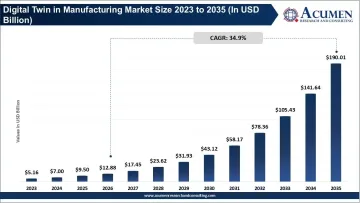
Digital twin in manufacturing is an integrated technology that creates virtual representations of products, equipment, production, factory, and supply-chain processes, and continuously links these models to data from physical manufacturing. The overall market is divided into software and services, and by application including asset level monitoring, predictive maintenance, process optimization, factory simulation, virtual commissioning, quality management and production planning.
Report Highlights
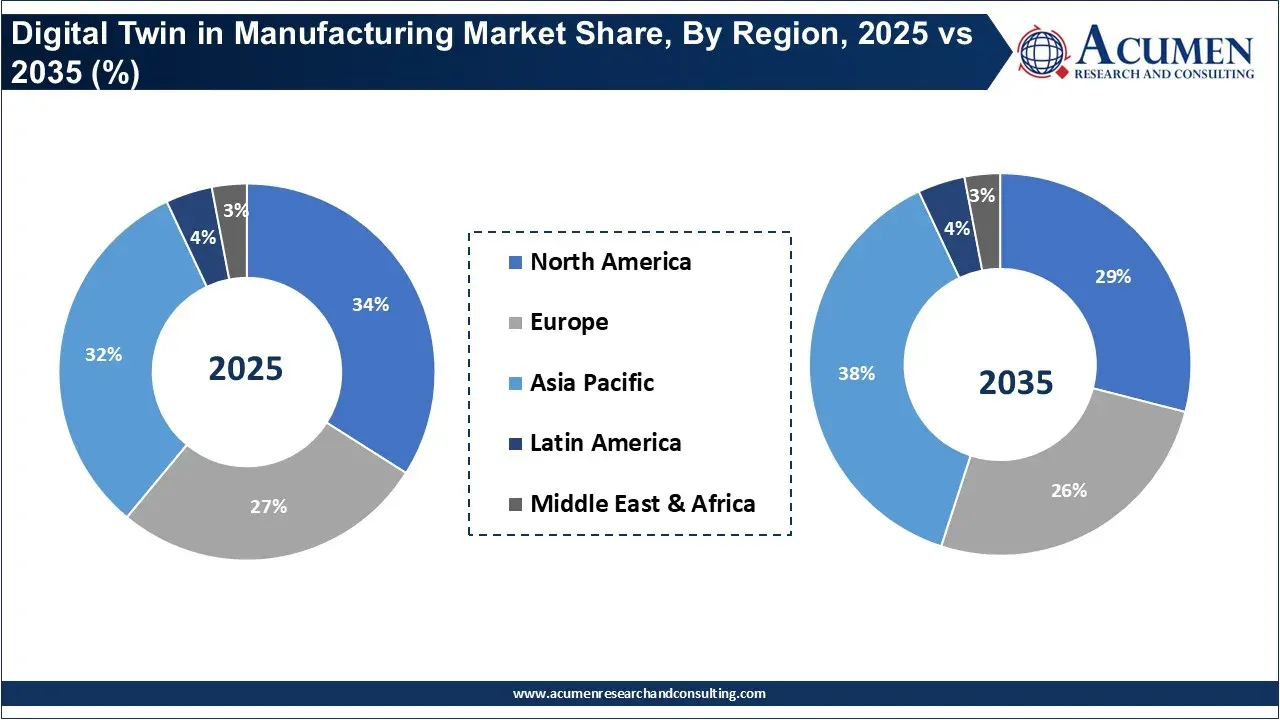
- By region, North America dominated the digital twin in manufacturing market in 2025 with a 34.0% share, supported by mature industrial automation, connected manufacturing infrastructure, and strong adoption of industrial IoT and enterprise technologies.
- By region, Asia-Pacific is projected to be the fastest-growing regional market, with a 37.5% CAGR from 2026 to 2035, driven by its large manufacturing base, smart-factory investments, industrial automation, and expanding adoption of AI, IoT, and digital manufacturing technologies.
- By component, software dominated the digital twin in manufacturing market in 2025 with a 70.0% share, supported by the central role of digital twin platforms in integrating, modeling, visualizing, and analyzing manufacturing data.
- By component, services represented 30.0% of the market in 2025 and are projected to register the fastest growth at a 36.7% CAGR from 2026 to 2035, driven by the need for consulting, integration, implementation, data engineering, cybersecurity, and system maintenance.
- By digital twin type, process twins dominated in 2025 with a 29.0% share, supported by their ability to simulate production processes and optimize interconnected operating parameters.
- By digital twin type, factory/system digital twins are projected to be the fastest-growing segment at a 36.9% CAGR from 2026 to 2035, driven by manufacturers' shift toward integrated virtual models covering equipment, production lines, material flows, energy consumption, and facility operations.
- By deployment mode, cloud deployment dominated in 2025 with a 42.0% share, supported by scalable computing capacity and centralized access to digital models, operational data, analytics, and collaboration tools.
- By deployment mode, on-premises deployment was the second-largest segment in 2025 with a 40.0% share, driven by manufacturers' requirements for greater control over operational data, cybersecurity, system availability, and plant-floor integration.
- By manufacturing type, discrete manufacturing dominated in 2025 with a 61.0% share, supported by extensive digital twin applications across automotive, electronics, machinery, aerospace, and transportation equipment production.
- By manufacturing type, process manufacturing accounted for 39.0% of the market in 2025, making it the second-largest segment, driven by the need to continuously monitor and optimize temperature, pressure, flow, material composition, energy consumption, and other production parameters.
- By enterprise size, large enterprises dominated in 2025 with an 81.0% share, supported by their greater financial resources, extensive manufacturing infrastructure, large equipment fleets, and higher volumes of operational data.
- By enterprise size, SMEs accounted for 19.0% of the market in 2025, with adoption supported by modular and cloud-based digital twin solutions that can reduce infrastructure requirements and enable gradual deployment.
- By manufacturing industry, automotive & transportation equipment dominated in 2025 with a 22.0% share, supported by complex assembly operations, automated production lines, robotics, equipment networks, quality-control requirements, and integrated supply chains.
- By manufacturing industry, semiconductor & electronics was the second-largest segment in 2025 with a 20.0% share, driven by highly controlled production environments requiring sophisticated equipment monitoring, process control, inspection, and optimization.
Investment Landscape
- Government of India reported data covering 3,819 enterprises showed aggregate actual CAPEX of ₹6,00,123.1 crore in 2024–25, with intended CAPEX of ₹6,11,160.7 crore in 2025–26 and ₹6,11,411.7 crore in 2026–27, providing a broader indication of manufacturing investment available for automation and digital infrastructure.
- In January 2025, Basetwo AI secured $11.5M in Series A funding, including AVP, Glasswing Ventures, Deloitte Ventures, Global Brain Ventures, Shimadzu Corporation, Chiyoda Corporation, and investors from the UAE.
- Shimadzu invested in Basetwo AI through its ¥5 billion Shimadzu Future Innovation Fund, linking corporate venture capital with manufacturing process optimization. Basetwo's technology combines physics-based models and machine learning to simulate pharmaceutical and chemical production processes, identify potential failures, and improve manufacturing yields.
- NVIDIA revealed 10,000-GPU industrial AI cloud in Germany that will serve European manufacturers with engineering, simulation, digital twins of factories, and robotics. Capital for AI led digital-twin environments expands as NVIDIA is developing the capacity of their DGX B200 and RTX PRO server systems.
- NVIDIA expanded its Omniverse manufacturing ecosystem in October 2025, with companies including Belden, Caterpillar, Foxconn, Lucid Motors, Toyota, TSMC, and Wistron developing factory digital twins.
- Siemens became the first company to develop digital-twin software supporting NVIDIA's factory-scale Omniverse Blueprint, connecting 3D factory models with live operational data.
Digital Twin in Manufacturing Market Driver & Future Outlook
- Smart-factory transformation accelerates digital twin deployment: The more connected production environments become, the more machine, process and operational data is generated by the factory floor and subsequently integrated into digital twin environments. Deloitte research shows that 92% of manufacturers surveyed believe smart manufacturing will play a critical role in enhancing competitiveness within three years.
- AI taking digital twins from visualization to prediction: The integration of machine learning, generative AI, physics-based models and operational data is evolving digital twins from passive virtual representations to active systems that can detect anomalies, make predictions and recommend production adjustments.
- Factory-level digital twins drive wider optimization: From single-motor models, manufacturers are progressing to integrated digital twins of production lines and plants, material and energy flows, and plant operations.
What Challenges the Growth of Digital Twin in Manufacturing Market?
The growth of digital twin adoption is constrained by the complexity of connecting virtual models with fragmented manufacturing environments. Many factories operate equipment from multiple generations and vendors, creating interoperability and data-integration challenges that can make it difficult to establish a consistent real-time representation of production operations. High-quality data is another critical requirement because inaccurate, incomplete, or inconsistent sensor and operational data can reduce the reliability of digital-twin outputs.
Startup and Innovation Landscape
| Startup / Innovator | Country | Digital Twin / Manufacturing Focus | Innovation Area |
|---|---|---|---|
| Basetwo AI | Canada | TwinOps platform for manufacturing digital twins | Low-code digital twin development and model deployment |
| MOLG | U.S. | AI- and robotics-enabled micro-factories | Autonomous and circular manufacturing |
| Siemens | Germany | Industrial digital twin ecosystem | Product, process and factory simulation |
| Dassault Systèmes | France | Virtual twin technologies | AI-enabled engineering and virtual product/process modeling |
| PTC | U.S. | Industrial digital twin and IoT platforms | Connected asset and product lifecycle management |
Digital Twin in Manufacturing Market Regional Insights
North America Maintains the Largest 2025 Market Position as Industrial Digitalization Supports Large-Scale Digital Twin Deployment
North America was the leading digital twin in manufacturing market in 2025 with a share of 34.0% in 2025. This has been primarily driven by the adoption of automation and industrial process control systems along with emerging deployment of connected manufacturing systems in manufacturing industries.
Manufacturers in North America are adopting digital twins to tie operational technology to enterprise applications, asset condition monitoring, production change simulation, and to optimize asset use without disrupting physical operations.
The concentration of large enterprises also supports adoption because these organizations can integrate digital twins with existing industrial IoT, manufacturing execution systems, enterprise resource planning platforms, cloud infrastructure, and advanced analytics.
- The United States represents the principal country-level market within the region, supported by substantial automotive, aerospace, semiconductor, electronics, machinery, and advanced manufacturing activity.
- Canada contributes through automotive, aerospace, machinery, food processing, and other industrial applications. Country-level adoption is increasingly shaped by the integration of digital twins with industrial IoT, AI, cloud computing, simulation, and manufacturing automation.
Asia-Pacific Emerges as the Fastest-Growing Regional Market as Manufacturing Digitization Accelerates
Asia-Pacific is projected to be the fastest-growing regional segment, recording a 37.5% CAGR between 2026 and 2035, compared with 32.5% for North America and 34.3% for Europe. The region represented 32.0% of the market in 2025.
The region's manufacturing strength, increased smart factory deployments, automation of the manufacturing lines, and rising investments in Industrial AI, IoT, robotics, and connected production infrastructure are driving digital twin market growth. With manufacturing-centric economies such as China, Japan, South Korea, India, and Taiwan, among others, the addressable market for digital twin adoption is large.
Digital twins have made significant inroads in APAC as manufacturers leverage its use to drive productivity gains through better machine efficiency, lower downtime, production simulations, and supporting increasingly complex production networks.
- Japan offers leading robotics, automation, high precision machining, and industrial equipment capabilities, and South Korea demands strength from the semiconductor, electronics, automotive, and other high value added manufacturing sectors.
- India is an emerging opportunity as the automotive, electronics, pharmaceuticals, machinery and other manufacturing industries become more automated and digitalized.
- The presence of large manufacturing footprints, investments in smart factories, industrial automation and an increased adoption of AI and IoT pave the way for digital twins in all these countries.
Digital Twin in Manufacturing Market Segmental Insights
Component Insights
Software held the majority share in 2025, comprising 70.0% of manufacturing digital twin in market share, compared to 30.0% for the services. The large share is due to the integral part played by digital twin platforms in gathering, combining, modeling, visualizing, and analyzing information gathered from manufacturing assets and processes on-site. Digital twin software systems nowadays can bind factory data, sensors, engineering models, production information, operational data and even analytics into a persistent virtual model.
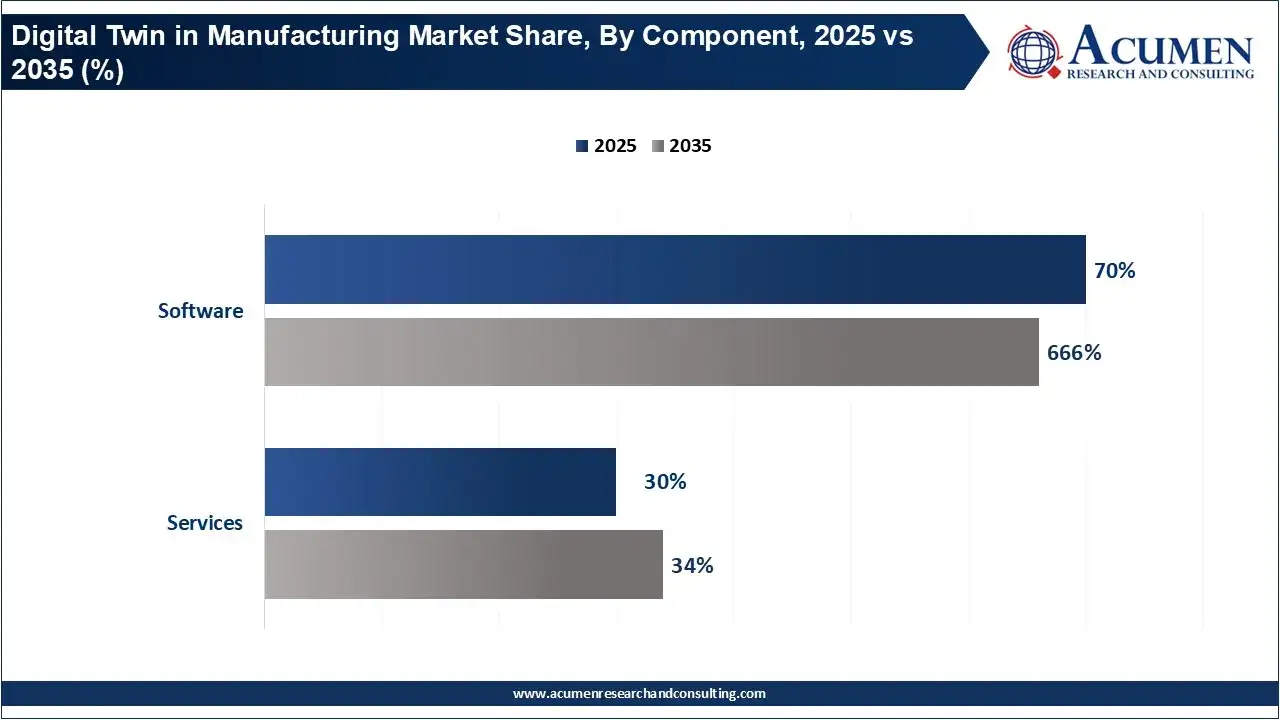
Services are expected to see the most rapid growth segment; the adoption of digital twins by end-users will be driven by a 36.7% CAGR from 2026 to 2035, compared with 34% for software. Growth in services will be largely driven by the complexity of deploying digital twins in existing manufacturing settings. Manufacturing companies often rely on a host of services, including consulting, integration, implementation, data engineering, system configuration, maintenance, cybersecurity and training.
Digital Twin Type Insights
In 2025, process twins led the digital twin types market share with 29% of total sales in the type segment, and ahead of equipment/asset twins with 26%. Process twins allow manufacturers to develop dynamic virtual models of production processes and simulate the impact of adjustments to parameters, equipment usage, material flows, production schedules, or operating conditions on productivity. This is most crucial for efficiencies relying on many interrelated process variables.
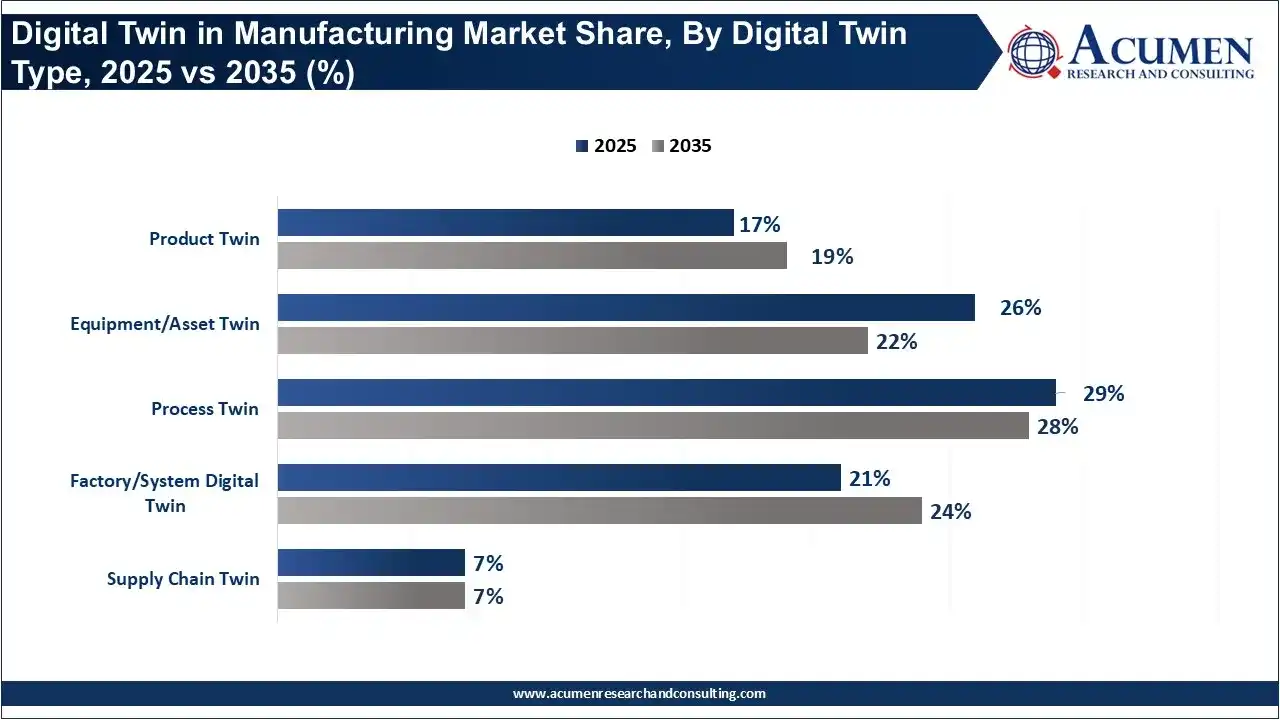
Factory/system digital twins represent the fastest-growing digital twin type, with a 36.9% CAGR from 2026 to 2035. The segment accounted for 21.0% in 2025. Their growth reflects manufacturers' increasing shift from isolated digital representations of individual machines toward comprehensive models of production environments. Factory-level twins can integrate equipment, production lines, processes, material movement, energy consumption, workforce-related parameters, and facility-level operating information.
Deployment Mode Insights
In 2025, cloud deployment held the largest share of the deployment-mode market at 42% and on-premises at 40%, and hybrid deployment accounted for the remaining 18%. Cloud-based digital twins enable manufacturers to leverage computing capacity in a scalable fashion and centralize digital models, operation data, analytics and collaboration in a single accessible place. Cloud is an excellent choice for applications where computation is a critical factor, such as Simulation, Analytics, AI and Machine Learning.
Digital Twin in Manufacturing Market Share, By Deployment Mode, 2025 (%)
| By Deployment Mode | Revenue Share, 2025 (%) |
|---|---|
| On-Premises | 40% |
| Cloud | 42% |
| Hybrid | 18% |
On-premises deployment was the second most popular deployment mode in 2025 at 40%. This ongoing popularity speaks to the manufacturing environments where companies desire more direct control over operational data, system uptime, cybersecurity, and integration with the plant-floor infrastructure.
Additionally, some production environments demand ultra-low-latency access to their operational data, or they may be unable to share potentially sensitive manufacturing data on an external cloud environment.
Manufacturing Type Insights
Discrete manufacturing represented 61% of the digital twin market in manufacturing in 2025 and is the most significant type of manufacturing. Discrete manufacturing involves the processing, integration, or assembly of products, components, or finished goods at specific production locations.
These types of environments are especially relevant for digital twins, as manufacturers can represent individual products, machines, production lines, assembly sequences, and the entire plant.
Automotive, electronics, machinery, aerospace, and transportation equipment manufacturers can use digital twins to model manufacturing processes, optimize assembly operations, track equipment, analyze quality, and test manufacturing changes.
Digital Twin in Manufacturing Market Share, By Manufacturing Type, 2025 (%)
| By Manufacturing Type | Revenue Share, 2025 (%) |
|---|---|
| Discrete Manufacturing | 61% |
| Process Manufacturing | 39% |
Process manufacturing accounted for 39.0% of the digital twin in manufacturing market in 2025, making it the second-largest segment after discrete manufacturing at 61.0%. Digital twins are increasingly applicable to process manufacturing environments such as chemicals, pharmaceuticals, food and beverage, and materials production, where continuous monitoring of temperature, pressure, flow rates, material composition, energy consumption, and other operating parameters is essential.
By creating virtual representations of production processes and equipment, manufacturers can simulate operating conditions, identify process inefficiencies, support predictive maintenance, optimize resource utilization, and improve product consistency.
Enterprise Size Insights
Large enterprises led the segment in 2025. They held 81% of the market share in the digital transformation programs market. This shows the large digital transformation programs require more financial and technological resources to be carried out. Most large companies have several manufacturing facilities, large amounts of plant equipment, large supply chains, and a wealth of operational data; a compelling use case for digital twins.
Digital Twin in Manufacturing Market Share, By Enterprise Size, 2025 (%)
| By Enterprise Size | Revenue Share, 2025 (%) |
|---|---|
| Large Enterprises | 81% |
| SMEs | 19% |
While in 2025, small & medium enterprises (SMEs) accounted for 19.0%. SMEs represent a smaller share but can increasingly adopt modular, cloud-based digital twin platforms that reduce upfront infrastructure requirements and allow organizations to begin with specific assets or processes before expanding deployments.
Manufacturing Industry Insights
Automotive & transportation equipment manufacturing led the market in 2025 with 22% of total, followed by semiconductor & electronics with 20%. Automotive manufacturing has high digital twin potential as vehicle manufacturing involves complex assembly operations, high automated production lines, robotics, quality inspections, huge equipment network, and closely integrated supply chains. Digital twins can be used throughout vehicle design, manufacturing line simulation, equipment monitoring, assembly process enhancement, quality, and factory planning.
Digital Twin in Manufacturing Market Share, By Manufacturing Industry, 2025 (%)
| By Manufacturing Industry | Revenue Share, 2025 (%) |
|---|---|
| Automotive & Transportation Equipment | 22% |
| Aerospace & Defense Manufacturing | 12% |
| Semiconductor & Electronics | 20% |
| Industrial Machinery & Equipment | 13% |
| Chemicals & Materials | 10% |
| Pharmaceuticals & Life Sciences Manufacturing | 7% |
| Food & Beverage | 6% |
| Consumer Goods | 4% |
| Pulp, Paper & Packaging | 3% |
| Other Manufacturing Industries | 3% |
Semiconductor & electronics manufacturing represented the second-largest industry segment in 2025 at 20.0%, only two percentage points behind automotive and transportation equipment. The segment's significant position reflects the highly controlled, equipment-intensive, and data-rich nature of electronics production.
Semiconductor and electronics facilities depend on sophisticated manufacturing equipment, process controls, inspection systems, environmental monitoring, and tightly controlled production parameters. Digital twins can model equipment behavior, process conditions, production flows, and facility operations to support optimization and predictive maintenance.
Digital Twin in Manufacturing Market Government Initiatives
| Country / Region | Government initiative / organization | Key initiative |
|---|---|---|
| United States | NIST | Digital Twins for Manufacturing program and 2026 workshop series |
| Germany | Federal Government / Industrie 4.0 ecosystem | Industry 4.0 and industrial digitalization programs |
| European Union | European Commission | Digital Europe Programme and European data-space initiatives |
| United Kingdom | UK Government | Made Smarter Innovation |
| Japan | METI | Society 5.0 and connected manufacturing initiatives |
| China | Ministry of Industry and Information Technology (MIIT) | Industrial digitalization and intelligent manufacturing programs |
Key Players
- Siemens
- NVIDIA
- Dassault Systèmes
- PTC
- Microsoft
- Autodesk
- Hexagon
- Ansys
- Rockwell Automation
- Schneider Electric
M&A, Partnerships and Product Launches
- January 2026: Siemens and NVIDIA expanded their strategic partnership to develop AI-native design and simulation, adaptive manufacturing, AI factories and supply-chain capabilities. The companies said digital twins would be continuously analyzed to test improvements virtually before translating validated insights into factory operations, with Siemens' Erlangen electronics factory serving as an initial blueprint.
- February 2026: Dassault Systèmes and NVIDIA announced a long-term partnership combining Dassault Systèmes' Virtual Twin technologies with NVIDIA's AI infrastructure, accelerated software and open models. The collaboration targets industrial AI applications across engineering and manufacturing, including virtual factories and physics-based simulation.
Segments Covered
By Component
- Software
- Services
By Digital Twin Type
- Product Twin
- Equipment/Asset Twin
- Process Twin
- Factory/System Digital Twin
- Supply Chain Twin
By Deployment Mode
- On-Premises
- Cloud
- Hybrid
By Manufacturing Type
- Discrete Manufacturing
- Process Manufacturing
- By Enterprise Size
- Large Enterprises
- SMEs
By Manufacturing Industry
- Automotive & Transportation Equipment
- Aerospace & Defense Manufacturing
- Semiconductor & Electronics
- Industrial Machinery & Equipment
- Chemicals & Materials
- Pharmaceuticals & Life Sciences Manufacturing
- Food & Beverage
- Consumer Goods
- Pulp, Paper & Packaging
- Other Manufacturing Industries
By Region
- North America
- Europe
- Asia-Pacific
- Latin America
- Middle East & Africa
Looking for discounts, bulk pricing, or custom solutions? Contact us today at sales@acumenresearchandconsulting.com
Frequently Asked Questions

Other ICT Reports
August 2024
October 2020
March 2025
January 2023