
Electric Vehicle Market Size, Share, Forecast Report 2026 to 2035
Electric Vehicle Market (By Propulsion Type: BEV, PHEV, HEV, FCEV; By Vehicle Category: Passenger Cars, Two-Wheelers, Light Commercial Vehicles, Medium & Heavy Commercial Vehicles, Buses & Coaches, Three-Wheelers; By Battery Type: Nickel Manganese Cobalt (NMC) Batteries, Lithium Iron Phosphate (LFP) Batteries, Lithium-Ion Batteries, Solid-State Batteries, Other Battery Chemistries; By Driving Range: 301–500 km, 150–300 km, Less than 150 km, Above 500 km; By Drive Type: Front-Wheel Drive (FWD), Rear-Wheel Drive (RWD), All-Wheel Drive (AWD); By Price Range; By End User) - Global Industry Analysis, Size, Share, Regional Analysis, Trends and Forecast 2026 - 2035
- Last Updated: 12 Jun 2026
- Report Code: ARC1578
- Category: Automotive And Transportation
Electric Vehicle Market Size, Share, Forecast Report 2026 to 2035
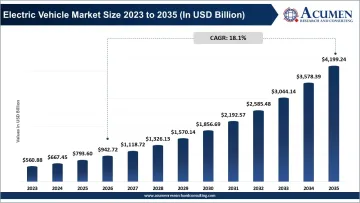
The global electric vehicle market size was valued at USD 793.60 billion in 2025 and is anticipated to hit around USD 4,199.24 billion by 2035, growing at a compound annual growth rate (CAGR) of 18.1% over the forecast period from 2026 to 2035.
Report Highlights
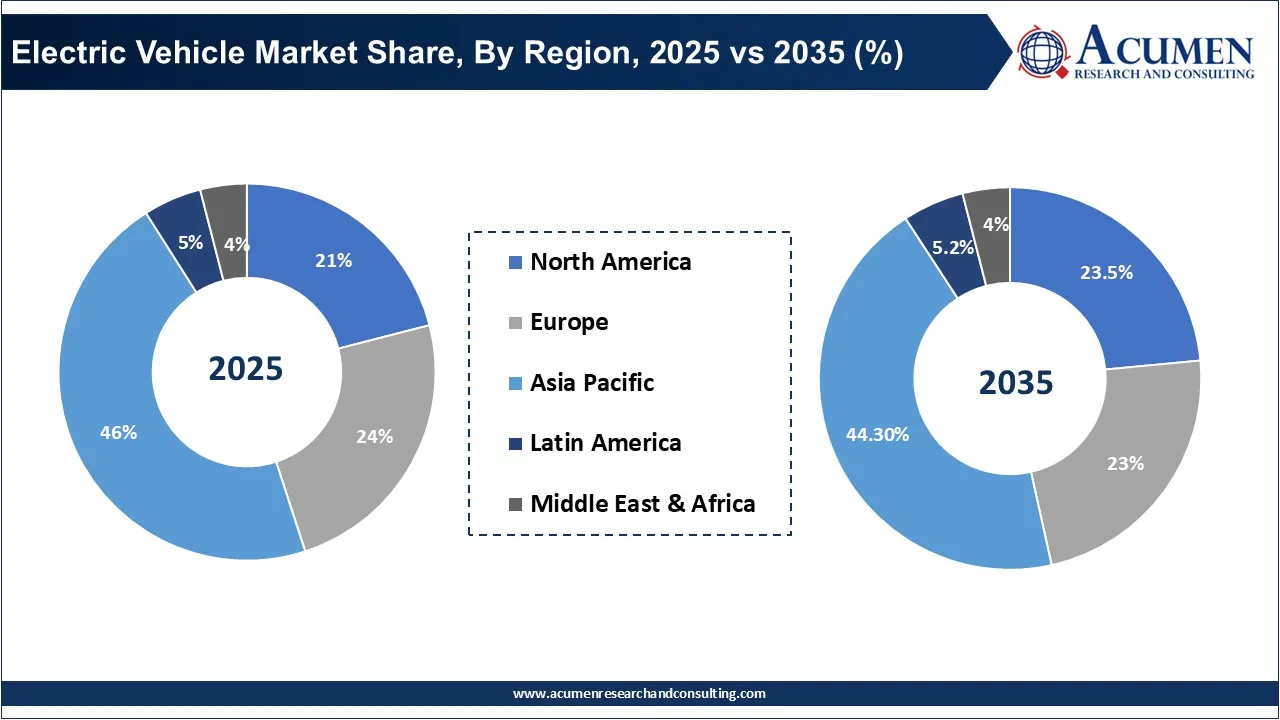
- By region, Asia-Pacific held largest share of 46.0% in 2025, owing to factors such as robust EV manufacturing capabilities, substantial battery production and increasing number of government policies.
- By region, North America is estimated to register the fastest CAGR of 19.5% over the forecast period. Increasing investments in charging infrastructure along with increasing vehicle electrification in the region are the key growth factors.
- By propulsion type, battery electric vehicles (BEVs) market held largest share of 62.0% in 2025 owing to decreasing battery prices along with increasing consumer preference towards zero emission vehicles.
- By propulsion type, plug-in hybrid electric vehicles (PHEVs) accounted for the second largest share of 18.0% in 2025, driven by flexibility to deal with limited availability of charging infrastructure.
- By vehicle category, passenger cars dominated the global electric vehicles market with a share of 57.0% in 2025. Strong consumer demand and the wide range of available EV models contributed to the segment's large share.
- By vehicle category, medium and heavy commercial vehicles is expected to grow at the fastest CAGR of 23.5% during the forecast period. Fleet electrification initiatives and strict emission standards regulations in the segment drove the segment growth.
- By battery type, NMC batteries led the market with a 42.0% in 2025. Higher energy density and its increasing usage in passenger electric vehicles boosted the market segment growth.
- By battery type, LFP batteries accounted for the second-largest share of 34.0% in 2025. Low price, high safety and increasing adoption in mass-market electric vehicles were the key growth drivers for the segment.
- By driving range, the 301–500 km segment is estimated to hold the largest market share in 2025 due to the ideal balance between driving range and price.
- By driving range, the above 500 km driving range vehicles are expected to register the fastest CAGR of 23.5% during the forecast period. The increasing demand for long-range EVs along with improvement in battery technologies are the key growth drivers for the segment.
- By drive type, front-wheel drive vehicles held the largest share of 44.0% in 2025. Cost efficiency and widespread use in mass-market electric cars drove the market segment's growth.
- By price range, mid-range electric vehicles accounted for the largest market share of 38.0% in 2025 and are anticipated to contribute a significant chunk to the global EV market over the forecast period.
- By end user, individual consumers dominated the global electric vehicles market with the largest share of 48.0% in 2025, owing to increasing awareness about environmental concerns along with increasing number of favorable government incentives and subsidies.
Global Electric Vehicle Production & Sales Highlights
- Nearly 22 million electric vehicles (EVs) were produced globally in 2025, an increase of over 25% compared to 2024. Of all EVs produced, about 25% were traded internationally, which shows how globalized the EV supply chain is becoming.
- Around 16 million EVs were produced in China, which accounts for about 75% of the global EV production.
- Chinese EV production was about 20% greater than domestic demand in 2025 and this is the reason why over 2.5 million EVs were exported in that year.
- The strong adoption of EVs in Europe reached 4.3 million units sold in 2025 as new emission standards and a rising consciousness among consumers to protect the environment have significantly driven the market.
- In North America, around 1.8 million EVs were sold in 2025. Charging infrastructure is widely available in North America and more and more EVs were launched in the market.
- About 2 million EVs were sold in the emerging markets of Asia, Latin America, and the Middle East in 2025. International trade of EVs continues to grow, and around 25% of the global EV production is exported. Chinese makers sold more than 2.5 million EVs in 2025 and its global impact increased.
Market Dynamics
Driver
Government Policies and Cost Reductions Drive the Growth of Electric Vehicles
Various governmental policies, purchase incentives, and battery cost reduction are significantly propelling the growth of electric vehicles. Several major countries are implementing tough emission standards and providing financial incentives, tax credits, subsidies for purchase, and production incentives for EV manufacturing to shift dependence from fossil fuels and meet carbon neutral targets.
Meanwhile, improved battery technology and economy of scales have also led to sharp declines in battery prices. As a result, affordability for consumers is increasing with better purchase options. Furthermore, expanded and reliable charging infrastructures are enabling ease of charging and boosting consumer confidence, allowing further penetration of electric vehicles across the globe.
Restraint
Vehicle Price and Charging Infrastructure Concerns
Higher vehicle prices and gaps in the charging infrastructure are major hurdles limiting electric vehicles adoption globally, despite a growing market outlook. While, EV battery costs have dropped considerably, most electric vehicles still represent a much higher upfront cost compared to internal combustion engine vehicle and thus the market for EV are restrained among price-sensitive customers.
Moreover, the inadequate network of charging stations (particularly in rural and developing economies) raise worries about range anxiety and availability, therefore creating a slowdown in the diffusion of electric vehicles in several emerging economies and hampering the overall growth in the forecast period.
Opportunity
Expansion of Battery Manufacturing and Emerging EV Markets
Localization of battery production and increasing EV penetration in emerging markets create vast opportunities for market participants. Billions of dollars are being poured by the governments and private players into gigafactories, recycling units, and critical minerals supply chains to reinforce domestic EV ecosystems. India, Indonesia, Thailand, Brazil, Saudi Arabia and the UAE are now rolling out pro-EV policies, while boosting infrastructure and R&D. The vehicle affordability and expanding charging infrastructure will turn emerging economies into substantial revenue streams for auto makers, battery manufacturers, and charging providers.
Regional Analysis
- The North America electric vehicle market size was valued at USD 166.66 billion in 2025 and is anticipated to hit around USD 986.82 billion by 2035, expanding at a CAGR of 19.5% from 2026 to 2035.
- The Europe electric vehicle market size was estimated at USD 190.46 billion in 2025 and is predicted to surpass around USD 965.83 billion by 2035, growing at a CAGR of 17.5% from 2026 to 2035.
- The Asia-Pacific electric vehicle market size reached at USD 365.06 billion in 2025 and is anticipated to reach around USD 1,860.26 billion by 2035, reflecting a CAGR of 17.6% from 2026 to 2035.
Why is the Asia-Pacific region leading the global electric vehicle market?
The Asia Pacific region led the global electric vehicle market and captured about 46.0% share of the global electric vehicles market in 2025. The prominent position of the region is attributed to the strong presence of the EV manufacturers, immense battery manufacturing capacity, supportive governmental regulations encouraging electrification of the automobiles.
In the countries such as China, Japan, South Korea and India there is still an intensive development in terms of infrastructure for electric vehicles, battery production capacities and other incentives given for electric vehicle adoption. The large part is represented by China, the leading EV market in the world. Growing urbanization, enhanced awareness regarding the protection of the environment and the national ambitions of carbon neutrality will reinforce the region in the predicted period.
Why is North America estimated to register the fastest CAGR in the electric vehicle market?
North America is estimated to register the fastest CAGR, 19.5% throughout the forecast period, driven by the increasing investment in the charging infrastructure, favorable governmental incentives and growing consumer acceptance of environmentally friendly transportation solutions. Battery manufacturing plants and vehicle production facilities in the North America are growing rapidly due to which the manufacturers are advancing towards the electrification strategies of their vehicles.
Increasing number of stringent government regulations to control greenhouse gas emission, increasing number of zero emission vehicles and high consumer acceptance rates in the region are expected to expand the market at a fast pace. Electric passengers, commercial vehicle fleet, innovative battery technologies is expected to witness considerable expansion in the market in the US and Canadian countries.
Segmental Analysis
Propulsion Type Insights
The market share of the battery electric vehicles segment in 2025 was estimated at 62.0%, mainly due to reduced costs of batteries and growing battery driving range capabilities, along with a favorable expansion of high-speed charging network globally. Government incentives and strict regulations on emissions coupled with increasing customer willingness for fully electric vehicle platforms in the market also drive market demand. Moreover, leading automotive companies are expanding focus on full electric vehicle platforms which is strengthening the dominance of the BEV market.
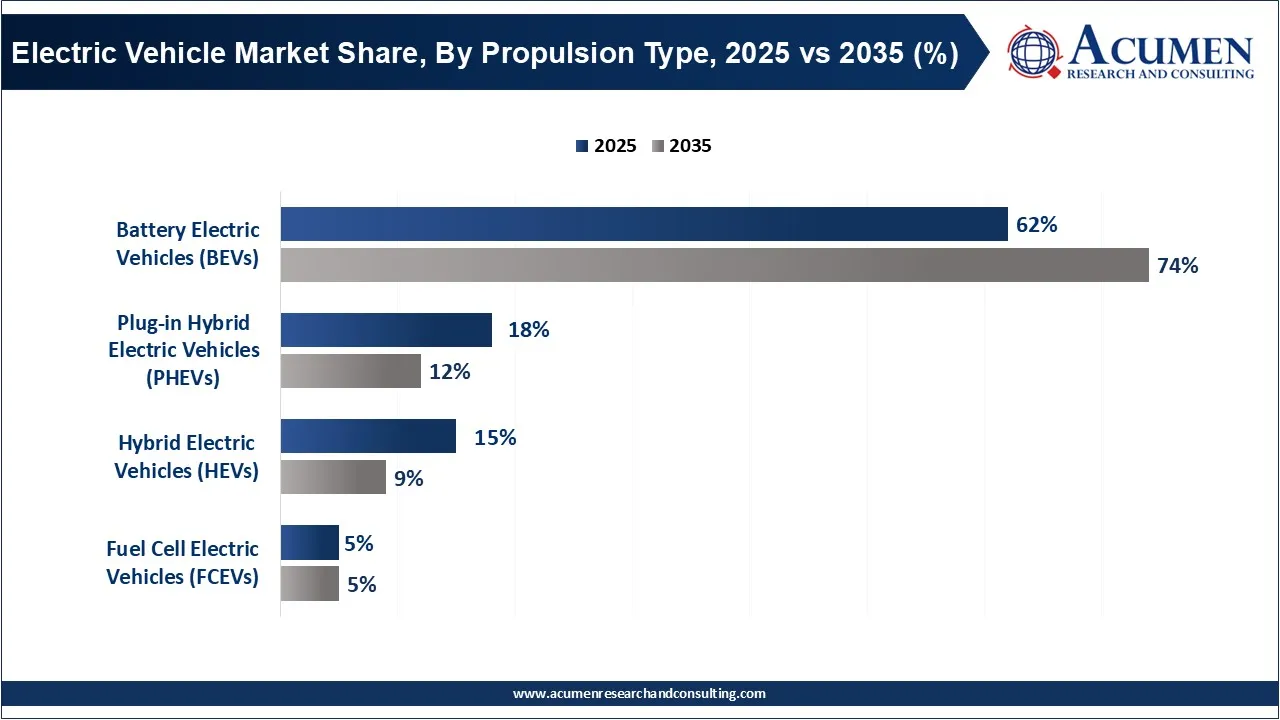
The second largest market share for plug-in hybrid electric vehicles segment in 2025 was estimated at 18.0% which provides dual functionality through both electric motor and combustion engine. It caters a transition for gradual adoption to electric vehicle technology across areas where charging infrastructure development is slow. Flexibility, extended driving range and significantly reduced carbon emission compared to fuel engine vehicle drives the market demand.
Vehicle Category Insights
The passenger car segment was the largest contributor to the electric vehicle market and contributed roughly 57.0% to the overall market in 2025. This market segment is propelled by rising consumer consciousness toward environmental sustainability, the increasing availability of affordable EV models and the expansion of charging infrastructure networks. Global automobile manufacturers continue to introduce new electric passenger car models across various price segments for widespread adoption.
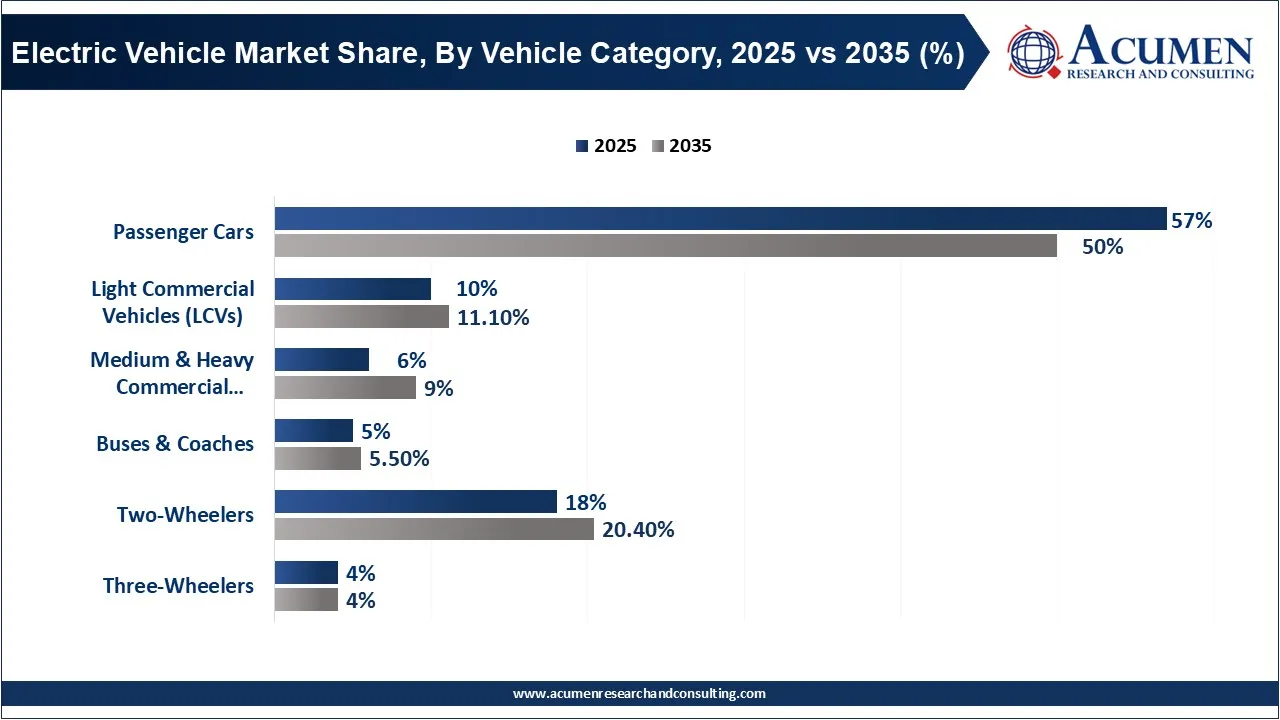
The medium & heavy commercial vehicles segment is estimated to register the fastest CAGR of 23.5% during the forecast period. The growth of this market segment can be attributed to government and fleet electrification initiatives, stringent emission regulations imposed on commercial vehicles and the increasing acceptance of electric trucks in the logistics and freight industries. Technological developments in battery technology and government incentives are enhancing the electrification of commercial vehicle fleets.
Battery Type Insights
NMC batteries held a leading position in 2025 with the largest market share of 42.0% on account of its high energy density, superior performance in terms of driving range and their usage in passenger electric vehicles. They offer an optimum balance in terms of energy storage capacity, performance, and endurance, making them an optimum choice for most major auto manufacturers.
EV Market Share, By Battery Type, 2025 & 2035 (%)
| Battery Type | Revenue Share, 2025 (%) | Revenue Share, 2035 (%) |
|---|---|---|
| Lithium-Ion Batteries | 21% | 10% |
| Lithium Iron Phosphate (LFP) Batteries | 34% | 45% |
| Nickel Manganese Cobalt (NMC) Batteries | 42% | 30% |
| Solid-State Batteries | 0% | 12% |
| Other Battery Chemistries | 3% | 3% |
LFP batteries represented the second-largest market segment in 2025 with a market share of 34.0%, attributed to their lower manufacturing cost, better safety attributes and the higher thermal stability they offer. The increasing penetration of mass-market electric vehicles and large-scale manufacturing of batteries across Asia Pacific will continue to drive segment growth.
Driving Range Insights
The 301-500 km market segment dominated the market with a share of nearly 34.0% in 2025. This is on account of them providing an ideal balance between the cost of the vehicle and the vehicle's performance in terms of driving range. The majority of mainstream EVs fall in this category and cater to the driving range needs of both city dwellers and long-haul drivers.
EV Market Share, By Driving Range, 2025 & 2035 (%)
| Driving Range | Revenue Share, 2025 (%) | Revenue Share, 2035 (%) |
|---|---|---|
| Less than 150 km | 16% | 11% |
| 150–300 km | 38% | 28% |
| 301–500 km | 34% | 43% |
| Above 500 km | 12% | 18% |
The above 500 km market segment is anticipated to grow at the fastest CAGR of 23.5% during the forecast period due to an increase in the battery energy density, future-generation battery technologies, and an increasing consumer appetite for electric vehicles with longer ranges. Performance EV manufacturers are introducing models with longer driving ranges, thereby fueling segment growth.
Top Companies
- AB Volvo
- BYD Company Ltd.
- Ford Motor Company
- General Motors
- Honda Motor Co., Ltd.
- Kawasaki Motors Corp., U.S.A
- Mercedes-Benz Group AG
- Mitsubishi Motors Corporation
- Nissan Motor Co., Ltd.
- Renault Group
- Tesla, Inc.
- Toyota Motor Corporation
- Volkswagen Group
- Zero Motorcycle
Recent News
- June 2026, VinFast reported strong revenue growth and continued investments in manufacturing capacity expansion across international markets. The company is increasing production capabilities and expanding its EV portfolio to strengthen its presence in Asia, North America, and Europe, reflecting the growing global demand for electric vehicles.
Electric Vehicle Market Segmentation
By Propulsion Type
- Battery Electric Vehicles (BEV)
- Plug-in Hybrid Electric Vehicles (PHEV)
- Hybrid Electric Vehicles (HEV)
- Fuel Cell Electric Vehicles (FCEV)
By Vehicle Category
- Passenger Cars
- Two-Wheelers
- Light Commercial Vehicles
- Medium & Heavy Commercial Vehicles
- Buses & Coaches
- Three-Wheelers
By Battery Type
- Nickel Manganese Cobalt (NMC) Batteries
- Lithium Iron Phosphate (LFP) Batteries
- Lithium-Ion Batteries
- Solid-State Batteries
- Other Battery Chemistries
By Driving Range
- 301–500 km
- 150–300 km
- Less than 150 km
- Above 500 km
By Drive Type
- Front-Wheel Drive (FWD)
- Rear-Wheel Drive (RWD)
- All-Wheel Drive (AWD)
By Price Range
- Mid-Range ($18,000–$35,000)
- Premium ($35,000–$70,000)
- Economy (Under $18,000)
- Luxury (Above $70,000)
By End User
- Individual Consumers
- Fleet Operators
- Corporate Users
- Mobility-as-a-Service Providers
- Government & Public Sector
By Region
- North America
- Europe
- Asia-Pacific
- Latin America
- Middle East & Africa
Looking for discounts, bulk pricing, or custom solutions? Contact us today at sales@acumenresearchandconsulting.com
Frequently Asked Questions

Other Automotive And Transportation Reports
August 2020
April 2021
April 2022
November 2020