
Endpoint Security Market Size, Share, Forecast Report 2025 To 2033
Endpoint Security Market (By Component Solution Services; By Deployment: On-Premise, Cloud; By Enterprise Size: Large Enterprises, Small and Medium Enterprises (SMEs); By End-Use Industry: IT & telecom, Industrial, BFSI, Education, Healthcare, Retail, Government & Defense, Others) - Global Industry Analysis, Size, Share, Regional Analysis, Trends and Forecast 2025 To 2033
- Last Updated: 20 May 2026
- Report Code: ARC2202
- Category: ICT
Endpoint Security Market Size and Forecast 2025 - 2033
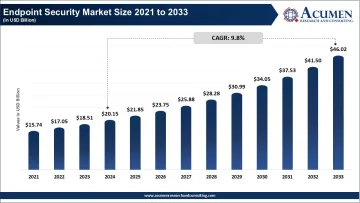
The global endpoint security market size reached at USD 21.85 billion in 2025 and is estimated to surpass around USD 46.02 billion by 2033 growing at a CAGR of 9.8% from 2025 to 2033.
The endpoint security is the procedure of securing endpoints or entry points of end-user devices such as laptops, desktops, tablets, and mobile devices from being exploited by malicious attacks. The endpoint security systems are intended to secure these endpoints on a network or in the cloud from cybersecurity threats. The need to secure data in the present business era where digital information is the most valuable asset of the company is very important. Additionally, the loss of this digital information may put the entire business at risk of insolvency. The endpoint security system uses end to end encryption and application control in order to secure devices accessing the enterprise network. The endpoint security software encompasses various entities such as machine-learning classification to detect zero-day threats in real-time, advanced antimalware and antivirus protection, proactive web security in order to ensure safe web browsing, Integrated firewall to block hostile network attacks, email gateway, centralized endpoint management platform, and endpoint, email and disk encryption to prevent data exfiltration.
Report Highlights
- The global endpoint security market is expected to reach USD 46.02 billion by 2033, with a CAGR of 9.8% from 2025 to 2033.
- The North America endpoint security market was valued at approximately USD 7.1 billion in 2024.
- The Asia-Pacific market is projected to grow at a CAGR of over 10.9% from 2025 to 2033.
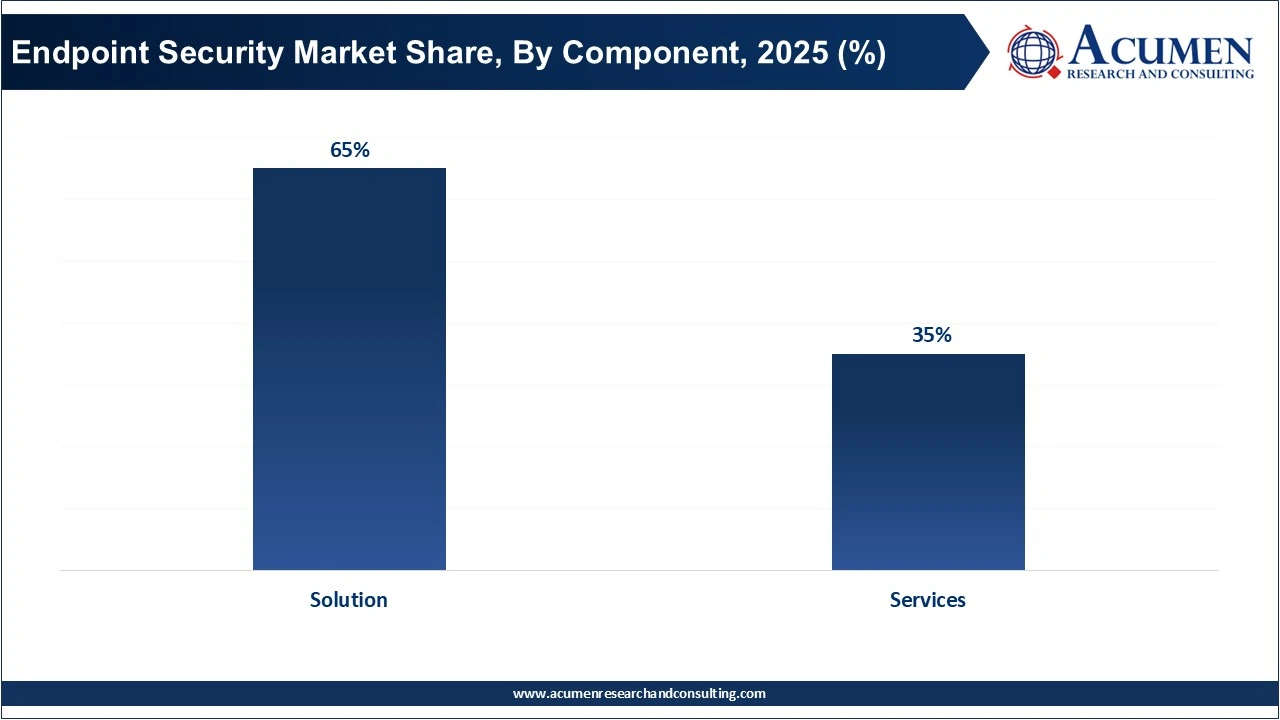
- The solution component sub-segment accounted for 65% of the endpoint security market share in 2024.
- Based on the deployment, the on-premise segment held around 60% market share.
- Rising awareness among SMEs about cybersecurity threats is a popular endpoint security market trend that fuels the industry demand.
Endpoint Security Market Dynamics
Market Drivers
- Rising incidences of cyberattacks are pushing organizations to strengthen endpoint protection
- Increasing adoption of remote work has expanded the need for secure endpoint devices
- Growth in bring your own device (BYOD) policies is driving demand for advanced endpoint security solutions
- Regulatory compliance requirements are compelling enterprises to invest in endpoint protection
Market Restraints
- High implementation and maintenance costs of endpoint security solutions deter small businesses
- Lack of skilled cybersecurity professionals hampers efficient deployment and management
- Compatibility issues with legacy systems reduce the effectiveness of new security tools
Market Opportunities
- Increasing adoption of AI and machine learning in endpoint protection presents new growth avenues
- Growing demand for cloud-based security solutions opens up scalable service opportunities
- Expansion of IoT ecosystems creates new market potential for endpoint security
Report Scope
| Attribute | Details |
|---|---|
| Endpoint Security Market Size 2025 | USD 21.85 Billion |
| Endpoint Security Market Forecast 2033 | USD 46.02 Billion |
| Endpoint Security Market CAGR During 2025 - 2033 | 9.8% |
| Analysis Period | 2021 - 2033 |
| Base Year | 2025 |
| Forecast Data | 2025 - 2033 |
| Segments Covered | By Component, By Deployment, Enterprise Size, By End-use Industry, and By Geography |
| Regional Scope | North America, Europe, Asia Pacific, Latin America, and Middle East & Africa |
| Key Companies Profiled | Panda Security, IBM Corporation, Microsoft, Intel Corporation, F-Secure, Cisco Systems, Inc., McAfee, LLC., ESET, spol. s r.o., Sophos Ltd., AO Kaspersky Lab, Broadcom, and Trend Micro Incorporated. |
| Report Coverage | Market Trends, Drivers, Restraints, Competitive Analysis, Player Profiling, Covid-19 Analysis, Regulation Analysis |
Endpoint Security Market Insights
The increasing number of endpoints and the bring your own device (BYOD) trend among enterprises, due to the shift from traditional infrastructure to technologically advanced systems, is supporting market growth. The rise in endpoint attacks and violations, along with the higher costs accumulated due to these attacks, is further bolstering the market. The growing demand for cost-effective alternatives to on-premises security deployment, mitigation of IT risks, and centrally managed protection and administration are also contributing to the demand for endpoint security systems in the market.
Furthermore, the growing need to secure IT infrastructure in the media and entertainment vertical, as well as the rising demand for integrated endpoint security infrastructure and software, is projected to provide potential opportunities over the forecast timeframe from 2025 to 2033. On the other hand, the use of free or pirated endpoint protection solutions and skepticism associated with cloud-based endpoint security is expected to restrict growth to some extent during this period. In addition, the integration of artificial intelligence (AI) and machine learning (ML) into endpoint security solutions is anticipated to redefine threat detection and response mechanisms, improving accuracy and reducing response times. The transition to remote work and hybrid environments has increased endpoint risks, requiring businesses to invest in more robust and flexible endpoint protection solutions. Cloud-based endpoint security products are also becoming more scalable and cost-effective, allowing small and medium-sized businesses to enhance their cybersecurity frameworks without incurring significant expenses. These shifting dynamics are expected to shape the competitive environment and fuel innovation in the endpoint security industry.
Endpoint Security Market Segmentation Insight
The worldwide market for endpoint security is split based on component, deployment, enterprise size, end-use industry, and geography.
Component Insight
According to endpoint security industry analysis, because of the increasing complexity and frequency of cyber threats targeting endpoint devices, the solution segment accounts for the majority of the market's component category. To prevent, detect, and mitigate possible breaches, organizations across industries are increasing their investments in comprehensive security solutions such as antivirus, endpoint detection and response (EDR), and firewall systems. These technologies provide real-time threat monitoring, automation, and increased visibility, which are critical in today's scattered work environments. Furthermore, the growing use of BYOD and mobile devices increases demand for integrated and scalable endpoint protection solutions. Enterprises seek complete software solutions over services because they serve as the primary security layer against sophisticated cyberattacks, fueling the segment's dominance.
Deployment Insight
The on-premise deployment segment of the endpoint security market is expanding rapidly as worries about data privacy, control, and regulatory compliance emerge. Organizations that handle sensitive or confidential information, particularly those in banking, healthcare, and government, choose on-premise solutions to maintain direct control over their security architecture. This deployment technique improves customization and integration with existing internal systems, resulting in enhanced protection against specific threats. Furthermore, with the rise of advanced persistent threats (APTs), many firms opt for on-premise deployments to ensure a stronger security perimeter. Companies that want to minimize third-party data access risks connected with cloud platforms are driving up demand even more.
Enterprise Size Insight
Large corporations produce significant revenue in the endpoint security market due to their extensive digital infrastructure and increased vulnerability to cyber threats. These enterprises handle enormous networks of endpoints ranging from desktops and laptops to mobile devices across various locations, necessitating comprehensive security solutions. Large companies, with higher financial resources, can invest in advanced endpoint protection solutions like endpoint detection and response (EDR) and AI-driven threat intelligence systems. Furthermore, compliance with strict legal frameworks such as GDPR, HIPAA, and PCI-DSS necessitates high-level security measures. Their proactive approach to cybersecurity, backed by specialized IT teams and larger budgets, considerably contributes to the market's income from this segment, establishing large companies as key contributors to overall expansion.
End-Use Industry Insight
The government and defense industry is likely to dominate the endpoint security market due to its high susceptibility to cyber espionage, data breaches, and nation-state threats. These organizations handle secret information, national security data, and essential infrastructure, making them attractive targets for sophisticated cyber attacks. To address these risks, governments and defense agencies spend heavily on strong endpoint protection mechanisms such as increased encryption, threat detection, and secure access control systems. Furthermore, the growing frequency of targeted ransomware and malware attacks has led to increased investment and deployment of cybersecurity frameworks in this industry. Government institutions prioritize endpoint security as a result of regulatory regulations and national cybersecurity policies, contributing to the segment's global market dominance.
Endpoint Security Market Regional Insight
In 2025, North America accounted for the maximum share (%) in terms of revenue (US$ Mn) owing to its major economies US and Canada. The advanced industrial infrastructure and ongoing investment for the incorporation of new technology in the working environment for efficient and effective results in reduced cost and time are further bolstering the regional market growth. The presence of major players in the region such as Cisco Systems, Inc. (US), Intel Corporation, and Microsoft Corporation are further supporting the market growth.
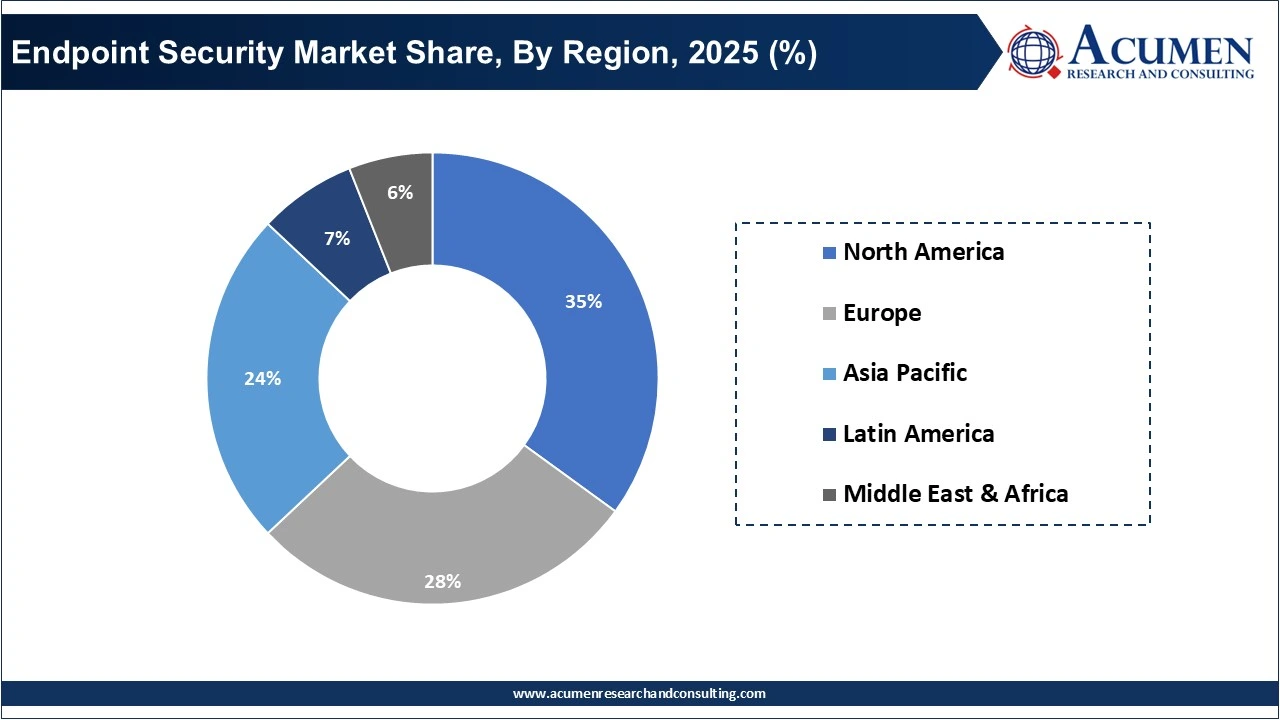
Moreover, the Asia Pacific is anticipated to exhibit the fastest growth in the industry with major CAGR (%) throughout the endpoint security market forecast period from 2025 to 2033. The ongoing investment in the field in order to develop industrial infrastructure along with the increasing disposable income of developing economies is bolstering the regional market value. The expansion of major global players in the developing economies of the region such as China and India is further accelerating the regional market growth.
Endpoint Security Market Key Players
- Panda Security
- IBM Corporation
- Microsoft
- Intel Corporation
- F-Secure
- Cisco Systems, Inc.
- McAfee, LLC.
- ESET
- spol. s r.o.
- Sophos Ltd.
- AO Kaspersky Lab
- Broadcom
- Trend Micro Incorporated
Market Segmentation
By Component
- Solution
- Antivirus
- Endpoint Encryption
- Application Control
- Endpoint Detection and Response
- Mobile Security Tools
- Firewall
- Others
- Services
- Managed
- Consulting
- Training & Support
By Deployment
- On-Premise
- Cloud
By Enterprise Size
- Large Enterprises
- Small and Medium Enterprises (SMEs)
By End-Use Industry
- IT & telecom
- Industrial
- BFSI
- Education
- Healthcare
- Retail
- Government & Defense
- Others
By Region
- North America
- U.S.
- Canada
- Europe
- U.K.
- Germany
- France
- Spain
- Rest of Europe
- Asia-Pacific
- India
- Japan
- China
- Australia
- South Korea
- Rest of Asia-Pacific
- Latin America
- Brazil
- Mexico
- Rest of LATAM
- The Middle East & Africa
- South Africa
- GCC Countries
- Rest of the Middle East & Africa (ME&A)
Looking for discounts, bulk pricing, or custom solutions? Contact us today at sales@acumenresearchandconsulting.com
Frequently Asked Questions

Other ICT Reports
February 2024
January 2021
December 2022
May 2024