
Hydrogen Buses Market Size, Share, Growth, Report 2026 To 2035
Hydrogen Buses Market (By Bus Type: Single-decker, Double-decker, Fuel Cell Hybrid Buses, Battery Electric; By Fuel Type: Green Hydrogen, Blue Hydrogen, Grey Hydrogen; By Propulsion Type: ICE, Fuel Cell Electric Vehicle; By Manufacturing: New Hydrogen Bus, Retrofitted; By Power Output: Below 100kW, 100-200kW, Above 200kW; By Technology: Proton Exchange Membrane Fuel Cell, Solid Oxide Fuel Cell, Alkaline Fuel Cell, Others; By Application: Public Transportation, Private Transportation, School Transportation, Tourism & Airport Transportation) - Global Industry Analysis, Size, Share, Regional Analysis, Trends and Forecast 2026 - 2035
- Last Updated: 04 May 2026
- Report Code: ARC3922
- Category: Automotive And Transportation
Hydrogen Buses Market Size and Forecast 2026 to 2035
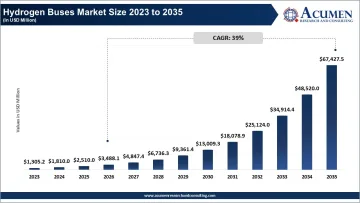
The global hydrogen buses market size reached at USD 2,510 million in 2025 and is estimated to surpass around USD 67,427 million by 2035 growing at a CAGR of 39% from 2026 to 2035. The rise in government subsidies for fuel-alternative vehicles and shift in zero-emission policies across the globe have offered sustain potential for the hydrogen buses market to expand.
Report Highlights
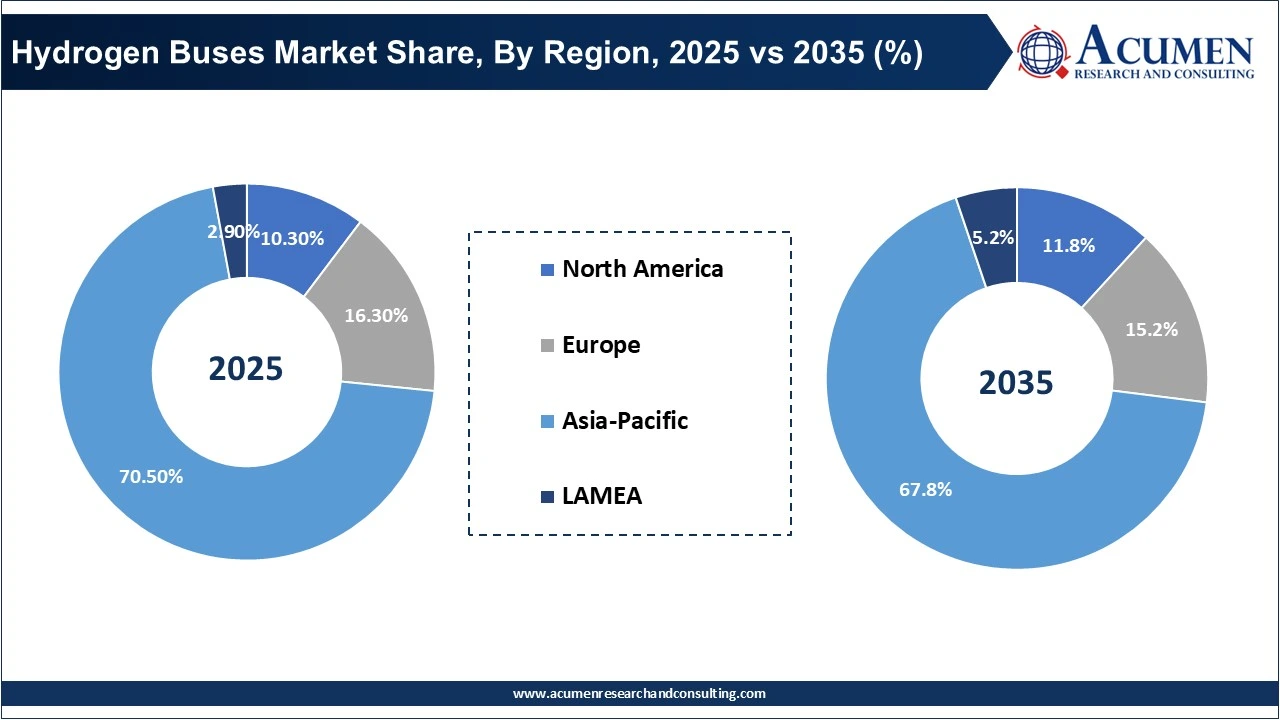
- By region, Asia Pacific dominated the market in 2025 supported by strong government roadmaps, large public fleets, and rapid infrastructure expansion.
- By region, Europe held the second-largest share in 2025 driven by strict emission regulations, funding programs, and city-level climate targets.
- By bus type, the single-deck hydrogen buses segment dominated with 36.89% share in 2025 due to faster deployment, lower infrastructure requirements, and strong suitability for urban transit routes.
- By bus type, the fuel cell hybrid buses segment held the second-largest share of 26.15% in 2025 driven by improved fuel efficiency and reduced hydrogen consumption in mixed urban-suburban operations.
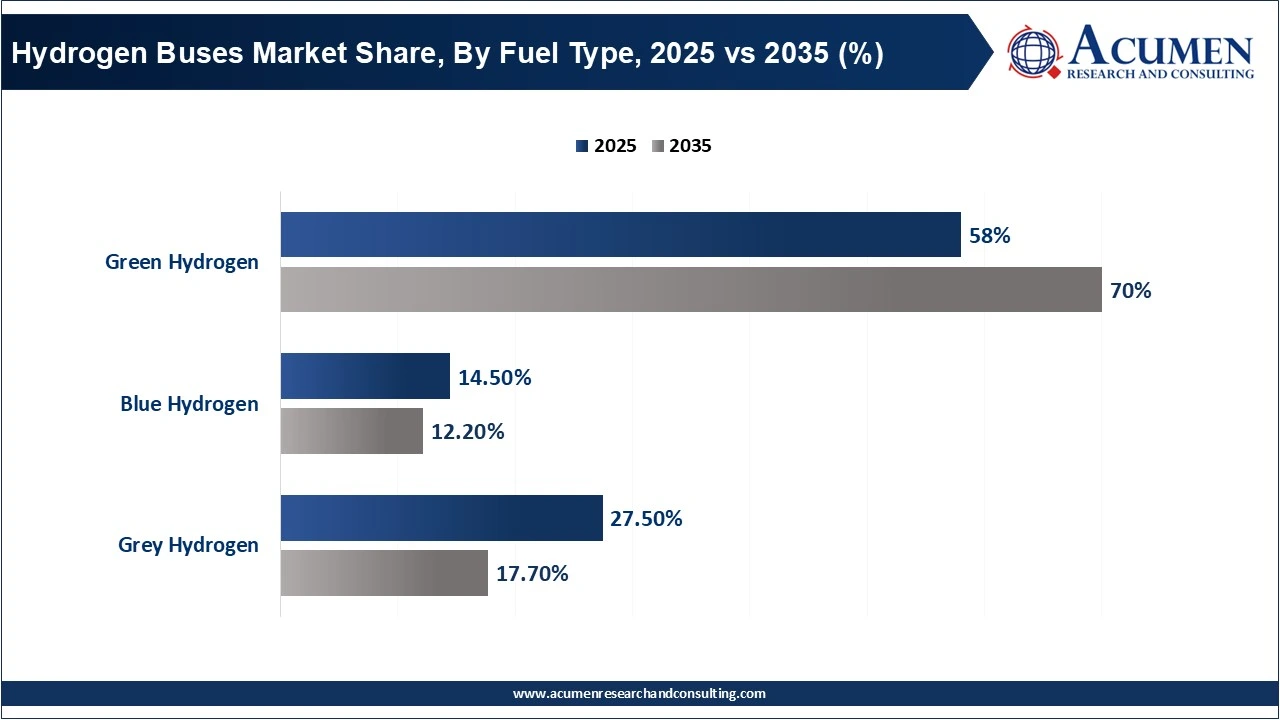
- By fuel type, the green hydrogen segment dominated with 57.96% share in 2025 supported by global net-zero mandates and growing integration of renewable energy with hydrogen production.
- By fuel type, the grey hydrogen segment held the second-largest share of 27.53% in 2025 as countries in early transition phases continue using existing hydrogen production infrastructure.
- By propulsion type, the hydrogen internal combustion engine (ICE) segment dominated with 59.50% share in 2025 due to lower upfront costs and easier integration with existing engine supply chains.
- By propulsion type, the fuel cell electric segment held the second-largest share of 40.50% in 2025 driven by higher efficiency, longer driving range, and faster refueling capability.
- By manufacturing, the new hydrogen buses segment dominated with 71.20% share in 2025 owing to large-scale fleet replacement programs and purpose-built vehicle designs.
- By manufacturing, the retrofitted hydrogen buses segment held the second-largest share of 28.80% in 2025 as a cost-effective transition solution for aging diesel fleets.
- By power output, the 100–200 kW segment dominated with 44.20% share in 2025 as it provides the optimal balance between performance, efficiency, and operating cost for city routes.
- By power output, the above 200 kW segment held the second-largest share of 32.50% in 2025 due to rising demand for intercity and high-capacity transit operations.
- By technology, the proton exchange membrane fuel cell segment dominated with 47.40% share in 2025 due to fast start-up, compact design, and transportation-focused performance.
- By technology, the alkaline fuel cell segment held the second-largest share of 29.70% in 2025 supported by lower manufacturing costs and adoption in emerging markets.
- By application, the public transportation segment dominated with 42.70% share in 2025 driven by government decarbonization targets and predictable fleet operations.
- By application, the tourism and airport transportation segment held the second-largest share of 27.70% in 2025 due to centralized routes and strong sustainability initiatives.
Hydrogen Buses Market Outlook: How is it Transforming Transportation Globally?
The hydrogen buses market revolves around the manufacturing, launching, operation and utilization of hydrogen fuel based buses. They use hydrogen either directly into internal combustion engines or fuel cells generating electrical energy for the bus. As compared to diesel based bus which emits NOx, CO2 and particulate matters, hydrogen buses are one of the cleanest heavy-duty vehicles since the only by product released from buses is water vapors.
One of the most substantial changes by hydrogen buses is the decarbonization of heavy duty transport which traditionally had been one of the toughest sectors to electrify. Urban air pollution largely stems from diesel powered buses. Nitrogen oxides and particulates from diesel bus emissions affect public health. By zeroing out tail pipe emissions at the source, hydrogen buses make smog and pollution in cities and towns negligible. In summary, hydrogen buses are revolutionizing transport by contributing to clean, quiet and energy independent solutions, which take cities closer to the environmental targets.
Hydrogen Buses Statistics: Subsidies, Production & Sales
- Major bus manufacturers including Ballard Power Systems, Toyota, Hyundai, Solaris, Wrightbus, and Caetano are scaling fuel-cell bus production to meet public transport tenders worldwide.
- In China, the governments at both national and provincial level has been providing subsidies up to 40-60% of the purchase price of hydrogen buses, this is one of the significant factors why China is at the forefront of global deployment.
- The EU Green Deal and Clean Hydrogen Partnership project witnessed a deployment of thousands of hydrogen buses by 2030 in the heavy-duty transport segment where batteries fail to meet range requirements and recharging duration issues.
- The EU Hydrogen Bus Joint Undertaking programmes, started supporting the allocation of various hydrogen bus projects around 300 million, aimed to provide funding for procurement and refueling infrastructure.
- By 2024 there have been over 7,000+ hydrogen fuel cell buses deployed worldwide and it is Asia with most deployment, predominantly China and South Korea.
- There were over 1,500 hydrogen buses in order in Europe by 2024 to support near term demand growth, and by 2023-2024.
- The U.S. Department of Energy allocated $8 billion for ‘Regional Hydrogen Hubs’ for expanding the hydrogen infrastructure.
Market Dynamics
Driver
Rising Demand for Long-Haul, Zero-Emission Transit Services
A strong force pushing the hydrogen bus market forward is the limitation of battery-electric buses on high-utilization transit routes. Battery buses can be very successful for short loops in urban areas, but many transit agencies operate 16-20-hour per day, high-mileage routes, or routes with extreme temperatures, terrain (hills), etc. Under such operating conditions, battery buses often require mid-day charging or need to be equipped with much larger, heavier battery packs, diminishing passenger capacity and compromising schedules.
Hydrogen buses can address this problem effectively. A single fuel fill of a hydrogen bus can provide 300-500 km (200-300 miles) and only requires minutes for refuelling and returning the bus to service-mimicking the daily operations of a conventional diesel bus. For many transit agencies unable to sustain downtime or complex charging strategies, this simplifies the operational transition from diesel buses.
Restraint
High Cost of Vehicles and Infrastructure
Despite the increasing attention given to them, the current reality of the hydrogen buses market is that high cost poses a significant challenge. Both the vehicle and necessary infrastructure remain significantly more expensive than those of their diesel and electric counterparts, placing the cost of wholesale fleet renewal out of reach for public transport operators without significant government support.
The price of a typical hydrogen fuel cell bus can almost double that of a diesel bus. The primary drivers for this are the expensive nature of the fuel-cell stack itself and the large on-board hydrogen storage tanks required, coupled with limited production volumes of these systems. In addition to the vehicle cost, infrastructure also presents a substantial challenge. Building and operating a hydrogen refueling station is an expensive process, as it requires appropriate storage, transportation and safety infrastructure.
Opportunity
Declining Cost and Expanding Infrastructure for Green Hydrogen
Long-term the growth opportunities in the hydrogen bus market will be strongly tied to development of the Hydrogen Economy. Investments in scale up production of green hydrogen through government's and energy companies will make fuels cheaper within 10 years from now through $ trillions invested on this market.
This long-term opportunity will make hydrogen buses one of the most feasible zero emission transport solutions for long-distance and high-usage needs as soon as hydrogen becomes competitive with diesel.
Hydrogen Buses Market Regional Insight
- The North America hydrogen buses market size was valued at USD 258.5 million in 2025 and is expected to reach around USD 7,956.4 million by 2035 growing at a CAGR of 40.9% from 2026 to 2035.
- The Europe hydrogen buses market size was estimated at USD 408.7 million in 2025 and is projected to hit around USD 10,249 million by 2035 growing at a CAGR of 38% from 2026 to 2035.
- The Asia-Pacific hydrogen buses market size was accounted for USD 1,768.7 million in 2025 and is predicted to surpass around USD 45,715.8 million by 2035 growing at a CAGR of 38.4% from 2026 to 2035.
- The LAMEA hydrogen buses market was valued at USD 74 million in 2025 and is anticipated to reach around USD 3,506.2 million by 2035 growing at a CAGR of 46.8% from 2026 to 2035.
Asia Pacific’s Leadership to Sustain by 2030
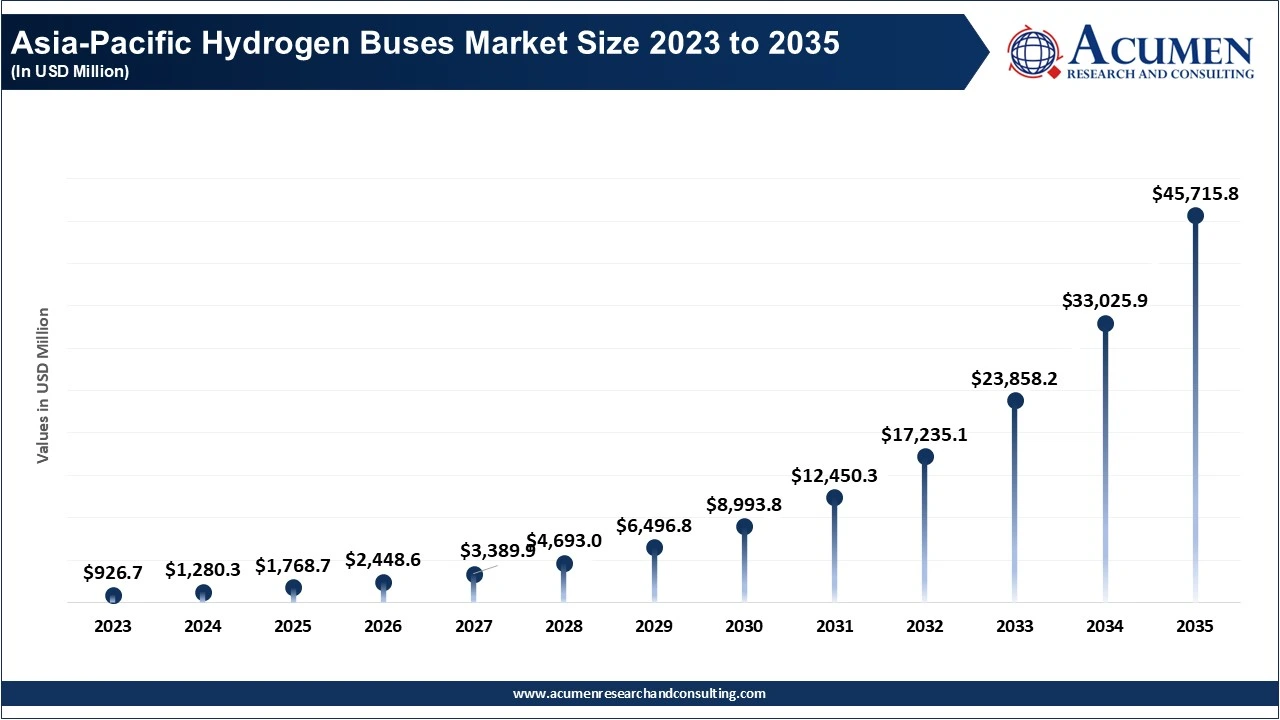
Asia Pacific led the hydrogen buses market in 2025, this leadership is a result of a rare trifecta of synchronized policy, manufacturing prowess and the critical necessity to deal with environment. In much of Asia Pacific, hydrogen mobility is being integrated not as a novel pilot study, but as a central part of national energy, industrial, and transport policy. China dominates much of Asia Pacific's hydrogen bus leadership. It has rapidly transitioned from pilots and experimental projects to large scale deployments over the last few years, building entire hydrogen value chains across its vast urban and industrial clusters.
India & Its Long Term Growth Opportunity in Hydrogen Buses Market
India presents itself as perhaps the single biggest long term opportunity in the hydrogen bus market in the Asia Pacific region. While it remains in the infancy stages, its fundamental structure is set up well to be a large beneficiary of hydrogen mobility over the next decade. India boasts one of the largest public bus networks in the world, many of which operate on diesel fuel. The launch of the National Green Hydrogen Mission has cemented the country's ambitions to build the entire value chain. Early hydrogen bus pilots have already commenced in several areas of India, often targeting locations such as high altitudes or remote long distances where battery electric buses are less viable. These trials offer a valuable window into operational characteristics, fuel needs and cost structures.
European Countries to Boom with Government Initiatives
The second largest market share was for Europe, driven by restrictive climate regulations and emission targets. Contrary to AP, which sees industrial strategy to be key driver to the hydrogen bus market, Europe’s hydrogen bus market adoption is embedded within climate policy and decarbonization efforts of public transport, as many European cities have legally binding climate neutral targets and hydrogen buses represent a highly visible and relevant approach to achieve those targets by substitution of diesel buses.
Government Support and Incentives in Europe
- Perhaps the biggest impetus to the growth of hydrogen buses across Europe has come from government support. At the European Union level, under the Green Deal and overall climate packages, money is available under a variety of funded programs, which benefits hydrogen mobility development, ranging from purchasing vehicles to constructing refueling infrastructure and making hydrogen buses affordable to purchase and operate by public transport companies.
- The two most important national supporters to hydrogen bus purchase are Germany with billions of euro investment under the national hydrogen strategy on production, infrastructure, and mobility, and France with significant state funding programs to support heavy-duty transport decarb.
- UK is also pushing ahead with funding under its net-zero transportation roadmap, while Netherlands and Nordic countries have tied hydrogen mobility up with the expansion of renewables like wind power to produce green hydrogen.
Hydrogen Buses Market Segmental Analysis
Bus Type Insight
Single-deck hydrogen buses represented the largest share of the market with 36.89% in 2025. The primary reason is that cities desire technologies that can be deployed relatively quickly without extensive modifications to their existing infrastructure. The vast majority of urban routes in all parts of the world are relatively short or medium-distance with frequent stop-and-start operation, an environment well-suited to single-deck buses that are relatively lighter, cheaper, and more simple to maintain than their double-deck counterparts. For the most part, transport authorities are looking for fleet renewal rather than capacity growth, so the priority is often on replacing diesel buses as quickly as possible as opposed to carrying higher numbers of people. The result of this is that the vast majority of city-based pilot programs (currently usually between 20 and 200 buses) begin with single-deck vehicles as they require the least infrastructure investment and logistical simplicity.
Hydrogen Buses Market, By Bus Type Revenue (US$ Mn), 2023-2025
| Bus Type | 2023 | 2024 | 2025 |
|---|---|---|---|
| Single-Decker Hydrogen Buses | 478.7 | 665.7 | 925.9 |
| Double-Decker Hydrogen Buses | 198.8 | 275.9 | 382.9 |
| Fuel Cell Hybrid Buses | 341.8 | 473.7 | 656.4 |
| Battery Electric Hydrogen Buses | 285.9 | 394.7 | 544.8 |
Fuel cell hybrid buses segment accounted for 26.15% of all new vehicles in 2025, and this technology is subtly gaining ground in mixed urban-suburban operating environments. They can leverage the hybrid drive system for regenerative braking and peak acceleration support, resulting in an average decrease of 15-25% in the amount of hydrogen fuel consumed. That level of operational cost saving has proven crucial, as hydrogen fuel cost remains a large portion of the operating costs for many fleet operators.
Fuel Type Insight
The green hydrogen segment’s market share in 2025 was 57.96%. This can directly be attributed to how hydrogen mobility has begun closely tying itself to renewable energy expansion. Governments are no longer content with "low-emission" transport, they require "zero lifecycle" emissions transport and these purchase requirements are globally shifting.
The cost differential between green and grey hydrogen has been declining significantly. Green H2 cost 3-4 times that of grey H2 in 2020; by 2025 it is estimated that it will be only 1.5-2 times the cost of grey H2 in certain areas due to cheaper solar and electrolyzer production scale.
Hydrogen Buses Market, By Fuel Type Revenue (US$ Mn), 2023-2025
| Fuel Type | 2023 | 2024 | 2025 |
|---|---|---|---|
| Green Hydrogen | 741.1 | 1026 | 1454.7 |
| Blue Hydrogen | 191.7 | 267 | 364.3 |
| Grey Hydrogen | 372.4 | 517 | 691 |
The grey hydrogen segment held 27.53% share in 2025. Countries undergoing early transitions will use grey H2 to begin their H2 bus deployment and develop their fueling infrastructure before ramping up green production capacity. On the other hand, the blue hydrogen will be used as a transitional technology. Countries with large natural gas resources will use it to ramp up hydrogen fueling infrastructure capacity more rapidly before transitioning entirely to green production.
Propulsion Type Insight
The share of hydrogen Internal Combustion Engine (ICE) segment as leading one in 2025 was a substantial 59.50% and it is predicted to retain majority share in the near future. The main factor is that the Hydrogen ICE bus offers the smoothest transition path for bus manufacturers, utilizing many aspects of existing engine supply chain, skilled workforce and after-care systems with minimal changes, and therefore reducing capital costs and operational risk for most operators.
The initial investment for the Hydrogen ICE bus is also 20-30% less than that of a fuel cell bus. This relatively lower cost makes Hydrogen ICE buses desirable for developing countries and transit agencies with budget constraints.
Hydrogen Buses Market, By Propulsion Type Revenue (US$ Mn), 2023-2025
| Propulsion Type | 2023 | 2024 | 2025 |
|---|---|---|---|
| Internal Combustion Engine (ICE) | 801.5 | 1,114.7 | 1,494.1 |
| Fuel Cell Electric Vehicle (FCEV) | 503.7 | 695.3 | 1,015.9 |
The fuel cell electric segment held 40.50% in 2025, but expected to achieve a larger share in the long run. The fuel cell bus uses less energy per kilometer and has a longer driving range than electric buses (300-500 km per refill vs. Mid-day recharges of battery electric buses), and its refueling process takes about 10-15 minutes like diesel buses so as not to disrupt established transit operation schedules.
Manufacturing Insight
With 71.20% in 2025, the new hydrogen buses segment dominated the market, since authorities and public transit companies seem to have a better forward looking vision rather than just experiment. Hydrogen buses are not simply an engine substitution, the chassis must be completely redesigned with hydrogen storage capacity strengthened, thermal management must be improved and the safety integrated. New hydrogen buses have better range, efficiency and reliability.
Hydrogen Buses Market, By Manufacturing Type Revenue (US$ Mn), 2023-2025
| Manufacturing Type | 2023 | 2024 | 2025 |
|---|---|---|---|
| New Hydrogen Bus | 905.8 | 1,258.3 | 1,785.9 |
| Retrofitted | 399.4 | 551.7 | 724.1 |
The retrofitted hydrogen buses segment accounted for 28.80% in 2025. There is still a significant amount of large diesel bus fleets that have half its useful life left and it would not be financially feasible to retire them straight away. This retrofitted segment seems to provide a "compromise". With the cost reduction of up to 40%-50% compared to new hydrogen bus, the public transit sector can still achieve great amount of emission reduction while minimizing the immediate cost burden; this seems a good solution in less developed markets where investment ability is lower but with increased environmental awareness.
Power Output Insight
The 100–200 kW range segment occupied a commanding majority share of 44.20% of the market in 2025, as this power range closely mirrors the operational requirements of conventional urban transport services. Conventional transit bus duty cycles, marked by stop-and-go traffic and average passenger loads in short to medium-range journeys, are perfectly matched with the torque generated from buses with a power range between 100 and 200 kW, which also keeps hydrogen consumption within manageable limits, an important factor in terms of operational expenditure. For a typical transit authority, this segment presents an optimal blend of performance characteristics, fuel consumption efficiency and overall cost effectiveness, which allows it to be considered as the workhorse category for the widespread adoption of hydrogen buses.
Hydrogen Buses Market, By Power Output Revenue (US$ Mn), 2023-2025
| Power Output | 2023 | 2024 | 2025 |
|---|---|---|---|
| Below 100kW | 300.7 | 419.0 | 583.9 |
| 100-200kW | 575.8 | 799.1 | 1,109.1 |
| Above 200kW | 428.7 | 591.9 | 817.0 |
The market for hydrogen buses above 200 kW stands at a significant 32.50%, attributed to increasing demand for performance buses that meet the demands of more challenging transit routes. High-powered hydrogen buses are considered more suitable for intercity routes, hilly terrains and BRT services due to the significantly better acceleration and passenger carrying capacities that they provide. With increasing proliferation of hydrogen infrastructure and fuel cells capable of producing significantly more power, this category is expected to witness healthy growth in the long-haul hydrogen mobility segments.
Technology Insight
The Proton Exchange Membrane (PEM) fuel cells segment had a commanding share of 47.40% in 2025, as this type of fuel cell was specifically designed with transportation as its target. PEM systems can start up quickly, operate at low temperatures and are small enough to fit inside bus design. As a result, PEM systems are ideal for everyday transit transit because of the high necessity for reliable, fast start up times. Investments in research and development over the last ten years have led to enhanced durability and decreasing costs. The majority of all hydrogen bus manufacturers agree that PEM fuel cells are the ultimate solution for mobility.
Hydrogen Buses Market, By Technology Revenue (US$ Mn), 2023-2025
| Technology | 2023 | 2024 | 2025 |
|---|---|---|---|
| Proton Exchange Membrane Fuel Cell (PEMFC) | 624.3 | 862.9 | 1,188.9 |
| Solid Oxide Fuel Cell (SOFC) | 255.5 | 354.7 | 491.0 |
| Alkaline Fuel Cell (AFC) | 385.6 | 537.3 | 746.4 |
| Others | 39.8 | 55.1 | 83.7 |
On the other hand, the alkaline fuel cells segment had a share of 29.70%, driven by low manufacturing costs and established procedures. Although they are neither as compact nor as responsive as PEM systems, their lower cost of manufacturing make them an attractive choice for developing markets. In addition to this, many developing countries seeking to break into the hydrogen mobility markets will likely opt for alkaline fuel cells.
Application Insight
With 42.70% share in 2025, the public transportation segment led the market for hydrogen buses. The dominance of public transport in the hydrogen bus market is largely due to the very nature of how these public transit systems operate. The established routes, central depots and planned routes, fixed daily mileage, made these city bus fleets a comparatively easy place to shift into hydrogen fuel. Increasingly urban pollution is a growing issue for governments, and diesels are a leading cause of particulate and NOx pollution for cities.
As such, a visible solution to a large contributor to the pollution issues is highly beneficial in showcasing government commitments and progress for cities, along with making those journeys and commutes a quieter, smoother emission-free experience, thereby improving public opinion.
Hydrogen Buses Market, By Application Revenue (US$ Mn), 2023-2025
| Application | 2023 | 2024 | 2025 |
|---|---|---|---|
| Public Transportation | 553.9 | 770.6 | 1,071.9 |
| Private Transportation | 252.7 | 349.8 | 484.3 |
| School Transportation | 133.8 | 186.1 | 258.8 |
| Tourism and Airport Transportation | 364.8 | 503.5 | 695.0 |
In 2025, the tourism and airport transportation segment followed closely behind, at 27.70% of the market. Tourism and airport transportation is a fast-growing segment and these locations fit the hydrogen buses perfectly due to their already established routes, and centralized refueling stations, combined with a growing requirement to appear 'green', as such it's a fantastic opportunity to exhibit commitment to carbon-neutral transit.
Recent News
- In April 2026, Tata Motors announced the launch of hydrogen bus production at is Uttar Pradesh plant. This pivot aligns with the broader national goal of decarbonising heavy commercial transport and solidifies the Lucknow unit’s role in the company’s long-term vision for a net-zero future
- Cochin International Airport, in February 2026 introduced the first hydrogen-fueled passenger buses in India with the airport transport linked to the green hydrogen production at the airport itself. This was possible after a Memorandum of Agreement signed with the Kerala Hydrogen Valley Innovation Cluster Foundation.
Hydrogen Buses Market Top Players
- Toyota Motor Corporation
- Hyundai Motor Company
- Ballard Power Systems
- Wrightbus
- Solaris Bus & Coach
- Van Hool
- Daimler Truck AG
- Volvo Group
- New Flyer Industries (NFI Group)
- Tata Motors
Hydrogen Buses Market Segmentation
By Bus Type
- Single-decker Hydrogen Buses
- Double-decker Hydrogen Buses
- Fuel Cell Hybrid Buses
- Battery Electric Hydrogen Buses
By Fuel Type
- Green Hydrogen
- Blue Hydrogen
- Grey Hydrogen
By Propulsion Type
- Internal Combustion Engine (ICE)
- Fuel Cell Electric Vehicle
By Manufacturing
- New Hydrogen Bus
- Retrofitted
By Power Output
- Below 100kW
- 100-200kW
- Above 200kW
By Technology
- Proton Exchange Membrane Fuel Cell
- Solid Oxide Fuel Cell
- Alkaline Fuel Cell
- Others
By Application
- Public Transportation
- Private Transportation
- School Transportation
- Tourism & Airport Transportation
By Region
- North America
- Asia Pacific
- Europe
- Latin America
- Middle East and Africa
Looking for discounts, bulk pricing, or custom solutions? Contact us today at sales@acumenresearchandconsulting.com
Frequently Asked Questions

Other Automotive And Transportation Reports
January 2025
December 2024
December 2024
February 2023