
Hyperscale Data Center Market Size, Share, Industry Report 2026 - 2035
Hyperscale Data Center Market (By Component: Hardware, Software, Services; By Power Capacity: 20 MW To 50 MW, 50 MW To 100 MW, 100 MW to 150 MW, 150 MW and Above; By Organization Size: Large Enterprises, Small and Medium Enterprises; By End Use: Cloud Providers, Colocation Providers, Enterprises) - Global Industry Analysis, Size, Share, Analysis, Trends and Forecast 2026 - 2035
- Last Updated: 31 Dec 2025
- Report Code: ARC3882
- Category: ICT
Hyperscale Data Center Market Size and Forecast 2026 - 2035
The global hyperscale data center market size accounted for USD 192.1 billion in 2025 and is projected to attain around USD 1,707.6 billion by 2035, registering a CAGR of 24.3% from 2026 to 2035. The growing adoption of AI and high-performance computing workloads is fueling the demand of hyperscale data centers. In addition, the proliferation of sustainability and green data center initiatives is opportunistic for the market growth.
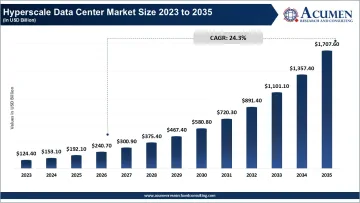
Hyperscale data center refers to a large-scale data center that provides extreme scalability and can handle large volumes of workloads in collaboration with its high-performance network infrastructure, network connectivity, and low latency. A hyperscale data center requires a location that can accommodate all the hardware associated with the data center, such as at least 5000 servers and over thousands of miles of connection hardware. This type of data center can also be referred to as a cloud data center, which refers to a very large, centralized, and highly efficient customized computing facility that is controlled by a single management entity. Increasing adoption of cloud, IoT, and big data among industry verticals drives the demand for hyperscale data centers.
Report Highlights
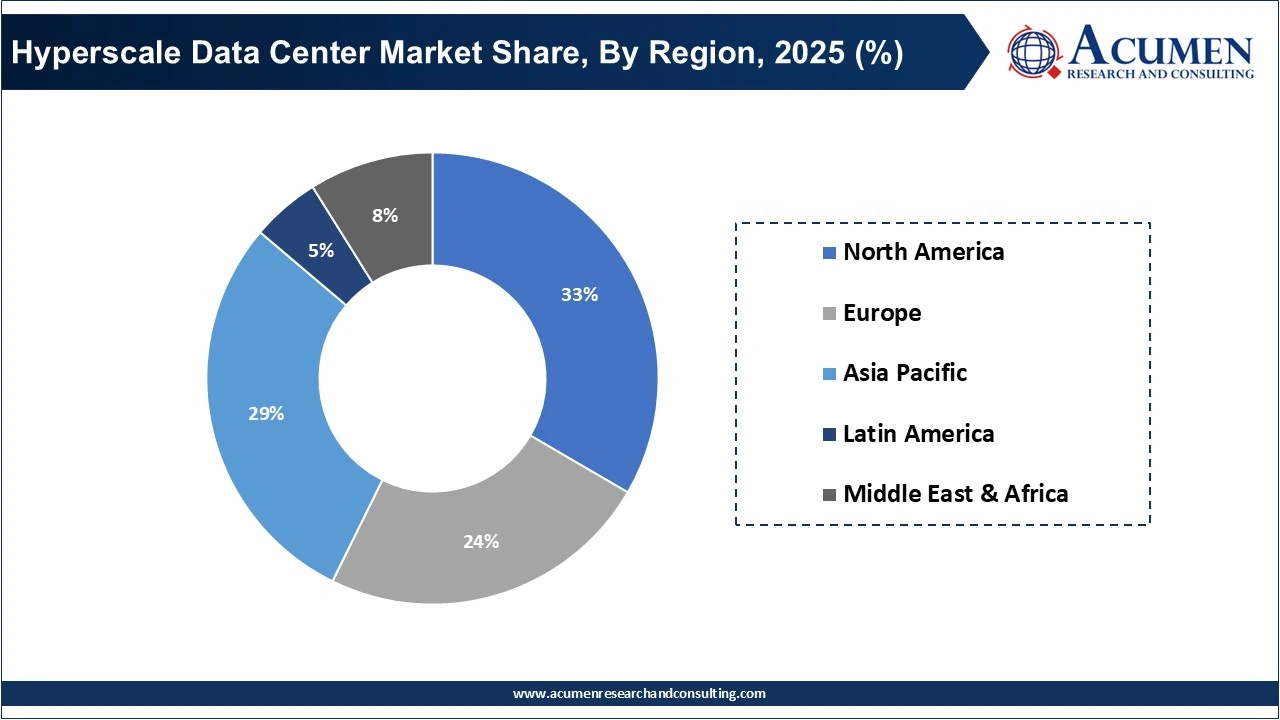
- By Region, the North America hyperscale data center market accounted for a revenue of USD 64.2 billion in 2025.
- By Region, the Asia-Pacific hyperscale data center market is expected to grow at a lucrative CAGR of over 25.8% from 2026 to 2035.
- By Component, the hardware segment represented 45% of the total market share in 2025.
- By Power Capacity, the 50 MW to 100 MW segment accounted for nearly 33% of the market share 2025.
- By Organization Size, large enterprises accounted for 74% of the hyperscale data center market share in 2025.
- By End Use, the cloud providers segment represented 62% of the total market share in 2025.
Hyperscale Data Center Market Dynamics
Market Drivers
Rising Need for Data Processing and Storage Capabilities
- The data centers at a large scale provide facilities to process a huge amount of data instantly. Also, there has been a tremendous growth in data, specifically due to the integration of IoT devices, social networking sites, online shopping, and other such services. As a consequence, there has been a need for a novel technology that can handle and process this enormous amount of data. Consequently, these hyperscale data centers are developed to meet the demands related to data storage and networking of users who need infrastructure that can handle a substantial amount of data instantly with the help of latest modern advancements such as AI, machine learning, virtual reality, and various other aspects. Due to the increasing need for storing a massive amount of data, there is projected be an increasing demand for these data centers in the coming years.
Increasing Demand for Cloud Computing Solutions
- With increased adoption of cloud computing services among enterprises for all scales of storage and computing needs, the overall IT spends are increasing in these businesses. The recent trend to operate in a work-from-home environment, with increased adoption of digital collaboration and communications solutions, has accelerated the demand for cloud computing services, especially in terms of project management solutions, communication solutions, and virtual desktop infrastructure.
Market Restraints
High Cost of Energy
- The cost of constructing and running a data center can develop high upfront investment and high operating costs, especially concerning consumption and cooling. Many IT devices and server tiers are capable of generating a substantial amount of heat at a local rack level. Therefore, there arises a need for a cooling system. The high power is a crucial requirement for supporting efficient cooling systems to keep hardware away from thermal overload conditions. The more usage of large volumes of energy by various operating servers and networking devices in order to continue their functions also boosts the total spending by data centers on power consumption. This contributes to increasing sustainability issues due to high energy consumption by the entire computing sector. Additionally, the integration between data center operations and advanced AI platforms, high performance computing, and consumption of large amounts of electrical power can result in increased expenses for data center maintenance and monitoring. Thus, the increased cost of energy is the key impeding factor for the market.
Grid Limitations and Power Availability Constraints
- One of the major forces that slows down the hyperscale data center market is the inability to access power. Hyperscale data centers require enormous amounts of power. However, the local power infrastructure in regions may not always be able to supply this power to hyperscale data centers. The availability of power from the grid and from renewable energy resources may delay the deployment of new data centers. Moreover, it has been observed that the concern for water usage is creating regulatory challenges that make it difficult to build new data centers.
Market Opportunities
Integration of Generative AI
- The integration of generative AI into hyperscale data centers addresses the ever-increasing complexity of data and workload associated with Gen AI applications. The increasing demand to handle a massive volume of AI-specialized servers, high electricity costs, and robust operational efficiency is expected to drive demand for high-scale AI-operated data centers during the forecast period. Gen AI automates many tasks, smooths workflow, improves operational efficiency, and reduces a number of operational and maintenance costs of the data center. It is observed in a recent survey that by 2025, half of all cloud data centers present across the globe use Artificial Intelligence to improve the performance and efficiency of the data center.
Adoption of Advanced Cooling and Energy-Efficient Technologies
- One of the most significant opportunities that hyperscale data center companies can reap is through the incorporation of next-generation cooling technologies and energy-efficient technologies. Technologies that fall into this category include liquid-cooling technology, immersion-cooling technology, energy management systems that utilize artificial intelligence, and modular data centers. Such technologies provide a higher level of server density with lower energy consumption, thus allowing hyperscale data center companies to enhance their performance per watt, achieve their environmental goals, and meet their environmental regulations.
Hyperscale Data Center Market Report Scope
| Attribute | Details |
|---|---|
| Hyperscale Data Center Market Size 2025 | USD 192.1 Billion |
| Hyperscale Data Center Market Forecast 2035 | USD 1,707.6 Billion |
| Hyperscale Data Center Market CAGR During 2026 – 2035 | 24.3% |
| Analysis Period | 2023 – 2035 |
| Base Year | 2025 |
| Forecast Data | 2026 – 2035 |
| Segments Covered | By Component, By Power Capacity, By Organization Size, By End Use, and By Geography |
| Regional Scope | North America, Europe, Asia-Pacific, Latin America, and Middle East & Africa |
| Key Companies Profiled | Amazon Web Services, Inc., Cisco Systems, Inc., IBM Corporation, Oracle Corporation, Arista Networks, Inc., Microsoft Corporation, Google, Inc., Intel Corporation, NVIDIA Corporation, and Ericsson, Inc. |
| Report Coverage | Market Trends, Drivers, Restraints, Competitive Analysis, Player Profiling, Covid-19 Analysis, Regulation Analysis |
Hyperscale Data Center Market Regional Analysis
North America dominated the hyperscale data center market by garnering a major market share in 2025. This is attributed to the well-established presence of prominent technology players, widespread acceptance of new technologies, well-developed IT infrastructure, and effective efforts in digital transformation. The presence of a well-developed IT infrastructure impacts positively in promoting a large adoption of this technology. Also, a large number of technology firms facilitate a highly competitive market.
| Region | Market Share, 2025 (%) | Key Highlights |
|---|---|---|
| North America | 33% | Dominant because of the robust presence of key tech players, high adoption of novel technologies, advanced IT infrastructure, and efficient initiatives in digital transformation. |
| Europe | 24% | Strict data protection laws (GDPR) and rapid digital transformation across public and private sectors are driving market growth. |
| Asia-Pacific | 29% | The region’s steady growth is driven by rapid digitization, and expansion of the IT sector. |
| MEA | 9% | MEA is observing heightened demand as governments and enterprises increase the pace of digitalization agendas and seek cost-efficient solutions. |
| Latin America | 5% | In Latin America, a growing trend is seen whereby SMEs are swiftly deploying localized digital applications. |
The Asia-Pacific market is expected to observe a significant growth throughout the forecast period. Digitization and development of the IT infrastructure are fueling the growth of the Asia-Pacific market. Large organizations in the Asia-Pacific are increasing the adoption of hyperscale data centers, which are used for the deployment and development of applications. Countries such as India, Japan, China, Australia, and South Korea are contributing significantly to the growth of the Asia-Pacific market.
Hyperscale Data Center Market Segmental Insights
The worldwide market for hyperscale data center is split based on component, power capacity, organization size, end use, and geography.
Component Insights
Based on component the market is segmented into hardware, software and services.
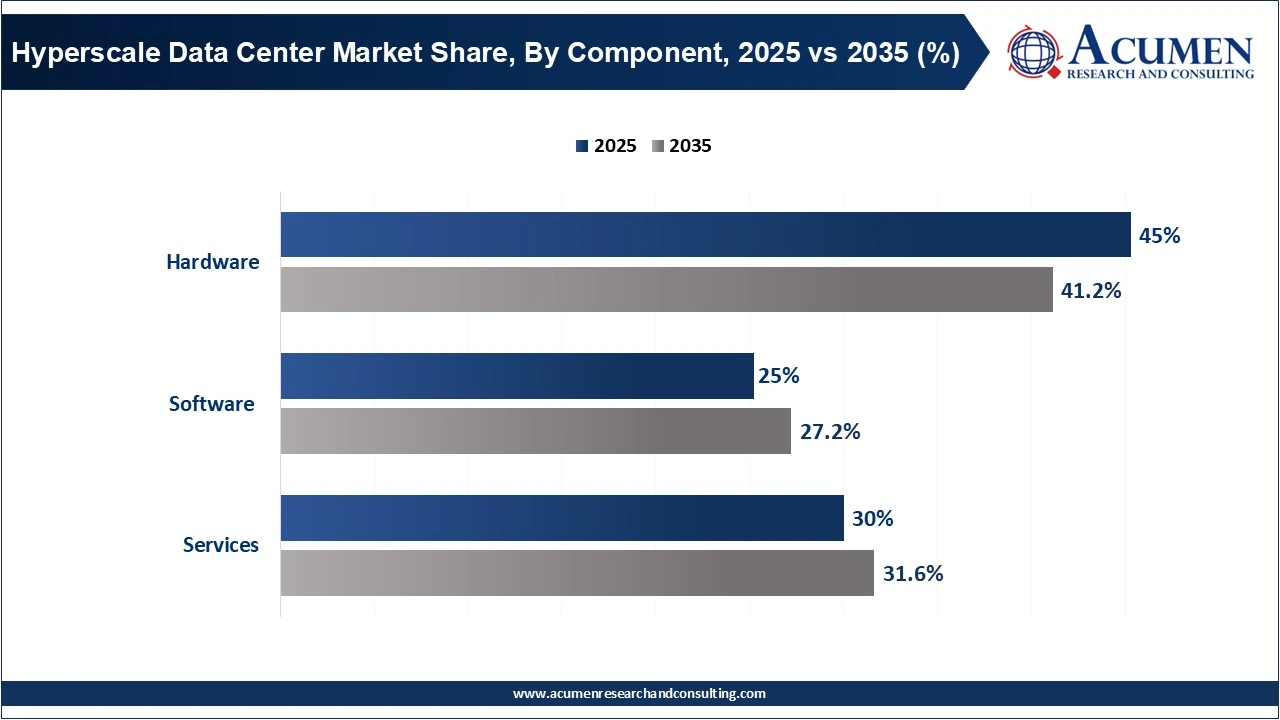
The hardware segment dominated the hyperscale data center market in 2025. The growth is facilitated by increasing concerns related to data privacy and regulatory pressures that impacts the hardware landscape as well. Hyperscale data centers are required to ensure that regional data laws along with the security protocols are maintained, by integrating hardware-level encryption, securing boot process mechanisms, and maintaining superior physical security. These types of hardware innovations are thus considered vital for preserving data integrity and instilling confidence among enterprise clients, this presents a strong impetus toward continued investment and advancements in the hardware segment.
| Component | Market Share, 2025 (%) | Key Highlights |
|---|---|---|
| Hardware | 45% | Increasing concerns related to data privacy and regulatory pressures is boosting the market demand. |
| Software | 25% | The increasing need for smart data center management with the help of software-defined infrastructure is boosting the market demand. |
| Services | 29% | Demand for managed services, colocation partnerships, and lifecycle management services is rising as hyperscale operators seek to optimize costs and accelerate deployment timelines. |
Power Capacity Insights
According to the hyperscale data center industry analysis, in 2025, the 50 MW to 100 MW power capacity dominated the market. With the expansion of hyperscale providers into emerging markets and secondary data center hubs, the power capacities of the infrastructure supporting the data centers need to draw from large capacities to provide redundancy, low latency, and high availability. The power capacity ranging from 50 MW to 100 MW is in line with the future-proof strategy and the regional data sovereignty regulations.
| Power Capacity | Market Share, 2025 (%) | Key Highlights |
|---|---|---|
| 20 MW to 50 MW | 11% | Data centers in this range are increasingly deployed to support regional cloud expansion and edge computing needs, offering faster deployment and improved latency. |
| 50 MW to 100 MW | 33% | The power capacity ranging from 50 MW to 100 MW is in line with the future-proof strategy and the regional data sovereignty regulations. |
| 100 MW to 150 MW | 25% | Hyperscale operators are favoring this capacity range for large, centralized campuses that enable economies of scale and advanced energy-efficient infrastructure. |
| 150 MW and Above | 31% | Mega-scale data centers above 150 MW are emerging as a key trend, driven by massive AI workloads, GPU clusters, and long-term investments in renewable power sourcing. |
Organization Size Insights
The large enterprises segment led the hyperscale data center sector owing to the growing adoption of these platforms for complex project handling, management, and data analytics. This can be attributed to the growing requirements for digital transformation, data-intensive applications, and scalable cloud infrastructure. Many large companies, including banks, manufacturing companies, telecommunication players, and the healthcare sector, are increasingly resorting to a cloud-first approach. This has led to the adoption of hyperscale data centers by companies for handling a huge amount of data and/or providing a resilient application or applications.
| Organization Size | Market Share, 2025 (%) | Key Highlights |
|---|---|---|
| Large Enterprises | 74% | Dominant because of the growing adoption of complex project handling, management, and data analytics. |
| Small and Medium-sized Enterprises | 26% | SMEs are increasingly adopting hyperscale cloud data center services to access scalable, cost-efficient computing power without heavy upfront infrastructure investments, supporting digital transformation and business agility. |
End Use Insights
The cloud providers segment held the largest market share in 2025. Leading players like Amazon Web Services (AWS), Microsoft Azure, Google Cloud, and Alibaba Cloud are heavily investing in the development of hyperscale data centers in order to handle the increasing workload of their customers, ensure high availability, and have a larger presence globally. These players need huge infrastructure that can scale to offer an ever-increasing number of services like virtual machines, databases, AI/ML platforms, and analytics solutions that run on hyperscale facilities.
| End Use | Market Share, 2025 (%) | Key Highlights |
|---|---|---|
| Cloud Providers | 62% | Leading players like Amazon Web Services (AWS), Microsoft Azure, Google Cloud, and Alibaba Cloud are heavily investing in the development of hyperscale data centers in order to handle the increasing workload of their customers, ensure high availability, and have a larger presence globally. |
| Colocation Providers | 12% | Colocation providers are increasingly partnering with hyperscale operators and expanding high-density, scalable facilities to meet growing cloud and AI infrastructure demand. |
| Enterprises | 26% | Enterprises are shifting toward hybrid and multi-cloud strategies, driving greater reliance on hyperscale data centers for flexible, secure, and cost-efficient IT infrastructure. |
Hyperscale Data Center Market Players
- Amazon Web Services, Inc.
- Cisco Systems, Inc.
- IBM Corporation
- Oracle Corporation
- Arista Networks, Inc.
- Microsoft Corporation
- Google, Inc.
- Intel Corporation
- NVIDIA Corporation
- Ericsson, Inc.
Hyperscale Data Center Market Segmentation
By Component
- Hardware
- Software
- Services
By Power Capacity
- 20 MW To 50 MW
- 50 MW To 100 MW
- 100 MW to 150 MW
- 150 MW and Above
By Organization Size
- Large Enterprises
- Small and Medium Enterprises
By End Use
- Cloud Providers
- Colocation Providers
- Enterprises
By Region
- North America
- U.S.
- Canada
- Europe
- U.K.
- Germany
- France
- Spain
- Rest of Europe
- Asia-Pacific
- India
- Japan
- China
- Australia
- South Korea
- Rest of Asia-Pacific
- Latin America
- Brazil
- Mexico
- Rest of LATAM
- Middle East & Africa
- South Africa
- GCC Countries
- Rest of the Middle East & Africa (ME&A)
Looking for discounts, bulk pricing, or custom solutions? Contact us today at sales@acumenresearchandconsulting.com
Frequently Asked Questions

Other ICT Reports
May 2026
June 2024
November 2022
July 2023