February 2023

Industrial Belt Scale Market (By Scale Type: Single-Idler, Dual-Idler, Triple-Idler, Multi-Idler; By Technology: Electronic Load-Cell, Mechanical, Hybrid, IoT; By Application: Process Control, Load Verification, Inventory Management, Production Monitoring, Batching/Blending; By End Use: Mining, Cement, Steel & Metallurgy, Aggregates & Quarrying, Power Generation, Fertilizers & Chemicals, Food & Beverage, Ports & Bulk Terminals, Logistics & Warehousing) - Global Industry Analysis, Size, Share, Analysis, Trends and Forecast 2026 - 2035
The global industrial belt scale market size accounted for USD 1,589.8 million in 2025 and is projected to reach around USD 2,385.0 million by 2035, registering a CAGR of 4.0% from 2026 to 2035. The increasing demand for precise and real-time material measurement is fueling the demand of industrial belt scales. In addition, the expansion of industrial automation, smart manufacturing, and IoT is opportunistic for the market growth.
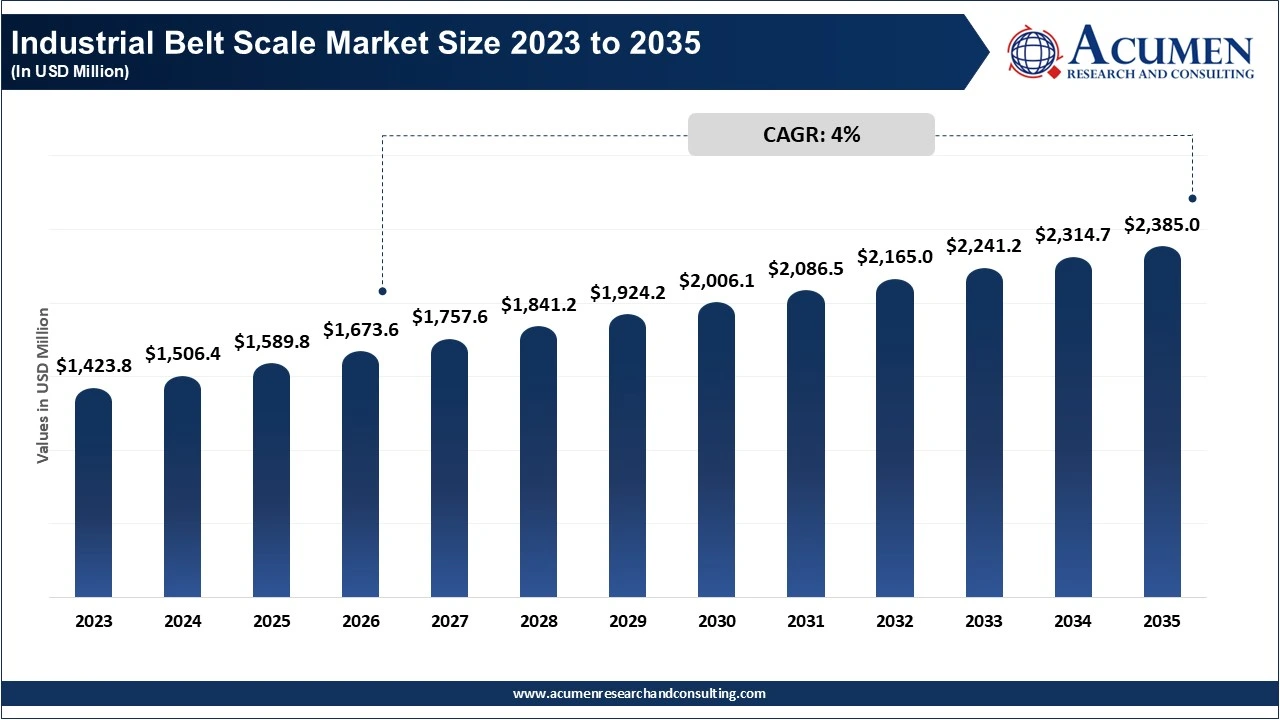
The market is undergoing a transformative growth process, owing to the technological evolution that is resulting in the adoption of efficient material handling techniques among various industries such as mining, logistics, and others, thereby increasing the efficiency of the operation and the accurate measurement of weight. This, in turn, is driven by the need for real-time data analysis, thereby allowing the businesses to efficiently optimize their processes and eliminate any waste in the process. In addition to the technological evolution, the environmental factors are also driving the growth of the market. Industries the market are becoming more environment-conscious, and thereby, the need is increasing for organizations to adopt environmentally sustainable approaches that boost the use of belt scales, while adopting energy efficiency and material wastage in the process of the operation of the belt scales.
Rising Demand for Automation
Technological Advancements
High Cost of Installation and Calibration
Sensitivity to Environmental Conditions
Sustainability Initiatives
Customization and Versatility
| Attribute | Details |
| Industrial Belt Scale Market Size 2025 | USD 1,589.8 Million |
| Industrial Belt Scale Market Forecast 2035 | USD 2,385.0 Million |
| Industrial Belt Scale Market CAGR During 2026 – 2035 | 4.0% |
| Analysis Period | 2023 – 2035 |
| Base Year | 2025 |
| Forecast Data | 2026 – 2035 |
| Segments Covered | By Scale Type, By Technology, By Application, By End Use, and By Geography |
| Regional Scope | North America, Europe, Asia-Pacific, Latin America, and Middle East & Africa |
| Key Companies Profiled | Siemens, Thermo Fisher Scientific, Schenck Process, Rice Lake Weighing Systems, Mettler-Toledo, Thayer Scale, Merrick Industries, Tecweigh/Tecnetics Industries, Minebea Intec, and Yamato Scale |
| Report Coverage | Market Trends, Drivers, Restraints, Competitive Analysis, Player Profiling, Covid-19 Analysis, Regulation Analysis |
The worldwide market for industrial belt scale is split based on scale type, technology, application, end use, and geography.
Based on scale type, the market is segmented into single-idler, dual-idler, triple-idler and multi-idler.
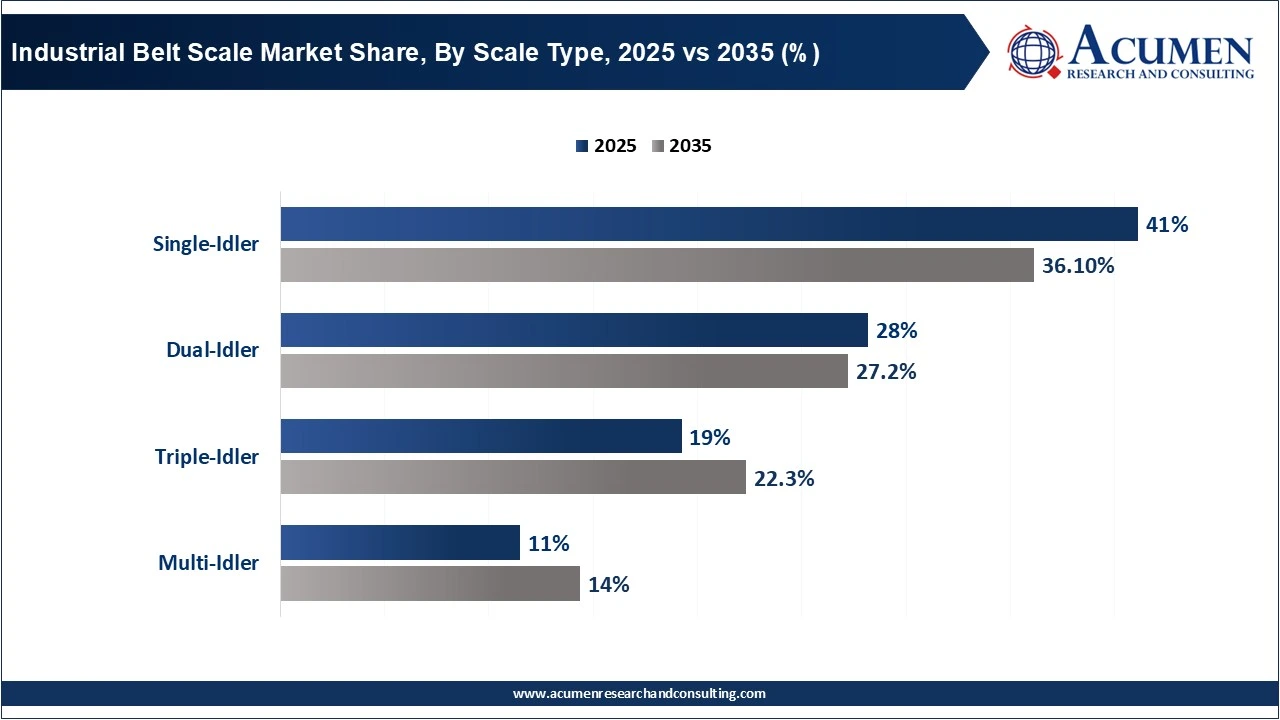
The single-idler segment dominated the industrial belt scale market in 2025. The single-idler belt scale is cost-effective, with a simple mechanics system, and can track lower-volume materials. It also enables the tracking of real-time data, which is more important than accuracy in the process, especially in the mining and cement industries. The multi-idler belt scale segment is projected to grow at the fastest CAGR owing to its exceptional properties including stability, extreme precision, and continuous operation.
| Scale Type | Market Share, 2025 (%) | Key Highlights |
| Single-Idler | 41% | Most widely adopted; cost-effective and suitable for general industrial applications. |
| Dual-Idler | 28% | Higher accuracy scale, which is preferred in cement, food, and mid-capacity systems. |
| Triple-Idler | 19% | Used for higher accuracy in mining, steel, and chemical sectors. |
| Multi-Idler | 11% | Niche, but essential for long conveyors and high-capacity continuous operations. |
Based on technology, the market is classified into electronic load-cell, mechanical, hybrid and IoT.
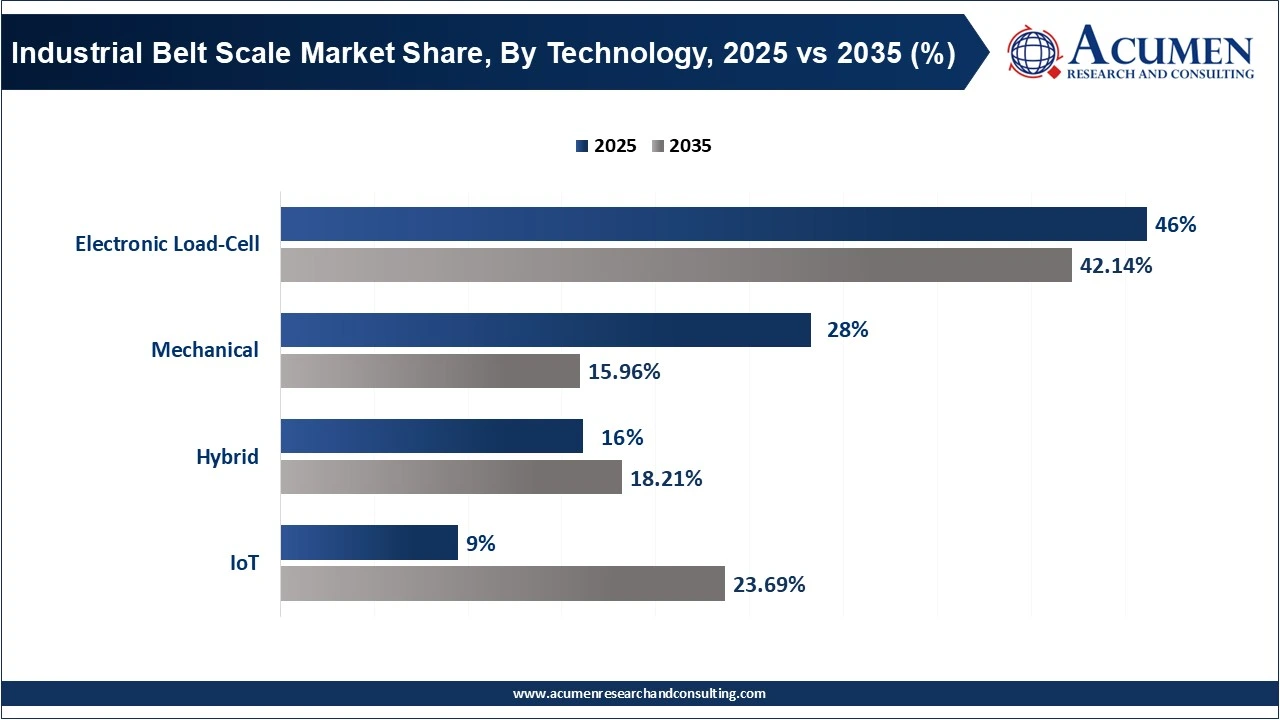
In 2025, the electronic load-cell technology dominated the market. The segment is leading because of its unmatched features, which include real-time tracking, efficiency, and accurate inventory management. The segment has immense potential and can be used for critical productivity and compliance requirements in the logistics, manufacturing, and mining sectors. Current participants in this segment, which include ABB, Metso, and Yamato Scale, are helping electronic load-cell belt scales with advanced solutions based on electronic load-cell technology.
| Technology | Market Share, 2025 (%) | Key Highlights |
| Electronic Load-cell | 46% | Dominant due to higher accuracy, reliability, and rapid shift from mechanical systems. |
| Mechanical | 28% | Widely used in traditional mining and aggregates; cost-effective and rugged. |
| Hybrid | 16% | Adopted where users need accuracy and durability; popular in steel, cement, and chemicals. |
| IoT | 9% | Emerging; adoption driven by cloud monitoring and predictive maintenance. |
Based on technology, the market is classified into process control, load verification, inventory management, production monitoring, and batching/blending.
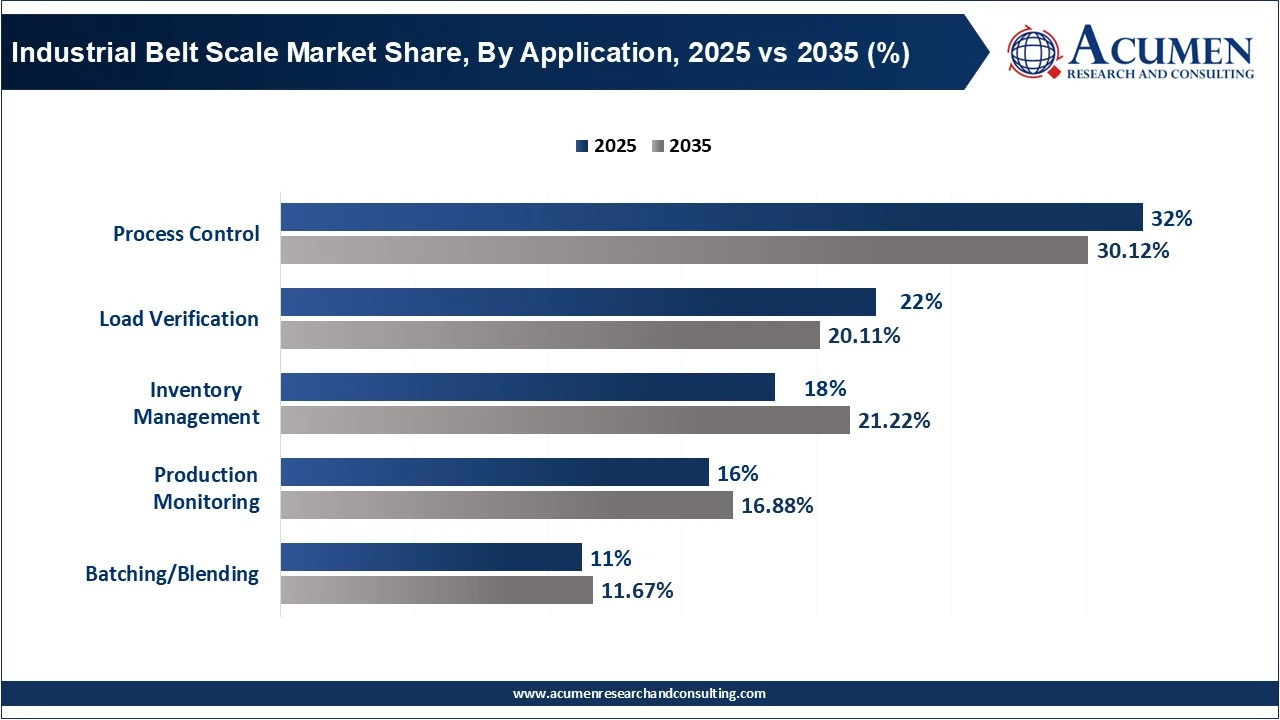
The process control application led the industrial belt scale sector. The segment is dominant because of the prominence of process controlling functions in every industry, allowing for maximum benefits with a minimum shutdown period. A steady supply of materials is critical for producing homogeneous products, which becomes easy with an industrial belt scale as it ensures the final product meets the desired product specifications.
| Application | Market Share, 2025 (%) | Key Highlights |
| Process Control | 32% | Core use case across mining, cement, and chemicals for continuous flow regulation. |
| Load Verification | 22% | Driven by strong need for weight accuracy in ports, terminals, aggregates, and logistics. |
| Inventory Management | 18% | Used for stock tracking in warehouses, silos, and bulk yards. |
| Production Monitoring | 16% | Supports plant KPIs, yield tracking, and operational efficiency. |
| Batching/Blending | 11% | Smaller but essential segment in food, chemicals, and fertilizer dosing lines. |
The mining segment held the largest market share in 2025. The segment is leading because of its advantages, which are uninterrupted flow of materials in sites with extreme conditions, such as mining sites, energy efficiency, improved worker safety, and quicker failure, consequently minimizing down time in mines and unnecessary costs of repairs. The belt scales can be applied in surface mining, crushing, underground mining, and screening.
| End Use | Market Share, 2025 (%) | Key Highlights |
| Mining | 27% | Largest consumer due to continuous, high-volume bulk material handling and the need for rugged, accurate belt scales. |
| Cement | 15% | Heavy use of conveyors for limestone, clinker, and raw material flow control drives strong adoption. |
| Steel & Metallurgy | 13% | Requires high-capacity and precise scales for ore, coke, pellet handling, and process monitoring. |
| Aggregates & Quarrying | 11% | Used extensively for gravel, sand, and stone processing; conveyor systems dominate operations. |
| Power Generation | 10% | Coal and biomass plants depend on belt scales for fuel feed rates, efficiency control, and emissions tracking. |
| Fertilizers & Chemicals | 9% | Demand driven by handling of powders, granules, and bulk chemicals requiring accurate dosing. |
| Food & Beverage | 8% | Adoption rising for grains, sugar, flour, and ingredients, though at lower capacities. |
| Ports & Bulk Terminals | 5% | Used for bulk commodity loading/unloading; fewer installations but critical for throughput accuracy. |
| Logistics & Warehousing | 2% | Smaller but fast-growing segment driven by automation, parcel handling, and inventory tracking. |
Asia-Pacific dominated the industrial belt scale market by garnering a major market share in 2025. The Asia-Pacific market is also expected to observe a significant growth throughout the forecast period. The growth in this region is driven primarily by rapid industrialization, especially in countries such as China and India. The demand for automation across various industries, such as manufacturing and logistics, along with supportive government initiatives, drives market growth. Focus on infrastructure development and modernization is another important factor driving the growth trajectory. China and India are emerging as key countries in this region, with an increasing number of local players entering into the manufacturing market. This has made the competitive landscape increasingly dynamic, with the prevalent existence of both domestic and international players. Companies such as Kistler-Morse and Belt-Way Scales Inc are expanding their presence by reaching out to customers with an emphasis on innovation while being cost-effective to meet various demands across the market.
| Region | Market Share, 2025 (%) | Key Highlights |
| North America | 23% | High adoption of digital load cells and modernization in mining, aggregates, and logistics. |
| Europe | 18% | Driven by Industry 4.0 upgrades and strict accuracy standards in manufacturing and bulk handling. |
| Asia-Pacific | 42% | Largest due to strong mining, infrastructure, cement, steel, and manufacturing expansion in China, India, and Southeast Asia. |
| MEA | 9% | Growth led by mining, construction, and port investments, especially in GCC and South Africa. |
| Latin America | 7% | Supported by mining (Chile, Peru), agriculture, and bulk terminals. |
By Scale Type
By Technology
By Application
By End Use
By Region
Looking for discounts, bulk pricing, or custom solutions? Contact us today at [email protected]

February 2023
September 2023
July 2022
February 2024
Trusted Market Intelligence | 2026–2035 Insights | Designed to Support Faster, Smarter Decisions
Thank you! Our team will reach out to you soon.