
Malaysia Online Food Delivery Market Size, Share, Trends and Forecast 2026 To 2035
Malaysia Online Food Delivery Market (By Type: Restaurant-to-consumer delivery, Platform-to-consumer delivery; By Customer Age: Generation Z, Millennials, Generation X, Baby Boomers; By Business Model: Order Focused, Logistics Based, Restaurant Specific; By Gender: Male, Female; By Payment Method: Cash On Delivery, Online) - Malaysia Industry Size, Share, Analysis, Trends and Forecast 2024 - 2032
- Last Updated: 07 Oct 2026
- Report Code: ARC1291
- Category: Consumer Goods and Food and Beverages
Malaysia Online Food Delivery Market Overview and Growth
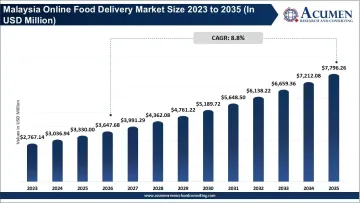
The Malaysia online food delivery market size was valued at USD 3,330 million in 2025 and is expected to reach USD 7,796.26 million by 2035; growing at a CAGR of 8.8% during the forecast period of 2026 to 2035. Growing consumer preference for convenience, promotions, and app-based ordering is also supporting sustained food delivery usage, with a 2026 Malaysian study finding that price sensitivity and promotions were the strongest behavioral drivers, followed by health and safety and convenience.
Market Size and Forecast
- 2025 Value: $3,330.00 Million
- 2026 Value: $3,647.68 Million
- 2035 Forecast: $7,796.26 Million
- Growth Rate: 8.8% CAGR (2026–2035)
Report Highlights
- By food service provider, independent restaurants dominated with 58.0% in 2025, while chain restaurants accounted for 27.0% and are projected to reach 34.0% by 2035.
- By delivery type, platform-to-consumer delivery represented 76.0% in 2025 and is projected to increase to 81.0% by 2035, highlighting the growing role of digital marketplaces in restaurant ordering and delivery fulfillment.
- By operating model, aggregator + 3PL accounted for 46.0% in 2025 and is projected to reach 52.0% by 2035, supported by restaurants seeking flexible third-party delivery capacity without maintaining dedicated rider fleets.
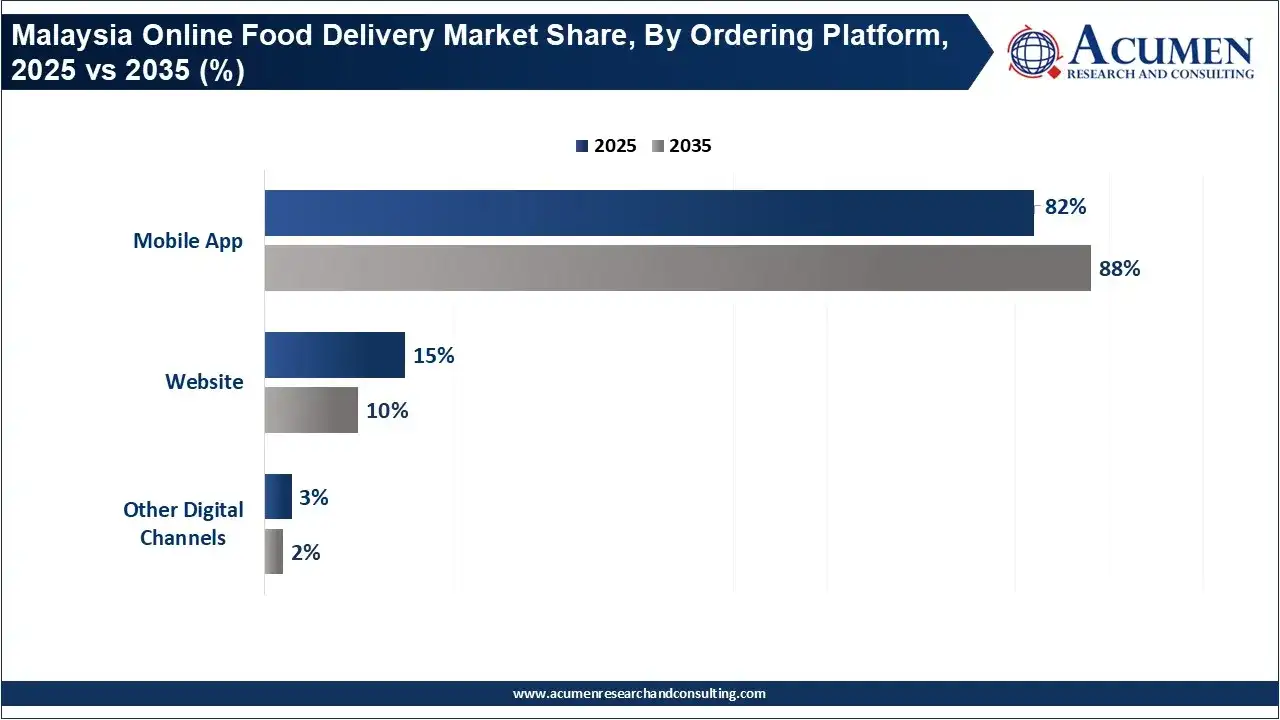
- By ordering platform, mobile apps accounted for 82.0% in 2025 and are projected to reach 88.0% by 2035, supported by integrated ordering, payment, location tracking, loyalty, promotions, and delivery notifications.
- By order type, on-demand/instant orders represented 88.0% in 2025, making them the dominant ordering format, while scheduled orders are projected to increase from 10.0% to 13.0% between 2025 and 2035.
- By cuisine/food category, Western/fast food represented 25.0% of online food delivery demand in 2025, followed closely by Malay/Malaysian cuisine at 24.0% and Chinese cuisine at 21.0%.
- By payment method, e-wallets represented 35.0% of online food delivery payments in 2025 and are projected to reach 42.0% by 2035, while Bank Negara Malaysia reported that e-payment transactions increased 25.0% to 18.4 billion in 2025.
- By digital payment adoption, active mobile banking users increased 8.7% to 25 million in 2025, while mobile banking accounted for 64.0% of the online banking channel, supporting the broader digital infrastructure used for food delivery transactions.
- By QR payment adoption, DuitNow QR transaction volume doubled to 3.0 billion transactions in 2025, with almost 3 million registered DuitNow QR touchpoints nationwide by the end of the year.
- By customer age, millennials represented 42.0% of online food delivery customers in 2025, followed by Gen Z at 27.0% and Gen X at 23.0%, indicating that consumers in digitally active working-age groups form the largest customer base.
How Is Malaysia's Online Food Delivery Market Evolving?
Third-party online food delivery companies are no longer a pandemic-driven convenience but an integrated part of the consumer behavior landscape supported by smart phones, digital payments, platform-based ordering and emerging consumer dining preferences. Even at the platform level, third-party online food delivery is already a mainstream consumption channel.
According to a consumer survey conducted at the end of 2025, 66% of respondents ordered food through third-party online food delivery and this has been unchanged for three consecutive quarters.
Subsequently, the competition gradually shifted from basic availability of delivery services to price, promotion, digital payments, discovering restaurants, operational flexibility, loyalty, and delivering an integrated app-based food ordering experience.
Malaysia Online Food Delivery Consumer Behavior Analysis
| Consumer behavior indicator | Latest statistical highlights |
|---|---|
| Usage frequency and spending | A 2026 Malaysian study of 150 GrabFood users found a significant increase in both usage frequency and spending after the pandemic. |
| Response to higher delivery costs | A July 2026 Rakuten Insight survey of 1,003 Malaysians found that 82% would change their behavior if food-delivery/e-hailing prices continued increasing. |
| Convenience | Only 8% of respondents in the July 2026 Rakuten Insight survey said they would continue using the services as usual despite higher prices because the convenience was worth paying for. |
| Food quality and service quality | A 2025 Malaysian pilot study involving 150 online-food-delivery customers found that food quality was the strongest predictor of customer satisfaction. System complexity and service quality also had significant effects. |
Drivers and Future Outlook
Rapid Adoption of Digital Payments & Mobile Banking
- Malaysia's expanding digital payment ecosystem is supporting online food delivery adoption by making app-based ordering and cashless transactions easier for consumers. In 2025, Malaysia recorded 18.4 billion e-payment transactions, representing a 25% increase from the previous year, while active mobile banking users increased 8.7% to 25 million. DuitNow QR transaction volume also doubled to 3 billion transactions, with close to 3 million registered DuitNow QR touchpoints nationwide by the end of 2025.
Expansion of Mobile-First & Digitally Integrated Food Ordering
- The digital convergence of food discovery, digital payments, loyalty, personalization, order tracking and delivery. With all these types of services being increasingly integrated to one another and offered through digital interfaces, it opens the opportunity for food delivery to capture consumers on the platform through mobile apps.
- Mobile apps made up 82.0% of the online food delivery ordering platform segment in Malaysia in 2025, and will grow to 88.0% in 2035. Mobile-first ordering also opens up possibilities for restaurants to incentivize repeat purchases through customer data, customer segmentation, targeted promotions, digital menus, loyalty and location-based offers.
Restaurant Margin Pressure Hindering the Market’s Expansion:
- Restaurant margin pressure remains a major challenge as food businesses balance platform commissions, packaging expenses, promotional discounts, labor costs, and food costs against consumer expectations for affordable delivery. The issue is particularly relevant for independent restaurants, which represented 58.0% of the supplied food service provider segmentation in 2025. The resulting pressure may encourage restaurants to adjust delivery menus, impose minimum order values, reduce discount participation, or promote direct ordering channels, potentially affecting platform-restaurant relationships as the market develops toward 2035.
Segmental Insights
Food Service Provider Insights
Independent restaurants led the Malaysia online food delivery market in 2025 with a share of 58.0%. Independent restaurants are expected to remain the largest segment through 2035, but their market share is forecast to fall to 50.0% as chain restaurants and digitally native food brands invest more heavily in delivery via third-party platforms. The dominant position of independent restaurants reflects the highly fragmented nature of the Malaysia foodservice industry.
A large number of local, neighbourhood restaurants, family-run food businesses, specialty food shops, hawker stalls, and small-scale food operators serve the base of the food delivery market, with many increasingly utilizing third-party online platforms to reach consumers outside of their immediate neighborhoods.
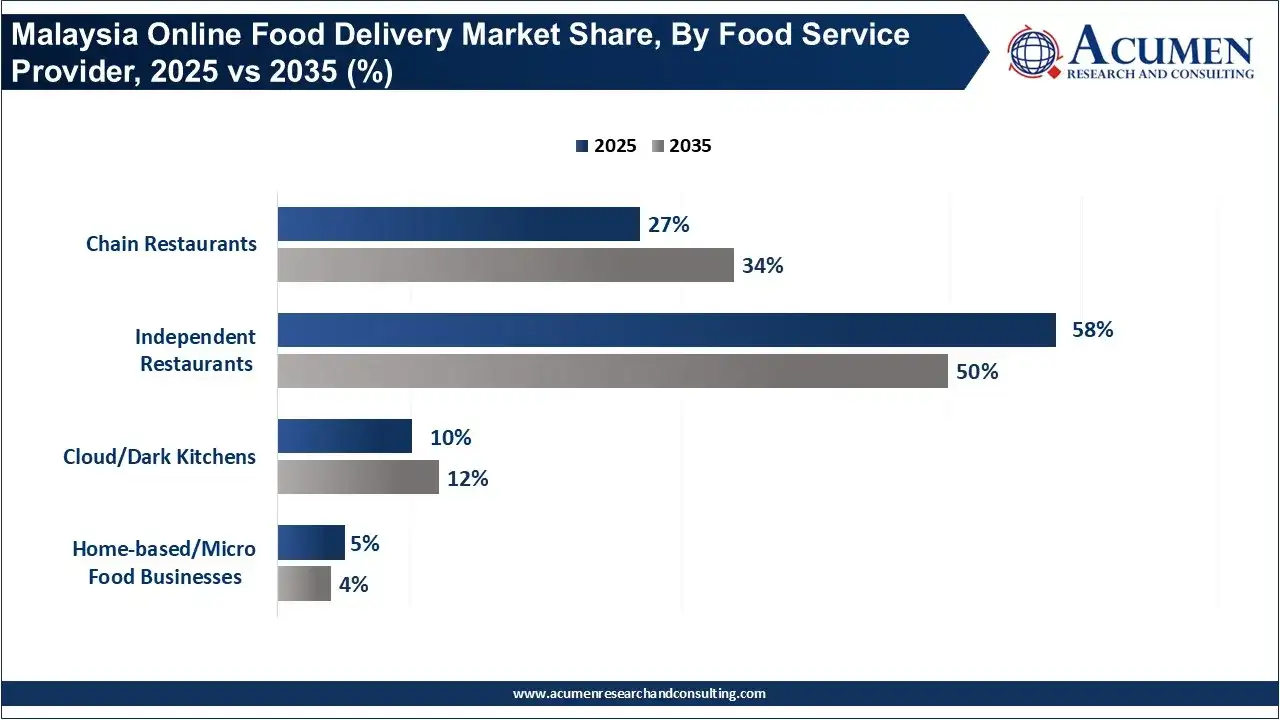
Chain restaurants represented 27.0% of the market in 2025 and are projected to reach 34.0% by 2035, making them the fastest-growing major food service provider segment in the supplied segmentation, with a 11.6% CAGR between 2026 and 2035.
The growth of chains is supported by their ability to combine physical restaurant networks with standardized digital operations. A chain can maintain consistent menus, pricing, promotions, packaging, and service standards across multiple locations while using online delivery platforms to generate incremental orders.
Delivery Type Insights
Platform-to-consumer delivery accounted for 76.0% of the market in 2025 and is projected to increase to 81.0% by 2035. The segment's dominance reflects the central role played by marketplace platforms that connect restaurants, consumers, payment systems, and delivery riders within one digital ecosystem. Instead of individual restaurants having to acquire customers, process payments, manage orders, and operate delivery fleets independently, platforms aggregate demand and coordinate fulfillment.
Malaysia's major food delivery platforms illustrate this operating structure. GrabFood provides restaurant discovery, instant delivery, scheduled delivery, and self-pickup through its digital platform, while foodpanda provides multiple delivery options and platform-based ordering.
Malaysia Online Food Delivery Market Share, By Delivery Type, 2025 & 2035 (%)
| Delivery Type | Revenue Share, 2025 (%) | Revenue Share, 2035 (%) |
|---|---|---|
| Restaurant-to-Consumer | 24% | 19% |
| Platform-to-Consumer | 76% | 81% |
Restaurant-to-consumer delivery accounted for 24.0% in 2025, but its share is projected to fall to 19.0% by 2035. This model remains relevant for restaurants with strong consumer recognition, established delivery operations, proprietary ordering systems, and loyalty programs. Direct ordering can provide restaurants with greater control over customer relationships, promotions, ordering data, and fulfillment.
Operating Model Insights
The aggregator + 3PL model accounted for 46.0% of the market in 2025 and is forecast to grow to 52.0% by 2035. It aggregates the online orders and customer acquisition of an aggregator with delivery fulfilment provided by third-party logistics (3PL) providers. The aggregator model enables restaurants to offer online delivery without needing to develop their own rider network.
3PL delivery is an attractive proposition for independent restaurants, as delivery volume can vary dramatically on a daily basis. Using a 3PL provider to deliver orders provides access to capacity without the operational and financial investment of operating a dedicated fleet.
Malaysia Online Food Delivery Market Share, By Operating Model, 2025 & 2035 (%)
| Operating Model | Revenue Share, 2025 (%) | Revenue Share, 2035 (%) |
|---|---|---|
| Aggregator + 3PL | 46% | 52% |
| Aggregator + In-house Delivery | 30% | 29% |
| Restaurant-owned Direct Delivery | 20% | 15% |
| Hybrid/Other | 4% | 4% |
Aggregator + in-house delivery accounted for 30.0% in 2025 and is expected to represent 29.0% by 2035. This model provides restaurants with access to marketplace demand while retaining greater control over their delivery operations. It can be particularly useful for larger restaurant groups that already possess delivery infrastructure. The relatively stable share indicates that the model is likely to remain relevant where restaurants have sufficient order density to justify operating their own delivery resources.
Ordering Platform Insights
Mobile apps captured the share of the Malaysia online food delivery market with 82.0% share in 2025, and is expected to grow further at 88.0% in 2035. This sector is also the most rapidly growing ordering platform, expected to grow at 9.7% CAGR from 2026-2035; expected market value from mobile-app ordering was forecasted to reach US$6.86 billion in 2035, up from US$2.99 billion in 2026.
The online food delivery concept is linked to the countrywide push for mobile-payment and digital-banking uptake, with Bank Negara Malaysia announcing in 2025 a rise of active users for mobile banking services by 8.7% to 25 million (a third of the population), with mobile banking representing 64% of the total online-banking channel.
The ability of the associated food delivery apps to leverage the same mobile ecosystem involves mobile payments, location, offers, loyalty, order tracking, reviews and delivery- notification all in one convenient smartphone App.
Website ordering represented 15.0% in 2025, but the share is projected to fall to 10.0% by 2035, with a comparatively modest 4.0% CAGR. Restaurant websites and desktop ordering remain useful for customers who prefer direct ordering, but mobile applications offer greater convenience for repeat purchases. Apps can also use push notifications, location information, saved addresses, digital wallets, loyalty programs, and personalized promotions to encourage recurring orders.
Order Type Insights
On-demand/instant orders accounted for 88% of the market in 2025. Although we expect the share to fall to 84.0% in 2035, on-demand/instant will remain the largest order type. Its strength lies in the fundamental consumer argument for food delivery: it's convenient and will save time. Consumers order because they want to avoid cooking, going to the store, paying a restaurant a visit or making an additional trip out.
Key players in Malaysia still tout super-fast turnaround for on-demand/instant orders. Grab Food offers a mix of scheduled and instant delivery, while Food Panda provides standard, saver, priority and scheduled delivery options.
Malaysia Online Food Delivery Market Share, By Order Type, 2025 & 2035 (%)
| Order Type | Revenue Share, 2025 (%) | Revenue Share, 2035 (%) |
|---|---|---|
| On-demand/Instant | 88% | 84% |
| Scheduled | 10% | 13% |
| Pre-order/Subscription | 2% | 3% |
Scheduled delivery will grow its market share from 10.0% in 2025 to 13% in 2035. The scheduled model is particularly valuable for office food, family meals, planned events, breakfast orders and for those who prefer not to be reliant on delivery during peak hours. FoodPanda Malaysia allows ordering customers to schedule delivery on future days up to two days in advance. FoodPanda allows consumers to schedule their delivery time in the future.
Cuisine/Food Category Insights
Western/fast food accounted for 25.0% of Malaysia's online food delivery market in 2025, making it the largest individual cuisine category in the supplied segmentation. The strong position reflects the suitability of standardized fast-food menus for delivery. Items can be prepared quickly, packaged consistently, and reproduced across multiple locations. Large fast-food chains also benefit from strong brand recognition and established digital ordering infrastructure.
Malaysia Online Food Delivery Market Share, By Cuisine/Food Category, 2025 (%)
| Cuisine/Food Category | Revenue Share, 2025 (%) |
|---|---|
| Malay/Malaysian | 24% |
| Chinese | 21% |
| Indian | 12% |
| Western/Fast Food | 25% |
| Japanese/Korean/Other Asian | 13% |
| Others | 5% |
Malay/Malaysian cuisine accounted for 24.0% in 2025, making it the second-largest category. Its strong position reflects the breadth of local food preferences, ranging from rice-based meals and noodle dishes to traditional Malay dishes, street food, and regional specialties. Local restaurants can also use delivery platforms to bring traditional food beyond their immediate neighborhood.
Payment Method Insights
E-wallets comprised 35% of online food delivery payments in 2025, making them the largest payment type. They are expected to make up 42.0% of online food delivery payments by 2035, the fastest growth of all payment methods in this report. Growth in food-delivery e-wallet payments is driven by increased e-wallet payment adoption in Malaysia's wider shift to cashless payment methods.
- In 2025, Bank Negara Malaysia stated the total value of e-payments experienced a 25% rise to 18.4 billion transactions, while Duit Now QR had a 2x increase in its transaction volume reaching 3 billion.
- At the end of 2025 there were close to 3 million registered Duit Now QR touchpoints nationwide.
Credit/debit cards accounted for 22.0% in 2025 and are projected to reach 23.0% by 2035. Cards remain relevant for consumers who prefer bank-linked payment instruments, particularly for higher-value orders and users who collect card-linked rewards or cashback.
Malaysia Online Food Delivery Market Share, By Payment Method, 2025 & 2035 (%)
| Payment Method | Revenue Share, 2025 (%) | Revenue Share, 2035 (%) |
|---|---|---|
| Cash on Delivery | 16% | 8% |
| Credit/Debit Card | 22% | 23% |
| E-wallet | 35% | 42% |
| Online Banking/Other Digital | 27% | 27% |
Online banking/other digital payments represented 27.0% in 2025 and are projected to remain at 27.0% in 2035. Malaysia's strong online-banking infrastructure supports this payment channel. Bank Negara Malaysia reported 25 million active mobile banking users in 2025, demonstrating the scale of mobile-based banking activity in the country.
Customer Age Insights
Millennials accounted for 42.0% of Malaysia's online food delivery customers in 2025, making them the largest age group in the market. Their presence is due to the converging factors of working age consumers, smartphone ownership, smartphone-savviness, familiarity with digital payments and regimen use of convenience services.
Malaysia Online Food Delivery Market Share, By Customer Age, 2025 (%)
| Customer Age | Revenue Share, 2025 (%) |
|---|---|
| Gen Z | 27% |
| Millennials | 42% |
| Gen X | 23% |
| Baby Boomers | 7% |
| Other/Unclassified | 1% |
Gen Z accounted for 27.0% in 2025. People today have grown up with smartphones, app-based services, social media, digital wallets and on-demand commerce. Consumers can discover food via short-form video, influencer content, restaurant reviews and social before they've made the purchase via a delivery app.
The much wider Malaysian digital-payment landscape reinforces this. Ipsos research for 2025 in Malaysia last year revealed especially high rates of e-wallet adoption among younger Malaysians. Young people, specifically those aged 25-34, are most likely to use e-wallets.
Kuala Lumpur and Klang Valley: Malaysia's Core Digital Food Delivery Hub
Kuala Lumpur and the Klang Valley have all the ingredients for a particularly robust digital food delivery environment- a relatively compact high-urban economy, high digital connectivity, a substantial restaurant ecosystem, and a vibrant service-sector economy.
Household access to the internet in Malaysia was 97.1% nationwide and 99.0% in urban areas, as of 2025; by the same date, the Kuala Lumpur metropolitan area had already achieved 100% household access to the internet in 2024, and access stood at 99.5% in neighbouring Selangor. Both regions are among the most digitally connected in Malaysia.
Malaysia's household access to the internet in 2025 was 97.1% nationally, 99.0% in urban areas and 98.9% in the Klang Valley. By 2025, 100% of households in Kuala Lumpur already had access to the internet in 2024, while access stood at 99.5% in Selangor.
At the same time, the economic base is also significant. The DOSM already reported for 2025 that Selangor's gross domestic product stood at RM460.1 billion and had grown at 6.3%.
Kuala Lumpur's GDP stood at RM265.1 billion and had grown at 5.2%. Services accounted for 91.7% of the economy in Kuala Lumpur, with wholesale and retail trade, F&B, accommodation, and finance and business services driving economic activity.
Major Online Food Delivery Platforms in Malaysia
- GrabFood: A leading food delivery platform in Malaysia, connecting consumers with restaurants, local food businesses, and on-demand delivery services.
- Foodpanda: A major online food delivery platform offering restaurant delivery, grocery delivery, and quick-commerce services across Malaysian cities.
- DeliverEat: A Malaysia-founded food delivery platform connecting consumers with thousands of restaurants and delivery partners across the country.
- AirAsia Food: AirAsia’s food delivery service, leveraging the group’s digital ecosystem and logistics network to connect consumers with restaurants and food businesses.
Investments & Breakthroughs
- In March 2026, Grab Malaysia launched 5-Star Eats, an in-app food guide endorsed by Tourism Malaysia as part of Visit Malaysia Year 2026. The initiative uses customer ratings and reviews to connect travelers and local consumers with Malaysian food experiences.
- In September 2025, Grab Malaysia expanded its collaboration with the Federal Agricultural Marketing Authority (FAMA), bringing 18 vendors from the new Pasar Tani Kekal Putrajaya onto GrabMart and GrabFood. The broader collaboration had digitized nearly 300 vendors across more than 30 Pasar Tani and Pasar Tani Kekal locations across Kuala Lumpur, Selangor and Johor Bahru since 2023.
Segments Covered
By Food Service Provider
- Chain Restaurants
- Independent Restaurants
- Cloud/Dark Kitchens
- Home-based/Micro Food Businesses
By Delivery Type
- Restaurant-to-Consumer
- Platform-to-Consumer
By Operating Model
- Aggregator + 3PL
- Aggregator + In-house Delivery
- Restaurant-owned Direct Delivery
- Hybrid/Other
By Ordering Platform
- Mobile App
- Website
- Other Digital Channels
By Order Type
- On-demand/Instant
- Scheduled
- Pre-order/Subscription
By Cuisine/Food Category
- Malay/Malaysian
- Chinese
- Indian
- Western/Fast Food
- Japanese/Korean/Other Asian
- Others
By Payment Method
- Cash on Delivery
- Credit/Debit Card
- E-wallet
- Online Banking/Other Digital
By Customer Age
- Gen Z
- Millennials
- Gen X
- Baby Boomers
- Other/Unclassified
Looking for discounts, bulk pricing, or custom solutions? Contact us today at sales@acumenresearchandconsulting.com
Frequently Asked Questions

Other Consumer Goods and Food and Beverages Reports
August 2018
September 2024
January 2024
December 2023