
Marine Buoys Market Size, Share, Trends, Forecast 2026 to 2035
Marine Buoys Market (By Product Type: Mooring Buoys, Data Buoys, Anchor Buoys, Special Purpose Buoys, Drift Buoys, Inflatable Buoys; By Material: Plastic, Foam, Steel, Others; By Size: Medium, Large, Small; By Application: Offshore Oil & Gas, Environmental Monitoring, Ports/Harbors, Marine Research, Wind Energy, Aquaculture, Other) - Global Industry Analysis, Size, Share, Analysis, Trends and Forecast 2026 - 2035
- Last Updated: 10 Feb 2026
- Report Code: ARC3902
- Category: Automotive And Transportation
Marine Buoys Market Size and Forecast 2026 - 2035
The global marine buoys market size was valued at USD 982.24 million in 2025 and is projected to reach USD 1,910.89 million by 2035, expanding at a compound annual growth rate (CAGR) of 6.9% during the forecast period from 2026 to 2035.
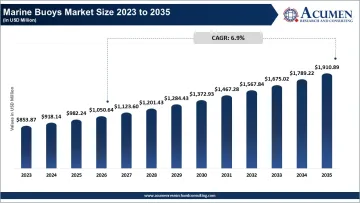
Report Highlights
- In 2025 North America accounted for around 38% of the global revenue in marine buoys market.
- Asia Pacific is projected to register the fastest CAGR of 8.0% from 2026 to 2035 in the marine buoys market.
- By product type, the mooring buoys accounted for the largest market share in 2025, representing around 34% of the total market.
- Based on buoy material, the plastic buoys dominated the market, accounting for approximately 40% share, followed by steel with around 28% share.
- By application, the offshore oil & gas was the largest application segment, holding around 25% of the market share.
Marine Buoys Market Overview
The marine buoys market is growing primarily due to increasing importance of maritime safety, efficient navigation, and reliable data collection. With the expansion of global shipping and offshore activities, governments and maritime authorities are investing in advanced buoy systems to ensure safe navigation, mark hazards, and comply with stringent maritime safety regulations. Buoys equipped with modern technologies such as GPS, IoT sensors, and a real-time communication system help ships to avoid collisions, monitor sea conditions, and support coastal security operations. This is driving their adoption across commercial shipping, defense, and port management sectors. Additionally, the use of buoys for environmental monitoring and scientific research is increasing as governments and research institutions focus on climate change studies, pollution monitoring, and marine ecosystem protection, all of which require reliable and continuous ocean data collection platforms.
Another significant growth driver for marine buoys market is the expansion of offshore energy projects, along with continuous technological advancements. The growth of offshore wind farms, oil and gas exploration, and renewable energy installations is creating the demand for specialized buoys used for site marking, mooring, and environmental monitoring. At the same time, innovations in buoy technology, including smart autonomous and energy-efficient systems are enhancing durability, data accuracy, and operational performance making these solutions more attractive across wider range.
Marine Buoys Market Dynamics
Market Drivers
Technological Advancements in Marine Navigation Systems
- Rapid technology innovation has significantly enhanced the capabilities of marine buoy and transformed them into high-tech navigation and monitoring systems. The integration of Automatic Identification Systems (AIS) technology enables buoys to transmit real-time digital information about their position and operational status directly to vessels through Electronic Chart Display and Information Systems (ECDIS). This form of electronic navigation (e-Navigation) improves maritime safety by ensuring high visibility and accurate positioning, even in poor weather conditions such as heavy fog or storms.
Increasing Investment in Offshore Renewable Energy
- The global transition towards renewable energy has significantly increased the focus on offshore renewable energy development. Offshore wind farms require an extensive network of buoys across different stages of their lifecycle, including site assessment, construction, and ongoing operational monitoring. During the pre-construction phase, meteorological and oceanographic (metocean) buoys equipped with Light Detection and Ranging (LiDAR) technology are widely used to measure wind speeds and sea conditions. These floating LiDAR buoys eliminated the need for fixed measurement platforms, reducing construction and avoiding regulatory and bureaucratic challenges associated with building permanent offshore structures.
Market Restraints
High Capital Expenditure and Maintenance Costs
- The high capital expenditure associated with advanced marine buoys remains a significant restraint for the growth of this market. Sophisticated buoys equipped with LiDAR systems, multi-parameter sensors, and satellite communication technologies can cost hundreds of thousands of dollars, making them unaffordable for smaller port authorities and developing countries. According to Miros' study, current estimates suggest hiring costs of up to USD 170,000 per year, per buoy. In addition to the initial purchase cost, ongoing expenses such as battery replacement, biofouling removal, regular calibration, and maintenance of sensitive electronic components further increase the total cost of ownership.
Strict Regulatory Compliance and Standardization Requirements
- The installation and operation of marine buoys are strictly governed by numerous international maritime and environmental regulations. Organizations such as the International Association of Marine Aids to Navigation and Lighthouse Authorities (LALA) mandate standardized requirements for buoy color, shape, lighting, and placement to ensure safe and interoperability, which increases the complexity and compliance costs for manufacturers and operators.
Market Opportunities
Internet of Things (IoT) & Smart Sensors
- The integration of IoT technology represents one of the largest opportunities in marine buoy market. By transforming buoys into “smart nodes” or interconnected devices, manufacturers can provide data with unprecedented speed, detail, and operational efficiency. IoT-enabled buoys can deliver real-time alerts for ship collisions, mooring line problems, or battery status, allowing for proactive monitoring and maintenance rather than fixing issues after they occur. This technology shift also opens the door for developing digital twins of maritime infrastructure, enabling advanced simulation, analysis, and management of marine operations, thereby creating new value and growth potential in the market.
Eco-Friendly & Sustainable Buoy Considerations
- The global focus on sustainability and circular economy is creating strong opportunities in the marine buoy market. There is a growing demand for buoys manufactured from recycled plastics or bio-based materials, which help reduce the environmental impact throughout their lifecycle. Adopting eco-friendly materials and designs allows manufacturers to comply with regulations, attract environmentally conscious customers, and create new opportunities in the sustainable market. Additionally, hybrid power systems that combine solar panels with wave energy converters or small wind turbines may extend buoy lifespan and reduce battery replacement.
Marine Buoys Market Report Scope
| Attribute | Details |
|---|---|
| Marine Buoys Market Size 2025 | USD 982.24 Million |
| Marine Buoys Market Forecast 2035 | USD 1,910.89 Million |
| Marine Buoys Market CAGR During 2026 - 2035 | 6.9% |
| Analysis Period | 2023 - 2035 |
| Base Year | 2025 |
| Forecast Data | 2026 - 2035 |
| Segments Covered | By Product Type, By Material, By Size, By Application, and By Geography |
| Regional Scope | North America, Europe, Asia Pacific, Latin America, and Middle East & Africa |
| Key Companies Profiled | Saab AB (Seaeye Marine Division), Fendercare Marine Solutions Ltd., Tideland Signal, Inc., KONGSBERG Maritime AS, Marine Technologies LLC, Sealite Pty Ltd, Blue Ocean Buoys Ltd, Mediterranean Mooring Systems SRL, Siemens Marine GmbH, Hydrosphere U.K. Ltd, IMECO Marine Group Inc., and Pacific Material Handling Solutions, Inc. |
| Report Coverage | Market Trends, Drivers, Restraints, Competitive Analysis, Player Profiling, Covid-19 Analysis, Regulation Analysis |
Marine Buoys Market Regional Analysis
North America is the dominant region in the global marine buoys market, accounting for 38% market share in 2025. This leadership is driven by the region's extensive coastline, well-developed maritime safety infrastructure, and the presence of major buoy manufacturers and research institutions. The market is mature with high adoption of smart and connected buoy technologies, strong regulatory compliance, and stringent safety standards. In addition, sustained investment in naval defense and maritime security, particularly by the United States, continues to drive demand.

Asia-Pacific represents the fastest-growing and most dynamic regional market for marine buoys. Rapid economic growth, industrialization, and urbanization across the region are fueling strong demand for maritime and port infrastructure, supported by increasing volumes of maritime trade. Countries such as China, India, and several Southeast Asian nations are heavily investing in port expansion to strengthen their export-driven economies. Large-scale infrastructure initiatives, notably China's Belt and Road initiative, are driving the development of deep-water ports and new shipping routes, all of which require extensive buoy network to support safe navigation and efficient maritime traffic management.
Marine Buoys Market Segmental Analysis
The worldwide market for marine buoys market is split based on product type, material, size, application, and geography.
Product Type Insights
Mooring buoys, accounting for an estimated 34% market share of the marine buoy market in 2025, are driven by the essential need to secure vessels in ports, harbors, and offshore oil and gas fields. Mooring buoys are built for high structural strength and durability to withstand the massive loads imposed by tankers and cargo ships. Continued growth in global shipping and expansion of offshore energyprojects are expected to sustain strong demand for mooring solutions.

Data buoys represent the fastest-growing segment of the market. Although fewer in number than mooring buoys, and their higher unit cost and the increasing demand for oceanographic and environmental data are driving rapid growth. Data buoys are widely used for meteorological monitoring, tsunami warning systems, and environmental research. Equipped with advanced sensors and satellite communication technologies, which makes them a high-tech solution capable of collecting and transmitting real-time oceanographic and environmental data and this has attracted significant investment from both government agencies and private research institutions.
Material Insights
Plastic buoys, particularly made from High-Density Polyethylene (HDPE), is the most popular type in use currently. Plastic marine buoys accounted for around 40% market share in the overall marine buoys market in 2025. They have become the industry standard for many navigational and light-mooring applications due to their excellent corrosion resistance, low maintenance requirements, and lower cost compared to traditional steel mooring solutions. Additionally, plastic allows color to be incorporated directly into the material, eliminating the need for painting, and it can be more easily recycled, which further drives its continued preference in the market.
| Material | Market Share, 2025 (%) | Key Highlights |
|---|---|---|
| Plastic | 40% | Use of composites and specialty materials for niche and advanced applications. |
| Steel | 28% | High structural strength required for heavy-duty offshore mooring applications. |
| Foam | 17% | Unsinkable design and superior impact resistance for harsh marine environments. |
| Others (Composites, Elastomers, etc.) | 15% | Customized applications for defense, research, and specialized offshore operations. |
Foam-filled buoys are emerging as the fastest-growing segment. These buoys consist of a durable outer shell, usually made of polyurethane or HDPE, which is filled with high-density closed-cell foam. This design makes them virtually unsinkable, even if the outer shell is punctured by a collision or similar impact. Foam-filled buoys can absorb shocks and offer better buoyance-to-weight ratios, making them ideal for heavy-duty mooring applications and for protecting sensitive equipment in data buoys. The increasing adoption of foam-filled buoys reflects the market's emphasis on reliability, safety, and performance in high-traffic or extreme marine environments.
Size Insights
Medium-sized marine buoys segment held the leading share of the overall marine buoys market in 2025, accounting for approximately 45% market share. Medium-sized buoys offer ideal balance of visibility, stability, and ease of deployment across various maritime applications. The optimal balance between load-veering capacity, stability, and cost, make them suitable for navigation aids, port and harbor operations. Their manageable size allows for easier deployment and maintenance compared to large buoys while still providing sufficient space for lighting systems, sensors, and communications equipment.
| Size | Market Share, 2025 (%) | Key Highlights |
|---|---|---|
| Medium | 45% | Balanced stability, payload capacity, and cost for wide-ranging marine applications. |
| Large | 30% | Supports heavy sensors, power systems, and offshore wind and deep-sea projects. |
| Small | 25% | Suitable for coastal navigation, shallow waters, and low-payload applications. |
The large marine buoy segment held around 30% market share in 2025 and is expected to grow at faster pace compared to other segments due to the need for heavier payloads. For example, massive battery banks, large solar arrays, and sensor suites that incorporate LiDAR or other acoustic modems. Large buoys are increasingly required for offshore wind farm assessments and deep sea research, especially as these buoys need to remain stable in high sea states and also provide enough surface area for power generation. As offshore activities transition further from shore into more energetic waters, the demand for larger, stable platforms will also increase.
Application Insights
Offshore oil & gas represents a dominant segment in the marine buoys market accounting for 25% market share. Offshore oil & gas industry widely uses buoys for marking exclusion areas, support mooring Floating Production Storage and Offloading (FPSO) units, and for providing navigational assistance to supply vessels. Despite global emphasis on climate change mitigation and transition toward renewable energy, the sustainment and growth of existing offshore oil and gas infrastructure will require significant market demand for high-specification mooring and navigation buoys.
| Application | Market Share, 2025 (%) | Key Highlights |
|---|---|---|
| Offshore Oil & Gas | 25% | Ongoing offshore production, FPSO mooring, and navigational safety requirements. |
| Environmental Monitoring | 18% | Climate monitoring, ocean health studies and extreme weather tracking needs. |
| Ports / Harbors | 15% | Expansion and modernization of port infrastructure and maritime traffic management. |
| Marine Research | 12% | Increased funding for oceanographic and scientific research activities. |
| Wind Energy | 10% | Growth of offshore wind farms requiring site assessment and monitoring buoys. |
| Security | 8% | Rising naval defense and coastal surveillance investments. |
| Aquaculture | 7% | Expansion of offshore fish farming and marine cultivation activities. |
| Others | 5% | Miscellaneous uses including tourism, rescue, and temporary installations. |
Environmental monitoring is the fastest growing segment in the marine buoys market, driven by international climate agreements and national mandate for environmental protections. Buoys in this segment are typically deployed to track ocean acidification, monitor oil spills, and observe marine mammal migrations. Furthermore, the increasing frequency of extreme weather events has also increased investment in coastal monitoring networks to protect human life and properties. The scientific research aspect combined with regulatory compliance make this application segment a major component of future upgrades in the market.
Marine Buoys Market Players
- Saab AB (Seaeye Marine Division)
- Fendercare Marine Solutions Ltd.
- Tideland Signal, Inc.
- KONGSBERG Maritime AS
- Marine Technologies LLC
- Sealite Pty Ltd
- Blue Ocean Buoys Ltd
- Mediterranean Mooring Systems SRL
- Siemens Marine GmbH
- Hydrosphere U.K. Ltd
- IMECO Marine Group Inc.
- Pacific Material Handling Solutions, Inc.
Marine Buoys Market Recent Developments
- In December 2025, Marine Technologies LLC partnered with Miros AS through a Memorandum of Understanding (MoU) to jointly develop next-generation marine sensing and vessel performance solutions.
- In September 2025, Saab was chosen to lead NATO’s Allied Underwater Battlespace Mission Network (AUWB-MN) project, starting on 1 September 2025. Under this role, Saab will develop interoperable mission-networking capabilities that enable seamless coordination between underwater and surface systems across allied nations.
Marine Buoys Market Segmentation
By Product Type
- Mooring Buoys
- Data Buoys
- Anchor Buoys
- Special Purpose Buoys
- Drift Buoys
- Inflatable Buoys
By Material
- Plastic
- Foam
- Steel
- Others
By Size
- Medium
- Large
- Small
By Application
- Offshore Oil & Gas
- Environmental Monitoring
- Ports/Harbors
- Marine Research
- Wind Energy
- Security
- Aquaculture
- Others
By Region
- North America
- U.S.
- Canada
- Europe
- U.K.
- Germany
- France
- Spain
- Rest of Europe
- Asia-Pacific
- India
- Japan
- China
- Australia
- South Korea
- Rest of Asia-Pacific
- Latin America
- Brazil
- Mexico
- Rest of LATAM
- Middle East & Africa
- South Africa
- GCC Countries
- Rest of the Middle East & Africa (ME&A)
Looking for discounts, bulk pricing, or custom solutions? Contact us today at sales@acumenresearchandconsulting.com
Frequently Asked Questions

Other Automotive And Transportation Reports
March 2023
July 2023
May 2024
September 2020