
No-Code Development Platform Market Size, Share, Report 2026 To 2035
No-Code Development Platform Market (By Component: Platform, Services; By Deployment Model: On-Premise, Cloud; By Organization Size: Large Enterprises, Small and Medium-sized Enterprises; By Industry Vertical: BFSI, Retail & E-commerce, Real Estate, Healthcare, Others) - Global Industry Analysis, Size, Share, Trends and Forecast 2026 to 2035
- Last Updated: 15 Dec 2025
- Report Code: ARC3869
- Category: ICT
No-Code Development Platform Market Size and Growth 2026 to 2035
The global no-code development platform market size was accounted for USD 34.7 billion in 2025 and is estimated to surpass around USD 261.4 billion by 2035 growing at a CAGR of 22.8% from 2026 to 2035. The rapid growth in digital transformation is driving the growth or the no-code development platform market. Further, the proliferation of AI applications continues to support the market demand.
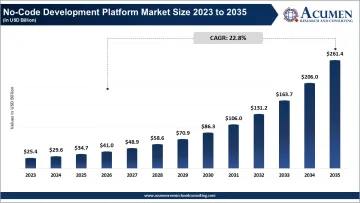
Report Highlights
- By Region, the North America no-code development platform market is valued at approximately USD 12.5 billion in 2025.
- By Region, the Asia-Pacific no-code development platform market is expected to grow at a CAGR of over 24.2% from 2026 to 2035.
- By Component, the platform segment represents 89% of the total market share in 2025.
- By Deployment Model, the cloud segment accounted for 76% of the total market share.
- By Organization Size, large enterprises accounted for 88% of the no-code development platform market share in 2025.
- By Industry Vertical, the BFSI segment represents 33% of the total market share in 2025.
The no-code development platforms are witnessing the growing need for restructuring development processes and growth in rapid application development. These platforms facilitate rapid application development with the use of automation tools and pre-built templates, pre-configured modules, drag-and-drop tools, and visual interfaces. The escalating demand for cloud-based platforms is driving the market growth.
These platforms enable business users to generate insights, automate repetitive tasks, and build predictive models independently, lessening the pressure on IT teams and enhancing time-to-value. As enterprises greatly pursue digital transformation and look for agility and advancements, the ability of no-code platforms to support quicker experimentation and optimized operational integration becomes a key market driver.
No-Code Development Platform Market Dynamics
Market Drivers
Rapid Growth in Digital Transformation
- The rapid growth in digital transformation in business operations for streamlining workflow and improving efficiency predominantly fuels the adoption of no-code development platforms. Organizations focus on augmenting cost-effectiveness and agility, making such platforms an ideal alternative. These platforms allow businesses to revolutionize legacy systems while enhancing the rate of consumer engagement. No-code platforms enable organizations to accelerate the development of apps and respond promptly to client requirements and fluctuating market conditions. Digital transformation has resulted into increasing demand for rapid application development across diverse range of industries and individual consumers, thereby fueling market growth.
Increasing Adoption Among Non-IT Professionals
- The adoption of no-code development platforms is proliferating among non-IT professionals, which leads to faster time-to-market and simplified development. These platforms allow non-technical work professionals to create applications effortlessly. The rapid growth of citizen developers and the outnumbering of traditional developers boost the market growth. Organizations are focusing on limiting their dependency on IT employees for building their own applications. These platforms help make creating apps easier for non-IT professionals, without the requirement of coding skills.
Market Restraints
Increasing Security Concerns
- Growth in security concern is a key restraint for the no-code development platform market. These platforms enable application developers to utilize their credentials, which can develop a risk of unlicensed access. In addition, lack of traditional security measures and vulnerability to cyber threats in these platforms further boost security concerns. Application migration includes a severe risk of revealing sensitive and critical data to hackers, which could also lead to insider threats and data breaches. Therefore, these platforms require security protocols including regular security audits, data encryption, access control, and secure configuration, and access control to alleviate the risk of unauthorized access and guarantee security.
Limited Scalability and Customization Flexibility
- One of the key restraints in the market includes limited scalability and customization flexibility as solutions and applications are becoming more complex. Though no-code tools excel at rapid prototyping and simple workflows, enterprise use commonly faces constraints while integrating advanced logic, handling high volumes of transactions, or connecting with existing legacy systems. This results in platform lock-in, where an organization becomes heavily dependent on proprietary features. Additionally, concerns around security, governance, and compliance-especially in regulated industries lead to slow adoption as IT teams question whether no-code outputs meet long-term architectural and performance requirements.
Market Opportunities
Adoption of AI Technologies
- The rapid evolution and development of AI and machine learning across the world fuel the growth of the market. Technologies including automated ML are gaining immense popularity as they are designed for organizations that lack competence in ML. Furthermore, the adoption of edge computing, IoT, and data science platforms and services has increased across diverse industries, further propelling the market demand. Overall, the no-code AI platforms assist in getting rid of defects, enhancing delivery time, and making data science more viable, offering lucrative growth avenues for market growth over the forecast period.
Expanding Role in Enterprise-grade Automation
- A major opportunity in the no-code development platform market is its expanding role in enterprise-grade automation and AI-driven application creation. As more organizations are trying to quicken the pace of digitization, no-code platforms will empower business users to build workflows, micro-apps, and smart process automations fully independent of scarce developer resources. The integration of generative AI with pre-built industry templates and low-code extensions is creating growth opportunities for more sophisticated and scalable solutions across finance, healthcare, retail, and manufacturing. It positions the no-code platforms to become the central enablers of rapid digital transformation in large enterprises, reducing development time, lowering costs, and accelerating innovation.
Report Scope
| Area of Focus | Details |
|---|---|
| No-Code Development Platform Market Size 2025 | USD 34.7 Billion |
| No-Code Development Platform Market Forecast 2035 | USD 261.4 Billion |
| No-Code Development Platform Market CAGR During 2026 – 2035 | 22.8% |
| Segments Covered | By Component, By Deployment Model, By Organization Size, By Industry Vertical, and By Geography |
| Regional Scope | North America, Europe, Asia-Pacific, Latin America, and Middle East & Africa |
| Key Companies Profiled | SAP SE, Zoho Corporation, Hexaware Technologies Limited, Pegasystems Inc., ServiceNow Inc., Quickbase Inc., Glide, Webflow Inc., Caspio Inc., Appy Pie |
| Report Coverage | Market Trends, Drivers, Restraints, Competitive Analysis, Player Profiling, Covid-19 Analysis, Regulation Analysis |
No-Code Development Platform Market Segmental Insights
The worldwide market for no-code development platform is split based on component, deployment model, organization size, industry vertical, and geography.
Component Insights
The platforms segment dominated the no-code development platform market in 2025. No-code development platforms enable the creation of advanced models without the need for IT coding professionals. These platforms decrease the time that is required to build applications to minutes, enabling enterprises to integrate machine learning models into the organization’s processes efficiently. No-code development platforms lower the entry barriers for enterprises and individuals to begin experimenting with AI and ML. These solutions allow organizations to affordably and swiftly implement AI models, enabling their domain specialists to benefit from the cutting-edge technology.
| Component | Market Share (%) | Key Highlights |
|---|---|---|
| Platform | 89% | Dominant as it serves as the core technological foundation that allows users to build, deploy, and automate applications without in-depth programming expertise. |
| Services | 11% | The rapid shift toward specialized consulting, integration, and managed support offerings assist enterprises scale and optimize no-code implementations. |
Deployment Model Insights
According to the no-code development platform industry analysis, in 2025, the cloud-based deployment model dominated the market. This is primarily driven by the accelerating need for cost-effective, flexible, and highly scalable solutions. The rapid growth in digitalization is augmenting the segment's growth. Additionally, cloud-based development platforms aid with quicker time-to-market scenarios for innovative products, driven by rapid application implementation and setups. These platforms improve the overall security and alliance among developers, stakeholders, and teams to enhance productivity.
| Deployment Model | Market Share (%) | Key Highlights |
|---|---|---|
| On-premise | 24% | A key trend in the on-premise model is the growing adoption among highly regulated industries that seek stringent data control and enhanced security compliance for no-code deployments. |
| Cloud | 76% | Dominant as there is an escalating need for flexible, cost-effective, and highly scalable solutions. |
Organization Size Insights
The large enterprises segment led the no-code development platform sector owing to the growing adoption of these platforms for complex project handling, management, and data analytics. Large enterprises necessitate solutions for complexities including cross-departmental workflow management and integrating legacy systems. These platforms provide flexibility in large enterprises and help to address changing business environments and scale up their applications. Larger organizations, banking, retail, and healthcare are adopting this platform for creating customized applications, automating internal operations, and enhancing overall experiences.
| Organization Size | Market Share (%) | Key Highlights |
|---|---|---|
| Large Enterprises | 88% | Dominant because of the growing adoption of these platforms for complex project handling, management, and data analytics. |
| Small and Medium-sized Enterprises | 12% | The growing shift toward no-code platforms for reducing the development costs and enabling quicker application creation without heavily relying on specialized IT teams is creating growth avenues for the segment. |
Industry Vertical Insights
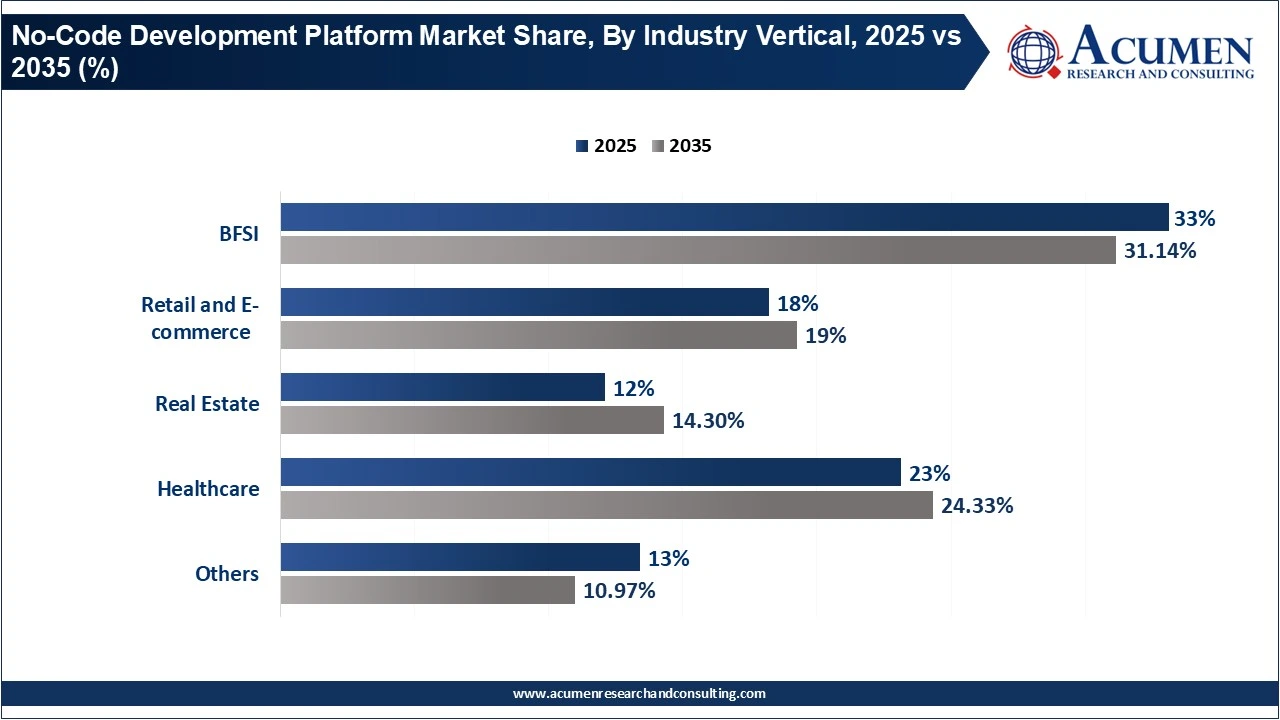
The BFSI segment held the largest market share in 2025. This is driven by the growth in adoption of no-code development platforms for faster development and deployment processes, automating processes, and improving the consumer experiences. The rapid digitalization in this industry is encouraging a surge in the deployment of these platforms to optimize processes and further boost digital transformation. The industry is looking for solutions to save resources in IT infrastructure, making such platforms a great fit. The increasing need to improve consumer experience further fuels the segmental growth.
| Industry Vertical | Market Share (%) | Key Highlights |
|---|---|---|
| BFSI | 33% | Dominant as no-code platforms are increasingly being adopted in the sector, enabling rapid building of secure and compliant customer-facing applications, while automating workflows in the back office. |
| Retail & E-commerce | 18% | The retailers are increasingly using no-code tools to customize digital storefronts, optimize inventory processes, and launch quick marketing apps. |
| Real Estate | 12% | No-code platforms are increasingly being used within real estate firms to create efficiencies in property management, workflow automation, and customer engagement portals. |
| Healthcare | 23% | Healthcare providers are adopting no-code solutions to digitize patient influx, streamline clinical operations, and support rapid creation of compliance-ready apps. |
| Others | 13% | No-code platforms serve a wide variety of industries to accelerate digital transformation, avoid IT backlogs, and empower the building of custom solutions by citizen developers. |
No-Code Development Platform Market Regional Analysis
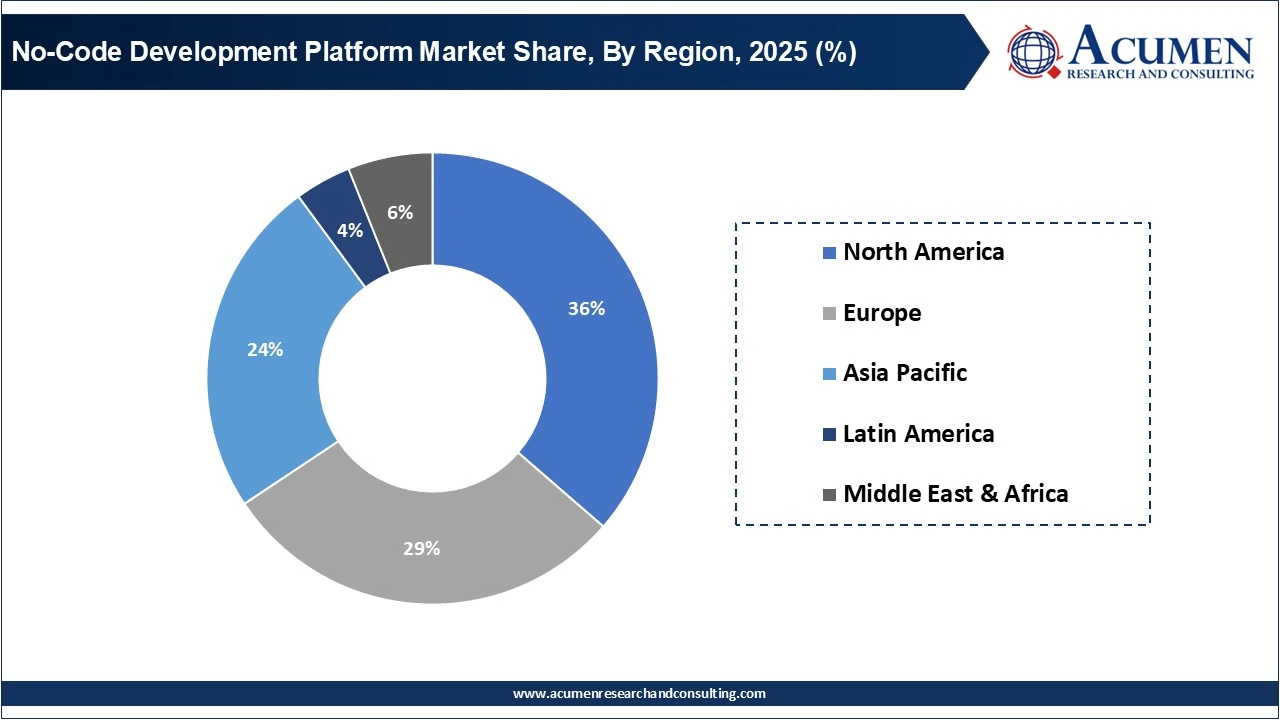
North America dominated the no-code development platform market by garnering a major market share in 2025. This is attributed to the robust presence of key tech players, high adoption of novel technologies, advanced IT infrastructure, and efficient initiatives in digital transformation. North America has a well-established IT infrastructure, driving significant adoption of these platforms. Moreover, the existence of a vast number of tech giants and startups proliferates the market competitiveness in the region.
| Region | Market Share (%) | Key Highlights |
|---|---|---|
| North America | 36% | Dominant because of the robust presence of key tech players, high adoption of novel technologies, advanced IT infrastructure, and efficient initiatives in digital transformation. |
| Europe | 29% | The growth of regulated, enterprise-grade no-code adoption continues to be on a strong upward trend in the Europe market due to strict data protection laws (GDPR) and rapid digital transformation across public and private sectors. |
| Asia-Pacific | 24% | The region’s steady growth is driven by rising adoption of mobile applications, rapid digitization, and expansion of the IT sector. |
| MEA | 6% | MEA is observing heightened demand for no-code platforms as governments and enterprises increase the pace of digitalization agendas and seek cost-efficient solutions. |
| Latin America | 4% | In Latin America, a growing trend is seen whereby SMEs are increasingly utilizing no-code tools for enterprise business operations modernization, decreasing development costs, and swiftly deploying localized digital applications. |
Asia-Pacific is projected to grow at a notable pace during the forecast period. The region’s steady growth is driven by rising adoption of mobile applications, rapid digitization, and expansion of the IT sector. The growth of large enterprises in the region is augmenting the adoption of no-code development platforms for the deployment and development of advanced applications. Countries such as India, Japan, China, Australia, and South Korea are boosting the regional market growth due to their increasing focus on digital literacy, technological innovation, and expansion of IT infrastructure.
No-Code Development Platform Market Players
- SAP SE
- Zoho Corporation
- Hexaware Technologies Limited
- Pegasystems Inc.
- ServiceNow Inc.
- Quickbase Inc.
- Glide
- Webflow Inc.
- Caspio Inc.
- Appy Pie
Market Segmentation
By Component
- Platform
- Services
By Deployment Model
- On-Premise
- Cloud
By Organization Size
- Large Enterprises
- Small and Medium-sized Enterprises
By Industry Vertical
- BFSI
- Retail & E-commerce
- Real Estate
- Healthcare
- Others
By Region
- North America
- U.S.
- Canada
- Europe
- U.K.
- Germany
- France
- Spain
- Rest of Europe
- Asia-Pacific
- India
- Japan
- China
- Australia
- South Korea
- Rest of Asia-Pacific
- Latin America
- Brazil
- Mexico
- Rest of LATAM
- The Middle East & Africa
- South Africa
- GCC Countries
- Rest of the Middle East & Africa (ME&A)
Looking for discounts, bulk pricing, or custom solutions? Contact us today at sales@acumenresearchandconsulting.com
Frequently Asked Questions

Other ICT Reports
December 2020
November 2020
July 2024
June 2021