
Physical AI Market Size, Share, Industry Report 2026 - 2035
Physical AI Market (By Component: Hardware, Software, Services; By Deployment: Cloud-based AI, On-device; By Technology: Computer Vision, Speech / NLP, Gesture / Movement Recognition, Reinforcement Learning & Control Systems, Others; By Robot Type: Industrial Robots, Service Robots, Humanoids/Social Robots, Cobots, Exoskeletons/Prosthetics, Mobile Robots/Drones; By Application: Healthcare, Manufacturing & Automotive, Logistics & Warehousing, Retail & Hospitality, Defense & Security, Agriculture, Education & Research, Others) - Global Industry Analysis, Size, Share, Trends and Forecast 2026 to 2035
- Last Updated: 11 Jul 2026
- Report Code: ARC3871
- Category: ICT
Physical AI Market Size and Growth Outlook 2026 - 2035
The global physical AI market size accounted for USD 5,021.2 million in 2025 and is estimated to achieve a market size of USD 82,790.9 million by 2035 growing at a CAGR of 32.8% from 2026 to 2035.
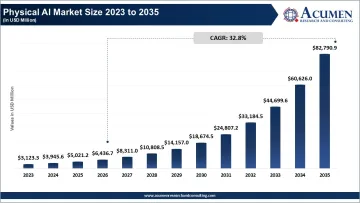
Physical AI Market Highlights
- By Region, North America holds approximately 40.6% of the global physical AI market share in 2025.
- By Region, Asia Pacific region accounts for about 30.6% market share and is projected to grow at a CAGR of 34.6% from 2026 to 2035.
- By Component, the hardware segment represents 57.4% of the total physical AI market share in 2025.
- By Deployment, the cloud-based AI account for 48% of the total market share, while on-device hold 51.7%.
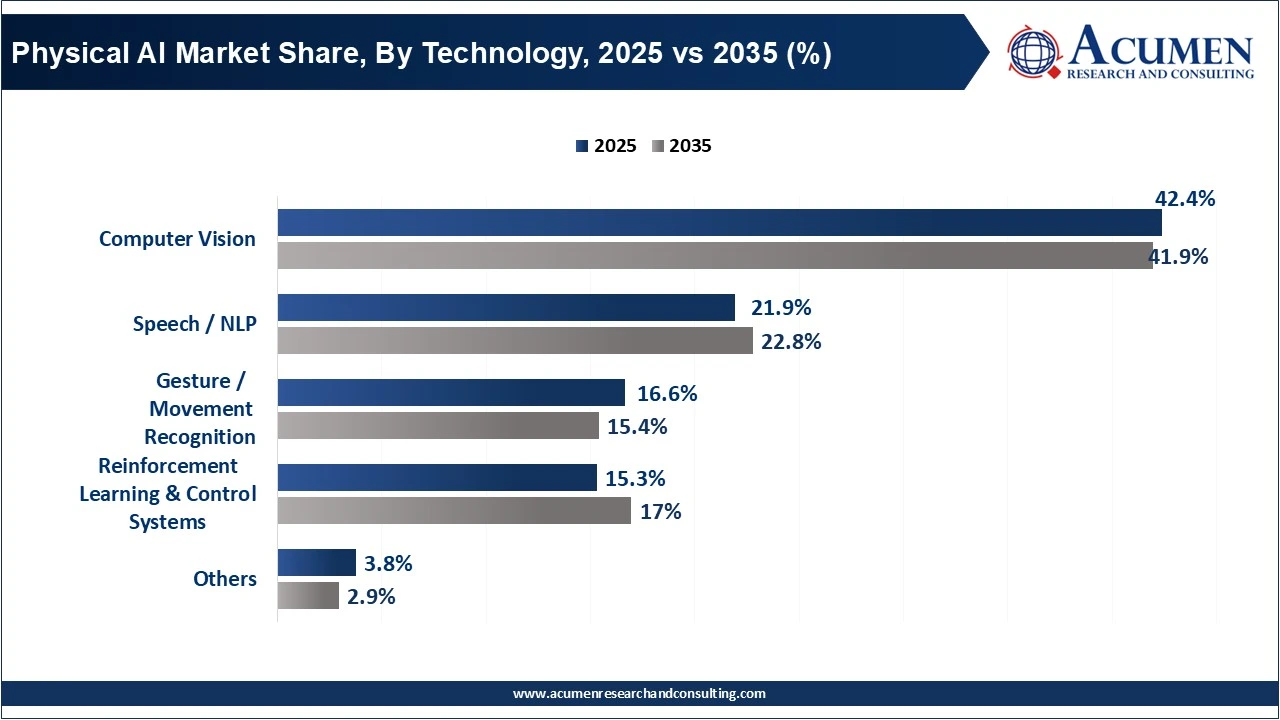
- By Technology, the computer vision segment holds 42.4% market share, followed by reinforcement learning & control systems with 15.3%.
- By Robot Type, the industrial robots segment has generated revenue share of 38.6% in 2025.
- By Application, the manufacturing & automotive segment has captured revenue share of 23.1% in 2025.
Physical AI Market Overview
The significant growth of the physical AI market is due to advancements in robotics, edge AI, computer vision and reinforcement learning have enabled machines to operate autonomously in environments. Increasingly, industries including manufacturing, logistics and healthcare are adopting Intelligent robots to help increase productivity and improve safety while addressing rising labour shortages. The rising number of physical AI components being integrated into sensors, actuators, humanoids, cobots and exoskeletons is greatly accelerating deployment of physical AI solutions across industrial and commercial markets. The increase in demand for automated solutions, precision solutions and operational intelligence within physical AI is pushing Businesses toward adopting physical AI solutions.
Another major factor for growth is significant investment from technology companies, robotics developers, and government agencies to promote the implementation of "Industry 4.0" and "smart factories" and the development of "AI-enabled" or "AI-based" infrastructure. Additionally, the emergence of on-device AI technology along with advances in multimodal learning and new use cases for robotics in various sectors including defense, agriculture, retail, and healthcare, is broadening the application of physical AI. The emergence of new classes of robotic technologies including service robotics, autonomous mobile robots, and AI-assisted devices, is creating numerous opportunities in the physical AI market.
Physical AI Market Dynamics
Market Drivers
Rising Demand for Automation in Healthcare & Industry
- The increased demand for Integrated robotic and artificial intelligence (AI) technology for precision work such surgery assistance, logistics, autonomous inspection, and rehabilitation is significantly contributed to the growth of the physical AI market. AI makes it possible for robots to improve human capabilities by allowing them to observe, learn, or interact securely within their surroundings using physical artificial intelligence (AI) and Healthcare applications including robotic surgery, assisted mobility, hospital automation, and industrial applications will all generate rapid growth in both investment in and adoption of these technologies.
Advancements in Sensors, Edge AI, and Human-Robot Interaction (HRI)
- The advanced technologies including motion control, computer vision and tactile sensors have improved the way robots interact with humans. In addition to improved safety when robots and humans are working together, these advances have created a greater degree of usability for robots and improve the reliability of physical AI. Because of the enhancement of these technologies reduce operational cost of a robot lower and opened the doors to many new high value applications, such as supporting autonomous retail to advanced exoskeletons.
Market Restraints
High Deployment Costs and Complex Integration
- The development and deployment of physical AI systems like surgical robots, cobots and robotic-assisted exoskeletons limit the adoption by small-to-medium-sized enterprises (SMEs) is major challenges of physical AI market. because of the required investment related to hardware, training data sets, maintenance, and the need to integrate these technologies into their existing workflows. Furthermore, due to the lack of standardization across all vendor and applications is technically difficult to integrate these solutions seamlessly.
Safety, Liability, & Ethical Concerns
- The robots increasingly interacting with people and performing critical activities, the concerns over the robot’s safety to the user and the risk of malfunction are the greatest roadblocks for overcome transition to widespread robotic technologies. There is still a lot of uncertainty regarding how the industry can establish standardized regulation for the operation of autonomous systems, These industry, in general, tends to hesitate to adopt these types of systems. Ethical issues related to job displacement and transparency regarding decision-making also restrict the widespread implementation of autonomous systems.
Market Opportunities
Expansion into Elderly Care, Rehabilitation, and Assisted Living
- Due to the increasing aging population throughout the world, there is a great opportunity for the use of physical AI in the areas of personal support, assistance with mobility, remote monitoring and rehabilitation robotics. AI-powered devices both companion and exoskeletons can create a major positive impact on reducing the amount of time caregivers spend with their patients by increasing patient outcomes. With increasing healthcare automation and the need for chronic disease management, this area is becoming a large commercial opportunity.
Growth in Smart Manufacturing & Autonomous Industrial Operations
- The physical AI market has an excellent opportunity for growth due to rise of smart manufacturing and autonomous industrial operations. Intelligent Robots are being adopted at a faster rate by companies who are developing Industry 4.0 capabilities to use intelligent robots for autonomous material handling, AI enabled assembly lines, and real-time safety monitoring. Physical AI enables manufacturers to make rapid decisions, adapt to automation, and create predictive maintenance systems to reduce downtime and improve productivity. As companies move towards Hyper automation, connected operations, the demand for advanced robotic platforms, and physical AI technology is expected to grow significantly over the market.
Physical AI Market Report Scope
| Attribute | Details |
|---|---|
| Physical AI Market Size 2025 | USD 5,021.2 Million |
| Physical AI Market Forecast 2035 | USD 82,790.9 Million |
| Physical AI Market CAGR During 2026 - 2035 | 32.8% |
| Analysis Period | 2021 - 2035 |
| Base Year | 2025 |
| Forecast Data | 2026 - 2035 |
| Segments Covered | By Component, By Deployment, By Technology, By Robot Type, By Application, and By Geography |
| Regional Scope | North America, Europe, Asia Pacific, Latin America, and Middle East & Africa |
| Key Companies Profiled | SoftBank Robotics Group, Agility Robotics, Mech-Mind Robotics, Siemens, KUKA AG, Toyota Motor Corporation, FANUC, ABB, Boston Dynamics, Tesla, NVIDIA, and DeepMind. |
| Report Coverage | Market Trends, Drivers, Restraints, Competitive Analysis, Player Profiling, Covid-19 Analysis, Regulation Analysis |
Physical AI Market Regional Analysis
- The North America physical AI market size was valued at USD 2,041.1 million in 2025 and is estimated to reach USD 31,848 million by 2035 growing at a CAGR of 32.1% from 2026 to 2035.
- The Europe physical AI market size was estimated at USD 1,183.1 million in 2025 and is forecasted to grow USD 18,949.4 million by 2035, at a CAGR of 32.4% from 2026 to 2035.
- The Asia-Pacific physical AI market size was reached at USD 1.536.4 million in 2025 and is estimated to hit around USD 28,910.5 million by 2035 with a CAGR of 34.6% from 2026 to 2035.
- The LAMEA physical AI market size reached at USD 260.6 million in 2025 and is anticipated to record USD 3,083 million by 2035 growing at a CAGR of 28.3% from 2026 to 2035.
North America currently dominates the physical AI market, because of its advanced technology ecosystem, access to early adopter robotics & AI, along with many large companies innovating on healthcare robotics, industrial automation, autonomous systems, and AI chips. High research and development (R&D) spending and existing manufacturing infrastructure are key assets in North America that benefit from the regulators that support automation & artificial intelligence (AI) integrations.
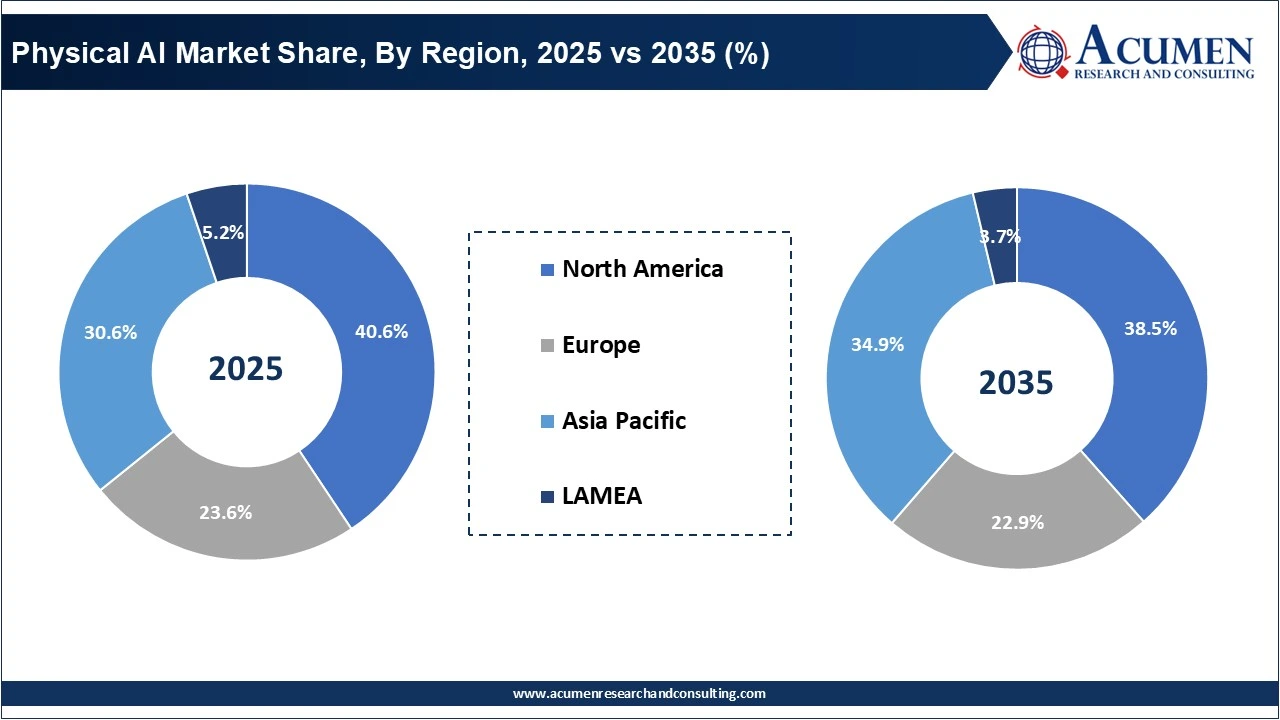
Asia Pacific is the fastest-growing region, due to the rapid growth of Industrialization, growing manufacturing bases, and increased Government initiatives are all driving the growth of AI, Robotics and Smart Factories. Countries such as China, Japan, South Korea and Singapore are investing heavily in industrial robots, service robots and autonomous systems with the hopes of boosting productivity, and addressing labour shortage. The rapid expansion of the electronics, automotive, health care and Logistics industries within Asia Pacific is accelerating the rate of deployment of robotics within these industries. Strong innovation support, high demand for automation and the capability to mass produce robots will continue to make Asia Pacific the fastest growing Market for Physical AI.
Physical AI Market Segmental Insights
The worldwide market for physical AI is split based on component, deployment, technology, robot type, application, and geography.
Component Insights
Hardware is currently the dominant component in the physical AI market because of primary building block of robotic and autonomous systems including sensors, actuators, mobility unit, AI processor chips and integrated mechatronic systems. These components represent the largest percentage of the total cost of a system and provide the required precision, safety and ability to interact with the physical environment. As the automation of various industries expands and there is increased demand for the most advanced hardware available to support these applications from surgical robots to industrial robotics. Due to continued hardware innovation, introduction of new robotic form factors and broadening deployments, hardware remains in the top position for physical AI solutions.
| Component | Market Share, 2025 (%) | Key Highlights |
|---|---|---|
| Hardware | 57.4% | Dominant due to high-cost sensors, actuators, robotic arms, chips, and mechanical systems essential for real-world interaction, safety, and precision. |
| Software | 30.6% | Fastest-growing segment driven by AI algorithms, perception models, reinforcement learning, cloud robotics, and digital twin platforms. |
| Services | 12% | Growing due to integration, maintenance, and AI-enabled operational support for robotic deployments. |
Software is the fastest-growing component, due to increased use of AI algorithms, real-time perception, control systems, and cloud robotics platforms. Software will continue to enable new degrees of adaptive automation, reinforcement learning models, digital twins, and predictive analytics, as the Physical AI space continues to evolve towards more complex, intelligent operations. The increasing dependence on AI-enabled decision-making, autonomous navigation, and cross-device orchestration forms the foundation for the increasing need for next-generation software platforms, resulting in faster growth than other areas within the ecosystem.
Deployment Insights
On-Device AI dominate the segment because to provide the user with low-latency processing, excellent reliability and real-time response, which are all critical requirements for medical robots, autonomous navigation, industrial arms and safety-critical systems. Further, its ability to function without the need for external connectivity makes it the best option for many of the environments in which these devices operate.
| Deployment | Market Share, 2025 (%) | Key Highlights |
|---|---|---|
| On-Device | 52% | Dominant due to low latency, high reliability, and real-time decision-making required in surgery, navigation, and factory automation. |
| Cloud-Based | 48% | Fastest-growing driven by cloud robotics, remote fleet control, digital twins, and continuous AI model updates. |
Cloud-Based AI is the fastest-growing segment, due to an increase in the acceptance of cloud robotics platforms, federated learning, and remote fleet management along with continuous updates of AI models. A cloud-based system allows greater coordination, centralised training, and real-time optimisation of geographically dispersed robotic fleet. Increasing digital twin simulations and automation between locations are also driving this segment and increasing the speed at which cloud AI will grow as connected, multi-robot intelligent systems allow for larger and more flexible deployments.
Technology Insights
Computer vision is the dominant segment because it provides the essential capabilities for object detection, mapping an environment, inspecting the surroundings and navigating within the environment for virtually all physical systems employing Artificial Intelligence (AI). Many areas where robots are currently deployed such as healthcare, logistics, security, and manufacturing highly depend on vision based perceptions to perform their operations safely and accurately. Additionally, new developments in imaging sensors and the use of deep-learning Vision Models will continue to expand the use of computer vision across all robot application areas such as drone technology, surgical robots, warehouse automaton and industrial robotics.
| Technology | Market Share, 2025 (%) | Key Highlights |
|---|---|---|
| Computer Vision | 42.4% | Dominant because robots rely on CV for navigation, object detection, inspection, and perception across all industries. |
| Speech/NLP | 21.9% | Expanding with conversational AI, voice-operated robots, and support systems. |
| Gesture / Movement Recognition | 16.6% | - |
| Reinforcement Learning & Control Systems | 15.3% | Fastest-growing due to increasing demand for self-learning robots, adaptive systems, and autonomous decision-making. |
| Others (Multi-modal, Biomimetic AI) | 3.8% | Supports advanced AI behaviors, human-like interaction, and sensing fusion. |
Reinforcement Learning & Control Systems is the fastest-growing segment due to increasing demand for adaptive, self-learning and autonomous systems to improve decision-making capabilities in the field of robotics. The benefits of using reinforcement learning are especially evident in tasks that require interaction with constantly changing environments including mobile robots, robotic manipulation, and industrial applications such as exoskeletons and factory optimization. Additionally, As more factories embrace hyper-automation and the implementation of autonomous workflows to the demand for robots that can learn and adapt to their surroundings will continue to accelerate, further driving market demand for RL-based systems.
Robot Type Insights
Industrial robots dominate the physical AI market due to their long-established role in manufacturing, automotive, electronics, and high engineering segments of the global economy for many years. The high precision, speed, and consistency of industrial robots make them Ideal solutions for welding, assembly, material handling, and quality inspections. As factory productivity and labor optimization continue to increase due to the Implementation of automation, industrial robots will continue to hold the largest market share. The proven reliability of industrial robots coupled with their significant installed base and ongoing upgrades of their AI-Based control systems strengthens their leading position globally.
| Robot Type | Market Share, 2025 (%) | Key Highlights |
|---|---|---|
| Industrial Robots | 38.6% | Dominant because they are widely deployed in manufacturing, automotive, and heavy industries for precision, speed, and efficiency. |
| Service Robots | 14.3% | High adoption in healthcare, hospitality, logistics, and retail. |
| Humanoids / Social Robots | 13.8% | Increasing demand for customer service, elderly care, and human-like interaction. |
| Cobots | 12.2% | Fastest Segment due to rapid adoption in SMEs and factories for safe human-robot collaboration. |
| Exoskeletons / Prosthetics | 8.8% | Steady growth in rehabilitation, defense, and industrial support. |
| Mobile Robots / Drones | 12.3% | Widespread use in logistics, surveillance, and mobility operations. |
Cobots is the fastest-growing segment, because of companies continue to recognize the value of increasing human-robot collaboration for safety, flexibility, and efficiency in production environments. Unlike traditional industrial robots, cobots are relatively inexpensive, easy to implement, and designed for use by small-to-medium-sized businesses (SMEs) for requiring minimal physical infrastructure to support automation. Cobots can perform their function safely while working alongside humans in a variety of applications including packaging, inspection, assembly, and testing which has been driving rapid adoption across various industries. As industry shifts towards more agile forms of automation and additional labor augmentation via automation.
Application Insights
Manufacturing & Automotive dominate the physical AI market because of their widespread use of industrial robotics in assembly, welding, inspection of materials, handling of materials, and production automation. The Manufacturing and Automotive sectors are also the highest users of industrial robots and cobots, as well as the most integrated users of AI-enabled machinery due to their adoption of Industry 4.0 and modernizing smart factories. The significant emphasis on precision, efficiency and cost savings continues to provide the foundation for Manufacturing and Automotive's leadership position. As a result of these factors, the manufacturing and automotive sectors maintain their positions as the leading sector in the global physical AI market, as they deploy robots on a large scale, and investors from OEMs are heavily investing and providing long-term roadmaps for automated manufacturing.
| Application | Market Share, 2025 (%) | Key Highlights |
|---|---|---|
| Manufacturing & Automotive | 23.1% | Dominant due to large-scale adoption of industrial robots, cobots, and AI-enabled automation across global factories. |
| Healthcare | 18% | Fastest-growing with demand for surgical robots, rehabilitation systems, and AI-enabled hospital automation. |
| Logistics & Warehousing | 13.6% | Strong adoption of AMRs, drones, and fulfillment robotics. |
| Retail & Hospitality | 12.4% | Growing use of service robots for customer support, delivery, and operations. |
| Defense & Security | 9.4% | Increasing use of autonomous systems, surveillance drones, and robotic units. |
| Agriculture | 8% | Expanding adoption of autonomous tractors, robotic harvesting, and crop monitoring. |
| Education & Research | 9.1% | Use of robots for training, experimentation, and R&D. |
| Others | 6.6% | Includes domestic robotics and facility management. |
Healthcare is the fastest-growing application segment due to the fast adoption of robotic-assisted surgical, rehabilitation and patient assistance devices as well as AI diagnostic platforms by hospitals. An increasing demand for precision Surgical procedures, the growing number of elderly patients and the lack of available workers in hospitals are accelerating the integration of robotic technologies into clinical practices. Additionally, we are seeing a massive increase in the number of companies that develop and sell robot-assisted surgical devices, Exoskeletons, and automated hospitals. As a result, healthcare providers around the world are adapting to the rapid growth of AI technologies for physical care.
Physical AI Market Players
- SoftBank Robotics Group
- Agility Robotics
- Mech-Mind Robotics
- Siemens
- KUKA AG
- Toyota Motor Corporation
- FANUC
- ABB
- Boston Dynamics
- Tesla
- NVIDIA
- DeepMind
Physical AI Market Segmentation
By Component
- Hardware
- Software
- Services
By Deployment
- Cloud-based AI
- On-device
By Technology
- Computer Vision
- Speech / NLP
- Gesture / Movement Recognition
- Reinforcement Learning & Control Systems
- Others (multi-modal AI, biomimetic robotics)
By Robot Type
- Industrial Robots
- Service Robots
- Humanoids/Social Robots
- Cobots
- Exoskeletons/Prosthetics
- Mobile Robots/Drones
By Application
- Healthcare
- Manufacturing & Automotive
- Logistics & Warehousing
- Retail & Hospitality
- Defense & Security
- Agriculture
- Education & Research
- Others
By Region
- North America
- U.S.
- Canada
- Europe
- U.K.
- Germany
- France
- Spain
- Rest of Europe
- Asia-Pacific
- India
- Japan
- China
- Australia
- South Korea
- Rest of Asia-Pacific
- Latin America
- Brazil
- Mexico
- Rest of LATAM
- The Middle East & Africa
- South Africa
- GCC Countries
- Rest of the Middle East & Africa (ME&A)
Looking for discounts, bulk pricing, or custom solutions? Contact us today at sales@acumenresearchandconsulting.com
Frequently Asked Questions

Other ICT Reports
March 2023
June 2026
February 2023
January 2020