
EV Battery Swapping Market Size to Surge USD 22.28 Billion by 2035, CAGR of 31.3%
Published : 13 Jul 2026
Author : Simone Lamb



What is the EV Battery Swapping Market Size?
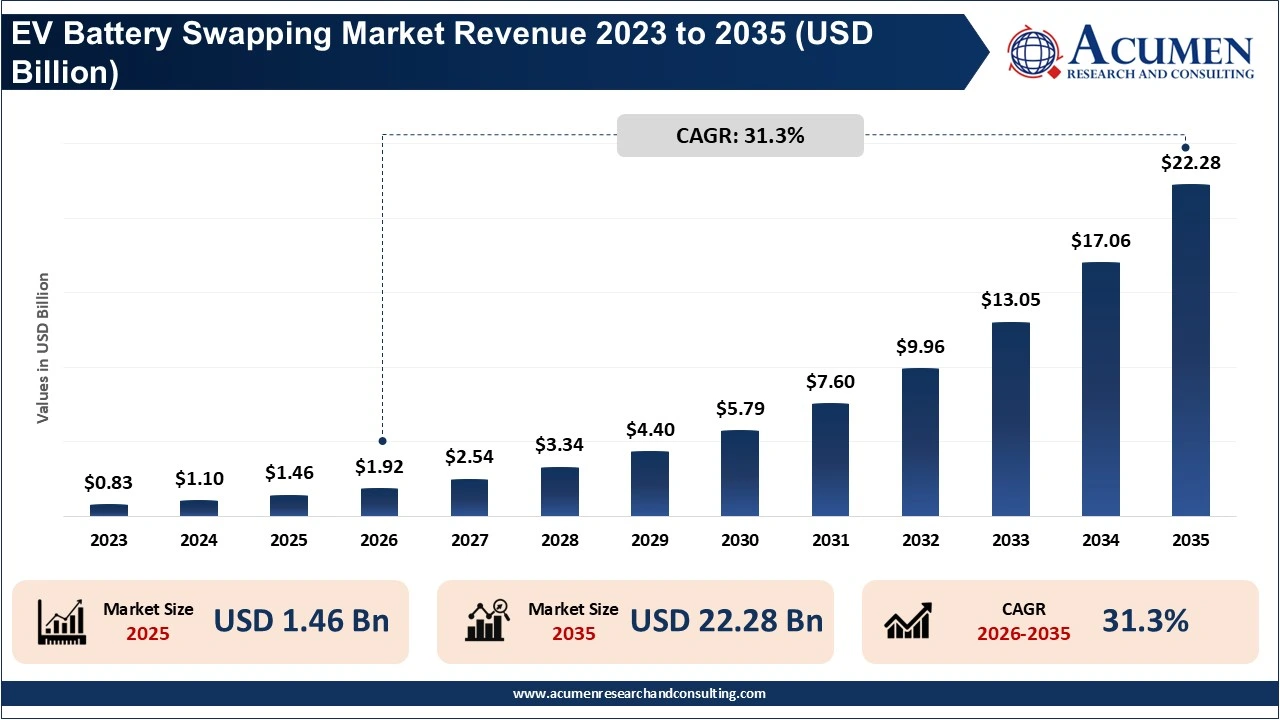
The EV battery swapping market size was recorded at USD 1.46 billion in 2025, the market is estimated to surge USD 22.28 billion by 2035; growing at a CAGR of 31.3% over the forecast period from 2026 to 2035. The accelerating global adoption of electric vehicles is a primary driver fueling the growth of the EV battery swapping market. As EV penetration continues to expand across passenger cars, commercial fleets, two-wheelers, and public transportation, the limitations of conventional charging infrastructure are becoming increasingly evident.
The EV battery swapping market is the entire system of infrastructure, service models, Battery Management System and networks that allow EV users to switch dead EV batteries with charged one's instead of taking the usual time for charging. The systems allow users to separate battery ownership and vehicle ownership for many purposes and make recharging much faster, reduce idle time and make EVs much cheaper to purchase.
The systems have been devised keeping in mind that it will remove the most significant roadblock of EV; time spent recharging. Conventional charging can take 30 minutes up to several hours (depending on battery size and charging speed). Battery switching can be performed in 3-5 minutes, drastically increasing the productivity of the vehicles, particularly those used in high-cycle mobility applications: logistics, ride-sharing, taxi services, public transport etc.
EV Battery Swapping Market Statistics
- By service type, the subscription-based segment captured the largest share of 62% in 2025, driven by battery ownership separation from vehicle ownership that significantly reduces initial purchase cost of EV, provides predictable monthly payments, ease of battery management and increased customer retention of swapping operators, and is highly desirable for heavy users, such as delivery riders and commercial fleets.
- By service type, the pay-per-use segment captured the second largest share of 38% as it provides an option to individual occasional and low-frequency EV users, who do not wish to invest in longer-term subscriptions, and is most popular among the individual users and small-scale fleets with a high demand variability, such as variable energy usage.
- By vehicle type, two-wheelers owned the largest market share of 48% in 2025, owing to smaller battery capacity and rapid swapping time of two-wheelers and higher daily mobility needs of the two-wheelers, as battery swapping is extremely effective and faster than charging for scooters and motorcycles. Moreover, strong growth of electric scooter penetration in Asia still keeps the segment leading.
- By vehicle type, commercial vehicles captured the highest CAGR of 36.3%, due to rapid electrification of logistics fleets, public buses, last mile delivery vehicles, etc. Commercial vehicle users are most concerned about downtime in their daily operation that makes them ideal candidate for battery swapping rather than traditional lengthy charging cycle, especially considering the boost in e-commerce.
- By station type, automated stations owned the largest share of 68% in 2025, which allows swapping of batteries in minutes with minimal intervention and further possesses functions of advanced diagnostics and battery monitoring as well as efficient inventory management, which enables quick installation in busy areas and thus quick scaling up of commercial battery swapping networks.
- By station type, manual stations accounted for 32% market share in 2025, which is lower in cost and easily installable, such as those used in regions where EV are primarily two-wheelers and three-wheelers and batteries were smaller in capacity.
Market Opportunity: Battery-as-a-Service (BaaS) Expansion for Commercial Fleets
A significant trend with one of the largest opportunities within the EV battery swapping market is BaaS for commercial mobility and logistics fleets. Increasing e-commerce volume, urban delivery business, and shared mobility services are pressuring fleet operators to achieve higher vehicle uptimes and reduce their operational costs.
By eliminating vehicle downtimes caused by charging, battery swapping has the capability to keep fleets operating nonstop which is particularly important for last-mile logistics, food delivery and urban freight. Fleet operators of commercial EVs increasingly opt to lease their batteries, in order to lower initial investment capital and sustain their adaptable power consumption.
With the standardization of the battery ecosystem, smart grid connectivity and advanced Al-based battery health monitoring, many new opportunities in public transportation electrification, taxi networks, autonomous delivery fleets, and electric heavy-duty commercial transportation is foreseen, which ultimately indicates that BaaS is predicted to be a substantial growth driver in the long run, in which ownership models become less emphasized.
EV Battery Swapping Market Regional Outlook
Why has Asia Pacific region held leading position in the EV battery swapping market?
The Asia Pacific region held 63% of the global EV battery swapping market in 2025 and remains the largest regional market. This expansion in the region is being driven by increased usage of two-wheelers, three-wheelers and passenger EVs in cities and a high rate of EV penetration in a number of economies with high populations. The large EV ecosystem, established battery manufacturers and growing infrastructure for swapping passenger vehicles are the main factors that are contributing to the increased sales of swapping services. India is another of the fastest growing markets due to widespread use of electric two-wheelers and increased activity from Baas startup companies. Taiwan, meanwhile is considered to be one of the front runners in the development of scooter battery swapping technology.
Why is North America estimated to be the highest growing market?
North America is estimated to be the highest growing market between 2025 and 2035 with a CAGR of 34.3% driven by increased electrifications in delivery services and the logistics sector. The sector is increasingly showing an interest in the use of battery swapping services for their large fleets in order to reduce downtime and lost time during operations. The majority market here is again being driven by the United States as companies start to adopt battery swapping for commercial applications, public transport and delivery services in their cities.
Who are the top companies operating in the EV Battery Swapping Market?
Major companies operating in the EV battery swapping market include NIO Inc., Gogoro Inc., SUN Mobility, Ample Inc., CATL, Honda Motor Co., Ltd., KYMCO, Ola Electric, Battery Smart, and Immotor. These companies are playing a critical role in standardizing battery ecosystems, expanding swapping infrastructure, reducing charging dependency, and improving EV affordability. Their significance lies in building the operational backbone for faster, scalable, and more commercially viable electric mobility systems globally.
Segments Covered
By Service Type
- Subscription Model
- Pay-Per-Use Model
By Vehicle Type
- Two-Wheeler
- Three-Wheeler
- Commercial Vehicle
- Passenger Vehicle
By Station Type
- Automated
- Manual
By Region
- North America
- Europe
- Asia-Pacific
- Latin America
- Middle East & Africa
Contact Us:
Mr. Richard Johnson
Acumen Research and Consulting
India: +91 8983225533