
EV Battery Swapping Market Size, Share, Growth, Report 2026 To 2035
EV Battery Swapping Market (By Service Type: Subscription Model, Pay-Per-Use Model; By Vehicle Type: Two-Wheeler, Three-Wheeler, Commercial Vehicle, Passenger Vehicle; By Station Type: Automated, Manual) - Global Industry Analysis, Size, Share, Growth, Trends, Regional Analysis And Forecast 2026 To 2035
- Last Updated: 23 Jun 2026
- Report Code: ARC3096
- Category: Energy and Power
EV Battery Swapping Market Size, Forecast 2026 To 2035
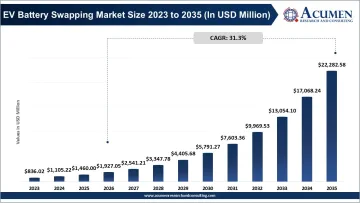
The EV battery swapping market size was calculated at $1,460 million in 2025, the market is estimated to reach at $22,282.58 million by 2035; growing at a CAGR of 31.3% during the forecast period of 2026-2035. The growing global adoption of electric vehicles, especially in two-wheelers, commercial fleets, and urban mobility services, is driving the EV battery swapping market as it offers significantly faster battery replacement compared to conventional charging, reducing downtime and improving vehicle utilization.
Report Highlights
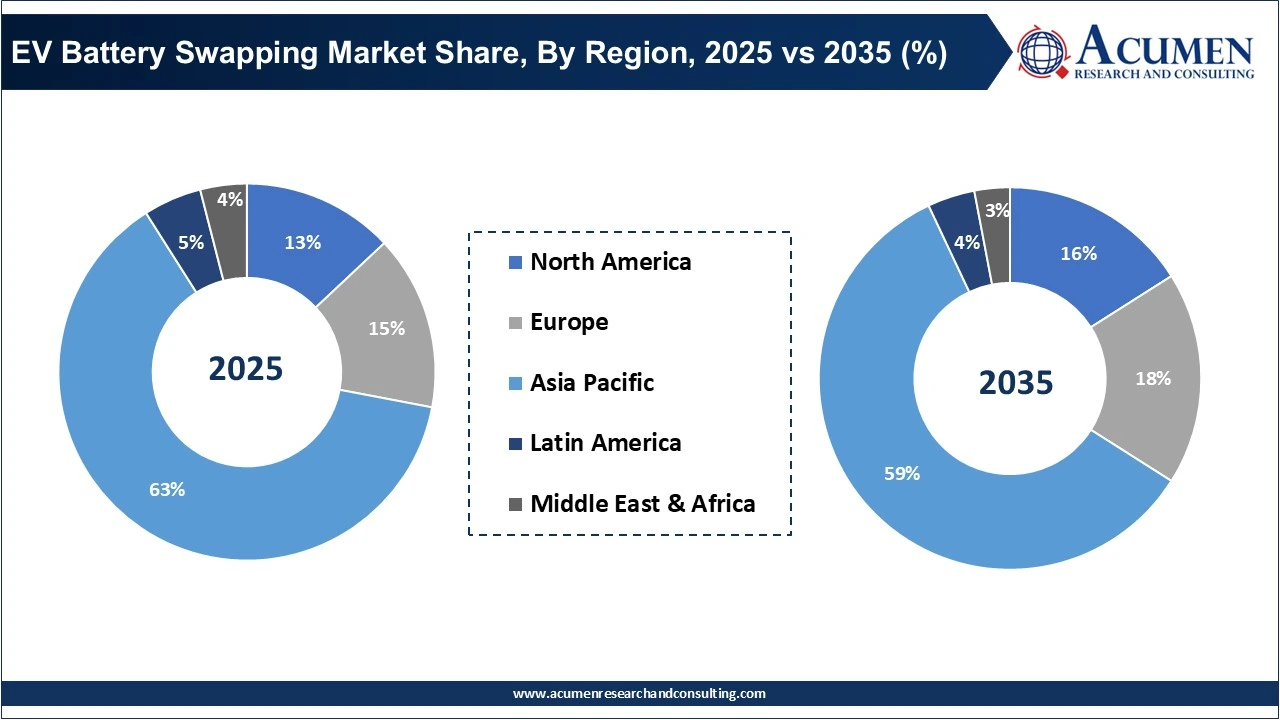
- By region, Asia-Pacific held the largest market share of 63% in 2025 due to massive electric 2W, 3W & passenger EVs adoption driven by rapid expansion of battery swapping infrastructure across China, India & Taiwan.
- By region, North America to grow at highest CAGR of 34.3% driven by increase in electric fleet conversion, investments in fast energy replenishment infrastructure and battery swapping for fleet and delivery vehicles.
- By service type, subscription model accounted for the largest share of 62% in 2025 due to its ability to lower the upfront cost of EV, provide stable monthly payment and increase customer retention for battery swapping operators.
- By service type, pay-per-use segment occupied the second largest share of 38% due to its provision of flexibility to sporadic users, individual rider and less frequent EV operators over commitment of long term subscription for battery swapping services.
- By vehicle type, two-wheelers held the largest market share of 48% in 2025 due to their smaller battery size, faster swapping speed, and higher mobility requirements in urban areas, enabling efficient battery swapping for electric scooters and motorcycles.
- By vehicle type, commercial vehicle is estimated to grow at highest CAGR of 36.3% owing to growing electric fleet for logistics, public transport & high volume delivery operations where less operational downtime is key.
- By station type, automated station accounted for the highest share of 68% in 2025 due to faster swap times, effective battery diagnostics, lesser human intervention & increased operational efficiency for large EV charging networks.
- By station type, manual station occupied a market share of 32% in 2025, it is cost-effective and widely deployed in emerging markets, mainly for electric 2W and 3W vehicles where battery handling is simpler and station cost is low.
EV Battery Swapping Market Dynamics
Driver
Rapid proliferation of EVs and necessity of rapid energy refilling
Rapid rise in global EV adoption is the chief growth catalyst for the EV battery swapping market. As EV sales pick up pace across passenger vehicles, commercial vehicles, two-wheelers, and public transport, the constraints of existing charging infrastructure are coming to the fore. Existing conventional chargers take anywhere from half an hour to several hours depending on the capacity and charger type, causing vehicle downtime to both individuals and fleet operators.
Battery swapping provides an instant solution by minimizing charging time to 2-5 minutes and effectively equaling refueling time of traditional vehicles. Time-saving is becoming invaluable across ride-hailing services, logistics companies, delivery fleets and public transportation sectors where vehicle uptime directly impacts the bottom line.
Restraint
Lack of standardization in batteries across OEMs
One of the biggest restraints faced by the EV battery swapping market is the complete lack of battery standardization across EV manufacturers. Unlike traditional fuel stations that can cater to multiple models and brands, the battery swapping requirement demands physical interoperability between the battery pack and the EV. EV makers develop batteries depending on the architecture of the vehicle; the chemistry, cooling systems, battery size and voltage, and safety features are all designed to specific vehicle models.
This lack of commonality across the various vehicle models poses significant compatibility problems, meaning a swapping station designed to handle batteries from one OEM's models might not accommodate another's models, thereby limiting the scale of the infrastructure. This forces battery-swapping providers to carry out a larger inventory of batteries for different brands, along with separate charging stations and tailored swapping mechanisms, significantly increasing infrastructure complexity and cost.
Opportunity
Growth of Battery-as-a-Service (BaaS) business models
Battery-as-a-Service (BaaS) is the biggest opportunity in the long-term growth of the EV battery swapping market. Under the BaaS models, the consumers purchase EV without the battery and instead subscribe to usage of battery for some rental fee. This drastically lowers the upfront cost of acquiring EVs, making it an affordable proposition for a mass market.
Battery costs form up to 30-40% of the cost of EV and the lowering of the upfront price of the vehicle via this business model aims to expand the reach of electric mobility to a much larger customer segment, especially in developing nations where price sensitivity is still a predominant factor, such as India and parts of Southeast Asia. It is also a lucrative model for commercial fleet operators as it helps manage cash flow by shifting the cost of batteries to operational expenditure.
EV Battery Swapping Market Segmental Insights
Service Type Insights
Subscription-based solutions grabbed the biggest share of the EV battery swapping market, with 62% of the total market share. Subscription models became quite popular for a couple of reasons; primarily for dissociating battery ownership from vehicle ownership which in turn lowers the cost of EVs, drastically.
Under subscription-based models, a monthly fee is paid by users in exchange for access to the batteries, resulting in both predictable costs and decreased responsibility towards battery maintenance. The model becomes highly effective for fleet operations, such as delivery operators, ride-sharing services, and similar ventures where batteries are consumed at a high rate.
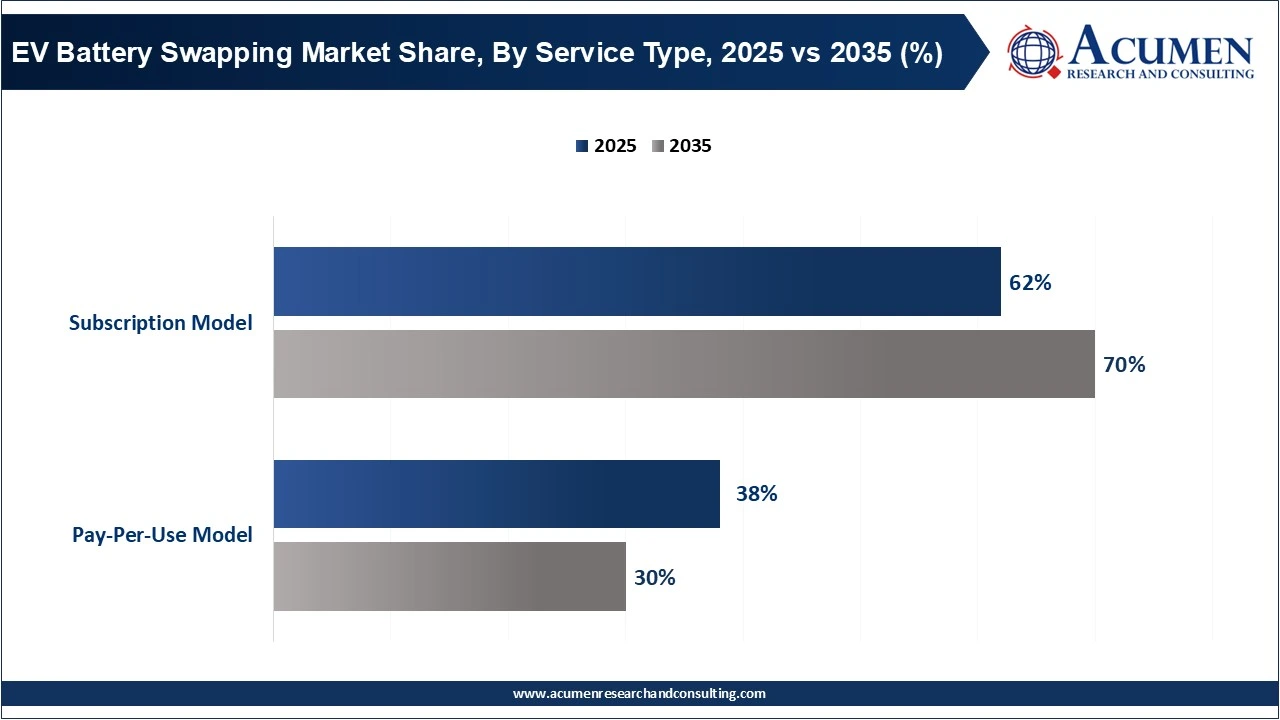
The pay-per-use model generated 38% of the total market share in 2025, and this model continues to play a crucial role, primarily in nascent and cost-sensitive markets. Under this pay-per-use model, a user is charged for battery swaps based on the number of swaps completed rather than a fixed monthly fee, making it flexible for occasional users.
Independent two-wheeler users, small-scale delivery operators and users who frequently switch the batteries were found to extensively adopt this payment method. This model ensures more freedom, however, long term costs are higher than subscription-based models.
Vehicle Type Insights
Two-wheelers formed the largest vehicle category within the EV battery swapping market making up 48% of total share in 2025. The high market share of the vehicle category is driven primarily by the high penetration of electric scooters and bikes across Asia-Pacific. Battery swapping is most suited for two wheelers as their batteries are relatively small, light and can be easily swapped in a manual or semi-automatic manner, with swapping times of less than 2 minutes providing considerable convenience.
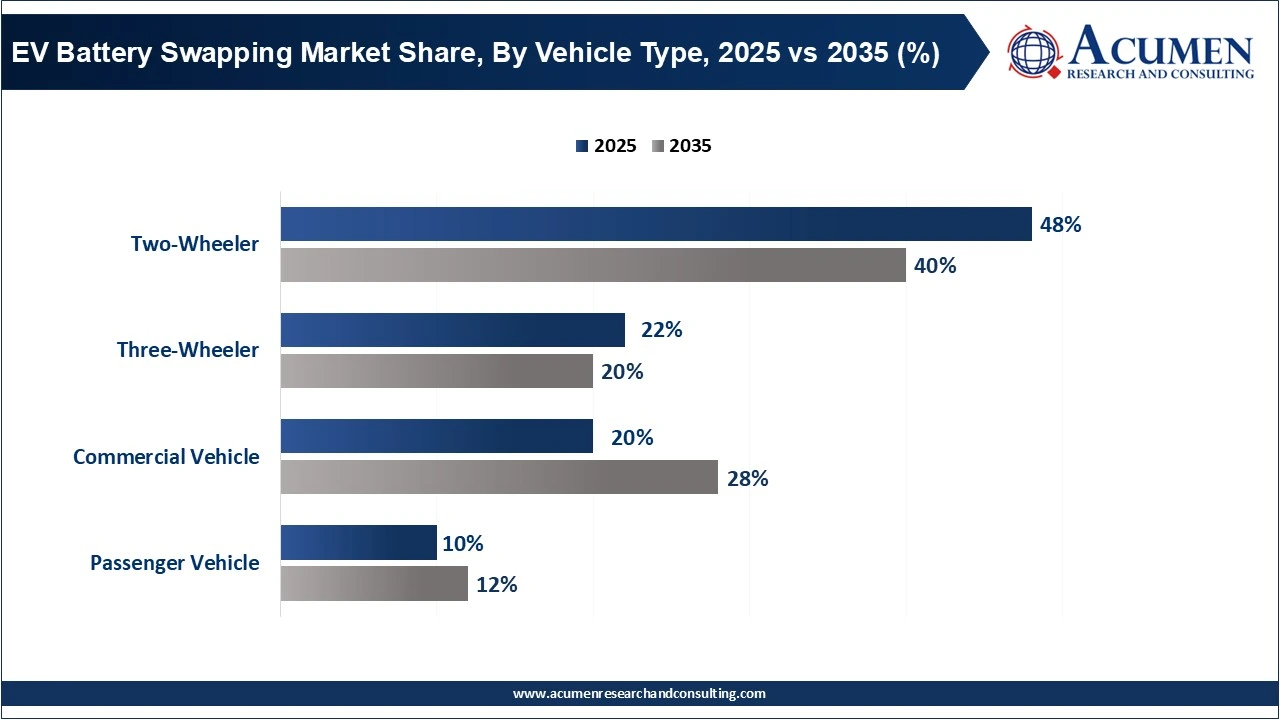
Commercial vehicles segment is forecasted to show the fastest growth, CAGR of 36.3% between 2026-2035. Commercial vehicle sector's growth is led by the accelerating electrification of the logistics and delivery networks, public transport buses and delivery vehicles. Battery swapping serves as the most economical for commercial vehicles as any vehicle downtime leads to revenue losses.
Battery swapping technology can drastically cut down charging time from a couple of hours to minutes which makes it highly attractive for the logistics businesses. Across China, US, and Europe, companies have started testing and adopting battery swapping models for their trucks and commercial vans.
Station Type Insights
Automated battery swapping stations constituted the larger segment, taking 68% of the market share in 2025. Automating allows for a quicker, safer, and more uniform battery swap experience through robotic arms and AI based diagnostics of battery status. This can take as little as 3-5 minutes a swap for passenger vehicles, taxis, and fleets. Widespread adoption of automated systems (i.e. Fully automated station networks deployed by NIO, Ample) among stakeholders is driving this segment's growth.
EV Battery Swapping Market Share, By Station Type, 2025 (%)
| By Station Type | Revenue Share, 2025 (%) |
|---|---|
| Automated | 68% |
| Manual | 32% |
Manual stations constituted 32% of the market share in 2025. These stations continue to be a popular option in emerging economies where a lower infrastructure investment is needed and the battery packs are lighter, such as in the electric two and three wheeler segment. While their long term share is set to decrease, they will still remain a key component to enabling widespread access to an EV infrastructure.
EV Battery Swapping Market Regional Analysis
- The North America EV battery swapping market size was valued at $189.80 million in 2025 and is predicted to hit $3,565.21 million by 2035; at a CAGR of 34.3% from 2026 to 2035.
- The Europe EV battery swapping market size was estimated at $219 million in 2025 and is calculated to record $4,010.86 million by 2035; growing at a CAGR of 33.9% from 2026 to 2035.
- The Asia-Pacific EV battery swapping market size was accounted for $919.80 million in 2025, it is estimated to surpass $13,146.72 million by 2035; expanding at a CAGR of 30.3% over the forecast period of 2026-2035.
Asia Pacific Dominated the EV Battery Swapping Market on the Back of Massive Production
Asia Pacific represented 63% of the total share in 2025. Its dominating presence in the market can be largely attributed to high adoption rate of electric vehicles at large scale, govt. Driven EV infrastructure initiatives, high penetration of EV battery swapping, and faster commercialization of two-wheel and three-wheel electric vehicles. China and India remain core drivers.
- China is at the forefront with a vast network of 3,500 swapping stations across major cities by 2025, which is largest in world EV battery swapping ecosystem. Players like NIO were pioneer in launching EV battery swapping service for passenger vehicles while the taxi fleets and logistics vehicles are rapidly adopting it for reducing downtime. The high sales of EVs, which went past 12 mn units in 2025 in China directly boosted swapping network expansion.
North America to Witness the Rapid Pace of Growth by 2035
North America will grow at the highest CAGR of 34.3% during the forecast period. North America is showing a renewed interest in EV battery swapping services as more and more fleet owners are seeking faster charging alternatives for their commercial mobility. On this front were not scaled commercially but now some newer ventures and fleet focused energy companies are re-evaluating the model for trucks, vans and fleet electric mobility services. Government incentives under the Inflation Reduction Act and state-level clean transportation programs are also expected to accelerate investments in EV infrastructure, including swapping stations.
Key Players
- Amplify Mobility
- BattSwap Inc.
- BYD Co. Ltd.
- ECHARGEUP
- NIO Inc.
- Gogoro Inc.
- Kwang Yang Motor Co. Ltd. (KYMCO)
- Leo Motors Inc.
- Lithion Power Private Limited
- Panasonic Corporation
- SUN Mobility Private Limited
- Tesla Inc
Segments Covered
By Service Type
- Subscription Model
- Pay-Per-Use Model
By Vehicle Type
- Two-Wheeler
- Three-Wheeler
- Commercial Vehicle
- Passenger Vehicle
By Station Type
- Automated
- Manual
By Region
- North America
- Europe
- Asia-Pacific
- Latin America
- Middle East & Africa
Looking for discounts, bulk pricing, or custom solutions? Contact us today at sales@acumenresearchandconsulting.com
Frequently Asked Questions

Other Energy and Power Reports
March 2024
February 2023
January 2021
June 2022