
Published : 15 Jul 2026
Author : Simone Lamb



The global hydrogen storage tanks and transportation market size was calculated at $530 million in 2025 and estimated to reach at $23,692 million by 2035; expected to grow at a notable CAGR of 46.2% during the forecast period of 2026-2035. Rapid expansion of green hydrogen production and hydrogen infrastructure investments across industrial, mobility, and energy sectors is significantly increasing demand for advanced hydrogen storage tanks and transportation systems.
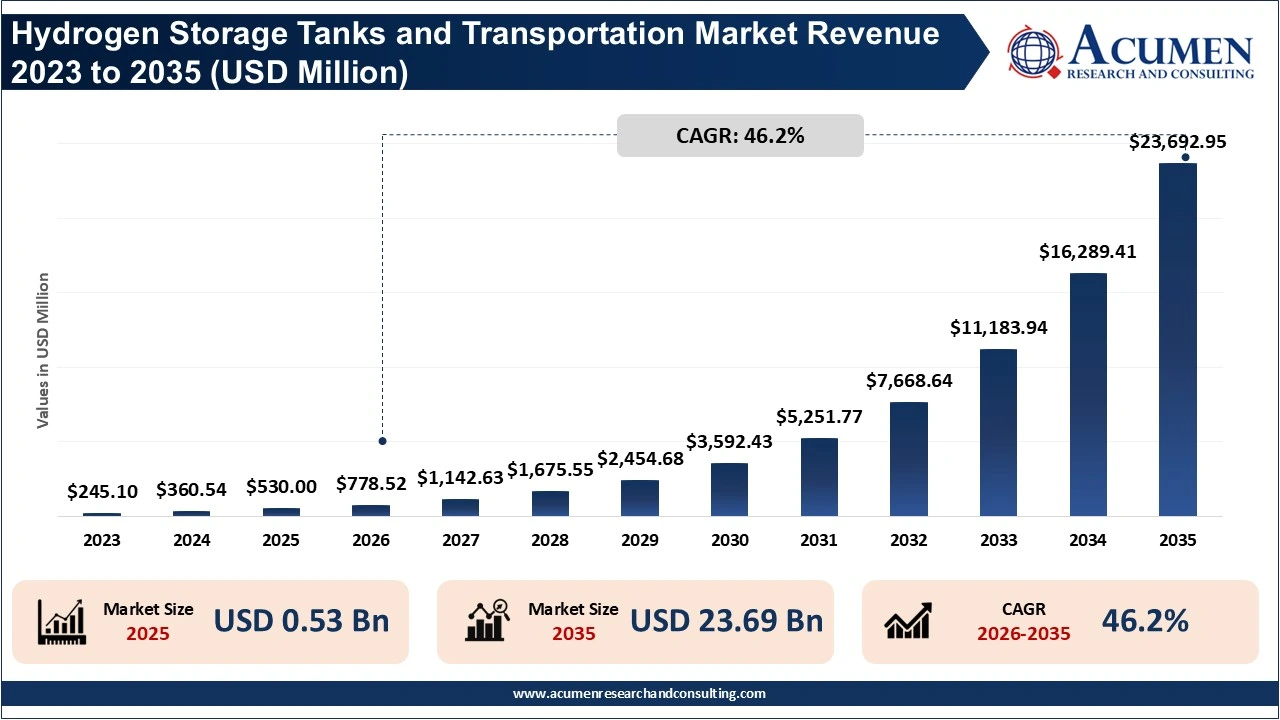
The hydrogen storage tanks and transportation market involves the manufacturing, installation and marketing of specific infrastructure and transport solutions required for containing, storing and conveying hydrogen along the energy supply chain. It includes high pressure compressed hydrogen storage tanks, cryogenic storage tanks for liquid hydrogen, hydrogen metal hydride storage systems, hydrogen tube trailers and cryo tankers and also pipeline systems and related transport equipment for delivery of hydrogen from its sources to consumers.
This market caters to different sectors like utilities, the chemical industry, Oil and Gas, transportation sector, aerospace industry, steel making, renewable sector and even maritime sector. These segments are spurred by growing green hydrogen production activities, the demand for mobile refueling infrastructure, and the development of integrated hydrogen supply chains globally and regionally.
How Is the Hydrogen Storage Tanks and Transportation Market Supporting Net-Zero Goals?
Renewed focus on net-zero globally is fueling robust growth opportunities in the hydrogen storage tanks and transportation market. There’s increasing consensus from governments and various industries on the importance of hydrogen as a viable energy alternative for tackling emissions in hard to decarbonize segments of the economy.
Furthermore, the growing development of hydrogen hub strategies and transnational clean energy partnerships are prompting demand for storage solutions with higher efficiencies and resilience along with enhanced security and a commitment to the expansion of industrial clusters, hubs and transnational supply chain routes.
“As noted by the International Energy Agency (IEA) the World will need nearly 430 million tonnes of hydrogen a year in a net-zero scenario by 2050 from less than 100 million tonnes a year currently. The EU aims to produce 10 million tonnes of renewable hydrogen and import an additional 10 million tonnes annually by 2030.”
The pursuit of a green transition and the shift towards an ever greener generation process is already driving R&D to innovate on composite based tanks (light-weight) along with advanced tracking and sensing systems, next generation of transportation solutions to mitigate hydrogen loss during transportation, among others.
Asia Pacific accounted for the largest share of 38% in 2025 and is anticipated to exhibit the fastest growth rate of 47.8% CAGR during the forecast period. Rapid expansion of hydrogen ecosystem and its commercialization in the region led to the development and implementation of hydrogen infrastructure. In the Asia-Pacific, a strong development of hydrogen infrastructure in the countries like China, Japan and South Korea can be observed.
These countries invest significantly in production, transportation, storage, and usage of hydrogen technology in various end applications. Growing use of FCEV in this region and the increase in usage of hydrogen gas to fulfill a large portion of the requirement from storage and transportation segments is fuelling the demand of hydrogen storage and transportation.
Europe held 28% of the total market share in 2025 and became the second largest market in the region. Hydrogen storage facilities, liquefied hydrogen plant, and hydrogen storage and transportation equipment is increasingly investment in the region driven by industrial decarbonization and clean transportation initiatives.
Increased focus on large-scale offshore renewable energy development is further accelerating the development of green hydrogen storage and generation infrastructure. Cross-border transportation corridors that will facilitate storage tank movement throughout the region in between countries in Europe will support the steady growth of storage tanks market and specialized storage and transport facilities in Europe.
Global leaders in hydrogen storage tanks and transportation market are injecting R&D investment into next-gen storage solutions, lightweight materials, and built-in hydrogen infrastructure as the world is transitioning towards a clean energy system. Key players such as Hexagon Purus is keeping up the pace in the market with Type IV composite cylinders as well as hydrogen distribution system.
Whereas Worthington Enterprises is empowering this market with its wide array of high-pressure cylinder for industrial & mobility applications. Luxfer Holdings PLC is paving way with their lightweight composite gas cylinders enhancing vehicle performance and efficiency of hydrogen storage.
Linde plc, Air Liquide and Air Products and Chemicals, Inc. together hold a majority market position by producing, storing, liquefying, and distributing and refueling hydrogen through a network of integrated hydrogen supply chains around the globe.
Toyota Motor Corporation is stimulating faster adoption of hydrogen with advanced fuel cell vehicles. These leading companies together aim to develop improved technologies in storage, efficiency and safety for global distribution of hydrogen fuel.
By Type
By Tank Type
By Storage Form
By Application
By Region
Contact Us:
Mr. Richard Johnson
Acumen Research and Consulting
India: +91 8983225533
E-mail: [email protected]