
Hydrogen Storage Tanks and Transportation Market Size, Share, Growth, Report 2026 To 2035
Hydrogen Storage Tanks and Transportation Market (By Type: Storage Tanks, Transportation Equipment; By Tank Type: Type I, Type II, Type III, Type IV, Type V; By Storage Form: Compressed Hydrogen, Liquid Hydrogen, Solid-State Hydrogen; By Application: Mobility, Hydrogen Refueling Stations, Industrial, Energy Storage, Aerospace & Defense, Marine & Rail, Others) - Global Industry Analysis, Size, Share, Growth, Trends, Regional Analysis And Forecast 2026 To 2035
- Last Updated: 14 Jul 2026
- Report Code: ARC3951
- Category: Energy and Power
Hydrogen Storage Tanks and Transportation Market Size, Forecast 2026 To 2035
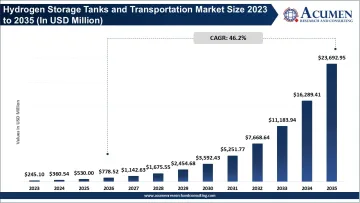
The global hydrogen storage tanks and transportation market size was valued at USD 530 million in 2025 and expected to reach USD 23,692 million by 2035; expected to grow at a notable CAGR of 46.2% during the forecast period of 2026-2035. Growing adoption of fuel cell electric vehicles (FCEVs), hydrogen refueling stations, and industrial decarbonization initiatives is driving the need for safe, lightweight, and high-capacity hydrogen storage and logistics solutions.
Report Highlights
- By region, Asia-Pacific dominated the global market with 38% revenue share in 2025 and is expected to grow at the fastest CAGR of 47.8%, supported by aggressive hydrogen investments and expanding clean energy initiatives.
- By region, Europe accounted for the second-largest 28% market share in 2025, owing to supportive government policies, expanding hydrogen infrastructure, and strong decarbonization targets.
- By type, storage tanks dominated the hydrogen storage tanks and transportation market with 62% share in 2025, driven by rising investments in stationary hydrogen storage infrastructure and hydrogen refueling stations.
- By type, transportation equipment is expected to witness notable growth during the forecast period due to the expansion of hydrogen distribution networks and long-distance hydrogen logistics.
- By tank type, Type I (All-Metal Tanks) held the largest 28% market share in 2025, owing to their lower manufacturing cost, durability, and widespread use in industrial hydrogen storage.
- By tank type, Type IV (Polymer Liner Fully Wrapped with Composite) is projected to register the fastest CAGR of 51.5% between 2026 and 2035, supported by increasing demand for lightweight high-pressure storage systems in fuel cell vehicles.
- By storage form, compressed hydrogen accounted for the largest 68% market share in 2025, attributed to its established infrastructure and widespread commercial adoption across multiple end-use industries.
- By storage form, liquid hydrogen is expected to grow at a significant pace over the forecast period owing to increasing investments in cryogenic storage and long-distance hydrogen transportation.
- By application, mobility captured the largest 32% market share in 2025, fueled by growing adoption of hydrogen-powered buses, trucks, passenger vehicles, and refueling infrastructure.
- By application, industrial held the second-largest 25% market share in 2025, driven by increasing hydrogen consumption in refining, chemical production, and steel manufacturing.
How Are Hydrogen Storage Tanks Transforming the Global Hydrogen Economy?
Hydrogen storage tanks and transportation systems are proving key in accelerating the global hydrogen economy, tackling one of the industry’s toughest issues. Across transportation, power, chemical, steel, and refining industries, interest is ramping up in adopting and utilizing low-carbon energy in the form of hydrogen to meet sustainability targets.
Global investments in the hydrogen economy, in terms of both production and refueling infrastructure, industrial hubs, and international hydrogen trading routes are accelerating, with many governments launching hydrogen strategies and funding large-scale pilots.
This trend, along with growing private sector investment in hydrogen storage and transport technologies, indicates that as the world transitions toward carbon neutral operations, hydrogen tanks and transportation systems will increasingly become the foundation for robust and integrated hydrogen supply chains, both domestically and on an international level.
How Are Public-Private Partnerships Accelerating Hydrogen Transportation Projects?
- Public-private partnerships (PPP) are fundamental for hydrogen logistics to leverage on strengths of both government and private sectors in addressing challenges such as significant initial costs, technological hurdles and long time to commercialization, inherent to hydrogen transport.
- In contrast with the established fossil fuel distribution, a hydrogen transport infrastructure necessitates costly dedicated storage tanks, pressurized tube trailers, cryo-liquid H2 trucks and/or pipelines and stations to provide the significant upfront investment.
- Through grants, tax credits, loan Guarantees or interest subsidies from government and the application of sophisticated storage solutions, engineering and operations expertise from the private sector, financial risks are shared to overcome such barriers.
| Partnership Initiative | Public Sector Contribution | Private Sector Contribution | Impact on Hydrogen Transportation |
|---|---|---|---|
| National Hydrogen Infrastructure Programs | Funding, policy incentives, permitting support | Development of storage tanks, transport vehicles, and logistics systems | Accelerates deployment of hydrogen transportation infrastructure and reduces project risks. |
| Hydrogen Mobility Corridors | Investment in refueling stations and transport infrastructure | Supply of hydrogen vehicles, trailers, and storage technologies | Establishes long-distance hydrogen distribution networks for commercial mobility. |
| Port-Based Hydrogen Hubs | Port modernization, land allocation, customs facilitation | Construction of liquid hydrogen terminals and storage facilities | Enables efficient import, export, and maritime transportation of hydrogen. |
| Industrial Hydrogen Clusters | Infrastructure grants and regulatory coordination | Pipeline development, bulk storage systems, and industrial logistics | Improves hydrogen supply chain efficiency between production and industrial consumption sites. |
| Research and Demonstration Projects | Funding for R&D and safety validation programs | Commercial testing of advanced tanks, cryogenic transport, and monitoring technologies | Accelerates commercialization of next-generation hydrogen transportation solutions. |
| Cross-Border Hydrogen Corridors | Bilateral agreements, infrastructure planning, regulatory harmonization | Investment in international transport assets and logistics operations | Facilitates large-scale international hydrogen trade and strengthens global supply chains. |
Market Dynamics
Driver
Rising Investments in Green Hydrogen Infrastructure Are Fueling Demand for Hydrogen Storage Tanks and Transportation Systems
Global green hydrogen capacity growth, driven by governments and private enterprises pouring into renewable energy projects and the build out of electrolyzer and refueling stations, are triggering increasing demand for hydrogen storage tank and transport solutions. Hydrogen must be stored at high pressure or cryogenic temperatures before it is delivered to end markets, such as power generation facilities, industrial sites, mobility applications or export facilities.
The IEA has projected that more than 520GW of green hydrogen electrolyzer projects announced worldwide could be completed by 2030, with more than $680 bn announced worldwide in green hydrogen related investment in production, infrastructure, storage and transportation, analysts anticipate that storage tanks and equipment required for transport will scale in proportion to increased hydrogen production capacity.
Restraint
High Capital Costs and Infrastructure Limitations Continue to Challenge Market Expansion
According to recent shifts in the industry, the type IV composite hydrogen tank contributes between 30% and 50% of the overall on-board storage system cost due to carbon fiber costs, a large portion of total material production cost. But even with extensive government policy support, the market for hydrogen storage tanks and transportation is still plagued by a challenging cost structure and technological complexities.
Hydrogen storage tanks must store gases at high pressures of 700 bar, or keep it at extremely low temperatures below -253°C to store it in liquid form. Because these require high performance materials, like carbon fiber composite or premium stainless steel, hydrogen tanks cost significantly more to produce than the storage systems for current conventional fuels.
Opportunity
Growing International Hydrogen Trade Is Creating New Demand for Advanced Transportation Solutions
New global trade lanes developing for hydrogen create a significant market opportunity for the makers of hydrogen storage tanks and transportation equipment. Nations with abundant renewable energy supplies are expected to become net exporters of green hydrogen in the coming years, whereas some heavily industrialized nations with a deficiency of their own sustainable energy resources are developing long-term strategies to be significant importers of hydrogen.
Developing these new global hydrogen trade routes and increasing supply chains are stimulating the demand for all sorts of hydrogen transporting mechanisms such as: large high-capacity tanks, liquid carriers, ammonia transport systems, port-based storage infrastructure, and cryogenic shipping methods.
For instance, the EU aims to be an importer of 10 million tons per year of renewable hydrogen by 2030 to complement a further 10 million tons per year in domestic production of green hydrogen. Additionally, like the EU, Australia, Saudi Arabia, the UAE, and Chile are pursuing multi-billion- dollar projects to be the world's future exporters of this green hydrogen commodity.
Segmental Insights
Type Insights
The storage tanks segment occupied a dominant 62% of the global market share in 2025. Driven by burgeoning expansion of hydrogen production facilities, industrial hydrogen storage solutions, and deployment of hydrogen refueling stations, this segment caters to essential role across major global economies.
As storage tanks form the fundamental part of the hydrogen value chain for securing contained and transportable forms of both gaseous compressed (CGH) and liquid hydrogen (LH), burgeoning demand for large stationary storage systems from green hydrogen projects and industries keen on their industrial decarbonization and renewable energy storage will boost the market growth.
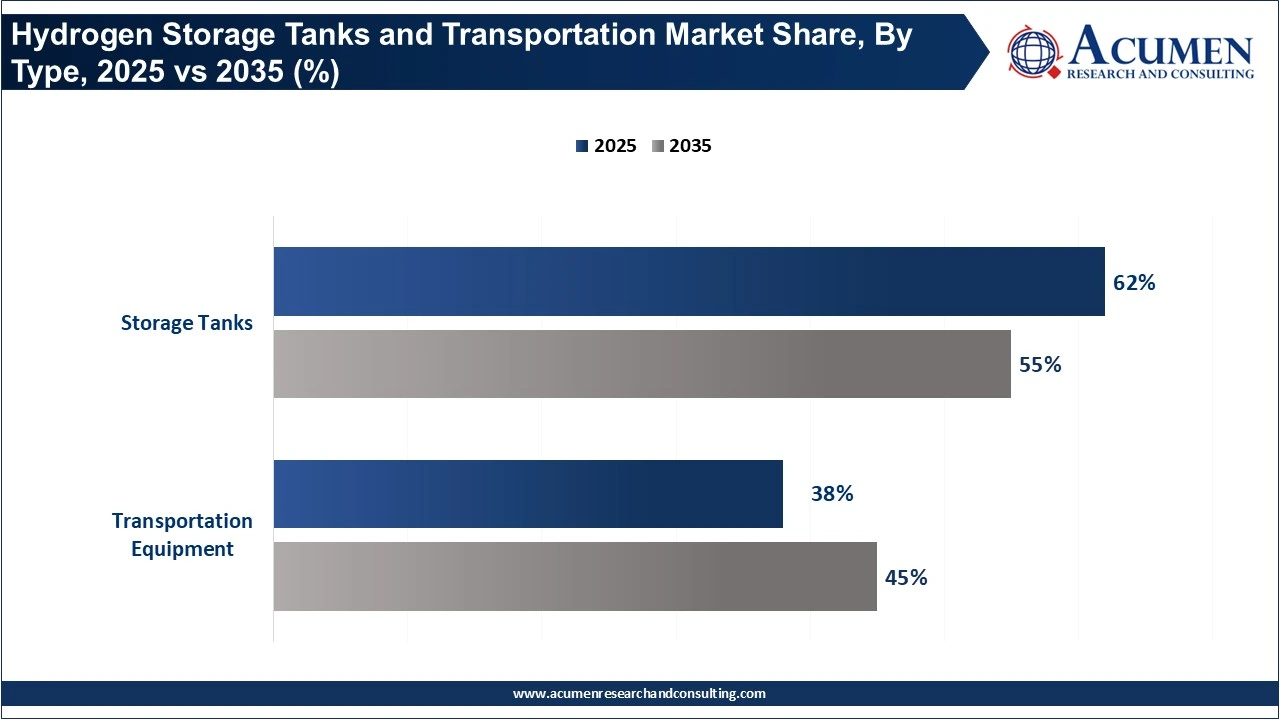
The transportation equipment segment is projected to experience the fastest growth through 2035, increasing its market share from 38% in 2025 to 45% by 2035. As global hydrogen production expands to beyond localities to support various hydrogen-based industries and fuel applications, cross border trade and growth in hydrogen export infrastructure will contribute to demand for this sector.
Tank Type Insights
Type I was largest by market share 28% in 2025, being most dominant worldwide by this type. Type I tanks continue to be preferred by many users because they are considered safe, durable, low-cost to manufacture, and robust under heavy-duty industrial applications. The market segments for type I tanks include use for industrial gas storage, chemicals production facilities, hydrogen production facilities, and stationary hydrogen storage applications where a low weight is of less importance than cost and structural robustness.
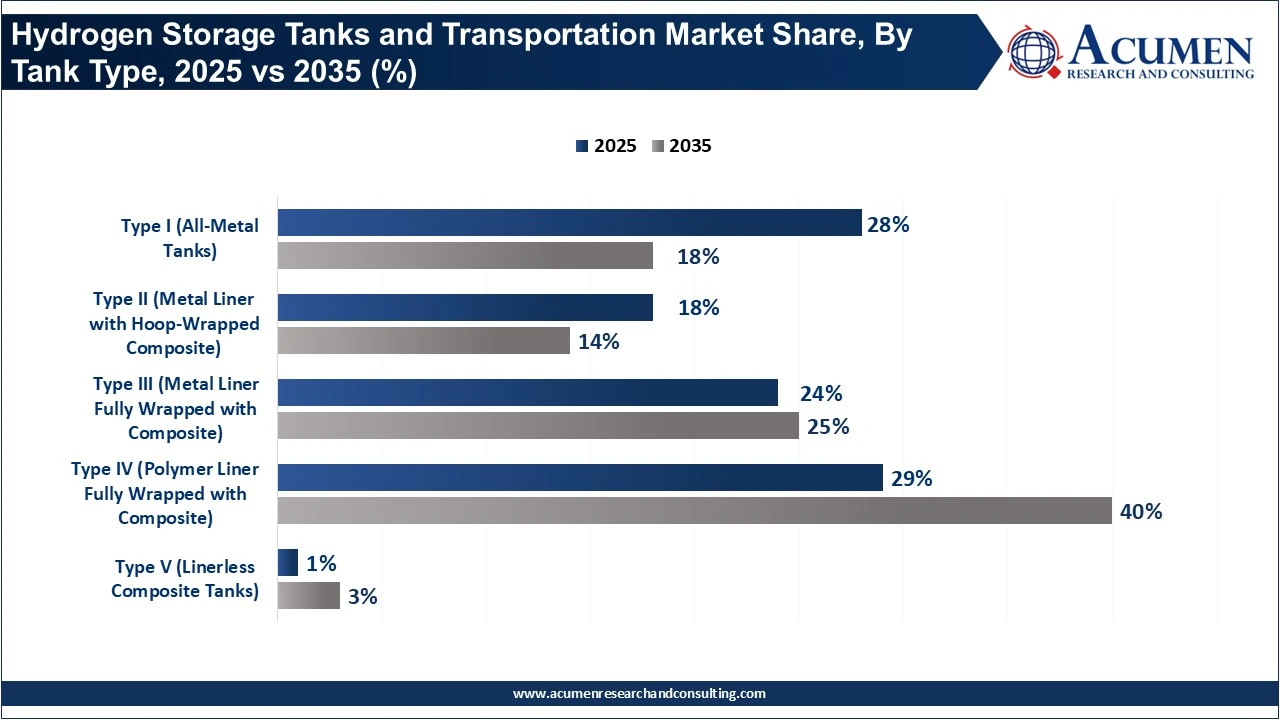
Type IV tank is expected to grow the fastest of all types by CAGR at 51.5% from 2026 to 2035, and gain a much larger market share from 29% to 40% by 2035, reflecting the faster deployment of FCEV hydrogen trucks, commercial vehicles, buses and fuel cell applications. The combination of a lightweight polymer liner and a full composite overwrapping of the entire body using a carbon fiber wrap creates an overall light weight for FCEVs, with storage capacities up to 700 bar. The resistance to corrosion, better hydrogen storage efficiencies and better fuel efficiencies made these tanks the preferred option for new fuel cell electric vehicles.
Storage Form Insights
Compressed hydrogen accounted for a market share of 68% in 2025, emerging as the leading storage format globally. The market position of compressed hydrogen is driven by its commercial maturity, existing fueling infrastructure and applications in transportation, industry, and fueling sectors.
Today, most hydrogen fueling stations provide compressed hydrogen at 350 bar or 700 bar, leading it to become the predominant storage type for fuel cell electric vehicles. Compressed hydrogen is comparatively easier to deploy infrastructure for the same as against the cryogenic liquid hydrogen, thereby finding it easy application for both static and mobile applications.
Hydrogen Storage Tanks and Transportation Market Share, By Storage Form, 2025 (%)
| Storage Form | Revenue Share, 2025 (%) |
|---|---|
| Compressed Hydrogen | 68% |
| Liquid Hydrogen | 27% |
| Solid-State Hydrogen | 5% |
While holding 27% market share in 2025, liquid hydrogen storage segment is expected to be spurred by a rising need for high-volume long-distance transport of hydrogen with the growing hydrogen demand globally. Liquefied hydrogen provides a higher energy density in terms of volumetric space than compressed hydrogen, facilitating its use in aerospace, maritime shipping, heavy-duty logistic, and the international hydrogen trade.
The ongoing growth of investment in cryogenic storage tanks, liquefaction plants, hydrogen export terminals, and the marine fleet for carrying liquefied hydrogen across borders has begun to support wider commercial adoption.
Application Insights
By application type, the mobility segment occupied the largest market share, holding 32% in 2025. Driven by the growing penetration of the hydrogen fuel cell electric vehicles globally in cars, buses, trucks, construction equipment, and material handling equipment, the mobility segment is experiencing high demand for the hydrogen storage. Governments globally offer financial incentives, emissions reduction goals, and investments in refueling infrastructure to accelerate hydrogen in mobility.
Hydrogen Storage Tanks and Transportation Market Share, By Application, 2025 (%)
| Application | Revenue Share, 2025 (%) |
|---|---|
| Mobility | 32% |
| Hydrogen Refueling Stations | 18% |
| Industrial | 25% |
| Energy Storage | 10% |
| Aerospace & Defense | 5% |
| Marine & Rail | 7% |
| Others | 3% |
The industrial segment held 25% market share in 2025, contributing to the second biggest market application. The major uses of hydrogen in industrial application includes refining, production of ammonia, methanol, and steel, as well as in chemical processes, and in the production of glass.
The widespread increase in production of green hydrogen across industries leads to increasing installation of hydrogen storage equipment for industrial production lines for continuous operation. Decarbonization in industrial application such as low carbon steel production, green chemical processes, and construction works are some factors contributing to the increased adoption of hydrogen storage, from compressed to liquid storage forms.
Regional Analysis
How is Asia Pacific Emerging as the Largest Hydrogen Storage Market?
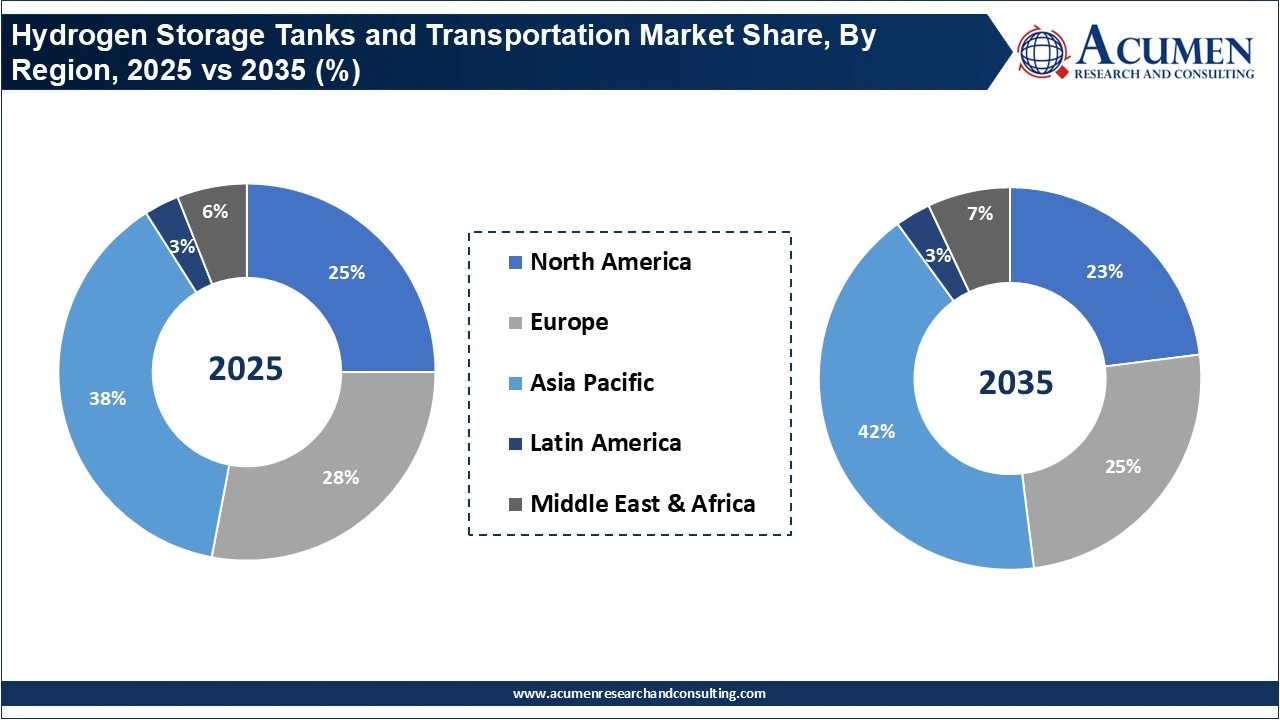
Asia-Pacific had the largest share of 38% in 2025, and the segment is expected to grow to 42% by 2035, with the highest CAGR of 47.8% over the forecast period. The increasing adoption of an aggressive road-map for hydrogen development, heavy public and private investment in the technology, and early commercialization of the technology in China, Japan and South Korea drive this growth in the region.
The China is scaling up hydrogen production capacity and fuel cell electric vehicle (FCEVs) adoption; while Japan continue to be at the forefront of hydrogen mobility and residential fuel cell systems. The South Korea has planned massive investment in hydrogen-based transportation and refueling infrastructure in the entire country through their hydrogen economy roadmap, whilst the India is establishing itself as a producer and exporter of green hydrogen backed by immense availability of renewable energy resources and massive export projects.
How is Europe Building a Hydrogen Transportation Network?
The second largest regional market, the European region held 28% share of global market in 2025 and is driven by stringent government policies, targets for decarbonization and substantial investments through national hydrogen strategy and other clean energy plans. Countries such as Germany, France, Spain and Netherlands are heavily developing hydrogen generation capacities, refueling infrastructure and its industrial utilization.
The increasing demand for specialized tanks for hydrogen storage and transportation equipment in the European region can be seen due to Europe's emphasis on renewable hydrogen, trans-border hydrogen pipelines and value-chain development of hydrogen and significant rise in investment for hydrogen powered rail, maritime, and heavy-duty transport applications in the region in future.
Top 5 Government Initiatives
| Government Initiative | Country/Region | Key Objective |
|---|---|---|
| European Hydrogen Bank | European Union | Accelerate renewable hydrogen production through competitive funding and market support mechanisms. |
| National Clean Hydrogen Strategy and Roadmap | Australia | Establish Australia as a leading global producer and exporter of clean hydrogen by expanding production and export infrastructure. |
| National Green Hydrogen Mission | India | Develop a competitive green hydrogen ecosystem through production incentives, and domestic manufacturing. |
| Hydrogen Shot Initiative | United States | Reduce the cost of clean hydrogen production while accelerating commercialization and infrastructure investments. |
| Basic Hydrogen Strategy and Green Growth Strategy | Japan | Expand hydrogen utilization across transportation, power generation, and industrial sectors. |
Recent News
- In June 2026, Hyundai E&C announced its acceleration of development for ultra-large liquid hydrogen infrastructure. Under this, it has also launched development and demonstration plan for Korea’s fist flat-bottom liquid hydrogen plant.
- In June 2026, in Korea, the Ministry of Climate and Environment and Environmental Industry and Technology Institute announced the official start of project for recycling hydrogen cars for future resources. The plan focuses on safely dismantling these vehicles to recover and recycle, establishing a circular economy.
Key Companies
- Hexagon Purus (Norway) – International leader in Type IV composite hydrogen cylinders, and the complete hydrogen solutions for both mobile and stationary applications.
- Worthington Enterprises (United States) – Significant supplier of high-pressure cylinders and hydrogen solutions in transport, industrial gases and the energy sectors in a worldwide setting.
- Luxfer Holdings PLC (United Kingdom) – A known provider of light-weight composite gas cylinders in the storage of fuel-cell-powered vehicle applications and gas transport.
- Linde plc (United Kingdom/Ireland) – One of the world’s largest producers of industrial gases, the company stands as a foremost in hydrogen manufacturing, distribution and storage (liquefied).
- Air Liquide (France) – A pioneering international leader within the hydrogen chain, offering advanced technology solutions related to storage, transport and refueling facilities in many different locations globally.
- Air Products and Chemicals, Inc. (United States) – a leading player providing hydrogen infrastructure, such as liquid hydrogen storage containers and transporting devices supporting large-scale green hydrogen operations.
- NPROXX B.V. (Netherlands) – Specialist in composite, high-pressure hydrogen storage tanks and well-known for its storage system solutions for buses, commercial vehicles and industrial sector use.
- Toyota Motor Corporation (Japan) – With consistent advances in fuel-cell-tech, Toyota has considerably advanced high-pressure storage for vehicle deployment.
- Chart Industries, Inc. (United States) – Leading global manufacturer of cryogenic equipment – offering a range of liquid hydrogen storage tanks, transport trailers and technologies as it relates to a developing hydrogen economy.
- Plastic Omnium (France) – Key producer of composite, high-pressure hydrogen storage systems in next-gen hydrogen vehicles, both passenger cars and commercial transportation options.
Segments Covered
By Type
- Storage Tanks
- Transportation Equipment
By Tank Type
- Type I (All-Metal Tanks)
- Type II (Metal Liner with Hoop-Wrapped Composite)
- Type III (Metal Liner Fully Wrapped with Composite)
- Type IV (Polymer Liner Fully Wrapped with Composite)
- Type V (Linerless Composite Tanks)
By Storage Form
- Compressed Hydrogen
- Liquid Hydrogen
- Solid-State Hydrogen
By Application
- Mobility
- Hydrogen Refueling Stations
- Industrial
- Energy Storage
- Aerospace & Defense
- Marine & Rail
- Others
By Region
- North America
- Europe
- Asia-Pacific
- Latin America
- Middle East & Africa
Looking for discounts, bulk pricing, or custom solutions? Contact us today at sales@acumenresearchandconsulting.com
Frequently Asked Questions

Other Energy and Power Reports
June 2020
April 2020
April 2024
August 2024