
Green Hydrogen Market Size, Share, Trends, Forecast 2026 To 2035
Green Hydrogen Market (By Technology: Alkaline Electrolyzer, PEM Electrolyzer, SOEC Electrolyzer; By Distribution Channel: Pipeline, Cargo; By Application: Transport, Power Generation, Others) - Global Industry Analysis, Size, Share, Analysis, Trends and Forecast 2026 - 2035
- Last Updated: 13 Jan 2026
- Report Code: ARC3892
- Category: Energy and Power
Green Hydrogen Market Size and Forecast 2026 - 2035
The global green hydrogen market size garnered at USD 11.4 billion in 2025 and is anticipated to attain around USD 173.5 billion by 2035, registering a CAGR of 31.2% from 2026 to 2035. The increasing decarbonization efforts and net-zero commitments are proliferating the demand of green hydrogen. In addition, the rapid decline in renewable energy and electrolyzer costs is opportunistic for the market growth.
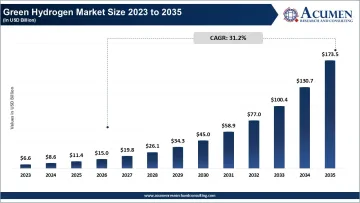
Report Highlights
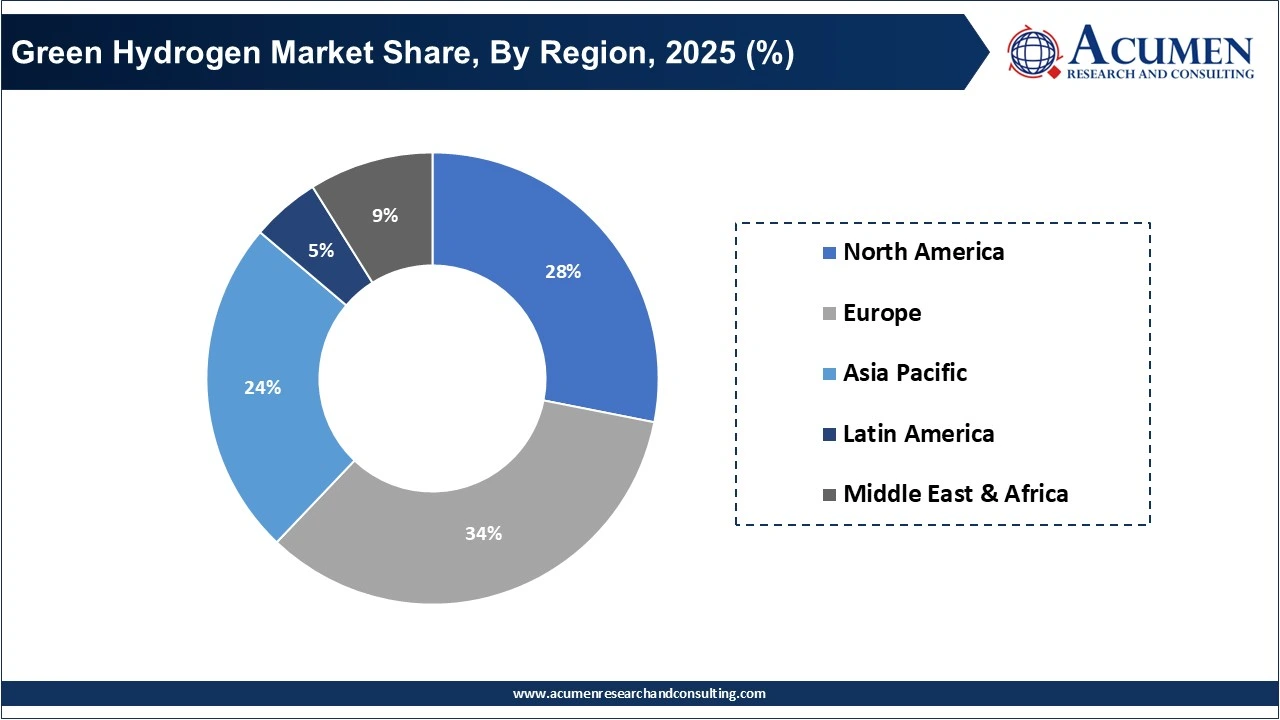
- By Region, the Europe green hydrogen market garnered a revenue of USD 3.9 billion in 2025.
- By Region, the Asia-Pacific green hydrogen market is poised to grow at a lucrative CAGR of over 32.8% from 2026 to 2035.
- By Technology, the alkaline electrolyzer segment accounted for 65% of the total market share in 2025.
- By Distribution Channel, the pipeline segment represented 61% of the market share in 2025.
- By Application, the transport segment contributed 42% of the total market share in 2025.
Green Hydrogen Market Overview
The global green hydrogen market represents a burgeoning sector that targets the production of hydrogen fuel without any emissions via the process of electrolyzing water, exclusively harnessing the use of solar and wind renewable energies. Green hydrogen represents a clean alternative to the use of fossil fuel-based hydrogen, which is classified as either grey hydrogen or blue hydrogen. It is a critical component in the quest for a net zero future. The sector is growing in light of the global target to combat climate change, the decreasing price of renewable energy, government policies, and advancements in the level of technological developments.
The demand for green hydrogen is rising because of environmental concerns and the drive for more environmentally friendly sources of energy. Nonetheless, high investment and operational expenses are some of the factors inhibiting this sector. Government support and increased adoption of hydrogen integration projects are projected to increase its adoption. With government protection favoring green hydrogen in the energy sector, the industry's revenue is projected to increase. This is because of rising environmental concerns associated with high carbon emissions from fossil fuel consumption.
Green Hydrogen Market Dynamics
Market Drivers
Rising Government Support
- Governments play an important part in ensuring that favorable policies and laws for the long-term sustainability of the green hydrogen market. Governments around the world are working to create the framework of renewable energy policies, set the goal of reducing emissions, and ensure carbon pricing policies, which make way for the demand for green hydrogen. They are working on the laws and policies that make the implementation of green hydrogen suitable for the existing energy structure. For example, the ability to mix green hydrogen with gas pipelines and fuel cells. In September 2025, a green hydrogen start-up scheme worth 100 crores was launched by Union Minister Pralhad Joshi, with a maximum of 5 crores for each project. In the Green Hydrogen R&D Conference, 25 start-ups presented their developments.
Increasing Demand for Renewable Sources of Energy
- Renewable energy sources are recurrent in nature and their generation relies on weather conditions. Energy storage becomes critical to balance the continuous demand and supply. Green hydrogen is produced during the periods of additional renewable energy generation and is stored for later usage. It can also be converted back to electricity with the help of fuel cells or used as a feedstock in industrial processes, offering a dependable energy storage solution while contributing to efficient grid stability. Many private organizations, governments, and regions have set targets with key regulatory policies to transition to renewable energy and reduce carbon emissions. Such goals often include an emphasis on the production of green hydrogen as a crucial component of energy transition strategies. The rising demand for renewable energy to attain these targets naturally fuels the demand for green hydrogen as a clean carrier of energy.
- The chart above shows a steady and sustained rise in the EU’s share of energy sourced from renewables, increasing from 17.42% in 2014 to 25.23% in 2024, reflecting consistent policy support and accelerated clean energy deployment. Growth notably strengthened after 2019, driven by expanded wind, solar, and bioenergy capacity aligned with EU Green Deal targets. This upward trajectory underscores the region’s continued commitment to decarbonization and energy security.
Market Restraints
Lack of Awareness in Remote Areas
- In underdeveloped regions, basic infrastructure such as power and transportation may be absent. This can hamper the development and dissemination of green hydrogen projects. In the absence of basic infrastructure, the development of local nodes for the use of green hydrogen may be hampered in underdeveloped regions. These regions face economic issues such as poverty and a lack of financial means. Typically, green hydrogen projects demand heavy investments and in-depth technical assistance. This could be a challenge for underdeveloped regions. Inadequate financial means and a lack of technical assistance make it difficult to develop and sustain a green hydrogen project. Thus, a lack of awareness in underdeveloped regions appears to be a major hindrance in the green hydrogen market.
Infrastructure Limitations
- The energy density of hydrogen is low, which makes it difficult to transport and store the fuel in an efficient manner. The infrastructure for hydrogen pipelines is not extensive, which may make it difficult to modify the existing infrastructure for the transport of natural gas. The absence of infrastructure for the transportation of hydrogen, such as shipping, trucks, and others, adds to the difficulties faced in the distribution of green hydrogen to the end-consumers. The requirement for specialized infrastructure for the storage of green hydrogen to avoid leakage and ensure safety further restricts the infrastructure for the storage of hydrogen, which remains a challenge for the growth of the market.
Market Opportunities
Technological Advancements
- Certain technological developments related to electrolyzers, renewable energy, and decarbonization technologies are providing avenues for expansion for the global market for green hydrogen. Technological developments aid in the development of infrastructure for the green hydrogen market. This includes developments in hydrogen storage and transport technologies, such as high pressure or refrigerated hydrogen storage, hydrogen fuel stations, and hydrogen pipelines. With developments in infrastructure, there is an increase in the potential for the penetration of green hydrogen.
Growing R&D Investments
- Research and development activities focuses on improving the efficiency and longevity of green hydrogen technology. Increasing the efficiency rate and lifespan of electrolytic cells can help increase hydrogen production capacity and decrease maintenance costs. At the same time, advancements in fuel cell technology can help improve the efficiency rate and lifespan of hydrogen fuel-based vehicles and other systems. While overcoming the primary cost barrier in the market, research can help minimize costs involved in the production of green hydrogen. As research advances, scientists and engineers can help identify areas to optimize such processes and minimize the use of expensive materials. This will increase the efficiency rate of production of green hydrogen to a great extent as compared to fossil fuels.
Green Hydrogen Market Report Scope
| Attribute | Details |
|---|---|
| Green Hydrogen Market Size 2025 | USD 11.4 Billion |
| Green Hydrogen Market Forecast 2035 | USD 173.5 Billion |
| Green Hydrogen Market CAGR During 2026 – 2035 | 31.2% |
| Green Hydrogen Market Analysis Period | 2023 – 2035 |
| Green Hydrogen Market Base Year | 2025 |
| Green Hydrogen Market Forecast Data | 2026 – 2035 |
| Segments Covered | By Technology, By Distribution Channel, By Application, and By Geography |
| Regional Scope | North America, Europe, Asia-Pacific, Latin America, and Middle East & Africa |
| Key Companies Profiled | Air Liquide, Air Products Inc., Bloom Energy, Cummins Inc., Engie, Linde plc., Nel ASA, Siemens Energy, Toshiba Energy Systems & Solutions Corporation, and Uniper SE |
| Report Coverage | Market Trends, Drivers, Restraints, Competitive Analysis, Player Profiling, Covid-19 Analysis, Regulation Analysis |
Green Hydrogen Market Regional Analysis
Europe dominated the green hydrogen market by garnering a major market share in 2025. This is due to the strict climate regulations, as well as the discontent of the oil and gas corporations from outside Europe, and the aim to adopt renewable energy. The European Union has plans to be climate neutral by 2050, and one of the key sources that will contribute to that target is green hydrogen. There are various countries within Europe that are implementing the launch of hydrogen plants. The European government is providing finance to help companies push forward to develop the future of hydrogen technology. In December 2025, RWE commissioned the largest green hydrogen plant of Europe in Germany. This 100MW electrolyzer plant is set to commence in 2026.
| Region | Market Share, 2025 (%) | Key Highlights |
|---|---|---|
| North America | 28% | The market is steadily expanding, driven by growing investments in clean energy infrastructure, industrial decarbonization initiatives, and hydrogen hubs. |
| Europe | 34% | This market is driven by strict climate regulations, as well as the discontent of the oil and gas corporations from outside Europe, and the aim to adopt renewable energy. |
| Asia-Pacific | 24% | Supportive policies and programs introduced by the government in the region are contributing to the promotion of the use of clean energy alternatives such as green hydrogen. |
| MEA | 9% | The market growth is supported by massive renewable energy potential, specifically solar, and robust government-driven initiatives. |
| Latin America | 5% | The regional market is driven by abundant renewable energy resources and growing foreign investments in projects related to green hydrogen. |
The Asia-Pacific market is expected to observe a significant growth throughout the forecast period. Facilitative policies and programs introduced by the government in the region that are contributing to the promotion of the use of clean energy alternatives such as green hydrogen include the abundance of renewable resources such as solar, hydro, and wind resources in the region that make the production of green hydrogen through the process of electrolysis economical. Additionally, the ongoing measures to decrease carbon emissions, advances in the technology of electrolysis, the intensification of investment in the development of renewables energy infrastructure support in the region, as well as the collaboration of local and international companies to execute major projects for the application of green hydrogen, are contributing to the acceleration of market growth in the region.
Green Hydrogen Market Segmental Insights
The worldwide market for green hydrogen is split based on technology, distribution channel, application, and geography.
Technology Insights
Based on technology, the market is segmented into alkaline electrolyzer, PEM Electrolyzer and SOEC Electrolyzer.
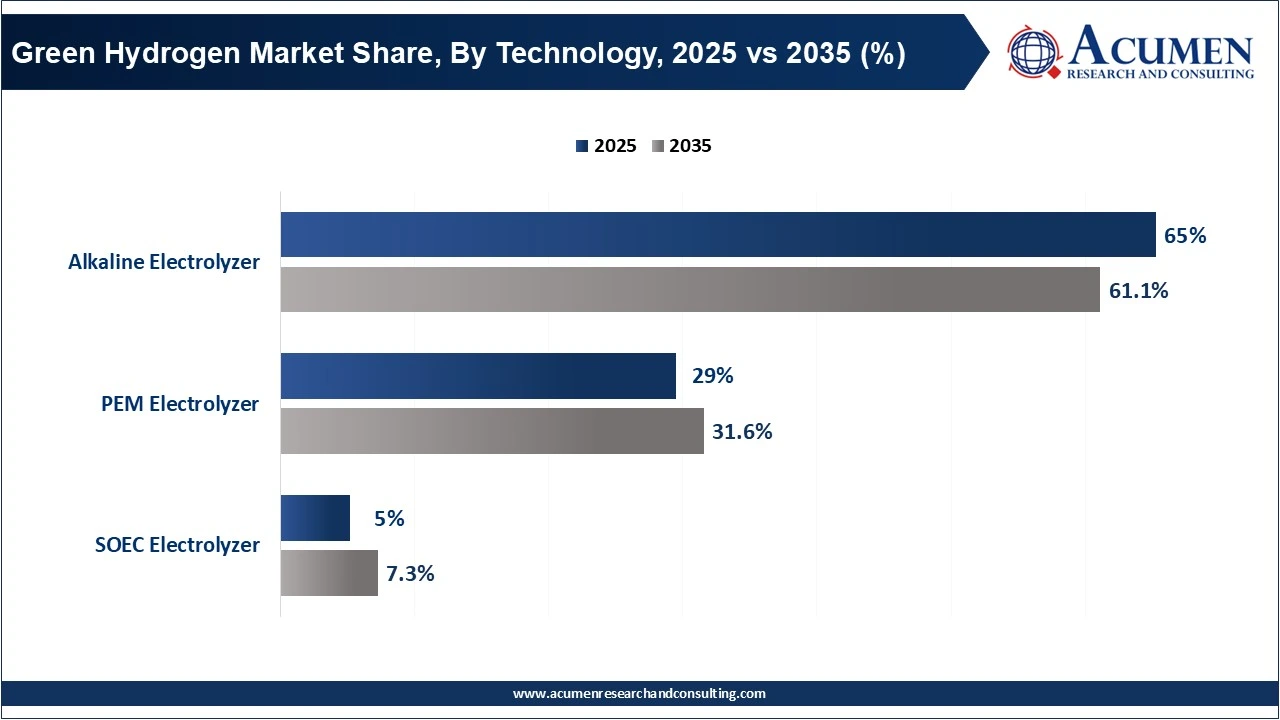
The alkaline electrolyzer segment dominated the green hydrogen market in 2025. Alkaline electrolyzers have emerged as one of the most mature and widely used technologies in green hydrogen production, ensuring reliability and a relatively low cost of establishment when compared to state-of-the-art electrolyzer technologies. The large-scale adoption of alkaline electrolyzers in industrial-scale green hydrogen production projects has been backed and facilitated by successful use and suitability and adaptability for large-scale renewable energy projects and installations. Moreover, substantial adoption in chemical industry processes, refineries, and power-to-hydrogen projects and favorable governmental policies and investments in renewable hydrogen infrastructure have also backed the dominance of alkaline electrolyzers in the market.
| Technology | Market Share, 2025 (%) | Key Highlights |
|---|---|---|
| Alkaline Electrolyzer | 65% | Alkaline electrolyzers have emerged as one of the most mature and widely used technologies in green hydrogen production, ensuring reliability and a relatively low cost of establishment when compared to state-of-the-art electrolyzer technologies. |
| PEM Electrolyzer | 29% | PEM electrolyzer technology is gaining strong traction in the green hydrogen market due to its high efficiency, rapid load response, and superior compatibility with intermittent renewable energy sources, making it ideal for grid-flexible and decentralized hydrogen production. |
| SOEC Electrolyzer | 5% | Operating at high temperatures, SOECs can attain far higher electrical efficiency and lower consumption of electricity upon being applied with waste heat or industrial processes. |
Distribution Channel Insights
According to the green hydrogen industry analysis, in 2025, the pipeline segment dominated the market. Pipeline distribution channel is popular for large-scale and steady-state hydrogen supply because it is economical, safe, and feasible for transporting large quantities over a long distance. Pipelining is ideal for areas with an industrial complex, hydrogen hub, or existing natural gas pipeline infrastructure and can be easily integrated with green hydrogen in chemical, refining, and power sectors of industries. Increasing investments in dedicated hydrogen pipeline networks and conversion of existing natural gas pipeline infrastructure have been contributing to the dominance of the pipeline segment.
| Distribution Channel | Market Share, 2025 (%) | Key Highlights |
|---|---|---|
| Pipeline | 61% | Increasing investments in dedicated hydrogen pipeline networks and conversion of existing natural gas pipeline infrastructure have been contributing to the dominance of the pipeline segment. |
| Cargo | 39% | Cargo-based transport, which includes liquefied hydrogen and other hydrogen-carrier fuels such as ammonia and Liquid Organic Hydrogen Carriers (LOHCs), is being considered for long-distance and international transportation of hydrogen. |
Application Insights
The transport segment held the largest market share in 2025. The dominance is based on the growing demand for hydrogen as a zero-emission fuel in fuel cell electric vehicles, heavy-duty trucks, rail, public transport buses, and maritime applications. Green hydrogen is rapidly gaining acceptance as a fuel for the transport sector, as its energy density is high, refueling is rapid, and it is suitable for long-range mobility and carrying heavier loads where battery electrification is not viable. Incentives from the government, lower emissions, and widespread hydrogen refueling infrastructure are subsequently fueling the market share of this segment.
| Application | Market Share, 2025 (%) | Key Highlights |
|---|---|---|
| Transport | 42% | The dominance is driven by the growing demand for hydrogen as a zero-emission fuel in fuel cell electric vehicles, heavy-duty trucks, rail, public transport buses, and maritime applications. |
| Power Generation | 36% | Green hydrogen is emerging as a strategic long-term solution for flexible, low-carbon power generation, enabling seasonal energy storage and decarbonizing gas turbines. |
| Others | 22% | Industrial applications such as refining, ammonia, and steel production are driving substantial demand for green hydrogen as companies transition away from fossil-based feedstocks to meet sustainability mandates. |
Green Hydrogen Market Players
- Air Liquide
- Air Products Inc.
- Bloom Energy
- Cummins Inc.
- Engie
- Linde plc.
- Nel ASA
- Siemens Energy
- Toshiba Energy Systems & Solutions Corporation
- Uniper SE
Green Hydrogen Market Segmentation
By Technology
- Alkaline Electrolyzer
- PEM Electrolyzer
- SOEC Electrolyzer
By Distribution Channel
- Pipeline
- Cargo
By Application
- Transport
- Power Generation
- Others
By Region
- North America
- U.S.
- Canada
- Europe
- U.K.
- Germany
- France
- Spain
- Rest of Europe
- Asia-Pacific
- India
- Japan
- China
- Australia
- South Korea
- Rest of Asia-Pacific
- Latin America
- Brazil
- Mexico
- Rest of LATAM
- The Middle East & Africa
- South Africa
- GCC Countries
- Rest of the Middle East & Africa (MEA)
Looking for discounts, bulk pricing, or custom solutions? Contact us today at sales@acumenresearchandconsulting.com
Frequently Asked Questions

Other Energy and Power Reports
January 2018
February 2020
March 2024
June 2026