
Technical Textile Market Size to Surge USD 384.89 Billion by 2035, Expanding at a CAGR of 5.3%
Published : 16 Nov 2026
Author : Lucas Hoffmann



What is the Technical Textile Market Size?
The global technical textile market size was valued at $241.36 billion in 2026 and is expected to surge around $384.89 billion by 2035, expanding at a CAGR of 5.3% during the forecast period 2026 to 2035. Rising demand for high-performance materials across healthcare, agriculture, construction, automotive, packaging, and industrial applications is supporting market growth. Increasing infrastructure investment, advancements in fibre engineering, and the shift toward lightweight, durable, and functional materials are further expanding the adoption of technical textiles.
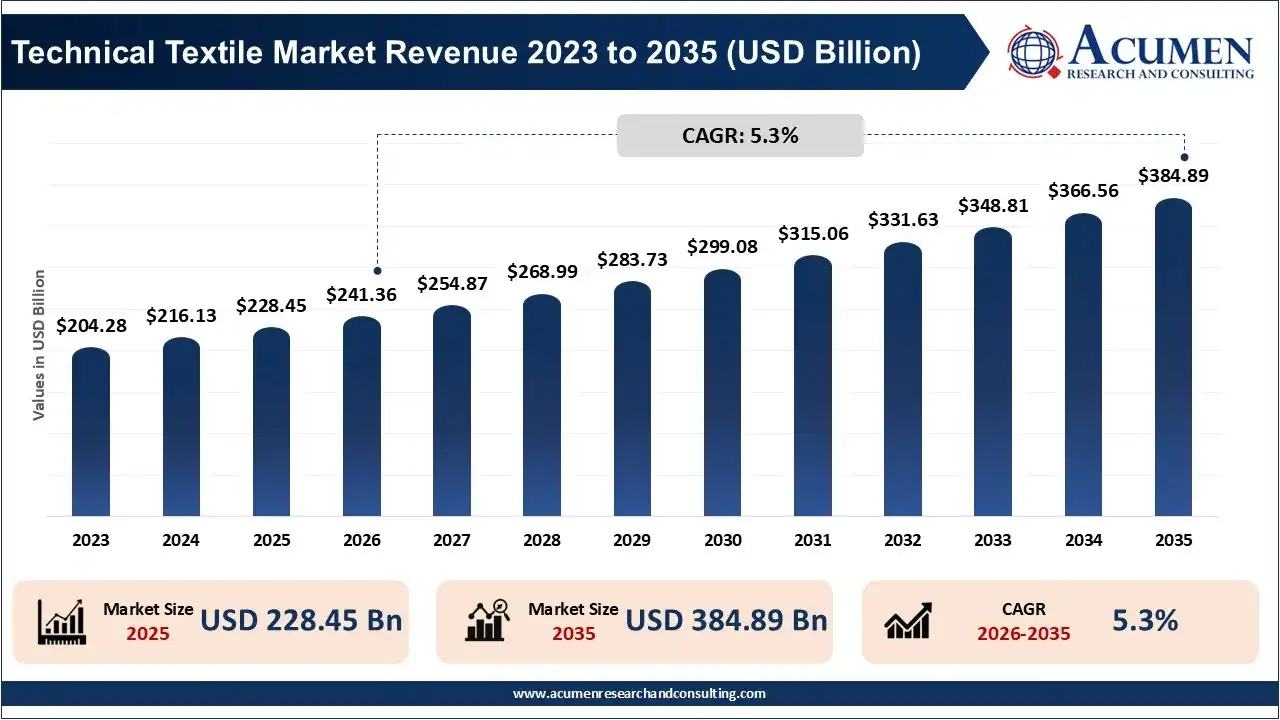
Technical Textile Market Overview
The technical textile market is evolving beyond conventional fabric applications, with manufacturers increasingly developing materials designed to deliver specific functional properties such as strength, filtration, thermal resistance, chemical protection, and moisture management. These textiles are becoming essential across industries where performance, durability, and specialized functionality matter more than appearance.
In 2025, Asia-Pacific accounted for 46.0% of the global market, supported by its large textile manufacturing base, industrial expansion, infrastructure development, and growing demand from packaging, automotive, and healthcare sectors. Meanwhile, the increasing use of advanced fibres, nonwoven technologies, and specialized medical textiles is creating new opportunities for manufacturers. The growing focus on efficient production, material innovation, and application-specific solutions is expected to shape the industry's development through 2035.
Technical Textile Market Future Outlook (2026–2035)
- The market is expected to benefit from increasing demand for functional fabrics across healthcare, automotive, construction, agriculture, and industrial applications.
- Asia-Pacific is likely to maintain its leadership, supported by manufacturing capacity, industrial expansion, and growing domestic consumption.
- Meditech applications are expected to gain momentum as healthcare systems increase their use of specialized medical and hygiene textiles.
- High-performance fibres are likely to attract greater investment as manufacturers seek materials with improved strength, durability, and thermal resistance.
- Nonwoven production is expected to expand across filtration, medical, hygiene, and automotive applications.
- Sustainability initiatives may encourage wider adoption of recycled polymers, bio-based fibres, and resource-efficient production methods.
- Latin America is expected to strengthen its contribution as industrial development and infrastructure investment create additional demand for technical fabrics.
Technical Textile Market Segmental Outlook
| Segment | Dominant category (2025) | Fastest-growing category |
|---|---|---|
| Application | Packtech: 15.0% share, USD 34.27 billion | Meditech: 6.6% CAGR, reaching USD 51.96 billion by 2035 |
| Material / Fibre Type | Synthetic commodity polymers: 62.0% share, USD 141.64 billion | High-performance fibres: 8.5% CAGR, reaching USD 36.56 billion by 2035 |
| Process / Technology | Woven textiles: 42.0% share, USD 95.95 billion | Nonwoven textiles: 6.2% CAGR, reaching USD 138.56 billion by 2035 |
Challenges in the Technical Textile Market
The technical textile industry faces challenges related to raw material price fluctuations, energy-intensive manufacturing, and the availability of specialized production technologies. Developing high-performance fibres and application-specific fabrics can require substantial investment in research, equipment, and quality control. Manufacturers must also meet varying performance and safety standards across end-use industries. In addition, competition from lower-cost producers and the need to improve the recyclability of synthetic materials may influence production strategies and profit margins.
Regional Outlook
Asia-Pacific Leads the Global Market
Asia-Pacific dominated the technical textile market with a 46.0% share in 2025, generating USD 105.09 billion in revenue. The region is also expected to remain the fastest-growing regional market, expanding at a CAGR of 6.2% between 2026 and 2035 and reaching USD 192.44 billion by 2035. Its leadership is supported by established textile manufacturing ecosystems, competitive production costs, growing industrial output, and increasing demand for specialized materials across healthcare, infrastructure, automotive, and packaging industries. China, India, Japan, and South Korea are important contributors to regional demand and manufacturing capabilities.
Latin America Emerges as a Growth Opportunity
Latin America is expected to present steady growth opportunities in the technical textile market, with its share projected to increase from 5.1% in 2025 to 5.5% by 2035. The regional market generated USD 11.65 billion in 2025 and is forecast to reach USD 21.17 billion by 2035, growing at a CAGR of 6.1% from 2026 to 2035. Demand from agriculture, construction, automotive manufacturing, packaging, and healthcare is creating opportunities for technical textile producers. Increasing investment in industrial infrastructure and the modernization of manufacturing operations are also expected to support regional expansion.
Country-Level Opportunities
- China: A major manufacturing hub, China benefits from extensive textile production capacity and demand from automotive, construction, packaging, and industrial sectors. Investments in advanced materials and nonwoven manufacturing are supporting its position.
- India: Expanding healthcare infrastructure, government-backed manufacturing initiatives, and demand for geotextiles, protective fabrics, and agricultural textiles are creating opportunities for domestic producers.
- Japan: Demand for high-performance fibres and specialized technical fabrics is supported by advanced automotive, electronics, healthcare, and industrial manufacturing industries.
- Brazil: Agricultural activity, infrastructure development, and expanding industrial applications are supporting demand for geotextiles, packaging textiles, filtration materials, and automotive fabrics.
Technical Textile Market Competitive Landscape
Freudenberg Group, Berry Global, DuPont, Toray Industries, Asahi Kasei, Mitsui Chemicals, Kimberly-Clark, Ahlstrom, Johns Manville, Milliken & Company, SRF Limited, and TechnoNICOL are among the prominent companies operating in the technical textile market. These players are focusing on product innovation, manufacturing capacity expansion, and the development of application-specific materials to strengthen their market positions. Investments in nonwoven technologies, high-performance fibres, filtration media, medical fabrics, and sustainable textile solutions are shaping competitive strategies.
Segments Covered
By Application
- Mobiltech (automotive, aerospace, rail, marine)
- Indutech (filtration, belts, composites reinforcement)
- Packtech (FIBCs, woven sacks, wrapping)
- Meditech (hygiene, medical and healthcare)
- Hometech (furnishing components, fillings)
- Buildtech (construction textiles)
- Protech (protective textiles)
- Clothtech (functional clothing components)
- Sportech (sports and leisure)
- Geotech (geotextiles)
- Agrotech (agricultural textiles)
- Oekotech (environmental protection)
By Material / Fibre Type
- Synthetic commodity polymers (PP, polyester, nylon, acrylic)
- High-performance fibres (aramid, carbon, UHMWPE, PBO, PPS)
- Natural fibres (cotton, jute, wool, flax, hemp)
- Regenerated cellulosic fibres (viscose, lyocell, modal)
- Inorganic fibres (glass, basalt, ceramic, metal)
By Process / Technology
- Woven
- Nonwoven (spunbond, meltblown, needlepunch, spunlace, others)
- Knitted (warp, weft, spacer)
- Braided, knotted and other processes
By Region
- North America
- Europe
- Asia-Pacific
- Latin America
- Middle East & Africa
Contact Us:
Mr. Richard Johnson
Acumen Research and Consulting
India: +91 8983225533