
Coal-to-Chemicals Market Size to Surpass USD 458.90 Billion by 2035, CAGR of 7.6%
Published : 24 Jul 2026
Author : Raghuram Nair



What is the Coal-to-Chemicals Market Size?
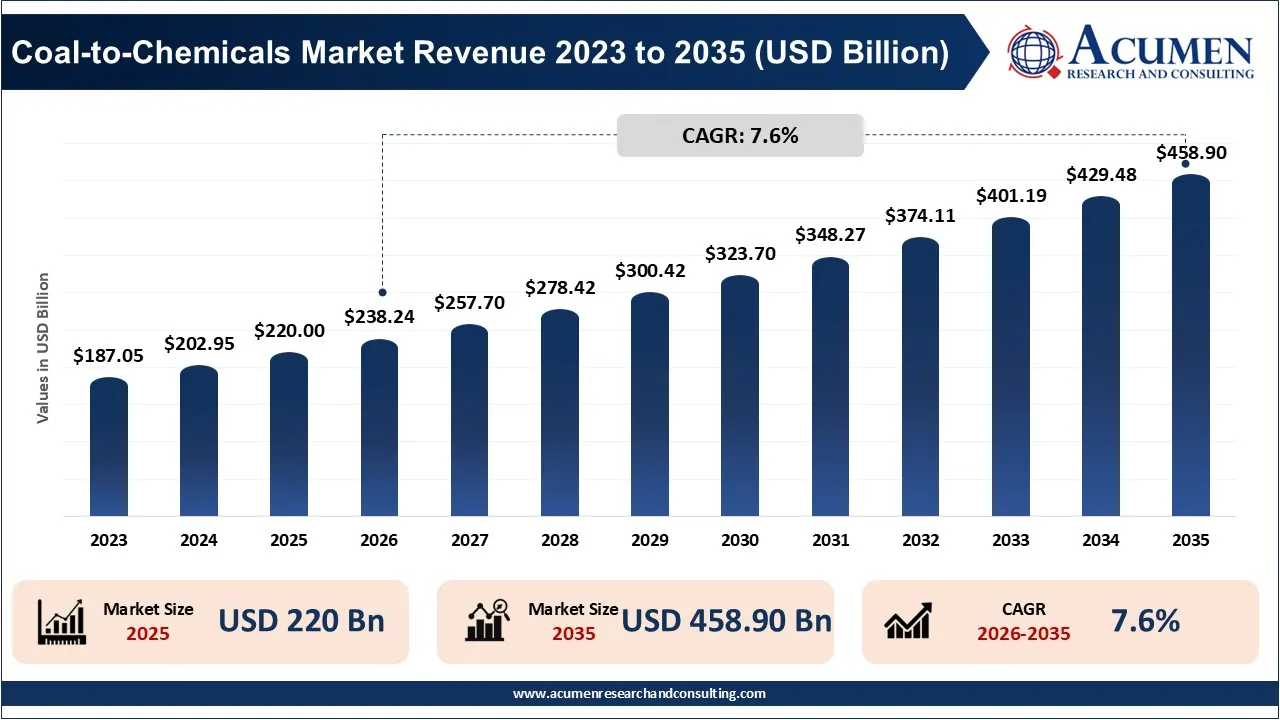
The global coal-to-chemicals market size was estimated at USD 220 billion in 2025 and is estimated to surpass USD 458.90 billion by 2035, growing at a CAGR of 7.6% over the forecast period from 2026 to 2035. The growth of the market is further supported by increasing chemical demand from industries such as plastics, agriculture, automotive, construction, and manufacturing. China accounts for a significant share of global methanol and olefin production capacity, with coal-based routes playing a crucial role in meeting domestic chemical demand.
Coal-to-Chemicals Market Overview
Coal-to-chemicals market is the global industry for transforming coal into high-value chemical products using various thermochemical technologies such as coal gasification, coal liquefaction, and gas-to-chemicals. Under this technology, coal is converted to syngas- a mix of H2 and CO. The syngas is further utilized to synthesize various high-value chemicals like methanol, ammonia, olefins, (ethylene and propylene), Synthetic Natural Gas (SNG), hydrogen, acetic acid, Dimethyl ether (DME), synthetic fuels, etc.
Coal-to-chemicals market comprises the entire value chain of Coal-feedstock, gasification technology, syngas technology, chemical synthesis technology, Engineering and construction (E&C) and downstream Chemical production. Coal to Chemicals technology is commonly used in countries where there are massive coal reserves, in an effort to minimize their dependence on the import of crude oil and natural gas. This also aids to enhance self-sufficiency in terms of chemical feedstock.
Latest Trends & Opportunity Outlook
- Growth in Integrated Coal Chemical Parks: Firms are investing in integrated coal chemical parks which bundle coal gasification, methanol, olefins and polymers production into a single complex for the benefit of operational efficiency and value creation.
- Coal-to-Methanol Capacity Keeps Expanding: Methanol continues to be the largest coal-based chemical and continues its growth trajectory, led by formaldehyde and acetic acid production, MTO technology, marine fuels and new e-fuels. Methanol demand totaled around 115 million tonnes in 2025 and is expected to be around 35% coal-derived, a consistent figure and indicates the continuing significance of coal as a source feedstock.
- Increased Interest in CCUS: CCUS technology continues to be a focus investment area for companies, aimed at curbing the emissions of the coal-to-chemical facilities.
- Coal-to-Hydrogen Emerges as a New Growth Segment: Coal gasification will be increasingly linked to hydrogen production, particularly in regions with coal resources. In July 2024, the first coal-to-chemicals facility in China, a part of Datang Group’s initiative that combines coal gasification and 70,000 tonne per annum (tpa) of methanol to hydrogen with 150 MW of wind and solar electricity (providing 70.6 million standard m³/year of hydrogen), became fully operational.
Will Coal Gasification Investments Create the Next Wave of Chemical Manufacturing Opportunities?
Coal gasification is emerging as a strategic pathway for transforming coal from a traditional energy resource into a high-value industrial feedstock. Via conversion to synthesis gas (syngas), a mixture of hydrogen (H2) and carbon monoxide (CO), coal gasification permits the production of an extensive spectrum of chemicals-including methanol, ammonia, olefins, hydrogen, synthetic fuels, and chemical intermediates.
With nations grappling with challenges of energy security, feedstock security, and the robustness of chemical supply chains, investment in coal gasification assets offers new avenues to foster local chemical production.
Although conventional oil and natural gas remain dominant petrochemical sources globally, coal abundant economies are increasingly turning to coal-to-chemical routes to decrease reliance on imported fossil fuels for feedstocks.
For instance, China is the world's premier market for coal to chemicals as a consequence of its ample coal resources, significant chemical production capabilities, and policy backing to capitalize on local resources. The country has made extensive investments in coal gasification facilities for products such as methanol and olefins.
Coal-to-Chemicals Market Regional Outlook
The market share of the coal-to-chemicals in Asia-Pacific reached close to 80% in 2025. China dominated the region with its leading role in coal conversion technology and significant capacity for manufacturing chemicals, given its massive availability of coal reserves, established infrastructure and the supportive government policies to manufacture chemicals domestically.
The coal-to-olefins industry in China have evolved to become a viable alternative to conventional petro-chemical routes; thus facilitating manufacturing of polyethylene & polypropylene with domestically available coal resource. India, Indonesia & Mongolia have increased coal gasification investments in the countries to manufacture methanol, hydrogen, ammonia and synthesis gas.
India also stood out as a prominent growth market; driven by government policies for encouraging coal gasification for production of methanol, hydrogen, ammonia and industrial chemicals. India with more than 300 billion tones of estimated reserves of coal is trying to capitalize its domestic resources through coal to value-added chemicals to decrease dependence on imported feedstocks.
Middle East & Africa represents a promising growth landscape for the market driven by efforts in domestic coal resource monetization & building of downstream industries. The operational success of Sasol operations in South Africa serves as the successful commercial example of coal to chemicals conversion. Resource rich nations in the Middle East and Africa are analyzing coal-to-chemicals projects to accelerate their industrial development and decline dependence on chemical imports.
Which are the Top Players operating in the Coal-to-Chemicals Market?
The coal-to-chemicals industry is largely consolidated amongst the established energy, mining, and chemical industry major companies, primarily in Asia-Pacific and South Africa owing to the presence of large coal deposits and higher demand for such products from industries that have the support of large scale project development.
The major companies engaged in the production and operation are Sasol Limited, China Shenhua Energy Company Limited, Ningxia Baofeng Energy Group Co., Ltd., China National Coal Group Corporation (ChinaCoal), Yankuang Energy Group Company Limited, Inner Mongolia Yitai Coal Co., Ltd., China National Petroleum Corporation (CNPC), Jincheng Anthracite Mining Group (JAMG), China Datang Corporation, and Air Products and Chemicals, Inc.
The players involved in the value chain are from various sectors such as coal conversion process, gasification technologies, syngas, methanol production, olefin production, hydrogen generation, carbon management, and other value-added chemicals from coal-based raw materials.
Players in the market are inclined towards developing integrated coal chemical facilities, improving efficiency, utilizing advanced gasification techniques and implementing a wide range of low-carbon technologies like carbon capture utilization and storage (CCUS) for increasing the competitiveness of the coal chemicals products in the future.
Strategic collaborations, capacity augmentation, and technology upgrades with the backing of government policies for promoting indigenous chemical production are driving the competition in the market.
Segments Covered
By Product Type/Output Chemical
- Methanol
- Olefins
- Ammonia
- Fertilizers
- Aromatics
- Specialty Chemicals
- Others
By Feedstock
- Lignite
- Sub-bituminous Coal
- Bituminous Coal
- Anthracite
- Coal Waste & Coal By-products
By Conversion Technology
- Coal Gasification
- Coal Liquefaction
- Carbonization/Coking
- Pyrolysis
By Application
- Agriculture
- Petrochemicals & Chemical Intermediates
- Plastics & Polymers
- Energy & Fuels
- Pharmaceuticals
- Other Industrial Applications
By Region
- North America
- Europe
- Asia-Pacific
- Latin America
- Middle East & Africa
Contact Us:
Mr. Richard Johnson
Acumen Research and Consulting
India: +91 8983225533