
Coal-to-Chemicals Market Size, Share, Growth, Report 2026 To 2035
Coal-to-Chemicals Market (By Product Type: Methanol, Olefins, Ammonia, Fertilizers, Aromatics, Specialty Chemicals, Others; By Feedstock: Lignite, Sub-bituminous Coal, Bituminous Coal, Anthracite, Coal Waste & Coal By-products; By Conversion Technology: Coal Gasification, Coal Liquefaction, Carbonization/Coking, Pyrolysis; By Application: Agriculture, Petrochemicals & Chemical Intermediates, Plastics & Polymers, Energy & Fuels, Pharmaceuticals, Others) - Global Industry Analysis, Size, Share, Growth, Trends, Regional Analysis And Forecast 2026 To 2035
- Last Updated: 23 Jul 2026
- Report Code: ARC3956
- Category: Chemicals And Materials
Coal-to-Chemicals Market Size, Forecast 2026 To 2035
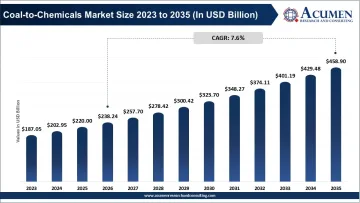
The global coal-to-chemicals market size was valued at USD 220 billion in 2025, it is estimated to reach at USD 458.90 billion by 2035. The market is observed to grow at the CAGR of 7.6% during the forecast period of 2026-2035. The market represents an emerging opportunity landscape, driven by increasing efforts to monetize domestic coal resources and develop downstream chemical industries. Multiple countries carry operations that highlight the commercial potential of coal conversion, while other resource-rich countries are evaluating coal-to-chemicals projects to support industrial growth and reduce reliance on imported chemicals.
Report Highlights
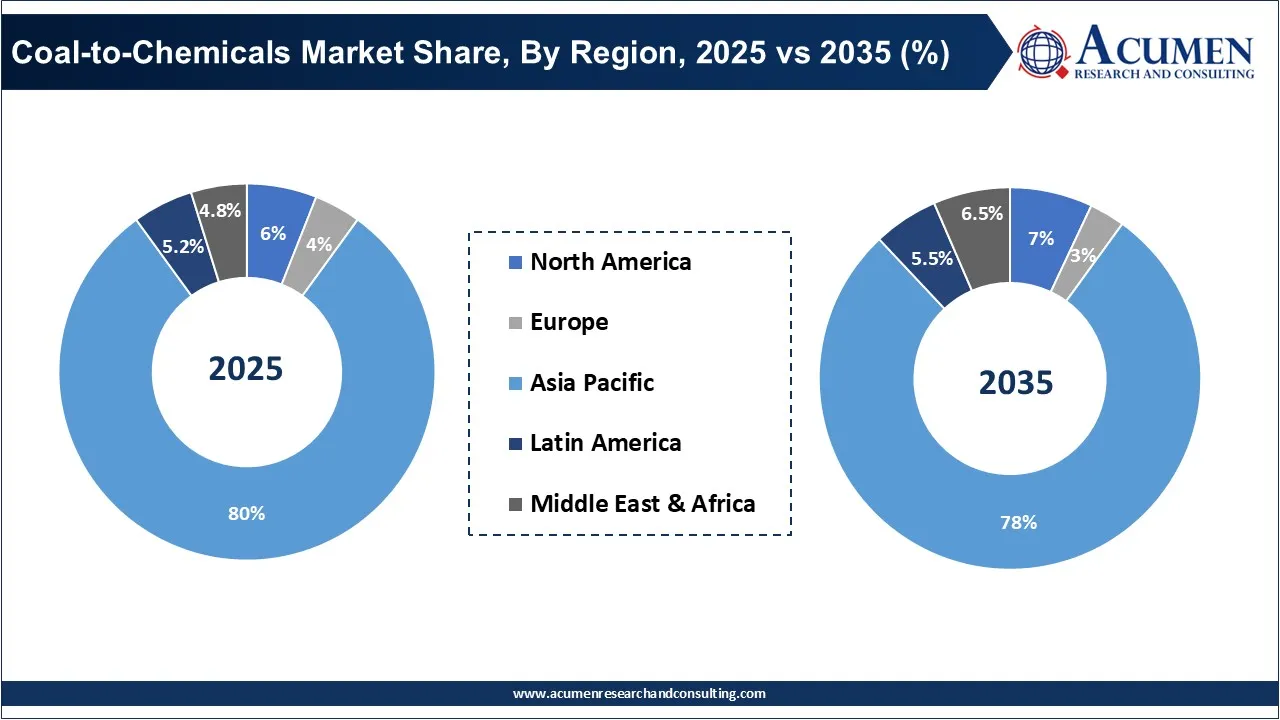
- By region, Asia-Pacific dominated the market in 2025, accounting for approximately 80% market share, due to abundant coal reserves, established chemical manufacturing infrastructure, and strong government support for coal conversion projects, particularly in China and India.
- By region, Asia-Pacific is expected to maintain its leading position through 2035, supported by continued investments in integrated coal chemical parks, expansion of coal-to-olefins capacity, and increasing demand for chemical intermediates across industries such as plastics, agriculture, and manufacturing.
- By region, the Middle East & Africa is projected to be the fastest-growing market during the forecast period, registering a CAGR of approximately 11.2% from 2026 to 2035, driven by increasing investments in industrial diversification, domestic chemical production, coal resource utilization, and advanced coal conversion technologies.
- By product type, methanol dominated the coal-to-chemicals market in 2025, accounting for approximately 27% market share, owing to its extensive commercial adoption, established production processes, and importance as a key intermediate for formaldehyde, acetic acid, dimethyl ether (DME), olefins, solvents, and synthetic fuels.
- By product type, olefins segment is projected to be the fastest-growing segment during the forecast period, with its market share expected to increase from 22% in 2025 to 25% by 2035, driven by rising demand for polyethylene, polypropylene, and other polymer products across packaging, automotive, construction, and consumer goods industries.
- By feedstock, bituminous coal dominated the market in 2025, accounting for approximately 52% market share, due to its high carbon content, lower impurities compared with lower-grade coal, and suitability for efficient gasification processes used in producing syngas, methanol, ammonia, and synthetic fuels.
- By feedstock, lignite accounted for approximately 23% market share in 2025, supported by its abundant availability in countries such as India, Germany, Greece, Turkey, Australia, and Eastern Europe, where domestic lignite reserves provide a cost-effective feedstock option for coal chemical applications despite its lower calorific value and higher moisture content.
- By conversion technology, coal gasification dominated the market in 2025, accounting for nearly 80% market share, due to its commercial maturity, scalability, and ability to convert coal into syngas, which serves as the primary building block for producing methanol, ammonia, hydrogen, olefins, synthetic natural gas, and liquid fuels.
- By conversion technology, pyrolysis is expected to register the fastest growth during the forecast period, expanding at a CAGR of approximately 7.6% from 2026 to 2035, driven by increasing demand for specialty chemicals, aromatic hydrocarbons, coal-derived carbon materials, and advanced chemical feedstocks from industries such as construction, chemicals, and advanced materials.
- By application, petrochemicals and chemical intermediates dominated the market in 2025, accounting for approximately 36% market share, owing to increasing demand for methanol, olefins, ammonia, and other chemical building blocks used in manufacturing plastics, solvents, synthetic fibers, paints, coatings, and industrial chemicals.
- By application, agriculture represented the second-largest segment in 2025, accounting for approximately 25% market share, supported by rising demand for ammonia-based fertilizers and increasing adoption of coal gasification-based fertilizer production to reduce dependence on imported natural gas-derived ammonia.
What is Coal-to-Chemicals Market?
The coal to chemicals market refers to the production, marketing, and implementation of technologies to produce chemical feedstocks and chemical products of value through conversion of coal as an alternative for traditional oil and natural gas-based production. The process begins with coal gasification, which generates synthesis gas (syngas).
The syngas can be converted into chemicals such as methanol, ammonia, hydrogen, olefins, fertilizers, synthetic natural gas (SNG), dimethyl ether (DME), acetic acid and other derivatives through various catalytic conversion technologies.
Market participants in the coal to chemicals market includes technology suppliers, coal producers, EPC companies, gasification equipment providers, chemical manufacturers, and complex coal chemical players in coal to chemical conversion process. These facilities are mainly located in coal mining countries in which the respective governments and industrial sectors are focused on value optimization of indigenous coal reserves and achieving higher chemical self-sufficiency while protecting from volatile crude oil and gas markets.
Coal-to-Chemicals Project Pipeline Tracker
| Project Name | Country | Main Products | Technology |
|---|---|---|---|
| Secunda Coal-to-Chemicals & Fuels Complex | South Africa | Synthetic fuels, ethylene, propylene, ammonia, solvents, polymers, chemical feedstocks | Lurgi fixed-bed gasification + Fischer-Tropsch technology |
| Shenhua Baotou Coal-to-Olefins (CTO) Project | China | Polyethylene (PE), Polypropylene (PP), Olefins | DMTO (Dimethyl Ether-to-Olefins/MTO technology) |
| Ningxia Baofeng Energy Coal-to-Chemicals Complex | China | Polyolefins, methanol, chemical intermediates | Coal gasification + MTO |
| Datang Duolun Coal-to-Olefins Project | China | Polyolefins and hydrogen-integrated chemical production | Coal chemical process integrated with green hydrogen and renewable energy |
Value Chain Analysis
- Coal Mining & Feedstock Supply: Coal mining as the genesis of the value chain which produces coal (thermal, bituminous, lignite, anthracite coal) for feed. The quality of coal feedstock has a substantial impact on gasification performance, operating cost and the overall yield of chemical.
- Coal Preparation: Coal produced in mining operations undergoes preliminary processes such as coal crushing, drying, sieving and removal of inorganic impurities in order to satisfy required particle size, uniformity and composition that ensures consistent operation of gasification and efficiency improvement.
- Coal Gasification: Pre-processed coal is transformed into the synthesis gas (syngas) via high-temperaturepartial oxidation and/or steam gasification process, resulting in hydrogen and carbon monoxide dominated gas that acts as the basic feed for downstream chemical processes.
- Syngas Purification & Conditioning: Crude syngas is processed through sulfur removal, particulate removal, Hg removal, CO 2removal and adjustment of H 2/CO ratio that is critical for subsequent chemical production. Chemical Synthesis Purified syngas is converted to value added chemicals such as methanol, ammonia, hydrogen, dimethyl ether (DME), synthetic natural gas (SNG), olefins, etc., via conventional industrial processes with the aid of a catalyst.
- Distribution & End-Use Industries: Chemicals derived from coal is utilized in downstream value chains, for example: petrochemistry, agriculture, automobile, construction, pharma, textile, packing and energy.
Market Dynamics
Driver
Rising Demand for Chemical Feedstock Security and Domestic Manufacturing Capabilities
The surging demand for reliable sources of chemicals feedstocks is a key trend underpinning the growth of the coal-to-chemicals industry. Countries that possess abundant coal reserves are pursuing coal conversion technologies to offset their reliance on crude oil imports, natural gas and chemical feedstocks and to create domestic value from their indigenous coal resources by producing methanol, ammonia, hydrogen, and olefins. The development of integrated chemical production networks around coal gasification processes has taken shape in the leading coal producing economies.
Furthermore, some countries, including India, are considering the development of coal-to-chemical projects, to leverage their native coal resources for producing chemicals like methanol, hydrogen, and fertilizer. This burgeoning demand for plastics, chemical intermediate and fertilizer has stimulated further investment in coal chemical plants.
Restraint
High Carbon Emissions and Environmental Concerns Associated with Coal Conversion
The high carbon Intensity of coal to chemicals production is one of the primary factors that restricts market growth. In comparison to natural gas-based or oil-based chemical production processes, coal gasification involves an energy-intensive transformation that yields a lot of carbon dioxide emissions. There are several reasons behind increased pressure for regulations around coal chemical facilities, such as a vast amount of water needed, potential environmental damage due to coal mining and concerns over air pollution.
The growth of new coal to chemicals plants may be curtailed in nations where governments impose aggressive climate regulations, carbon pricing, and emissions reduction targets.
Another significant issue that might pose as a threat to this industry is the high upfront investment required to construct gasification plants, as well as CCUS infrastructure and relevant supporting facilities, thus limiting new entrants into this space. The push by multiple industrial segments towards low carbon processes, forces the coal to chemicals sector to install CCUS, integrate renewable energy and boost efficiency.
Opportunity
Integration of Carbon Capture, Hydrogen Production, and Low-Carbon Technologies
The adoption of cutting-edge technologies provides substantial opportunity for growth in the coal-to-chemicals market by allowing for the use of environmentally friendly production pathways. The concentration of captured carbon during gasification as well as the proximity of capture equipment upstream from chemical conversions is considered beneficial for the integration of carbon capture. CCUS technologies will allow to capture the CO2 from coal-tochemical processes thereby allowing these facilities to adapt to the increasing climate concerns.
Additionally, coal-to-hydrogen using coal gasification technology has attracted the interest of several nations that have an abundant access to coal and a rising need for industrial hydrogen.
The hybridization between coal gasification and capture technologies, renewables electricity as well as the integration of green hydrogen offers great opportunity to design low carbon intensity hybrid production chains. Emerging regions such as India, Southeast Asia and other coal regions are identified as strong potential for investments in the development of coal-to-methanol, coal-to-hydrogen, coal-to-ammonia facilities, and industrial parks focusing on chemical manufacturing due to their rising concerns about chemical supply chain security and industrial development.
Top Government Policies
| Country | Policy / Initiative | Government Authority | Key Objective |
|---|---|---|---|
| China | 14th Five-Year Plan for Modern Coal Chemical Industry Development | Chinese Government | Encourage high-value utilization of coal resources through advanced chemical production rather than conventional coal consumption |
| India | Coal Gasification Mission | Ministry of Coal, Government of India | Promote conversion of domestic coal into chemicals, hydrogen, synthetic fuels, and other value-added products |
| South Africa | Industrial Policy Action Plan (IPAP) | Department of Trade, Industry and Competition (DTIC) | Strengthen domestic manufacturing and value-added industrial activities |
| United States | Carbon Capture, Utilization, and Storage (CCUS) Incentives under the Inflation Reduction Act (IRA) | U.S. Federal Government | Accelerate carbon capture deployment across industrial sectors |
Regional Insights
Which Region Held the Largest Share of Coal-to-Chemicals Market?
Asia Pacific led the market globally, owing to large coal reserves, well-developed chemical manufacturing infrastructure, and government incentivized coal conversion initiatives. Asia Pacific’s position is predominantly held by China, as it represents the world's largest coal chemical market due to extensive coal reserves and strategic initiatives aimed at reducing reliance on imported oil and natural gas based feedstocks for chemical production.
- China has developed a coal chemical system of enormous scale, including coal gasification, methanol production, coal-to-olefins (CTO), and coal-to-liquids.
- China hosts large coal chemical complexes where it produces methanol, polyethylene, polypropylene, and other intermediates of chemical processes.
- The Shenhua Baotou Coal-to-Olefins project in China (Inner Mongolia), with its capacity of nearly 600 ktpa of polyolefins produced via the coal-to-methanol-to-olefins technology, serves as a pilot in commercializing the utilization of coal for production of polymer feedstock.
Coal-to-chemicals market in the Asia Pacific is anticipated to maintain its dominant position in the market throughout the projection period till 2035 owing to continued investment in integrated coal chemical parks, technological upgrades and growth in demand for chemical intermediate products.
Which is the Fastest Growing Region in Coal-to-Chemicals Market?
The Middle East & Africa region is projected to record the fastest growth, with a predicted CAGR of 11.2% during the forecast period up to 2035, due to rising investments in resource-based industrial development, and a shift towards chemical production diversification. The region's most established coal-to-chemicals market in the Middle East & Africa is South Africa. It's mainly because Sasol's Secunda facility is among the largest coal conversion facilities in the world.
The facility is using coal gasification and the Fischer-Tropsch process to generate various synthetic fuels and chemicals like solvents, chemicals intermediates, and polymers from the huge quantity of coal processing that happens at the plant each year, a great demonstration of how effective coal conversion process can be at industrial level.
Countries like Botswana, Mozambique, and Nigeria in the Middle East & Africa are planning to capitalize on their existing coal and carbon resources in order to enhance the region's domestic production capacity in chemical products, with fertilizer and industrial chemical demand growing, and a general urge for improved energy security. Moreover, the increasing adoption of carbon capture and low-carbon coal conversion technologies are becoming significant for industrial progress.
Segmental Insights
Product Type/Output Chemicals Insights
Methanol had the largest share in the coal-to-chemicals market, which accounted for about 27% in 2025. Methanol is the one of the most commercialized coal-to-chemical products based on the long history of industrial application. Coal-to-methanol conversion consists of the two step processes, first is producing synthesis gas from coal by gasification, second is converting synthesis gas into methanol through catalyst.
As an important building block for formaldeyhyde, acetic acid, DME, olefins, solvents, and fuels, Methanol is strategically important for the entire chemical industry. The rapid growth of methanol-to-olefins technology, has increased the consumption of coal-based methanol further, and companies are putting investment to the technologies of methanol converting into ethylene and propylene for plastics producing, particularly in China.
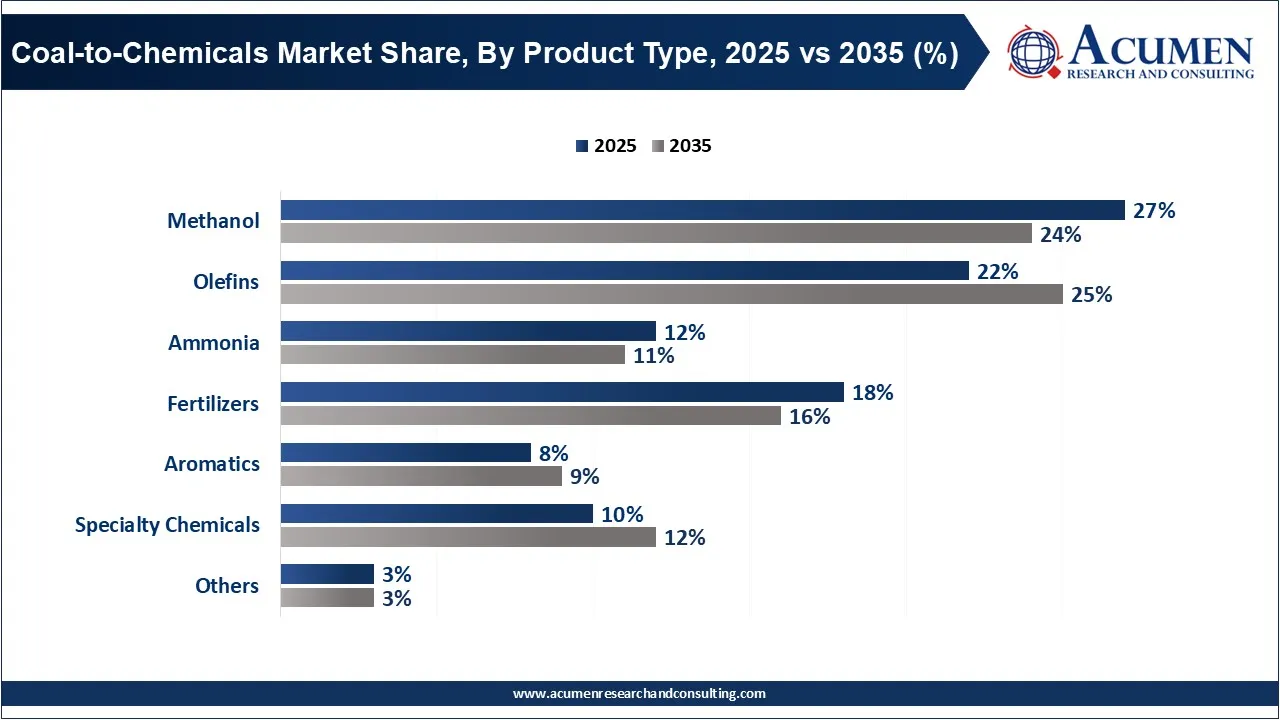
During the forecast period, the olefins segment will witness considerable growth, and the market share is expected to grow from 22% in 2025 to 25% in 2035. Increasing demand for polyethylene, polypropylene and other polymers in the downstream sector including packaging, automotive, construction, consumer products industries will drive the growth of olefins segment.
Coal-to-olefins technology has been getting considerable attention from all over the world as it allows the country abundant coal resource to achieve oil independence on feedstock for chemical production from cracking of naphtha, thus Coal-to-olefins technology is adopted by China increasingly in recent years.
Feedstock Insights
Bituminous coal dominated the coal-to-chemicals market in 2025, accounting for approximately 52% of total market share. Its suitable characteristics make it preferable to use it in bulk chemical conversions processes. Bituminous coal having high carbon content and fewer impurities in comparison to the low grade coal, make it a perfect fit to use in gasification processes and produce syngas.
This type of coal is widely used by major nations such as China, India, and South Africa for coal chemical processes, as the readily available feedstock can support the gasification system in efficient production of hydrogen and carbon monoxide, in the production of methanol, ammonia, and synthetic fuels.
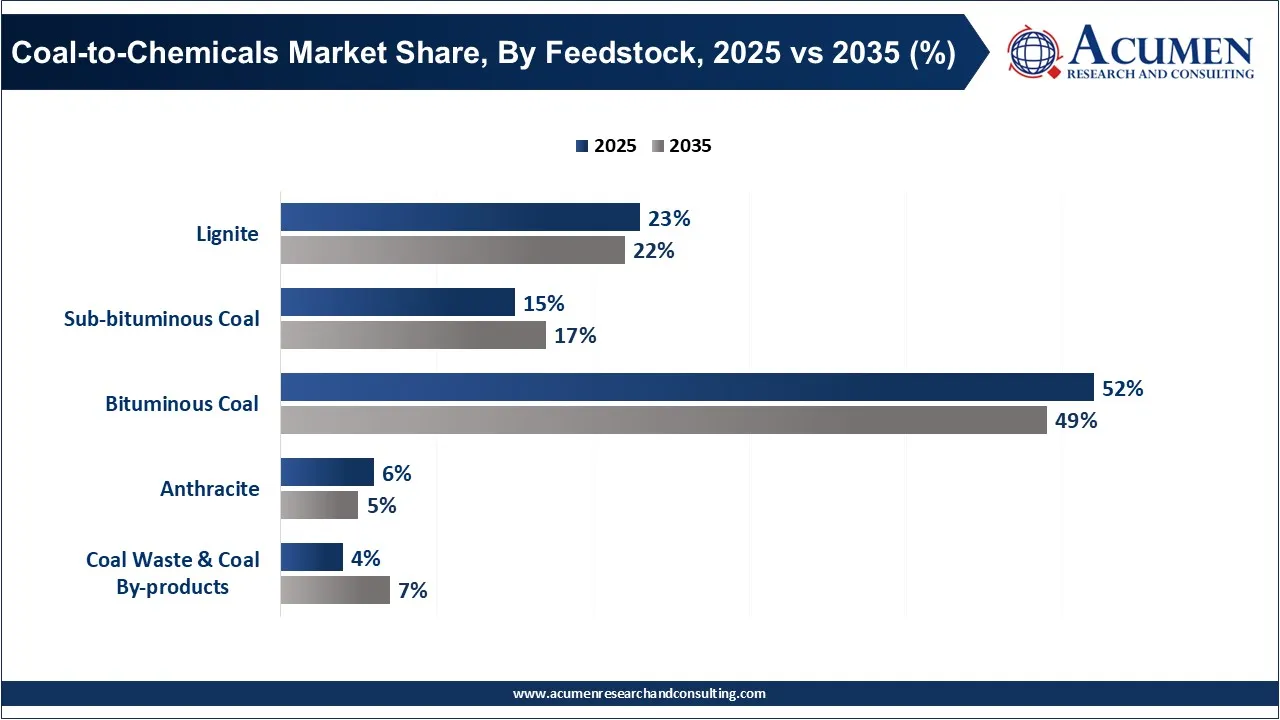
Lignite accounted for approximately 23% of the coal-to-chemicals market share in 2025, due to its vast availability in countries including India, Germany, Greece, Turkey, Australia and some of the countries of Eastern Europe. Though lignite is comparatively low in calorific value and high in moisture content and greater impurity when compared to higher grades of coal, yet the large availability of domestic reserves of lignite in certain countries proves to be cost-effective.
Conversion Technology
Coal gasification was the dominant coal to chemicals process in 2025, with a market share of nearly 80% owing to its ability to effectively convert coal into a synthesis gas (syngas), the building block of most chemicals. The process converts coal into a mixture of hydrogen and carbon monoxide gases which can be further processed into various chemicals such as methanol, ammonia, hydrogen, olefins, SNG, and liquid fuels. Coal gasification is extensively used commercially due to its maturity, scalability and application in Integrated Coal to Chemicals facilities.
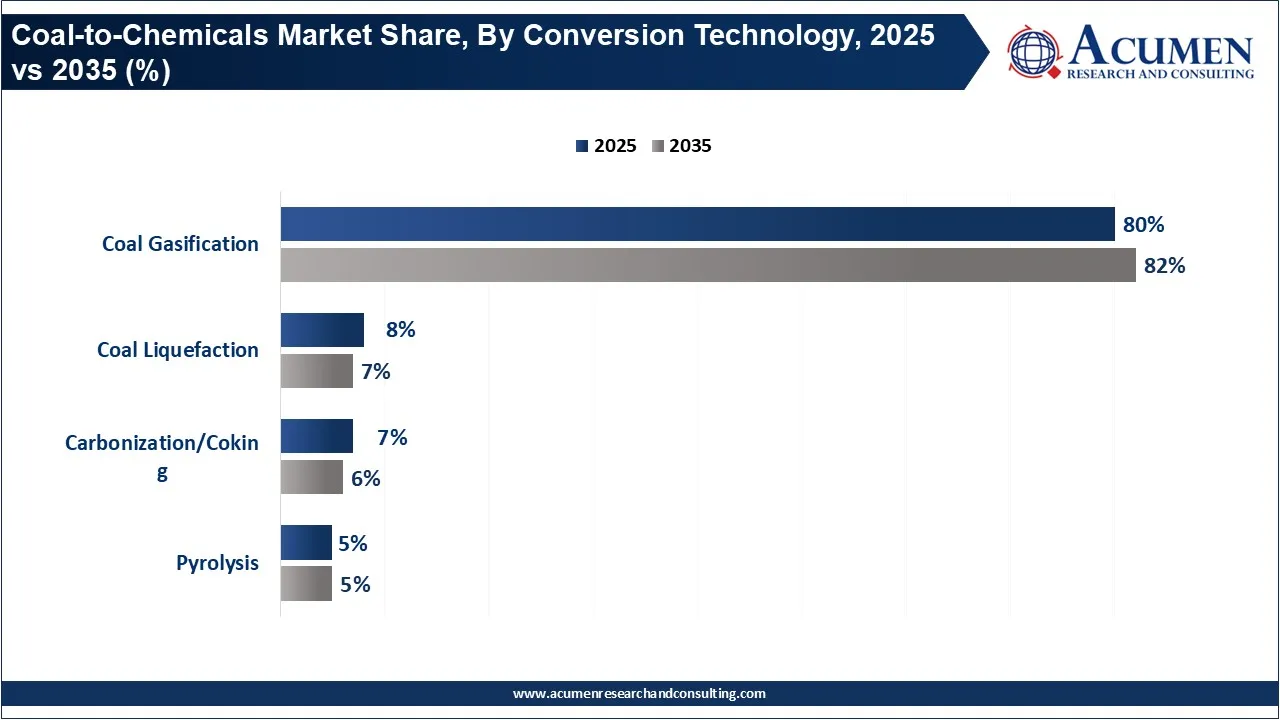
Pyrolysis is expected to register the highest growth among the conversion technologies within the coal to chemicals sector, at a CAGR of over 7.6% during the period under review, as focus on innovative coal to chemicals technologies increases. Pyrolysis involves the thermal degradation of coal in an oxygen-deficient atmosphere to yield coal tar, gases, char, and aromatic hydrocarbons that can be used as feedstock for producing other valuable chemical products.
Rise in demand for various products like specialty chemicals, aromatic hydrocarbons and carbon based materials by industries such as construction, chemicals and advanced materials drives the growth of coal pyrolysis.
Application Insights
In 2025, petrochemical and chemical intermediates constituted about 36% of the coal-to-chemicals market by value, as consumption for products such as methanol, olefins, ammonia, and various other chemical building blocks was high across industries. The chemicals that are produced using coal are used as feedstock and raw materials for manufacturing plastics, solvents, synthetic fibers, paints, coatings, and various other industrial products.
Demand for these polymers and chemicals is increasing in developing countries such as the APAC region. Coal to chemical plants is also a source for generating petrochemical feedstock that otherwise would depend entirely on crude oil, especially in countries with abundant coal reserves.
Coal-to-Chemicals Market Share, By Application, 2025 (%)
| By Application | Revenue Share, 2025 (%) |
|---|---|
| Agriculture | 25% |
| Petrochemicals & Chemical Intermediates | 36% |
| Plastics & Polymers | 22% |
| Energy & Fuels | 10% |
| Pharmaceuticals | 2% |
| Other Industrial Applications | 5% |
Agriculture represented the second-largest application segment in the coal-to-chemicals market, accounting for approximately 25% of the market share in 2025 with the rising demand for ammonia fertilizers and increased domestic production of the same playing the role.
Gasification of coal to produce hydrogen gas that reacts with nitrogen to form ammonia is an alternative process for producing fertilizers such as urea. This process is quite beneficial in developing nations with large agrarian base, which face supply challenges for natural gas derived fertilizer.
Both China and India represent some of the biggest consumer for coal based fertilizers as a significant chunk of their population works in farming and they consume a good quantity of these fertilizers for their respective agricultural sectors. India has also introduced coal gasification-based fertilizer production plants in order to lessen its reliance on import of ammonia for their domestic use.
Top Company Profiles
- Sasol Limited: Sasol is the largest producer of synthetic fuels in the world and operates one of the world's largest coal-to-chemicals facilities in South Africa, utilizing coal gasification and Fischer-Tropsch technologies to produce chemical intermediates and specialty chemicals.
- China Shenhua Energy Company Limited: China Shenhua is an integrated coal and chemical enterprise with a focus on coal-to-olefins, coal-to-liquids and other large-scale coal conversion projects that play a crucial role in supplying China's domestic chemical industry.
- Ningxia Baofeng Energy Group Co., Ltd.: Ningxia Baofeng Energy is engaged in integrated coal chemical production, utilizing coal to produce methanol, polyethylene, polypropylene, and other chemicals.
- China National Coal Group Corporation (ChinaCoal): ChinaCoal is a major player in the coal and chemical industry, with initiatives to develop advanced coal chemical projects focusing on methanol, olefins, and other chemicals through China's abundant coal reserves.
- Yankuang Energy Group Company Limited: Yankuang Energy focuses on the coal chemical industry, with facilities producing methanol, olefins, and other intermediate chemicals.
- Inner Mongolia Yitai Coal Co., Ltd.: Yitai Coal operates coal-to-liquid and coal chemical projects, converting coal into synthetic fuels and other chemical feedstocks.
- China National Petroleum Corporation (CNPC): CNPC is actively involved in coal chemical technologies, including coal-to-liquids and coal-to-gas projects, aiming to diversify its industrial feedstock sources.
- Jincheng Anthracite Mining Group (JAMG): JAMG is a coal company that has ventured into coal chemical production, with facilities manufacturing methanol, ammonia, and other chemical products from coal.
- China Datang Corporation: China Datang is investing in coal-to-chemicals projects, including coal-to-olefins, while also looking at the integration of renewable energy and hydrogen into its processes.
- Air Products and Chemicals, Inc.: Air Products offers advanced coal gasification, syngas processing, hydrogen production, and carbon capture technologies that are essential for supporting major coal-to-chemicals plants around the world.
Recent News
- In June 2026, India launched its first commercial-scale coal-to-ammonium nitrate project in Odisha with an investment of approximately ₹25,016 crore. The project will use coal gasification technology to produce ammonium nitrate, supporting domestic fertilizer and mining industry supply chains.
- In May 2025, The Phase I Inner Mongolia Baofeng Coal-to-Olefins project achieved full commissioning, becoming one of the world's largest single-site coal-to-olefins facilities with planned production capacity of around 3 million tonnes of olefin products annually using advanced DMTO technology.
Segments Covered
By Product Type / Output Chemical
- Methanol
- Olefins
- Ammonia
- Fertilizers
- Aromatics
- Specialty Chemicals
- Others
By Feedstock
- Lignite
- Sub-bituminous Coal
- Bituminous Coal
- Anthracite
- Coal Waste & Coal By-products
By Conversion Technology
- Coal Gasification
- Coal Liquefaction
- Carbonization/Coking
- Pyrolysis
By Application
- Agriculture
- Petrochemicals & Chemical Intermediates
- Plastics & Polymers
- Energy & Fuels
- Pharmaceuticals
- Other Industrial Applications
By Region
- North America
- Europe
- Asia-Pacific
- Latin America
- Middle East & Africa
Looking for discounts, bulk pricing, or custom solutions? Contact us today at sales@acumenresearchandconsulting.com
Frequently Asked Questions

Other Chemicals And Materials Reports
May 2023
March 2025
September 2023
October 2018