
Retrieval Augmented Generation (RAG) Market Size, Share, Report 2026 - 2035
Retrieval Augmented Generation Market (By Deployment: Cloud, On-Premises; By Function: Document Retrieval, Recommendation Engines, Response Generation, Summarization and Reporting; By Application: Content Generation, Customer Support and Chatbots, Research and Development, Knowledge Management, Marketing and Sales, Legal and Compliance; By End User: Retail and E-commerce, Healthcare, Financial Services, IT and Telecommunications, Education, Media and Entertainment, Others) - Global Industry Analysis, Size, Share, Regional Analysis, Trends and Forecast 2026 - 2035
- Last Updated: 31 Mar 2026
- Report Code: ARC3911
- Category: ICT
Retrieval Augmented Generation (RAG) Market Size and Forecast 2026 - 2035
The global retrieval augmented generation market size was valued at USD 1,990.53 million in 2025 and is projected to reach USD 101,630.03 million by 2035, expanding at a compound annual growth rate (CAGR) of 48.2% during the forecast period from 2026 to 2035. The retrieval augmented generation (RAG) market is primarily driven by growing demand for relevant, timely, and context-rich AI insight outputs across enterprises. Traditional generative AI models often rely on pre-trained knowledge, which can lead to outdated or inaccurate responses. RAG addresses this limitation by retrieving real-time and domain-specific information from external data sources before generating answers. This capability is especially valuable for organizations handling large volumes of structured and unstructured data, such as legal documents, medical records, financial reports, and technical manuals. As businesses increasingly depend on AI for decision-making, customer interactions, and knowledge discovery, the need for an AI system that provides accurate, transparent, and reliable responses is significantly accelerating retrieval-augment generation (RAG) adoption.
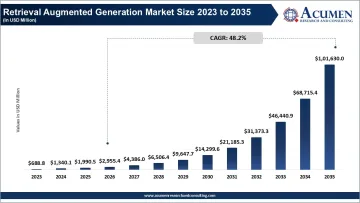
Beyond traditional AI deployments, enterprise digital transformation, and cloud adoption are key drivers accelerating the growth of RAG market. Organizations are increasingly integrating RAG into customer support systems, virtual assistants, enterprise search platforms, and analytics tools to improve operational efficiency, deliver accurate real-time insights, and enhance user experience. The ability of RAG to seamlessly connect with internal databases, cloud storage, and data lakes allows organizations to unlock full value of their existing data without retaining large language models. Additionally, increasing regulatory pressure around data accuracy, privacy, and compliance is pushing industries such as healthcare, finance, and government to adopt RAG-based techniques, as they offer better control over information sources and reduce the risk of AI hallucinations. These factors are creating strong and sustained growth for the global retrieval augmentation generation market.
Report Highlights
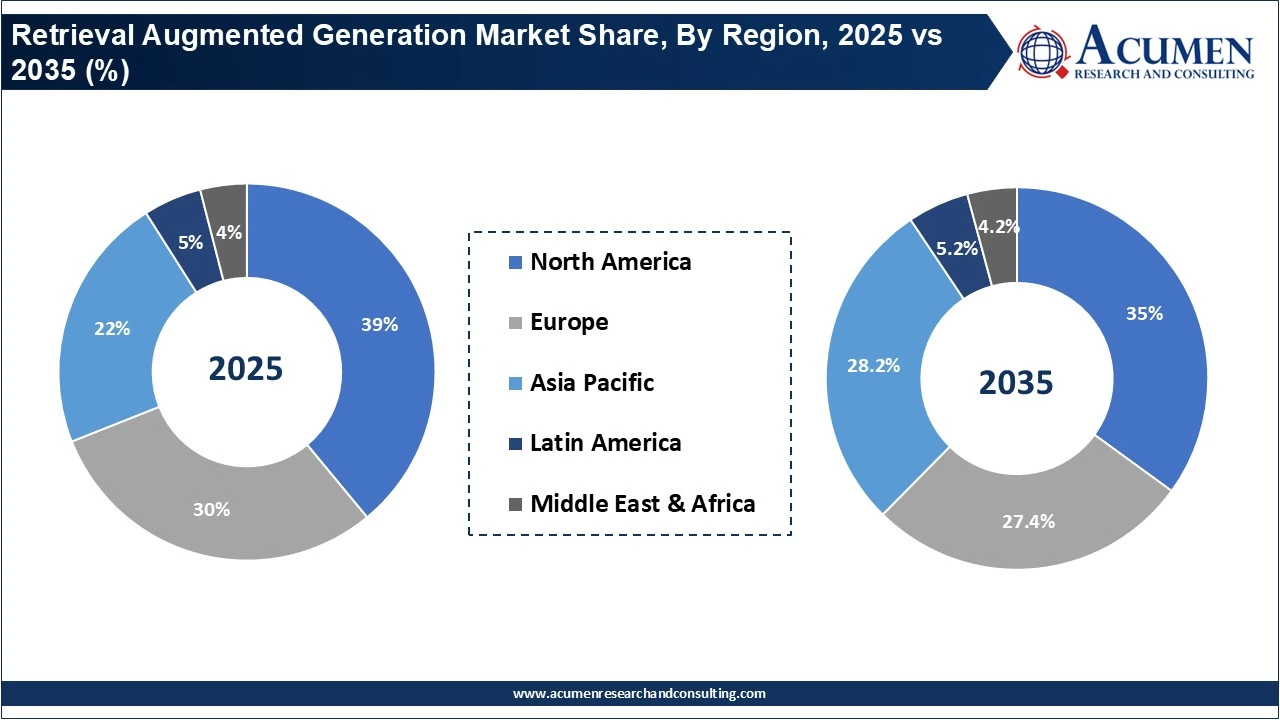
- By Region, in 2025, North America held the largest market share, accounting for around 39% of global RAG Market revenue.
- By Region, the Asia Pacific region is expected to experience the fastest growth in global Retrieval Augmented Generation Market, registering a CAGR of approximately 52.3% from 2026 to 2035.
- By Deployment, the cloud based segment held the dominant market position, representing 72% of the total RAG market share in 2025.
- Based on Function, the document retrieval segment leads the market, contributing 34% of the overall RAG market share.
- By Application, the content generation segment accounted for the largest portion of market adoption, holding around 30% of the total RAG Market share in 2025.
Retrieval Augmented Generation Market Dynamics
Market Drivers
1. Growing Demand for Real-Time Data in AI Systems
In today's fast-moving global economy, the data is truly valuable only when it reflects the most current and up-to-date information, as critical information such as market trends, customer activity, and inventory levels changes rapidly. This drives strong demand for retrieval augmentation generation (RAG) solutions, which enable AI systems to access newly updated information almost instantly. Unlike traditional fine-tuning, which takes weeks or months, RAG allows real-time retrieval and response generation. This capability is critical for customer support, market intelligence, and financial analysis, where accurate and up-to-date insights directly impact decision-making and operational efficiency.
2. Economic Efficiency of Knowledge Management and Model Fine-Tuning
High costs associated with fine-tuning large language models are pushing organizations towards RAG-based architectures. Fine-tuning AI models requires specialized expertise, large datasets, and expensive computing resources, which can be costly and challenging, especially for small and mid-sized enterprises. In contrast, retrieval augmented generation (RAG) provides a cost-effective approach by separating the reasoning engine from knowledge storage and allowing companies to use general-purpose models while maintaining their data externally. This approach reduce total ownership costs, simplifies knowledge updates, and supports scalable growth as data volumes continue to increase.
Market Restraints
1. Complexity of System Integration and Architecture
One of the major restraints limiting the widespread adoption of RAG solutions is the technical complexity involved in system design and integration. Unlike standalone generative AI models, RAG systems rely on seamless integration of multiple components, including data ingestion pipelines, vector database, embedding models, retrieval mechanisms, and large language models. Ensuring accurate information retrieval, low-latency performance, and reliable performance across these layered demands requires advanced technical expertise. For organizations with limited AI or data engineering capabilities, building and maintaining such architecture can be challenging, time-consuming, and costly. This complexity often slows down deployment timelines and increases implementation risk, especially for enterprises transitioning from traditional AI systems.
2. Data Quality, Governance, and Security Challenges
The performance of a RAG system is highly dependent on the quality, relevance, and governance of underlying data sources. Even with an advanced retrieval mechanism, outputs can be inaccurate or misleading if the data is outdated, inconsistent, or poorly organized. Additionally, managing sensitive or regulated data introduce concerns related to privacy, compliance, and access control. Industries such as healthcare, finance, and government must ensure strict data security measures when integrating internet knowledge bases with RAG models. These governance and security requirements add operational overhead and can limit deployment, as organizations must invest heavily in data management frameworks to ensure data and risk deployment.
Market Opportunities
1. Expanding Adoption Across Regulated and Knowledge-Intensive Industries
Retrieval augmented generation (RAG) offers a strong opportunity in industries where accuracy, traceability, and up-to-date information are critical, including healthcare, financial services, legal, and government sectors. These industries need an AI system that can trace outputs back to trusted data sources, reducing the risk of misinformation and maintaining compliance with regulatory standards. RAG allows enterprises to access and utilize real-time data without the need to retrain AI models. With increasing regulatory focus on AI transparency and accountability, enterprises are increasingly adopting RAG as a safer and more controllable approach to deploying generative AI, further supporting sustained long-term market growth.
2. Rising Demand for Enterprise Knowledge Management and Productivity Tools
The growing volume of enterprise data is creating an opportunity for RAG-based solutions that improve knowledge access and workforce productivity. Organizations often struggle to extract insights from vast repositories of documents, reports, and internal systems. RAG allows employees to interact with enterprise data using natural language, enabling faster decision-making, improved collaboration, and reduced manual search efforts. As businesses prioritize operational efficiency and AI-driven automation, RAG-powered assistants for research, documentation, customer support, and developer productivity are gaining traction. This demands that RAG be positioned as a core technology for next-generation enterprise intelligence platforms.
Retrieval Augmented Generation Market Report Scope
| Attribute | Details |
|---|---|
| RAG Market Size 2025 | USD 1,990.53 Million |
| RAG Market Forecast 2035 | USD 101,630.03 Million |
| RAG Market CAGR During 2026 - 2035 | 48.2% |
| Analysis Period | 2023 - 2035 |
| Base Year | 2025 |
| Forecast Data | 2026 - 2035 |
| Segments Covered | By Deployment, By Function, By Application, By End User, and By Geography |
| Regional Scope | North America, Europe, Asia Pacific, Latin America, and Middle East & Africa |
| Key Companies Profiled | Microsoft, Amazon Web Services (AWS), Google DeepMind / Google, OpenAI, Anthropic, Cohere, Hugging Face, IBM Watson, Informatica, Salesforce, Palantir Technologies, and DataRobot |
| Report Coverage | Market Trends, Drivers, Restraints, Competitive Analysis, Player Profiling, Covid-19 Analysis, Regulation Analysis |
Retrieval Augmented Generation Market Regional Analysis
- The North America retrieval augmented generation market size was valued at USD 776.31 million in 2025 and is projected to reach USD 35,570.51 million by 2035, expanding at a compound annual growth rate (CAGR) of 46.4% during the forecast period from 2026 to 2035.
- The Europe retrieval augmented generation market size was valued at USD 597.16 million in 2025 and is projected to reach USD 27,846.63 million by 2035, expanding at a compound annual growth rate (CAGR) of 46.7% during the forecast period from 2026 to 2035.
- The Asia-Pacific retrieval augmented generation market size was valued at USD 437.92 million in 2025 and is projected to reach USD 28,659.67 million by 2035, expanding at a compound annual growth rate (CAGR) of 52.3% during the forecast period from 2026 to 2035.
Why North America dominates in the RAG market?
North America dominated the RAG market with around 39% market share in 2025 due to its strong AI ecosystems, early adoption of advanced technologies, and presence of major cloud service providers and AI innovators. Enterprises across the U.S and Canada are rapidly deploying RAG solutions to enhance enterprise search, customer support automation, content generation, and data-driven decision-making. Industries such as financial services, healthcare, legal, and e-commerce extensively use RAG to retrieve real-time information from internal knowledge bases and regulatory documents while generating accurate, explainable responses. In addition, high cloud maturity, strong data infrastructure, and significant investments in generative AI research and developments have enabled organizations in North America to scale RAG implementation quickly and effectively, reinforcing the region's market leadership.
Why is Asia Pacific expected to grow at the fastest CAGR in the RAG market?
Asia Pacific is expected to grow at the fastest CAGR in the RAG market during the forecast period, fueled by an increase in enterprise AI adoption, boom in digital transformation projects, and rising investments in regional AI solutions. Organizations in the region are adopting RAG solutions to support customer service, large-scale e-commerce platforms, and enterprise knowledge management across diverse languages and data sources. Growth is also driven by businesses getting attention towards cost-efficient and scalable AI solutions use cases such as AI-Powered chatbots, real-time recommendation systems, and automated content. Additionally, the growing startup ecosystem, rising government support for AI initiatives, and increasing availability of enterprise data are accelerating the RAG market.
Retrieval Augmented Generation Market Segmentation Insights
The global retrieval augmented generation market is split based on deployment, function, application, end-user and geography.
Deployment Insights
Cloud-deployment dominated the RAG market due to its flexibility, scalability, and ease of interaction with existing AI and data ecosystems. Cloud platforms allow organizations to quickly deploy RAG solutions without heavy upfront infrastructure investment, making them especially attractive to enterprises adopting generative AI at scale. Cloud environment also supports seamless integration with vector databases, APIs, and real-time data pipelines, enabling faster updates and continuous model interaction. Additionally, the growing adoption of cloud-based AI services and management platforms has accelerated cloud dominance, as organizations prioritize rapid deployment, cost-effective operations, and seamless global access for their RAG applications.
| By Deployment | Market Share, 2025 (%) | Key Highlights |
|---|---|---|
| Cloud | 72% | High scalability, faster deployment, lower infrastructure cost, and seamless integration with AI and data platforms. |
| On-premises | 28% | Growing demand for data privacy, regulatory compliance, and full control over sensitive enterprise data. |
Despite comparatively smaller market size, on-premises RAG deployment segment is experiencing the fastest growth, driven by increasing concerns over data security, privacy, and adherence to regulatory requirements. Industries such as healthcare, financial services, government, and defense handle highly sensitive data that cannot always be stored or processed in public cloud environments. As a result, organizations in these sectors are adopting on-premise RAG systems to maintain full control over proprietary information and internal knowledge bases. Advancements in enterprise hardware and private AI infrastructure are also making on-premises RAG deployments increasingly practical, enabling organizations to adopt this solution and drive market growth despite the high initial investments.
Function Insights
Document retrieval dominated the RAG market as it forms the foundational layer of any RAG architecture. Effective retrieval of relevant documents directly determines the accuracy and usefulness of the generated response. Enterprises rely heavily on RAG systems to search large volumes of internal documents, contracts, manuals, and reports, making document retrieval the most widely adopted function. Its importance in reducing AI hallucinations and improving factual accuracy has positioned document retrieval as the core use case across customer support, enterprise search, and compliance-driven applications.
| By Function | Market Share (%) | Key Highlights |
|---|---|---|
| Document Retrieval | 34% | Core RAG function enabling accurate, relevant, and context-aware AI responses |
| Response Generation | 30% | Rising use of AI-generated answers, reports, and conversational outputs |
| Summarization & Reporting | 22% | Increasing need to convert large data volumes into concise, actionable insights |
| Recommendation Engines | 14% | Growing demand for personalized content, products, and decision support |
Recommendation engines represent the fastest-growing functional segment, fueled by rising demand for personalized and context-aware experiences. Organizations are increasingly leveraging RAG-powered recommendations systems to suggest relevant content, products, insights, or next-best actions on real-time data and user intent. Unlike traditional recommendation models, RAG enhances recommendations by grounding them in up-to-date and domain-specific information. This capability is particularly valuable in retail, e-commerce, marketing, and digital platforms, where personalization directly influences customer engagement and revenue growth, driving rapid adoption of recommendation-based RAG solutions.
Application Insights
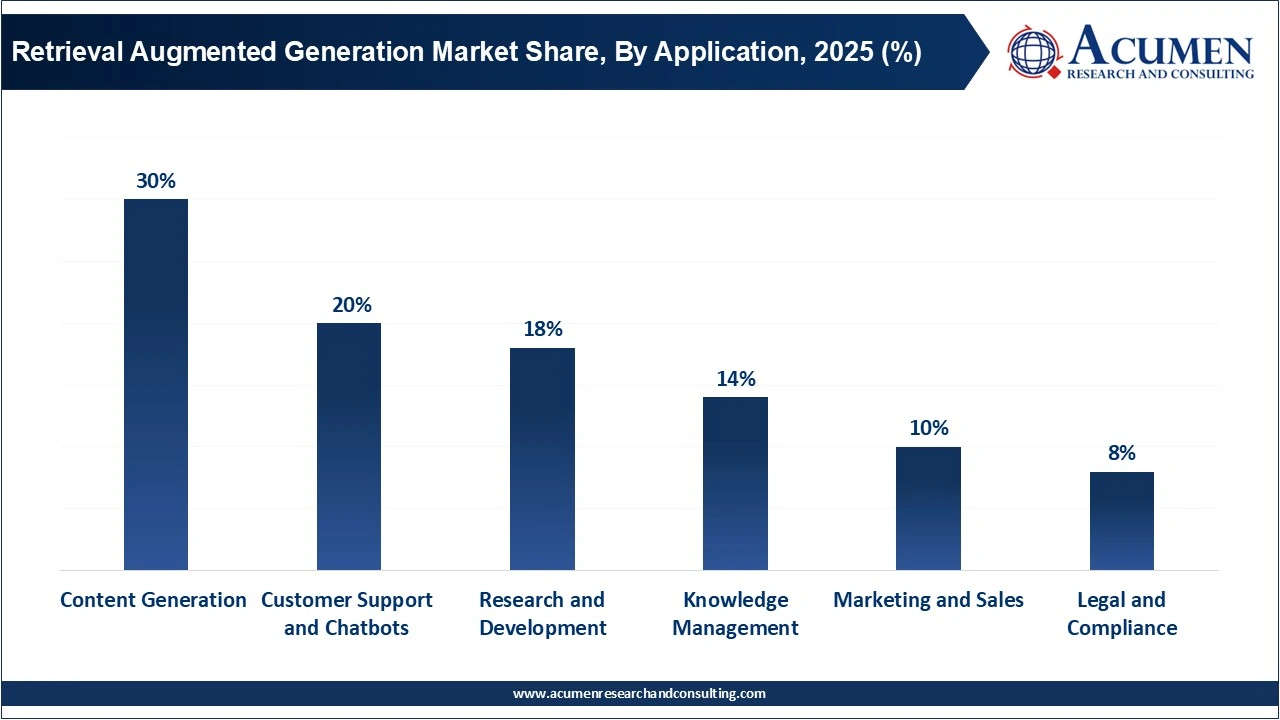
Content generation segment led the RAG market with around 30% share because it is the most widely adopted and commercially mature application of generative AI across industries. Organizations use RAG-powered content generation to produce accurate, context-aware reports, articles, product descriptions, technical documentation, and marketing material by grounding out in verified data sources. The ability to combine real-time information with fluent text generation significantly reduces content creation time while improving accuracy and consistency. As enterprises increasingly adopt AI-driven content workflows, content generation remains the largest contributor to RAG adoption due to its immediate productivity and cost benefits.
| By Application | Market Share, 2025 (%) | Key Highlights |
|---|---|---|
| Content Generation | 30% | High adoption for marketing, documentation, and enterprise content automation |
| Customer Support & Chatbots | 20% | Demand for real-time, accurate, and scalable customer engagement solutions |
| Research & Development | 18% | Need for faster access to updated research, technical, and scientific data |
| Knowledge Management | 14% | Growing enterprise focus on internal data accessibility and productivity |
| Marketing & Sales | 10% | Use of AI for personalized campaigns and customer insights |
| Legal & Compliance | 8% | Requirement for accurate, traceable, and regulation-aligned information |
Customer support and chatbots represent the fastest-growing segment, driven by the need for real-time, personalized, and reliable customer interactions. RAG enables chatbots to retrieve the latest policies, order statuses, and knowledge-base updates, ensuring accurate responses without retraining models. This capability is important for businesses to handle increasing customer expectations for instant and correct support across digital channels. The rapid expansion of e-commerce, digital banking, and online services is accelerating the deployment of RAG-powered customer support systems, making this the fastest-growing area in the market.
End User Insights
The retail and e-commerce segment held a significant share in the global RAG market in 2025 as this sector heavily rely on real-time data, personalization experiences, and content automation. Retailers use RAG to enhance product descriptions, recommendation systems, virtual shopping assistants, and customer engagement platforms by combining live inventory, pricing, and customer behavior data. The scale and frequency of AI interactions in the retail environment, combined with the direct impact in sales and customer experience, position retail and e-commerce as accelerating market segment.
| By End User | Market Share (%) | Key Highlights |
|---|---|---|
| Retail & E-commerce | 32% | Heavy reliance on personalization, recommendations, and customer engagement |
| Healthcare | 22% | Need for real-time, evidence-based clinical and research information |
| Financial Services | 14% | Use in compliance, risk analysis, and data-driven decision-making |
| IT & Telecommunications | 11% | Automation of support, network intelligence, and knowledge systems |
| Education | 9% | Adoption of AI-driven learning and research assistance |
| Media & Entertainment | 7% | Content creation, summarization, and audience engagement |
| Others | 5% | Emerging use cases across manufacturing, government, and logistics |
Healthcare is the fastest-growing end user sector for retrieval augmented generation market, fueled by increasing need for accurate, up-to-date, and evidence-based information access. RAG enables healthcare professionals to retrieve and summarize clinical guidelines, research papers, patient records, and regulatory updates in real-time, supporting better clinical decision-making. Growing digitalization of healthcare systems, combined with strict requirements for data accuracy and traceability, is driving rapid adoption of RAG solutions across hospitals, research institutions, and life science organizations.
Retrieval Augmented Generation Market Key Players
- Microsoft
- Amazon Web Services (AWS)
- Google DeepMind / Google
- OpenAI
- Anthropic
- Cohere
- Hugging Face
- IBM Watson
- Informatica
- Salesforce
- Palantir Technologies
- DataRobot
Recent Developments
- In November 2025, OpenAI formed a 7-year, USD 38 billion strategic partnership with AWS to access large-scale NVIDIA GB200/GB300 GPU infrastructure, enabling strong support for advanced, enterprise-scale AG workloads.
- In Feb 2025, Microsoft, in collaboration with Renmin University, launched CoRAG, an enhanced RAG framework that improves response accuracy by refining information retrieval through iterative steps before generation
Market Segmentation
By Deployment
- Cloud
- On-Premises
By Function
- Document Retrieval
- Recommendation Engines
- Response Generation
- Summarization and Reporting
By Application
- Content Generation
- Customer Support and Chatbots
- Research and Development
- Knowledge Management
- Marketing and Sales
- Legal and Compliance
By End User
- Retail and E-commerce
- Healthcare
- Financial Services
- IT and Telecommunications
- Education
- Media and Entertainment
- Others
By Region
- North America
- U.S.
- Canada
- Europe
- U.K.
- Germany
- France
- Spain
- Rest of Europe
- Asia-Pacific
- India
- Japan
- China
- Australia
- South Korea
- Rest of Asia-Pacific
- Latin America
- Brazil
- Mexico
- Rest of LATAM
- Middle East & Africa
- South Africa
- GCC Countries
- Rest of the Middle East & Africa (ME&A)
Looking for discounts, bulk pricing, or custom solutions? Contact us today at sales@acumenresearchandconsulting.com
Frequently Asked Questions

Other ICT Reports
November 2024
December 2020
April 2025
April 2025