
Robotic Process Automation Market Size, Share, Trends and Forecast 2026 to 2035
Robotic Process Automation Market (By Type: Software, Services [Consulting, Implementation, Training]; By Operation Mode: Unattended, Attended, Hybrid / Agentic; By Deployment: Cloud, On-Premise; By Organization Size: Large Enterprises, Small and Medium Enterprises; By Application: BFSI, Telecom and IT, Pharma and Healthcare, Manufacturing, Retail, Logistics, Energy and Utilities, Communication, Media and Education, Others) - Global Industry Analysis, Market Size, Opportunities and Forecast, 2026 - 2035
- Last Updated: 27 Nov 2026
- Report Code: ARC984
- Category: Process Control and Automation
Robotic Process Automation Market Size and Forecast 2026 to 2035
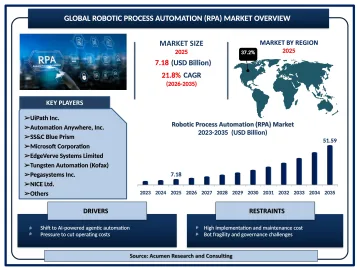
The global robotic process automation (RPA) market size was valued at $7.18 billion in 2025. The market is projected to reach $51.59 billion by 2035 from $8.75 billion in 2026, expanding at a CAGR of 21.8% during the forecast period from 2026 to 2035. Growth in the robotic process automation market is driven by the shift from rule-based software bots to agentic automation that combines RPA with AI agents, intelligent document processing, and orchestration; steady pressure to cut back-office costs; rapid cloud adoption; and growing demand from banking, healthcare, telecom, and the public sector. Leading RPA vendors now position their platforms as the execution and governance layer for enterprise AI agents, keeping software bots at the center of business automation.
- Base Year Market Size (2025): $7.18 billion
- Current Year Market Size (2026): $8.75 billion
- Estimated Year Market Size (2035): $51.59 billion
- Forecast Period CAGR (2026-2035): 21.8%
Key Takeaways
- By region: North America dominated the robotic process automation market with a 37.2% share in 2025, generating USD 2.67 billion, supported by early enterprise adoption and the presence of most leading RPA vendors.
- By region: Asia-Pacific is the fastest-growing region, with a projected CAGR of 24.5% from 2026 to 2035, driven by digital transformation in India, China, Japan, and Australia and the region's large shared-services and IT services base.
- By type: Software held a 58.6% share in 2025, generating USD 4.21 billion, while services such as consulting, implementation, and training accounted for the remaining 41.4%.
- By deployment: Cloud led with a 54.3% share in 2025 and is expected to grow at a CAGR of 25.8%, reaching a 72.6% share by 2035.
- By operation mode: Hybrid and agentic automation is the fastest-growing segment, with a CAGR of 28.9%, as companies combine bots with AI agents and human review.
- By application: BFSI held the largest share at 27.4% in 2025, generating USD 1.97 billion, while pharma and healthcare is the fastest-growing application with a CAGR of 24.9%.
Robotic Process Automation Market Overview
What Is Robotic Process Automation (RPA)?
Robotic process automation (RPA) is software that uses "bots" to perform repetitive, rule-based computer tasks the way a person would: logging into applications, copying and entering data, reading forms, moving files, and triggering actions across systems. Bots work through the user interface or APIs of existing applications, so companies can automate work without replacing legacy systems. Typical uses include invoice processing, account reconciliation, claims handling, customer onboarding, payroll updates, and IT service requests.
Modern RPA platforms go well beyond simple screen scraping. They include intelligent document processing to read unstructured documents, process and task mining to find automation opportunities, low-code development tools, centralized orchestration and governance, and AI agents that can make decisions within defined limits. This evolution has turned RPA into a core part of broader workflow automation and intelligent process automation strategies.
Attended vs. Unattended vs. Agentic RPA
| Operation Mode | How it works |
|---|---|
| Unattended RPA | Bots run on servers or virtual machines without human involvement, processing high-volume back-office work on schedules or triggers. |
| Attended RPA | Bots run on an employee's desktop and are triggered by the user to speed up front-office tasks such as call-center work. |
| Hybrid / agentic automation | Combines bots, AI agents, APIs, and human checkpoints; AI agents handle judgment and unstructured data while bots execute deterministic steps. |
Recent Trends
- From RPA to agentic automation: Leading vendors are combining deterministic bots with AI agents and orchestration so that one platform can run rule-based, AI-driven, and human-in-the-loop steps in the same process.
- Orchestration and governance as the new battleground: Enterprises want a single control layer to manage bots, AI agents, APIs, and people, with audit trails and policy controls.
- AI-driven bookings: A growing share of new RPA spending now includes AI capabilities, as customers move agentic pilots into production.
- Intelligent document processing: Reading invoices, contracts, and forms with AI is extending RPA to processes that were previously too unstructured to automate.
- Cloud-delivered automation: Customers are moving from on-premise bot farms to cloud platforms that are easier to scale and update.
- Industry solutions: Vendors are launching pre-built automations for finance, procurement, IT service desks, banking compliance, and healthcare.
Robotic Process Automation Market Dynamics
Growth Drivers
Shift to agentic automation: Generative and agentic AI are expanding the range of processes RPA can handle. Instead of only following fixed rules, platforms can now read documents, interpret emails, and decide on next steps, while bots carry out the actions reliably. This is opening new use cases and larger deal sizes for RPA vendors.
Pressure to reduce operating costs: Labor shortages, rising wages, and pressure on margins are pushing companies to automate high-volume back-office work in finance, HR, procurement, customer service, and IT. Software bots work around the clock with fewer errors, freeing employees for higher-value work.
Legacy systems that are hard to replace: Many banks, insurers, hospitals, and governments run older applications without modern APIs. RPA lets them automate across these systems without costly replacement projects.
Restraints
Implementation and maintenance costs: Large RPA programs require licenses, infrastructure, skilled developers, and ongoing bot maintenance, which can reduce returns for smaller deployments.
Bot fragility: Traditional bots can break when application screens or processes change, increasing support work and slowing scale-up.
Opportunities
SMEs and cloud platforms: Subscription-based cloud RPA and pre-built templates are making automation affordable for small and medium-sized businesses, the fastest-growing customer group with a CAGR of 24.9%.
Low-code and citizen developers: Drag-and-drop and natural-language tools let business users build their own automations, supporting demand alongside low-code development platforms.
Challenges
Governance of AI agents: As bots and AI agents take on more decisions, companies must ensure security, auditability, and compliance, especially in regulated industries.
Competition from adjacent platforms: Workflow, CRM, ERP, and IT service management vendors are adding their own automation and AI agents, increasing pressure on standalone RPA providers.
Robotic Process Automation Market Segmental Insights
Operation Mode Insights
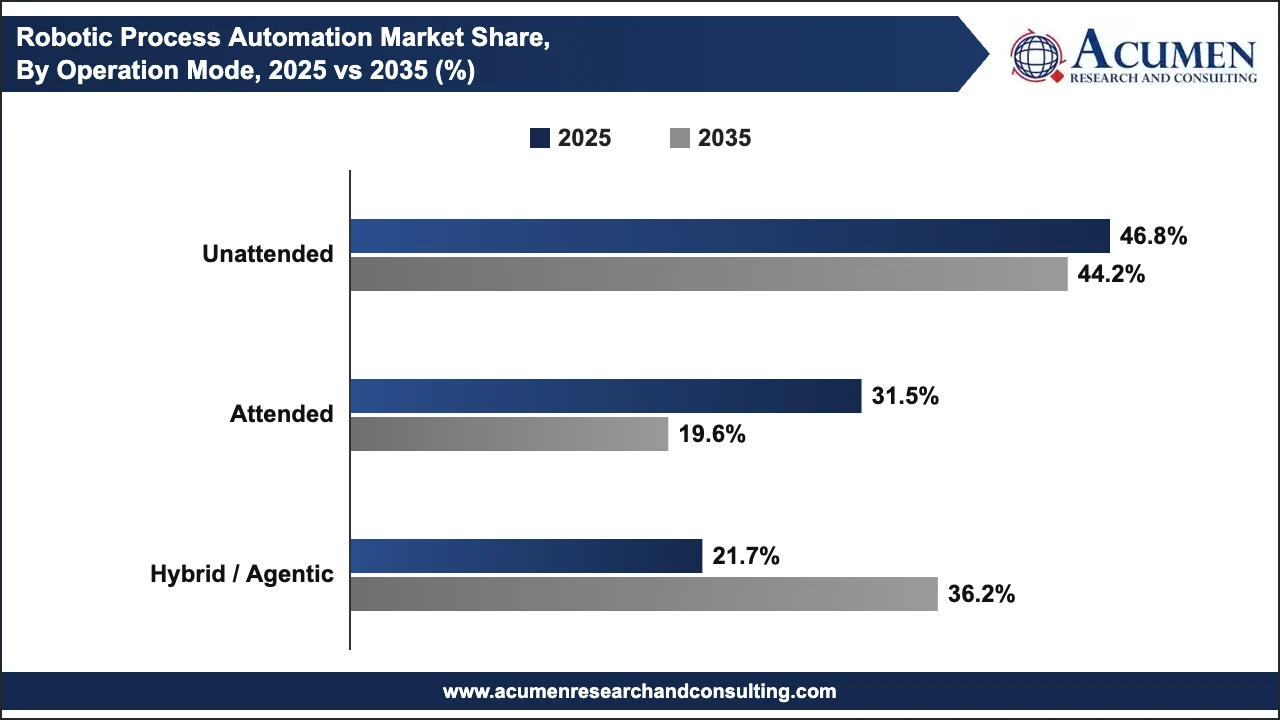
Unattended: Unattended RPA held the largest share at 46.8% in 2025, generating USD 3.36 billion, because high-volume back-office processes deliver the biggest savings.
Attended: Attended RPA accounted for 31.5% of the market in 2025 and remains common in contact centers and front-office roles, though its share is expected to decline as AI assistants take over many desktop tasks.
Hybrid / agentic: Hybrid and agentic automation held 21.7% of the market in 2025 and is the fastest-growing segment, with a CAGR of 28.9%, expected to reach a 36.2% share by 2035.
Type Insights
| Type | Share 2025 (%) | Key Highlights |
|---|---|---|
| Software | 58.6 | Generated USD 4.21 billion. Includes bot development tools, orchestration, AI agents, document processing, and analytics; growing at a CAGR of 22.8%. |
| Services | 41.4 | Consulting (16.8%), implementation (17.2%), and training (7.4%); demand driven by automation strategy, process redesign, and managed bot operations. |
Deployment Insights
Cloud: Cloud deployment held a 54.3% share in 2025, generating USD 3.90 billion, and is expected to grow at a CAGR of 25.8% to reach 72.6% of the market by 2035.
On-premise: On-premise deployment accounted for 45.7% of the market in 2025, mainly among banks, insurers, governments, and other organizations with strict data control requirements.
Organization Size Insights
| Organization Size | Share 2025 (%) | Key Highlights |
|---|---|---|
| Large Enterprises | 66.8 | Run large automation centers of excellence and are early adopters of agentic automation and orchestration. |
| Small and Medium Enterprises (SMEs) | 33.2 | The faster-growing segment, with a CAGR of 24.9%, supported by cloud subscriptions and pre-built automations. |
Application Insights
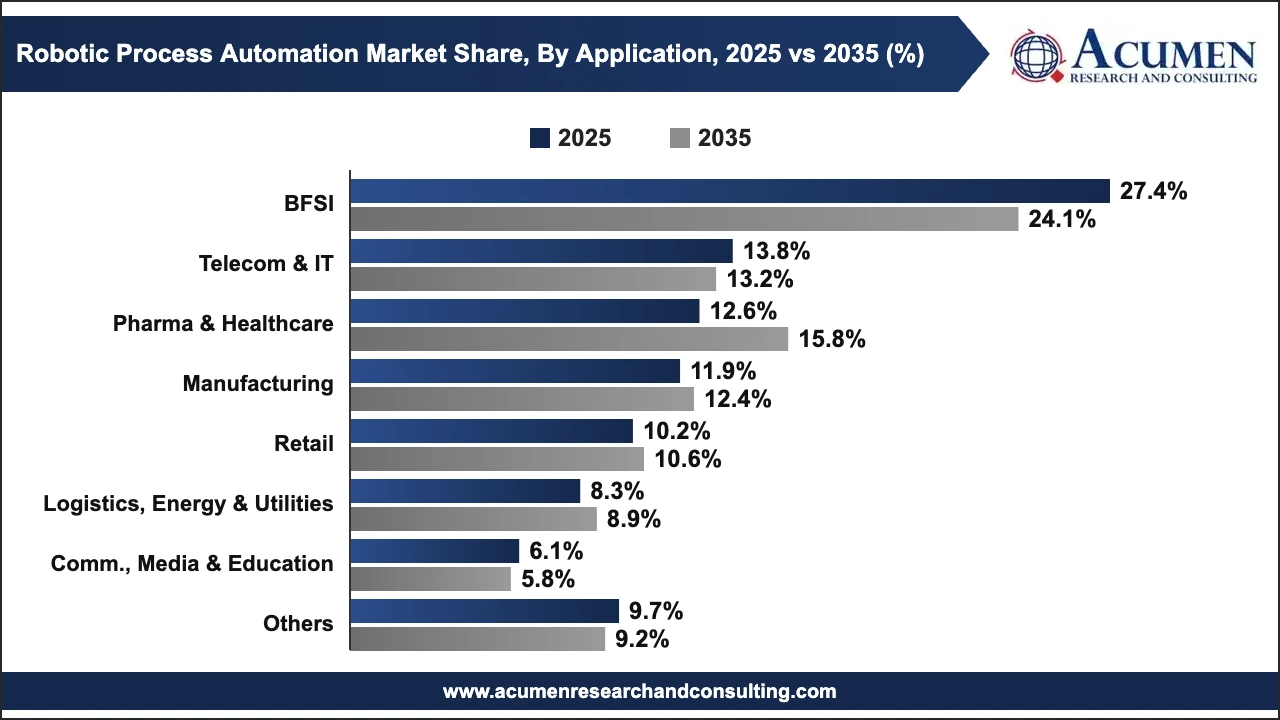
BFSI: Banking, financial services, and insurance held the largest share at 27.4% in 2025. Account opening, loan processing, KYC checks, claims, reconciliation, and regulatory reporting are among the most automated processes in any industry.
Pharma and healthcare: Pharma and healthcare held a 12.6% share in 2025 and is the fastest-growing application, with a CAGR of 24.9%, as hospitals and insurers automate patient registration, prior authorization, billing, and claims.
Other applications: Telecom and IT (13.8%), manufacturing (11.9%), retail (10.2%), logistics, energy and utilities (8.3%), communication, media and education (6.1%), and others (9.7%) make up the rest of the market.
Robotic Process Automation Market Regional Insights
Why Does North America Lead the RPA Market?
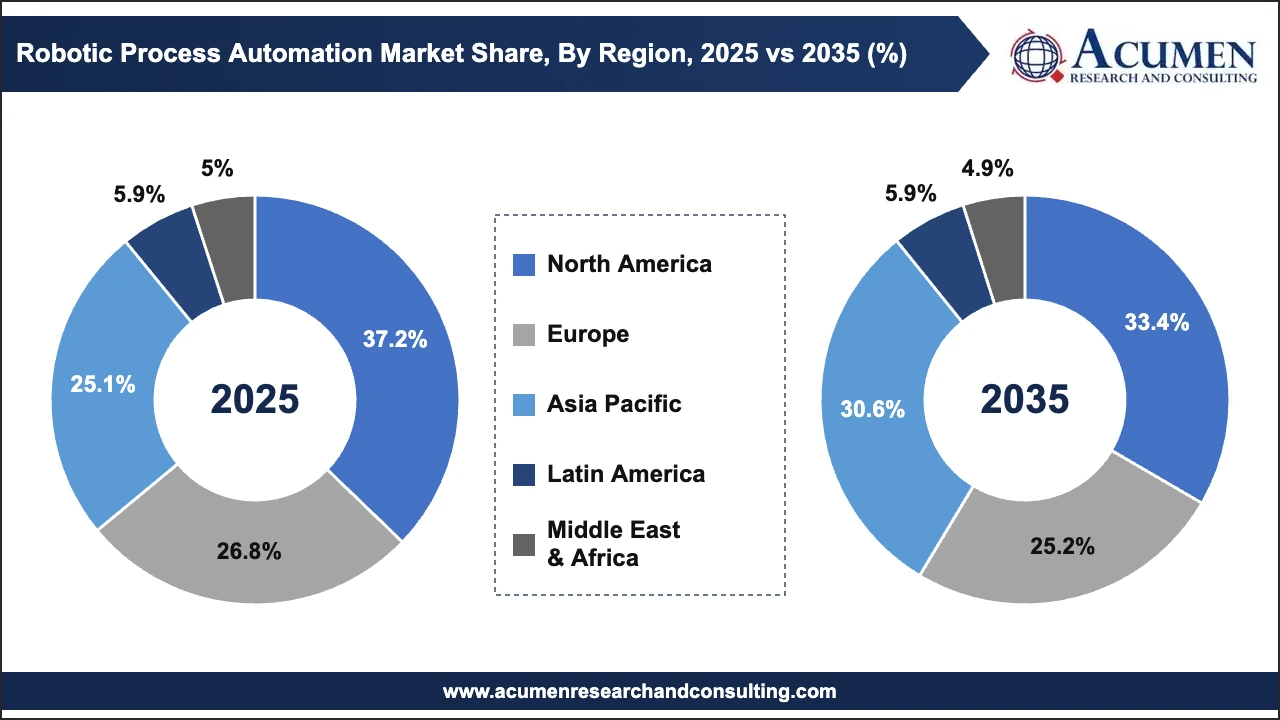
North America held a 37.2% share of the robotic process automation market in 2025, generating USD 2.67 billion. The region has the highest concentration of large enterprises with mature automation programs, early adoption of agentic AI, and the headquarters of most leading RPA vendors. Banking, insurance, healthcare, and government agencies are the largest users.
Europe Robotic Process Automation Market Outlook
Europe accounted for 26.8% of the market in 2025. The U.K., Germany, and France lead adoption, driven by banking, insurance, manufacturing, and public-sector digitization. Data protection rules and the EU AI Act are increasing demand for governed, auditable automation platforms.
Why Is Asia-Pacific the Fastest-Growing Region?
Asia-Pacific is projected to grow at a CAGR of 24.5% from 2026 to 2035, increasing its share from 25.1% in 2025 to 30.6% by 2035. India's large IT services and global capability centers, Japan's use of automation to offset labor shortages, and fast digitization in China, Australia, and Southeast Asia are driving demand. Latin America (5.9%) and the Middle East & Africa (5.0%) are growing as banks, telecom operators, and governments digitize operations.
Top Countries to Watch
- United States: The largest market, with early deployment of agentic automation across banking, healthcare, and government.
- United Kingdom: Strong adoption in banking, insurance, and the public sector.
- Germany: Demand from manufacturing, automotive, and financial services.
- India: A global hub for automation development, shared services, and fast domestic adoption.
- Japan: RPA widely used to address labor shortages in back-office work.
- Australia: Growing use in banking, government, and utilities.
Top Companies
| Company | RPA Focus |
|---|---|
| UiPath Inc. | Agentic automation platform combining RPA, AI agents, document processing, and Maestro orchestration. |
| Automation Anywhere, Inc. | Agentic process automation (APA) platform with pre-built agentic solutions for finance, IT, HR, and customer service. |
| SS&C Blue Prism | Enterprise RPA and the WorkHQ agentic automation platform for governed orchestration of digital workers and AI agents. |
| Microsoft Corporation | Power Automate desktop and cloud flows integrated with Copilot Studio and Microsoft 365. |
| EdgeVerve Systems Limited | AssistEdge automation and AI platforms for enterprise operations. |
| Tungsten Automation (formerly Kofax) | Intelligent automation and document processing software. |
| Pegasystems Inc. | Robotic automation within its low-code workflow and case management platform. |
| NICE Ltd. | Attended and unattended RPA for contact centers and customer service. |
| SAP SE | SAP Build Process Automation for automating SAP and non-SAP workflows. |
| IBM Corporation | RPA and AI orchestration within its business automation and watsonx portfolio. |
Other notable companies include FPT Software, NTT Advanced Technology Corporation, OnviSource, Inc., Xerox Corporation, Appian, Laiye, and WorkFusion (UiPath).
Recent Breakthroughs
- April 2026: SS&C launched SS&C Blue Prism WorkHQ, an agentic automation platform that orchestrates people, AI agents, APIs, and digital workers in one governed environment. In July 2026, Marsh announced it would use WorkHQ to scale agentic automation, building on its existing 130 Blue Prism digital agents.
- April 2026: Automation Anywhere reported that 61% of its fourth-quarter software bookings came from AI, as enterprises deployed agentic automation in core business functions.
- March 2026: UiPath reported fiscal 2026 revenue of $1.611 billion, up 13%, and annual recurring revenue of $1.853 billion, with AI product ARR of nearly $200 million.
- February 2026: UiPath announced the acquisition of WorkFusion, a provider of AI agents for financial crime compliance, to expand its agentic automation for banking and financial services.
- January 2026: Automation Anywhere announced new AI-native agentic solutions developed in collaboration with OpenAI, combining its Process Reasoning Engine with OpenAI reasoning models.
- November 2025: Automation Anywhere acquired Aisera to strengthen its agentic AI capabilities for IT and employee service.
Segments Covered
By Type
- Software
- Services (Consulting, Implementation, Training)
By Operation Mode
- Unattended
- Attended
- Hybrid / Agentic
By Deployment
- Cloud
- On-Premise
By Organization Size
- Large Enterprises
- Small and Medium Enterprises (SMEs)
By Application
- BFSI
- Telecom and IT
- Pharma and Healthcare
- Manufacturing
- Retail
- Logistics, Energy and Utilities
- Communication, Media and Education
- Others
By Region
- North America (U.S., Canada)
- Europe (U.K., Germany, France, Spain, Rest of Europe)
- Asia-Pacific (China, India, Japan, Australia, South Korea, Rest of Asia-Pacific)
- Latin America (Brazil, Mexico, Rest of Latin America)
- Middle East & Africa (GCC, South Africa, Rest of Middle East & Africa)
Looking for discounts, bulk pricing, or custom solutions? Contact us today at sales@acumenresearchandconsulting.com
Frequently Asked Questions

Related Market Research Reports
June 2023
June 2022
June 2023
June 2022
June 2022
June 2022
June 2022
June 2022