
Solar Vehicle Market Size, Share, Growth, Forecast 2025 To 2033
Solar Vehicle Market (By Electric Vehicle: Battery Electric Vehicle (BEV), Hybrid Electric Vehicle (HEV), Plug-in Hybrid Electric Vehicle (PHEV); By Battery Type: Lithium Ion, Lead Acid, Lead Carbon; By Solar Panel: Monocrystalline, Polycrystalline; By Vehicle Type: Passenger Vehicle, Commercial Vehicle) - Global Industry Analysis, Size, Share, Regional Analysis, Trends and Forecast 2025 - 2033
- Last Updated: 18 May 2026
- Report Code: ARC2074
- Category: Semiconductor and Electronics
Solar Vehicle Market Size, Forecast 2025 - 2033
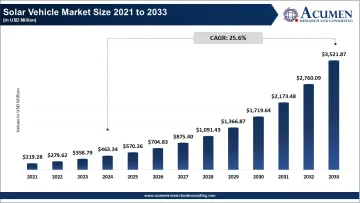
The global solar vehicle market size was accounted for USD 570.26 million in 2025 and is estimated to surpass around USD 3,521.87 million by 2033 growing at a CAGR of 25.6% from 2025 to 2033.
Solar vehicles are hybrid vehicles that use solar power for their propulsion as a form of fuel. Solar panels are fitted with panels installed in solar panels which convert the solar energy directly into the battery of the vehicle and are equipped with photovoltaic cells. These solar panels consist of silicone that absorbs heat and transforms it into electricity. The increasing use of state-of-the-art vehicle technology has led to an increasing demand for solar vehicles and a global market growth in solar vehicles. As technology progresses, solar cars are predicted to become increasingly efficient, cost-effective, and widely used in various parts of the transportation industry.
Report Highlights
- The global solar vehicle market is expected to reach USD 3,521.87 million by 2033, with a CAGR of 25.6% from 2025 to 2033.
- The North America solar vehicle market was valued at approximately USD 171.4 million in 2024.
- The Asia-Pacific market is projected to grow at a CAGR of over 28.2% from 2025 to 2033.
- The monocrystalline solar panel sub-segment accounted for 65% of the solar vehicle market share in 2025.
- Based on the vehicle type, hybrid electric vehicle generated considerable revenue in 2025.
- Collaboration between governments and manufacturers to promote solar vehicle infrastructure is a popular solar vehicle market trend that fuels the industry demand.
Solar Vehicle Market Dynamics
Market Drivers
- Increasing demand for eco-friendly and sustainable transportation solutions
- Technological advancements in solar panel efficiency and vehicle integration
- Growing government incentives and support for green energy initiatives
- Rising fuel prices driving the need for alternative energy sources
Market Restraints
- High initial cost of solar vehicle production and infrastructure
- Limited energy storage capacity and dependency on weather conditions
- Slow adoption due to lack of awareness and infrastructure development
Market Opportunities
- Expanding solar vehicle adoption in commercial fleets and public transportation
- Integration of solar technology with electric vehicles for improved efficiency
- Development of lightweight, durable solar panels to reduce vehicle weight
Report Scope
| Attribute | Details |
|---|---|
| Solar Vehicle Market Size 2025 | USD 570.26 Million |
| Solar Vehicle Market Forecast 2033 | USD 3,521.87 Million |
| Solar Vehicle Market CAGR During 2025 - 2033 | 25.6% |
| Analysis Period | 2021 - 2033 |
| Base Year | 2025 |
| Forecast Data | 2025 - 2033 |
| Segments Covered | By Electric Vehicle, By Battery Type, By Solar Panel, By Vehicle Type, and By Geography |
| Regional Scope | North America, Europe, Asia Pacific, Latin America, and Middle East & Africa |
| Key Companies Profiled | Sono Motors, Aptera Motors Corp., Fisker, Inc., Lightyear, GENERAL MOTORS, Hyundai Motor Company, Tesla, Kandi America, Inc., Cruise LLC, and Squad Mobility B.V. |
| Report Coverage | Market Trends, Drivers, Restraints, Competitive Analysis, Player Profiling, Covid-19 Analysis, Regulation Analysis |
Solar Vehicle Market Insights
The growing concern over carbon emissions is a significant factor that is projected to boost the electric vehicle (EV) solar energy market during the forecast period. Solar-powered electric vehicles offer a sustainable alternative to environmental degradation and energy shortages, becoming an attractive option compared to traditional petrol engines. These vehicles not only improve engine performance, but also make it more efficient. With traditional fuels depleting, the demand for solar-powered electric vehicles is likely to increase. Furthermore, these vehicles assist owners in meeting federal fuel system emissions rules, making them a viable option in today's ecologically sensitive market.
Solar-powered electric vehicles come with various advantages, such as zero emissions, reduced maintenance, quick charging, noise-free operation, and improved overall vehicle performance. The market is expected to benefit from these advantages, providing a competitive opportunity throughout the projected period. A solar-powered electric vehicle is a promising response to the issue of urban emissions, offering a simple, economic, and non-invasive solution to the growing environmental crisis.
Solar energy, on the other hand, is directly dependent on sunlight, which implies that weather patterns and geographic location can affect solar power generation, influencing demand for solar vehicles. Despite this, the solar car sector is expected to develop, owing to increased demand for ecologically benign energy sources.
The government's initiatives are helping to drive this increase. The Indian government's FAME India initiative offers incentives worth ₹5,294 crore to encourage the use of electric vehicles. Furthermore, India aims to have 500 GW of non-fossil fuel-based power capacity by 2030, with solar energy playing an important role. As electric vehicles grow increasingly popular, solar-powered models are viewed as an important element of the transportation future.
Solar Vehicle Market Segmentation Insights
The worldwide market for solar vehicle is split based on electric vehicle, battery type, solar panel, vehicle type, and geography.
Electric Vehicle Insights
The hybrid electric vehicles (HEVs), which combine an internal combustion engine and an electric motor, are expected to be the dominant sector in the market. HEVs outperform traditional automobiles in terms of fuel efficiency and pollution reduction without relying solely on electric charging infrastructure. Unlike battery electric vehicles (BEVs), which run entirely on electricity, HEVs may switch between the engine and the motor, increasing range and versatility. This versatility makes HEVs especially appealing in locations with limited charging stations. As governments struggle for stricter emission regulations and consumers seek more environmentally friendly transportation options, demand for HEVs is likely to surge, resulting in market dominance.
Battery Type Insights
The industry's Lithium-Ion battery category is expected to grow significantly throughout the solar vehicle market forecast period. Lithium-Ion batteries are well-known for their high energy density, extended lifespan, and low self-discharge rates, making them ideal for electric vehicles, particularly solar-powered ones. These batteries are lighter and more efficient than alternatives such as lead acid and lead carbon, giving vehicles longer range and faster charging times. The increasing global use of electric vehicles (EVs), combined with developments in battery technology, drives up demand for lithium-ion batteries. As governments tighten emission restrictions and consumers migrate to cleaner transportation options, lithium-ion batteries are expected to dominate the industry, driving significant rise in solar vehicle usage.
Solar Panel Insights
The monocrystalline solar panels are expected to become the dominating category in the market over the forecast period. Their better efficiency, higher power output, and compact design make them ideal for use in electric vehicles, where space and energy economy are crucial. Compared to polycrystalline panels, monocrystalline types perform better in low-light circumstances and have a longer operating lifespan, which aligns well with the growing demand for durable and sustainable automotive technology. Advancements in solar panel manufacturing and increased investments in sustainable transportation contribute to their market dominance. As automakers seek to maximize energy harvesting capabilities, monocrystalline panels stand out for their efficiency and technological versatility, making them the ideal choice for next-generation solar-powered vehicles.

Vehicle Type Insights
The passenger vehicles are expected to experience significant growth over the forecast period. This expansion is primarily driven by expanding environmental consciousness, increased demand for sustainable personal mobility, and supportive government efforts promoting clean energy vehicles. Consumers are increasingly selecting environmentally friendly mobility solutions, and solar-powered passenger vehicles provide the added benefit of fewer carbon emissions and gasoline or electricity expenses. Lightweight solar panels and improved battery storage technology have also helped to increase the viability and appeal of solar passenger vehicles. Furthermore, the adoption of solar-integrated electric vehicles by major automotive manufacturers is hastening this trend, establishing the passenger vehicle segment as the primary driver of growth within the larger solar vehicle market landscape.
Solar Vehicle Market Regional Insights
The solar vehicle market analysis is provided for major regional markets including North America, Europe, Asia-Pacific, Latin America, and Middle East & Africa. For each region, the market size for different segments has been covered under the scope of report.
It is estimated that the Asia-Pacific region will be the fastest growing in the market. The region includes some of the world's fastest-growing economies, such as China and India. Asia-Pacific is the leading automobile market with rising customer buying power increasing automobile demand in the country. Climate conditions are also appropriate for these vehicles in Southeast Asian countries. Furthermore, the high demand for passenger cars from the region's emerging countries is likely to drive Asia Pacific industry growth over the solar vehicle market forecast period. In terms of early adoption of electric cars in the world, Europe is at the top of the list.

The adoption of such vehicles in Europe is therefore expected to gain momentum throughout the forecast period. The rapid introduction of such vehicles in the area is likely to adhere to stringent environmental policies and emission control initiatives. Each new automobile sold in Europe will be electric in the near future, according to a recent report by ING, one of Europe's leading financial institutions. Solar panels are more integrated with electric vehicles, which can result in higher adoption of these vehicles in the region. The primary reason for the prediction is beneficial government support, lower battery costs and economies of scale.
Solar Vehicle Market Key Players
- Sono Motors
- Aptera Motors Corp.
- Fisker, Inc.
- Lightyear
- General Motors
- Hyundai Motor Company
- Tesla
- Kandi America, Inc.
- Cruise LLC
- Squad Mobility B.V.
Market Segmentation
By Electric Vehicle
- Battery Electric Vehicle (BEV)
- Hybrid Electric Vehicle (HEV)
- Plug-in Hybrid Electric Vehicle (PHEV)
By Battery Type
- Lithium Ion
- Lead Acid
- Lead Carbon
By Solar Panel
- Monocrystalline
- Polycrystalline
By Vehicle Type
- Passenger Vehicle
- Commercial Vehicle
By Region
- North America
- U.S.
- Canada
- Europe
- U.K.
- Germany
- France
- Spain
- Rest of Europe
- Asia-Pacific
- India
- Japan
- China
- Australia
- South Korea
- Rest of Asia-Pacific
- Latin America
- Brazil
- Mexico
- Rest of LATAM
- The Middle East & Africa
- South Africa
- GCC Countries
- Rest of the Middle East & Africa (ME&A)
Looking for discounts, bulk pricing, or custom solutions? Contact us today at sales@acumenresearchandconsulting.com
Frequently Asked Questions

Other Semiconductor and Electronics Reports
November 2022
November 2018
November 2022
August 2023