
Static Heat Meter Market Size - Global Industry, Share, Analysis, Trends and Forecast 2025 - 2033
The Global Static Heat Meter Market Size accounted for USD 1.70 Billion in 2024 and is estimated to achieve a market size of USD 2.98 Billion by 2033 growing at a CAGR of 6.5% from 2025 to 2033.
- Last Updated: 26 May 2025
- Report Code: ARC3840
- Category: Energy and Power
The Global Static Heat Meter Market Size accounted for USD 1.70 Billion in 2024 and is estimated to achieve a market size of USD 2.98 Billion by 2033 growing at a CAGR of 6.5% from 2025 to 2033.
Static Heat Meter Market Highlights
- The global static heat meter market is expected to reach USD 2.98 billion by 2033, with a CAGR of 6.5% from 2025 to 2033
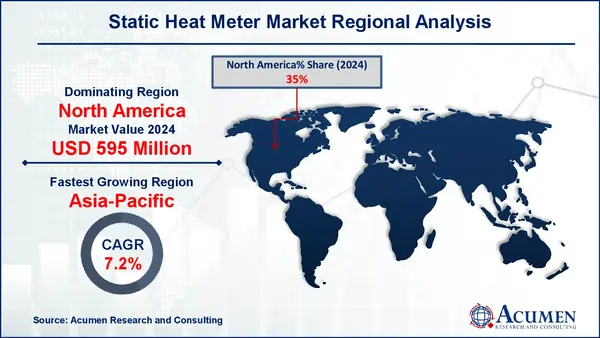
- The North America Static Heat Meter market was valued at approximately USD 595 Million in 2024
- The Asia-Pacific market is projected to grow at a CAGR of over 7.2% from 2025 to 2033
- The commercial sub-segment accounted for 48% of the market share in 2024
- Integration of IoT and smart metering technologies in static heat meter is a popular market trend that fuels the industry demand
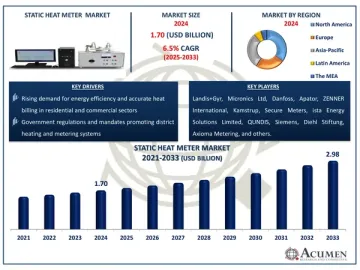
A static heat meter is a device used to measure the thermal energy consumed in heating or cooling systems, typically in residential, commercial, or industrial buildings. Unlike mechanical meters, it operates without moving parts, using technologies like ultrasonic or electromagnetic flow measurement to ensure high accuracy and long-term reliability.
It calculates energy consumption by measuring the flow of heat transfer fluid and the temperature difference between the supply and return lines. Static heat meters are essential for fair billing, energy efficiency, and smart energy management, especially in district heating and cooling networks.
Global Static Heat Meter Market Dynamics
Market Drivers
- Rising demand for energy efficiency and accurate heat billing in residential and commercial sectors
- Government regulations and mandates promoting district heating and metering systems
- Growing adoption of smart building and IoT-integrated energy management solutions
Market Restraints
- High initial cost of installation and system integration for static heat meters
- Lack of awareness and technical expertise in emerging and underdeveloped markets
- Data privacy and cybersecurity concerns in smart metering infrastructure
Market Opportunities
- Expansion of smart city projects and district heating networks globally
- Integration of AI and advanced analytics for real-time energy monitoring and reporting
- Growing retrofitting demand in aging buildings to meet energy compliance standards
Static Heat Meter Market Report Coverage
|
Market |
Static Heat Meter Market |
|---|---|
|
Static Heat Meter Market Size 2024 |
USD 1.70 Billion |
|
Static Heat Meter Market Forecast 2033 |
USD 2.98 Billion |
|
Static Heat Meter Market CAGR During 2025 - 2033 |
6.5% |
|
Static Heat Meter Market Analysis Period |
2021 - 2033 |
|
Static Heat Meter Market Base Year |
2024 |
|
Static Heat Meter Market Forecast Data |
2025 - 2033 |
|
Segments Covered |
By Component, By Functionality, By Application, and By Geography |
|
Regional Scope |
North America, Europe, Asia Pacific, Latin America, and Middle East & Africa |
|
Key Companies Profiled |
Landis+Gyr, Micronics Ltd, Danfoss, Apator, ZENNER International, Kamstrup, Secure Meters, ista Energy Solutions Limited, QUNDIS, Siemens, Diehl Stiftung, Axioma Metering, Schneider Electric, Huizhong Instrumentation, Sontex, and Itron. |
|
Report Coverage |
Market Trends, Drivers, Restraints, Competitive Analysis, Player Profiling, Covid-19 Analysis, Regulation Analysis |
Static Heat Meter Market Insights
As customers and building managers become more conscious of the importance of energy conservation, they seek accurate solutions to monitor heat usage. For example, the Bureau of Energy Efficiency (BEE) has undertaken various public campaigns to promote energy conservation, in accordance with the Ministry of Information and Broadcasting requirements. These efforts, carried out by the Directorate of Advertising & Visual Publicity (DAVP) and the National Film Development Corporation of India (NFDC), include electronic, print, outdoor, and social media platforms. Such programs reflect an increasing public concern on energy efficiency, which encourages the use of devices such as static heat meters. As awareness grows, the necessity for precise heat monitoring and fair billing methods is anticipated to fuel the growth of the static heat meter market.
Government regulations are also playing a key role in this trend. In the United States, for instance, both federal and state authorities promote energy efficiency through regulations and incentives. The Department of Energy (DOE) sets national standards for appliances and systems, encouraging wider implementation of heat metering solutions in both new construction and retrofit projects. However, despite the long-term cost savings these meters offer, their high initial cost including the device, installation, and integration remains a significant barrier, especially in developing nations with tight infrastructure budgets.
On the other hand, the growth of smart cities and the expansion of district heating systems are opening up new prospects. According to the International Energy Agency (IEA), district heating is critical to attaining net-zero emissions by 2050 by providing adaptable, future-ready energy solutions. In Denmark, district heating presently meets 65% of building heat demand, this trend is projected to greatly boost the static heat meter industry in the future years.

Static Heat Meter Market Segmentation
The worldwide market for static heat meter is split based on component, type, functionality, application, and geography.
Static Heat Meter Market By Component
- Flow Sensor
- Temperature Sensor
- Calculator Unit
- Others
According to static heat meter industry analysis, each component is critical to achieving accurate and dependable thermal energy measurement. Flow sensors detect the volume of heat transfer fluid, which is required to calculate energy consumption. Temperature sensors monitor the difference between inlet and output water temperatures, which is an important aspect in evaluating heat consumption. The calculator unit uses flow and temperature data to calculate the total energy consumed.
Static Heat Meter Market By Functionality
- Monitoring And Control
- Metering And Billing
- Data Analysis And Reporting
According to static heat meter industry analysis, monitoring and control systems are critical in the static heat meter business because they provide precise measurement and energy efficiency. These systems support real-time data tracking, defect detection, and remote access, which improve reliability and performance. With rising need for energy efficiency in both home and commercial settings, improved monitoring has become critical. As a result, it leads the market in automation and smart heat management systems.
Static Heat Meter Market By Application
- Residential
o Individual Houses
o Apartments / Multi-Dwelling Units
- Commercial
o Office Buildings
o Shopping Malls
- Industrial
o Manufacturing Plants
o Power Generation Facilities
According to static heat meter market forecast, commercial sector, particularly office buildings and shopping malls dominates due to their high energy consumption and demand for efficient heating systems. These large-scale operations prioritize accurate energy monitoring in order to reduce operational costs and achieve sustainability objectives. Static heat meters provide dependable, maintenance-free solutions that are appropriate for such settings. Their capacity to properly track thermal energy utilization makes them an ideal choice for commercial applications.
Static Heat Meter Market Regional Outlook
North America
- U.S.
- Canada
Europe
- U.K.
- Germany
- France
- Spain
- Rest of Europe
Asia-Pacific
- India
- Japan
- China
- Australia
- South Korea
- Rest of Asia-Pacific
Latin America
- Brazil
- Mexico
- Rest of LATAM
The Middle East & Africa
- South Africa
- GCC Countries
- Rest of the Middle East & Africa (ME&A)
Static Heat Meter Market Regional Analysis
In terms of regional segments, North America dominates the static heat meter market, owing to early adoption of smart metering technology and strong legislative support for energy saving. The region benefits from excellent infrastructure, big market players, and the extensive use of district heating systems. For example, district energy systems provide efficient heating and cooling from centralized plants, with combined heat and power (CHP) playing an important role in improving energy efficiency, reliability, and resilience. CHP also promotes renewable energy integration and acts as a backbone for microgrids, ensuring continuous power during grid failures. The widespread use of district heating and government-backed incentives continues to drive market expansion in both the residential and commercial sectors.
Asia-Pacific is significantly growing at CAGR 7.2% in industry. APAC’s commitment to climate goals and smart energy management is hastening the spread of contemporary heat metering technology throughout the region.
The static heat meter market in Europe is expanding rapidly, owing to rigorous energy efficiency laws and strong sustainability goals. Leading countries, including Germany, Denmark, and Sweden, have enacted obligatory metering measures to promote energy conservation. For example, in December 2022, Kamstrup delivered around 40,000 improved water and heat meters to Silkeborg Forsyning, each with wireless connection and future-ready features for precise data collecting. These modifications have greatly enhanced operational efficiency and commercial performance.
Static Heat Meter Market Players
Some of the top static heat meter companies offered in our report include Landis+Gyr, Micronics Ltd, Danfoss, Apator, ZENNER International, Kamstrup, Secure Meters, ista Energy Solutions Limited, QUNDIS, Siemens, Diehl Stiftung, Axioma Metering, Schneider Electric, Huizhong Instrumentation, Sontex, and Itron.
Looking for discounts, bulk pricing, or custom solutions? Contact us today at sales@acumenresearchandconsulting.com
Frequently Asked Questions
Other Energy and Power Reports
July 2020
December 2024
January 2021
April 2020