
AI in Asset Management Market Size, Share, Trends and Forecast 2026 to 2035
AI in Asset Management Market (By Component: Software / platforms, Professional services, Managed services; By Technology: Machine learning, Natural language processing, Generative AI, Others; By Deployment: Cloud-based, On-premises; By Asset Class: Equities, Fixed income, Multi-asset, Alternatives, Others; By Organization Size (AUM): Large firms, Small and mid-sized firms; By Application; By End User) - Global Industry Analysis, Size, Share, Regional Analysis, Trends and Forecast 2026 - 2035
- Last Updated: 27 Oct 2026
- Report Code: ARC4003
- Category: ICT
AI in Asset Management Market Size and Forecast 2026 to 2035
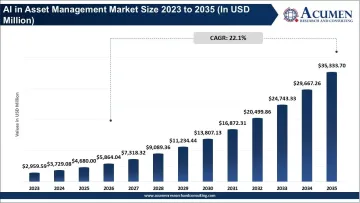
The global AI in asset management market size was valued at USD 4,680 million in 2025 and is expected to reach at USD 35,333.70 million by 2035, while expanding at a CAGR of 22.1% during the forecast period 2026 to 2035. Demand for faster investment decisions, expanding financial data volumes, rising automation needs, and advances in generative AI are accelerating adoption. Asset managers increasingly use AI to improve research productivity, portfolio monitoring, risk assessment, regulatory compliance, and personalized investor services.
AI in Asset Management Market Key Statistics
- Base Year Market Size (2025): $4,680 million
- Current Year Market Size (2026): $5,864.04 million
- Estimated Year Market Size (2035): $35,333.70 million
- Forecast Period CAGR (2026-2035): 21.1%
- Leading Region: North America (46% revenue share)
Key Takeaways
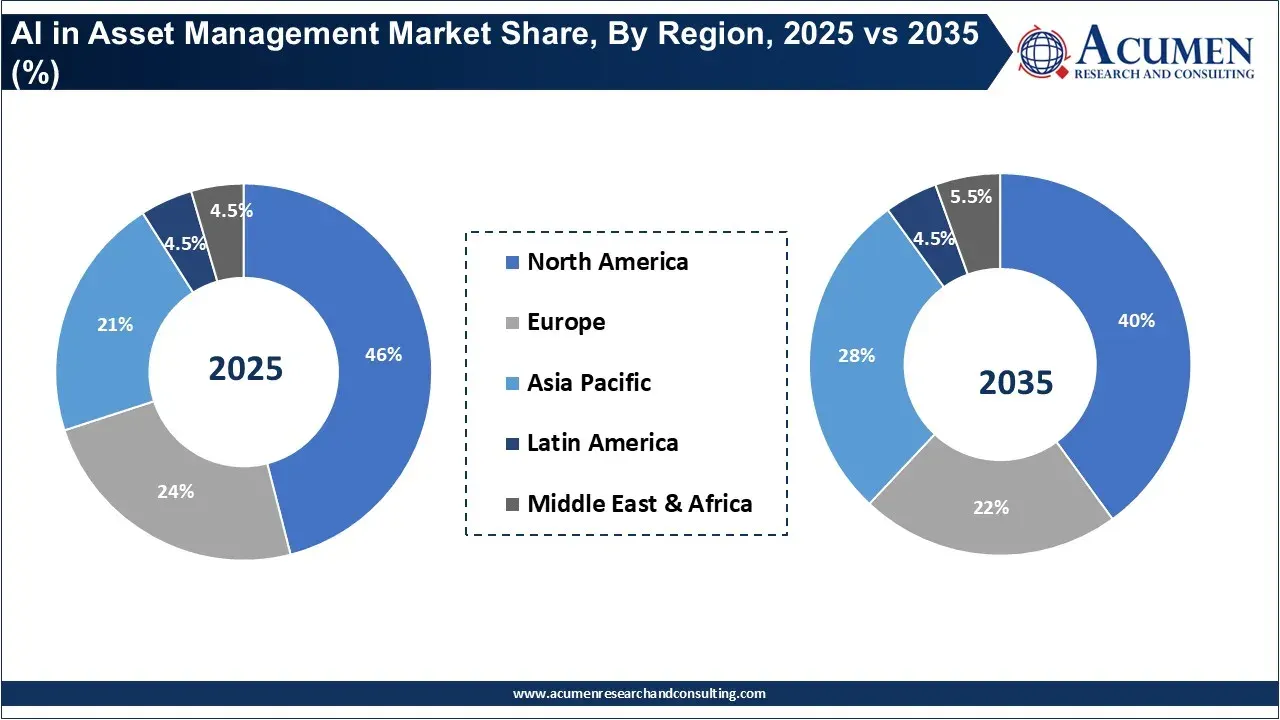
- By region: North America dominated the AI in Asset Management Market with a 46.0% share in 2025, generating USD 2.15 billion in revenue. The regional market is projected to reach USD 14.13 billion by 2035, registering a CAGR of 20.4% from 2026 to 2035.
- By component: Software / platforms dominated the market with a 66.0% share in 2025, generating USD 3.09 billion in revenue. Managed services are the fastest-growing component segment, with a projected CAGR of 24.8% from 2026 to 2035, reaching USD 5.30 billion by 2035.
- By technology: Machine learning, including deep learning, dominated the market with a 58.0% share in 2025, generating USD 2.71 billion in revenue. Generative AI and large language models are the fastest-growing technology segment, with a projected CAGR of 32.4% from 2026 to 2035, reaching USD 11.66 billion by 2035.
- By deployment: On-premises deployment dominated the market with a 57.0% share in 2025, generating USD 2.67 billion in revenue. Cloud-based deployment is the fastest-growing segment, with a projected CAGR of 27.3% from 2026 to 2035, reaching USD 23.32 billion by 2035.
- By application: Portfolio optimisation and construction dominated the market with a 27.0% share in 2025, generating USD 1.26 billion in revenue. Client engagement and advisory is the fastest-growing application segment, with a projected CAGR of 26.2% from 2026 to 2035, reaching USD 4.95 billion by 2035.
- By end user: Traditional asset managers dominated the market with a 38.0% share in 2025, generating USD 1.78 billion in revenue. Private equity and alternative asset managers represent the fastest-growing end-user segment, with a projected CAGR of 24.8% from 2026 to 2035, reaching USD 3.53 billion by 2035.
- By asset class: Equities dominated the market with a 40.0% share in 2025, generating USD 1.87 billion in revenue. Alternatives are the fastest-growing asset-class segment, with a projected CAGR of 24.8% from 2026 to 2035, reaching USD 7.07 billion by 2035.
- By organization size (AUM): Large firms with AUM greater than USD 100 billion dominated the market with a 64.0% share in 2025, generating USD 3.00 billion in revenue. Small and mid-sized firms with AUM of USD 100 billion or less are the fastest-growing segment, with a projected CAGR of 24.5% from 2026 to 2035, reaching USD 15.55 billion by 2035.
Industry Overview
AI in asset management market includes technologies that are utilized for the purpose of investment research, portfolio construction & optimization, asset allocation, risk management, trading, compliance, and investor services. Asset managers are looking at how they can bring value from AI to large volumes of data, generate signals, and automate repetitive work or processes, for creating automated research, making investment decisions and more.
Adoption is moving out of research support and into integrated investment and operational activities, but organizations are at different levels of maturity. Once firms move from experimentation to production, competitive advantage will come from how well they embed AI into investment processes while maintaining human involvement and delivering quantifiable business results.
Recent Trends
- Predictive portfolio risk analytics: Machine learning models are being applied to identify portfolio exposures, detect anomalies, assess changing market conditions, and support scenario analysis.
- Alternative data integration: Investment teams are combining traditional financial data with news, corporate filings, satellite imagery, supply-chain indicators, and other alternative datasets to identify potential investment signals.
- AI-assisted compliance monitoring: Natural language processing and anomaly detection are helping compliance teams review communications, flag suspicious activity, and identify potential policy breaches.
- Personalized wealth management: AI-enabled tools are supporting investor segmentation, customized portfolio insights, client communication, and scalable advisory services.
- Human-supervised automation: Firms are increasingly distinguishing between AI that recommends or prepares decisions and systems permitted to execute actions autonomously.
Investment Workflow Transformation Statistics
- Mercer’s 2026 survey of 131 asset managers found that 55% had integrated AI into at least one investment process, 27% remained at the pilot or proof-of-concept stage, and 18% had not integrated AI into their investment processes.
- 69% cited data quality or access as a material obstacle to wider AI adoption, emphasizing the importance of clean, integrated, and reliable investment datasets.
- BlackRock's 2026 survey of 303 senior investment decision-makers found that 72% of surveyed organizations relied on eight or more platforms for fund lifecycle and investment operations. In addition, 56% identified legacy technology as a major constraint on flexibility and scalability, highlighting the integration work required to embed AI across investment workflows.
Market Dynamics
Growth Drivers
- Increasing Demand for Data-Driven Investment Decisions: Asset managers are adopting AI-powered analytics to process financial data, identify market patterns, assess portfolio risks, and support investment decisions, enabling faster analysis of complex market conditions and changing investor requirements.
- Growing Adoption of Portfolio Automation: Financial institutions are integrating AI into portfolio construction, asset allocation, rebalancing, and performance monitoring to streamline investment workflows, improve operational efficiency, and reduce dependence on repetitive manual processes.
- Expansion of Alternative Data Analytics: Increasing availability of satellite imagery, transaction records, news feeds, market sentiment, and other alternative datasets is encouraging asset managers to use AI models to identify investment signals and strengthen forecasting capabilities.
Restraints
- Data Privacy and Cybersecurity Risks: AI-based asset management platforms process sensitive financial information, client records, and proprietary investment strategies, creating exposure to data breaches, unauthorized access, and cybersecurity threats that require robust governance controls.
- High Implementation and Integration Costs: Deploying AI infrastructure requires investment in computing resources, specialized software, data engineering, and skilled personnel. Integrating these technologies with legacy portfolio management and trading systems can further increase implementation costs.
- Limited Model Explainability: Complex AI models may produce investment recommendations that are difficult to interpret, making it challenging for asset managers to explain decisions, validate assumptions, and demonstrate compliance with internal risk policies and regulatory expectations.
Opportunities
- Personalized Wealth and Portfolio Management: AI-powered profiling and recommendation engines create opportunities to deliver investment strategies tailored to individual risk tolerance, financial objectives, liquidity requirements, and changing portfolio conditions.
- AI-Enabled Risk and Compliance Monitoring: Advanced analytics can help asset managers detect unusual transactions, monitor portfolio exposures, identify potential compliance breaches, and conduct scenario analysis, creating opportunities for integrated risk management solutions.
- Generative AI for Investment Research: Generative AI tools can summarize earnings reports, analyze regulatory filings, extract insights from financial documents, and support research workflows, helping investment teams process information more efficiently while retaining human oversight.
Challenges
- Managing Algorithmic Bias and Model Risk: AI systems trained on incomplete or historically biased datasets may generate unreliable forecasts or investment recommendations, requiring continuous validation, stress testing, and monitoring across different market conditions.
- Adapting to Market Volatility: Financial markets can change rapidly because of economic shocks, geopolitical developments, and unexpected events. AI models trained on historical patterns may struggle during unprecedented conditions, affecting forecasting accuracy and portfolio decisions.
- Ensuring Regulatory Accountability: Asset managers must establish clear accountability for AI-supported investment decisions, maintain appropriate documentation, protect client interests, and comply with applicable financial regulations while balancing automation with human supervision.
Regulatory and Governance Outlook, 2026–2030
| Country | Regulatory framework and oversight | Outlook, 2026–2030 |
|---|---|---|
| United States | SEC and FINRA requirements, existing securities laws, fiduciary duties, investor-protection rules, and applicable privacy and cybersecurity requirements. | Greater focus on AI oversight, investor protection, model testing, and accountability under existing securities regulations. |
| United Kingdom | FCA regulatory framework, Consumer Duty where applicable, senior management accountability, UK GDPR, and principles-based AI governance. | Continued emphasis on responsible AI adoption, explainability, fair customer outcomes, and supervisory scrutiny of higher-risk applications. |
| India | SEBI's AI/ML-related regulatory and reporting requirements for regulated securities-market entities, alongside applicable data protection and cybersecurity rules. | Greater attention to AI accountability, disclosure, risk management, and governance as adoption expands across securities-market participants. |
| Singapore | Monetary Authority of Singapore (MAS) Guidelines on Artificial Intelligence Risk Management for Financial Institutions, issued on 7 October 2026. | Guidelines take effect on 7 October 2027, with phased implementation for specified sections through 7 October 2028. Further agentic AI guidance is expected to be explored in 2027. |
| China | Generative AI service measures, algorithm recommendation provisions, deep-synthesis rules, and applicable data security and personal information protection requirements. | Continued regulatory attention to generative AI services, algorithm governance, data security, and the use of AI in financial-sector applications. |
AI in Asset Management Market Segmental Insights
Component Insights
Software / Platforms: Software and platforms dominated the market in 2025, accounting for 66.0% and generating USD 3.09 billion in revenue. The segment is projected to hold a 62.0% share in 2035, reaching USD 21.91 billion as asset managers expand AI-enabled portfolio analytics, risk modelling, and investment workflows.
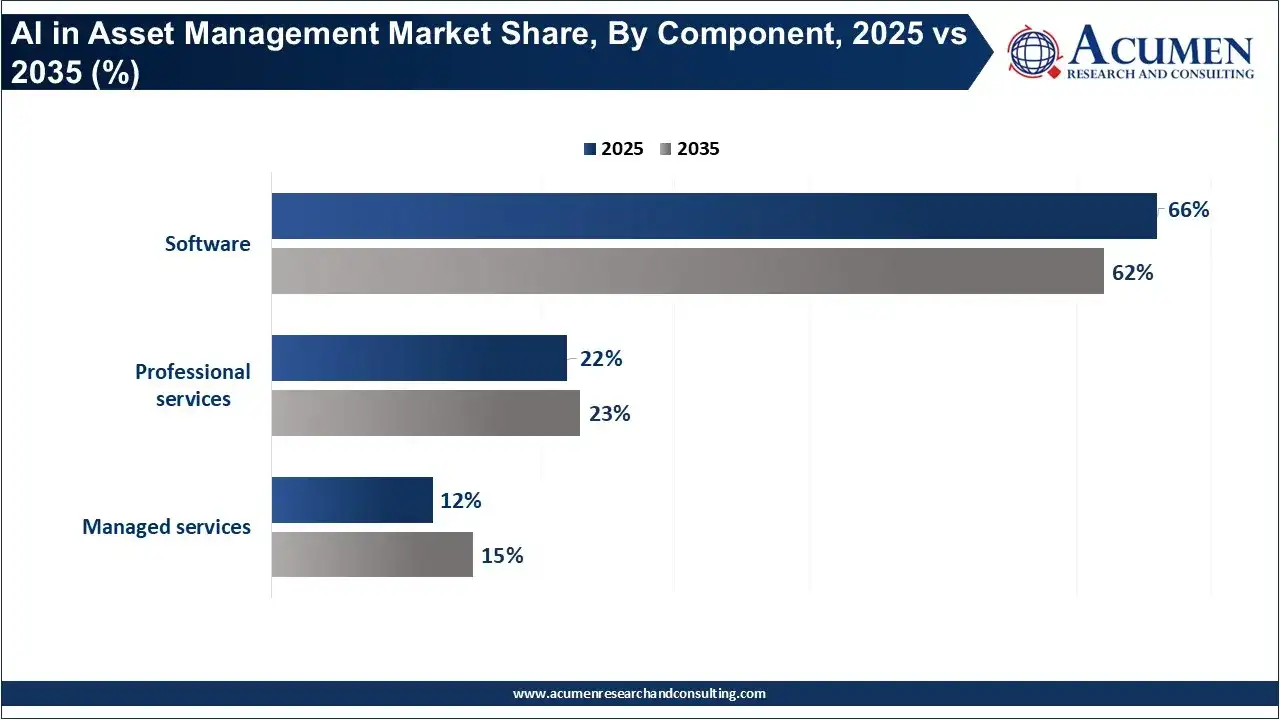
Managed Services: Managed services are projected to be the fastest-growing component segment, with a 24.8% CAGR from 2026 to 2035. The segment accounted for 12.0% of the market in 2025, generating USD 561.60 million, and is projected to reach USD 5.30 billion by 2035 as firms seek external expertise and ongoing AI model support.
Technology Insights
Machine Learning (Including Deep Learning): Machine learning dominated the market in 2025, accounting for 58.0% and generating USD 2.71 billion in revenue. Its share is projected to decline to 45.0% by 2035, although revenue is expected to reach USD 15.90 billion as predictive analytics and automated investment models remain important.
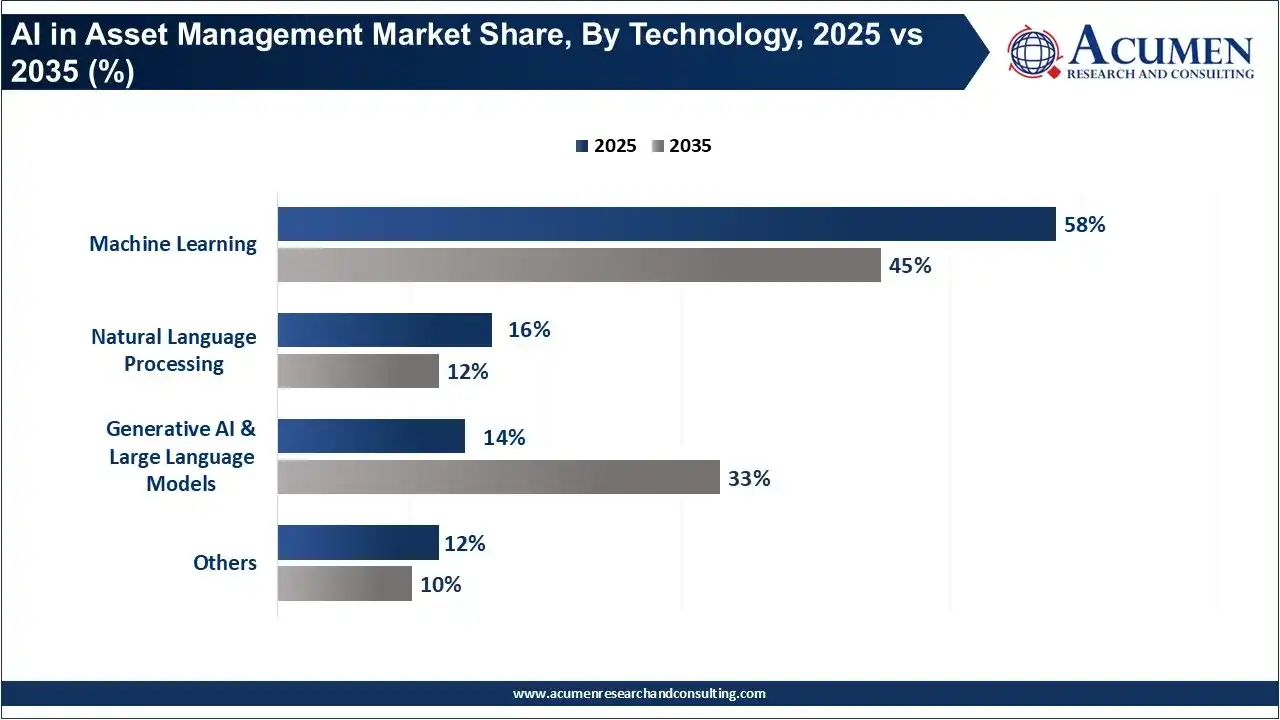
Generative AI & Large Language Models: Generative AI and large language models, including AI agents, are projected to be the fastest-growing technology segment, registering a 32.4% CAGR. From a 14.0% share and USD 655.20 million in 2025, the segment is projected to reach USD 11.66 billion by 2035.
Deployment Insights
On-Premises: On-premises deployment dominated in 2025, accounting for 57.0% of the market and generating USD 2.67 billion. Its share is projected to decline to 34.0% by 2035, although revenue is expected to reach USD 12.01 billion as some firms retain direct control over sensitive investment data and infrastructure.
AI in Asset Management Market Share, By Deployment, 2025 & 2035 (%)
| Deployment | Revenue Share, 2025 (%) | Revenue Share, 2035 (%) |
|---|---|---|
| Cloud-based | 43% | 66% |
| On-premises | 57% | 34% |
Cloud-Based: Cloud-based deployment is projected to be the fastest-growing segment, with a 27.3% CAGR from 2026 to 2035. It held a 43.0% share in 2025, generating USD 2.01 billion, and is projected to reach USD 23.32 billion and a 66.0% share by 2035.
Application Insights
Portfolio Optimisation & Construction: Portfolio optimisation and construction dominated in 2025, accounting for 27.0% of the market and generating USD 1.26 billion. The segment is projected to hold a 24.0% share in 2035, with revenue reaching USD 8.48 billion as AI supports asset allocation, portfolio construction, and investment scenario analysis.
Client Engagement & Advisory: Client engagement and advisory, including robo-advice and conversational AI, is projected to be the fastest-growing application segment, with a 26.2% CAGR. It accounted for 10.0% of the market in 2025, generating USD 468.00 million, and is projected to reach USD 4.95 billion by 2035.
End User Insights
Traditional Asset Managers: Traditional asset managers, including mutual funds and ETFs, dominated in 2025, accounting for 38.0% of the market and generating USD 1.78 billion. Their share is projected to decline to 34.0% by 2035, while revenue reaches USD 12.01 billion as AI adoption expands across portfolio management, compliance, and research.
Private Equity & Alternative Asset Managers: This segment is projected to be the fastest-growing end-user category, with a 24.8% CAGR. It represented 8.0% of the market in 2025, generating USD 374.40 million, and is projected to reach USD 3.53 billion by 2035 as firms apply AI to due diligence, valuation, and portfolio monitoring.
Asset Class Insights
Equities: Equities dominated the market in 2025, accounting for 40.0% and generating USD 1.87 billion in revenue. The segment is projected to hold a 35.0% share in 2035, with revenue reaching USD 12.37 billion as AI supports equity research, signal generation, portfolio optimisation, and market surveillance.
AI in Asset Management Market Share, By Asset Class, 2025 & 2035 (%)
| Asset Class | Revenue Share, 2025 (%) | Revenue Share, 2035 (%) |
|---|---|---|
| Equities | 40% | 35% |
| Fixed income | 22% | 21% |
| Multi-asset | 15% | 16 |
| Alternatives | 16% | 20% |
| Others | 7% | 8% |
Alternatives: Alternative assets, including private equity, private credit, real estate, and infrastructure, are projected to be the fastest-growing asset-class segment, with a 24.8% CAGR. The segment held a 16.0% share and generated USD 748.80 million in 2025, reaching a projected USD 7.07 billion by 2035.
Organization Size (AUM) Insights
Large Firms (AUM Greater Than USD 100 Billion): Large firms dominated in 2025, accounting for 64.0% of the market and generating USD 3.00 billion. Their share is projected to decline to 56.0% by 2035, while revenue reaches USD 19.79 billion as large asset managers deploy AI across portfolios, research, risk, and operations.
AI in Asset Management Market Share, By Organisation Size, 2025 & 2035 (%)
| Organisation Size | Revenue Share, 2025 (%) | Revenue Share, 2035 (%) |
|---|---|---|
| Large firms (AUM > US$100 Bn) | 64% | 56% |
| Small & mid-sized firms (AUM <= US$100 Bn) | 36% | 44% |
Small and Mid-Sized Firms (AUM of USD 100 Billion or Less): Small and mid-sized firms are projected to be the fastest-growing organisation-size segment, registering a 24.5% CAGR. They accounted for 36.0% of the market in 2025, generating USD 1.68 billion, and are projected to reach USD 15.55 billion and a 44.0% share by 2035 as cloud platforms and managed AI services lower adoption barriers.
AI in Asset Management Market Regional Insights
Why Does North America Lead the AI in Asset Management Market?
North America dominated the AI in Asset Management Market in 2025, accounting for 46.0% of the global market and generating USD 2.15 billion in revenue. The regional market is projected to reach USD 14.13 billion by 2035, registering a CAGR of 20.4% from 2026 to 2035.
The region benefits from a mature asset management industry, established financial technology infrastructure, and significant investment in data analytics, cloud computing, and machine learning. Large asset managers, hedge funds, and institutional investors use AI to support portfolio construction, risk modelling, alternative data analysis, and trading decisions. Demand is also supported by the need to process growing volumes of financial information and improve operational efficiency across investment workflows.
How Will Europe Strengthen Its Position in the AI in Asset Management Market?
Europe captured the second largest regional share in 2025 due to 24.0% share and USD 1.12 billion revenue in AI in asset management market. It is assessed to attain USD 7.77 billion by 2035 with a CAGR of 21.0% from 2026 to 2035.
Potential demand for AI exists, given the region's strength in financial centres, institutional investment activity, and growing interest in and need for more sophisticated portfolio analytics, risk management and regulatory reporting. Asset managers are also beginning to adopt AI tools to automate research-intensive tasks, automate the ingestion of investment data, and enhance control of complex portfolios.
However, multitude of regulators and fragmented requirements, legacy technology estates, and the appetite for explanations and transparency could lengthen implementation timelines and increase complexity.
Why Is Asia-Pacific the Fastest-Growing Regional Market?
Asia-Pacific accounted for 21.0% of the AI in Asset Management Market in 2025, generating USD 982.80 million. The regional market is projected to reach USD 9.89 billion by 2035, registering the fastest regional CAGR of 25.6% from 2026 to 2035.
Its share is expected to rise to 28.0%, positioning the region as an increasingly important source of incremental demand. Growth opportunities are supported by expanding wealth management activity, digital financial services, and rising interest in data-driven investment strategies. Financial institutions are exploring AI to improve research efficiency, personalise investment recommendations, automate operational processes, and strengthen fraud detection.
Growing digital infrastructure and cloud adoption can also help firms access AI capabilities without extensive investment in proprietary computing environments. Demand may increase among wealth managers, fintech platforms, quantitative investment firms, and established asset managers modernising their technology stacks.
Competitive Landscape
- BlackRock
- Bloomberg
- IBM
- Microsoft
- NVIDIA
- State Street Corporation
- SS&C Technologies
- FactSet
- MSCI
- SimCorp
- Morningstar
- Aladdin by BlackRock
- Clearwater Analytics
- Charles River Development
- Palantir Technologies
Segments Covered
By Component
- Software / platforms
- Professional services, including consulting, integration, and model development
- Managed services
By Technology
- Machine learning, including deep learning
- Natural language processing (non-generative)
- Generative AI and large language models, including AI agents
- Others, including computer vision, knowledge graphs, and intelligent automation
By Deployment
- Cloud-based
- On-premises
By Application
- Portfolio optimisation and construction
- Risk management and compliance
- Investment research and data analysis, including alternative data
- Trading and execution
- Client engagement and advisory, including robo-advice and conversational AI
- Operations and process automation
- Others, including ESG analytics and fraud detection
By End User
- Traditional asset managers, including mutual funds and ETFs
- Hedge funds and quantitative investment firms
- Wealth managers and private banks
- Institutional asset owners, including pension funds, insurers, and sovereign wealth funds
- Private equity and alternative asset managers
- Others, including family offices and fintech robo-advisors
By Asset Class
- Equities
- Fixed income
- Multi-asset
- Alternatives, including private equity, private credit, real estate, and infrastructure
- Others, including commodities and digital assets
By Organization Size (AUM)
- Large firms (AUM greater than USD 100 billion)
- Small and mid-sized firms (AUM of USD 100 billion or less)
By Region
- North America
- Europe
- Asia-Pacific
- Latin America
- Middle East & Africa
Looking for discounts, bulk pricing, or custom solutions? Contact us today at sales@acumenresearchandconsulting.com
Frequently Asked Questions

Other ICT Reports
October 2024
April 2026
October 2023
September 2023