March 2023

AI-RAN Market (By Component: Hardware, Software, Services; By Deployment: Cloud-based, On-premise; By Network Architecture: Open RAN, vRAN, Hybrid RAN; By End User: Telecom Operators, Enterprises, Government & Defense) - Global Industry Analysis, Size, Share, Regional Analysis, Trends and Forecast 2026 - 2035
The global AI-RAN market size was valued at USD 3 billion in 2025 and is estimated to surpass around USD 36.35 billion by 2035 growing at a CAGR of 28.1% over the forecast period from 2026 to 2035. The rapid expansion of cloud and edge computing is seen to offer potential to the market in the upcoming period.
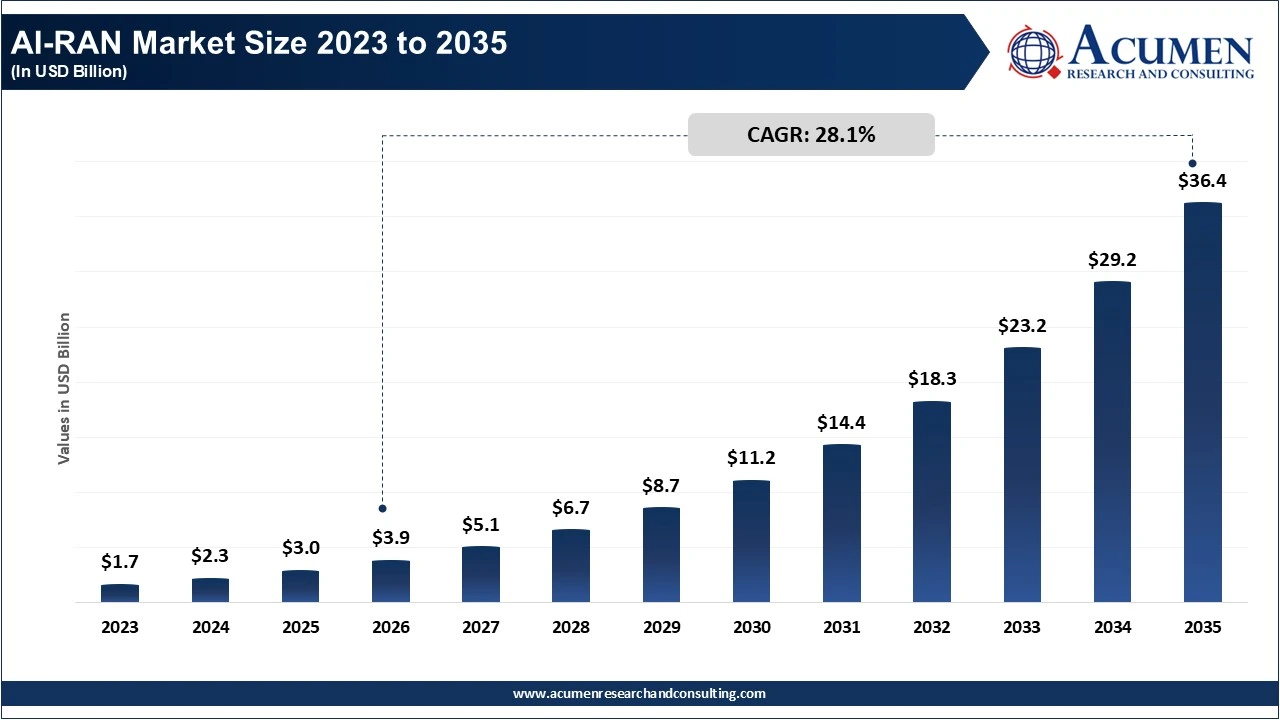
AI-RAN is an emerging market that consists of technologies, platforms, and services that use artificial intelligence as part of radio access networks. The intent behind integrating AI into these networks is to create smarter, more autonomous, and more efficiently operating wireless communication systems. The AI-RAN market includes software platforms, edge computing infrastructure, and virtualized network architectures that enable dynamic, on-the-fly network optimization, and real-time network optimization decisions to be made.
The AI-RAN market’s future will be determined by several key drivers, including the rapid pace of digital transformation, private 5G deployments, and initial investments in 6G-related research. AI-enabled network automation systems are becoming a strong focus of investment for telecom operators, governments, and enterprises because they allow for lower operating costs and increased reliability of services. As cloud computing, edge AI & semiconductors continue evolving, the use of AI-RANs will increase the ability to support ultra-low latency applications; additionally, AI-RANs will pave the way for the next generation of smart wireless connections.
| Attribute | Details |
| AI-RAN Market Size 2025 | USD 3 Billion |
| AI-RAN Market Forecast 2035 | USD 36.35 Billion |
| AI-RAN Market CAGR During 2026 - 2035 | 28.1% |
| Analysis Period | 2023 - 2035 |
| Base Year | 2025 |
| Forecast Data | 2026 - 2035 |
| Segments Covered | By Component, By Deployment, By Network Architecture, By End User, By Region |
| Regional Scope | North America, Europe, Asia Pacific, Latin America, and Middle East & Africa |
| Key Companies Profiled | Qualcomm, NVIDIA, Intel, IBM, Cisco Systems, Dell Technologies, Hewlett Packard Enterprise, Samsung Electronics, Fujitsu, NEC Corporation, Rakuten Symphony, Huawei Technologies, ZTE Corporation |
| Report Coverage | Market Trends, Drivers, Restraints, Competitive Analysis, Player Profiling, Covid-19 Analysis, Regulation Analysis |
Rising Network Complexity and 5G Traffic Driving Need for Intelligent Automation
This rapid global expansion of the world’s 5G mobile networks, the number of connected devices, and the proliferation of data-heavy applications has created an extraordinary amount of structural complexity in the telco environment. As a result, mobile data traffic is growing at an acceleratory rate, due to video streaming, online gaming via the cloud, IoT, augmented reality/virtual reality, and edge computing, while putting tremendous pressure on the telecommunications operator community to maintain their performance and reliability while keeping their costs under control.
As an example, telecom operators are using AI-generated traffic prediction to determine peak demand in highly populated urban areas and automatically scale their Ethernet access switch capacity accordingly. AI-driven energy management systems will also allow networks to greatly reduce power usage at their base station locations during off-peak times, essential to decreasing operational costs. In summary, the demand for AI-based automation will continue to drive the growth of the AI-RAN market as telco networks scale to 6G and are expected to harness billions of connected devices.
High Deployment Costs and Integration Complexity
The AI-RAN market involves upfront costs and the need to bring a skilled workforce to do development work. To make the change from their existing technologies to one that supports AI capabilities, telecom companies must revamp their existing technologies, put in new hardware and install AI-capable software at various levels of their networks. This will require a lot of money and time because existing RANs are extremely complex and have been around for a long time.
Integrating multiple systems of different manufacturers can also be challenging, especially in Open RAN environments as interoperability and standardization for those systems continues to develop. In order to work well together, telecom companies must ensure that the different vendors provide completed products that can work together properly via hardware; software; and cloud platforms, which adds to the difficulty of deploying RANs and can take longer to complete.
Expansion of Private 5G, Edge AI, and 6G Research
The emergence of private 5G networks across a variety of sectors creates opportunities for AI-RAN solutions. The increasing implementation of private networks by industries including manufacturing, logistics, mining, healthcare and energy are generating increased demand for automation, robots, and real-time analysis within these sectors and therefore creating a demand for high reliability and low-latency access to networks via artificial intelligence (AI) for network optimization.
For example, smart factories can apply AI-RAN to assist autonomous robotics, predictive maintenance, and real-time quality assurance testing. In addition, AI-enabled installations of private networks in logistics will help to manage connected warehouses and automate the supply chain process. Furthermore, some governments are building a base of AI-enabled telecom systems that will be the foundation of smart cities, emergency response operations and defence communications networks.
North America led the AI-RAN market with highest revenue share 35% in 2025. The success of North America is attributed to its well-developed digital infrastructure, as well as its early adoption of 5G and large investments in AI and cloud computing. Telecom operators in Canada and the U.S. are aggressively transitioning their networks to cloud-native and AI-driven architectures to handle the increasing amount of mobile traffic and to improve their operational efficiency. The presence of hyperscale, cloud providers, semiconductor manufacturers, and telecom equipment vendors adds to the maturity of the ecosystem and stimulates the deployment of AI RANs.
In addition, research funding and private investment from the technology sector into next-generation telecom technologies continues to bolster North America's leadership. The U.S. is the largest single reason for regional growth. There are several factors driving U.S. growth, such as significant 5G deployments, Open RAN trials, and partnerships between telecom operators and Cloud Providers.
Investment in private 5G networks, edge computing, and research into 6G technologies are also driving increased adoption of these technologies. Canada is making steady progress toward AI-enabled telecom infrastructure through government-sponsored innovation programs and increased collaboration between telecommunications operators and technology companies.
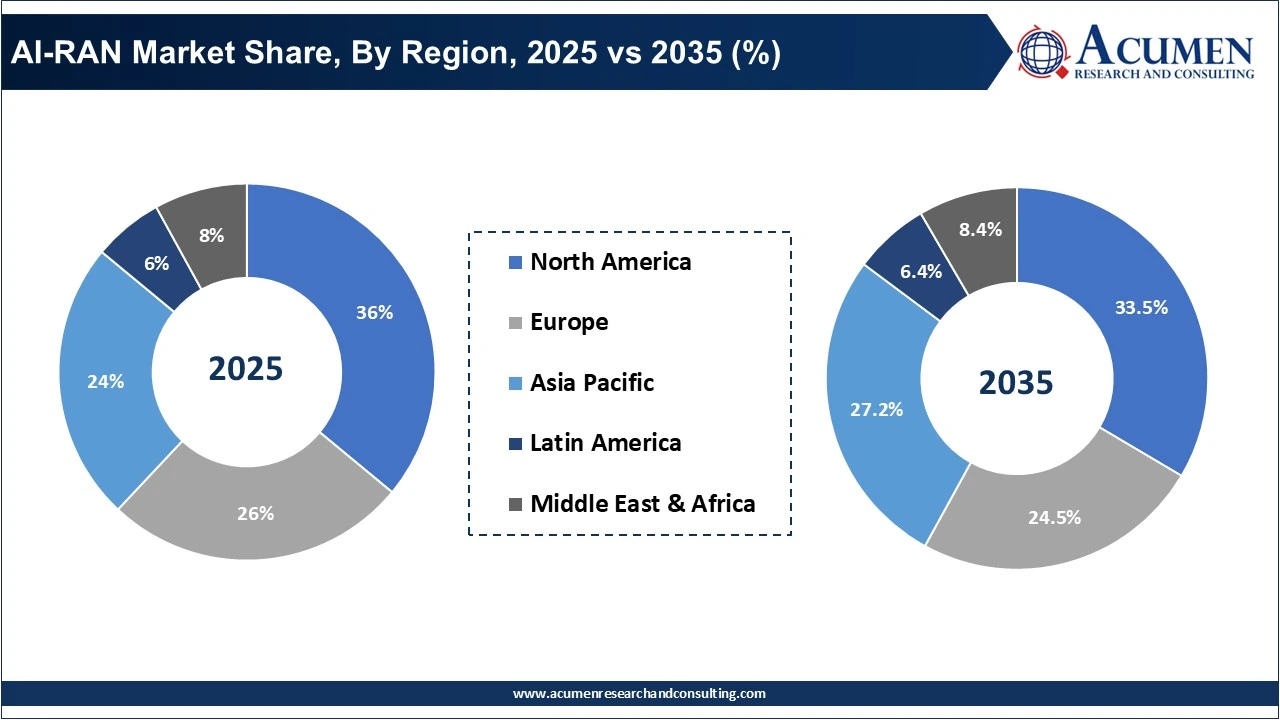
Asia Pacific is the fastest-growing region globally. An enormous number of mobile users in Asia-Pacific and a significant amount of investment in 5G telecommunications will ensure significant growth in the region. Countries within Asia-Pacific are implementing large-scale 5G deployments, whilst also looking into AI communications infrastructure that is able to support smart cities, digital economies and industrial automation. Many countries within Asia-Pacific are actively supporting this shift towards AI-driven networks through their respective national digital transformation efforts, spectrum allocation policies and funding for the 5G and AI research.
The Asia-Pacific's push for smart cities, Industry 4.0, and local equipment manufacturing will also play an important role in driving the rapid expansion of AI-driven telecommunications networks. Therefore, the growing demand for private 5G networks, combined with strong policy support and the presence of operational telecommunications equipment manufacturers, will likely position Asia-Pacfic as a major center for deploying AI-ran or radio access networks within the next few years.
The software segment accounted for the largest share of 41% in 2025. AI-RAN software provides intelligence for automating network functions (e.g., network automation, traffic forecasting, self-optimizing networks (SONs), and real-time analytics) to reduce OPEX and optimize performance. Therefore, telecom operators are implementing AI-enabled orchestration platforms to reduce operational costs and increase network performance.
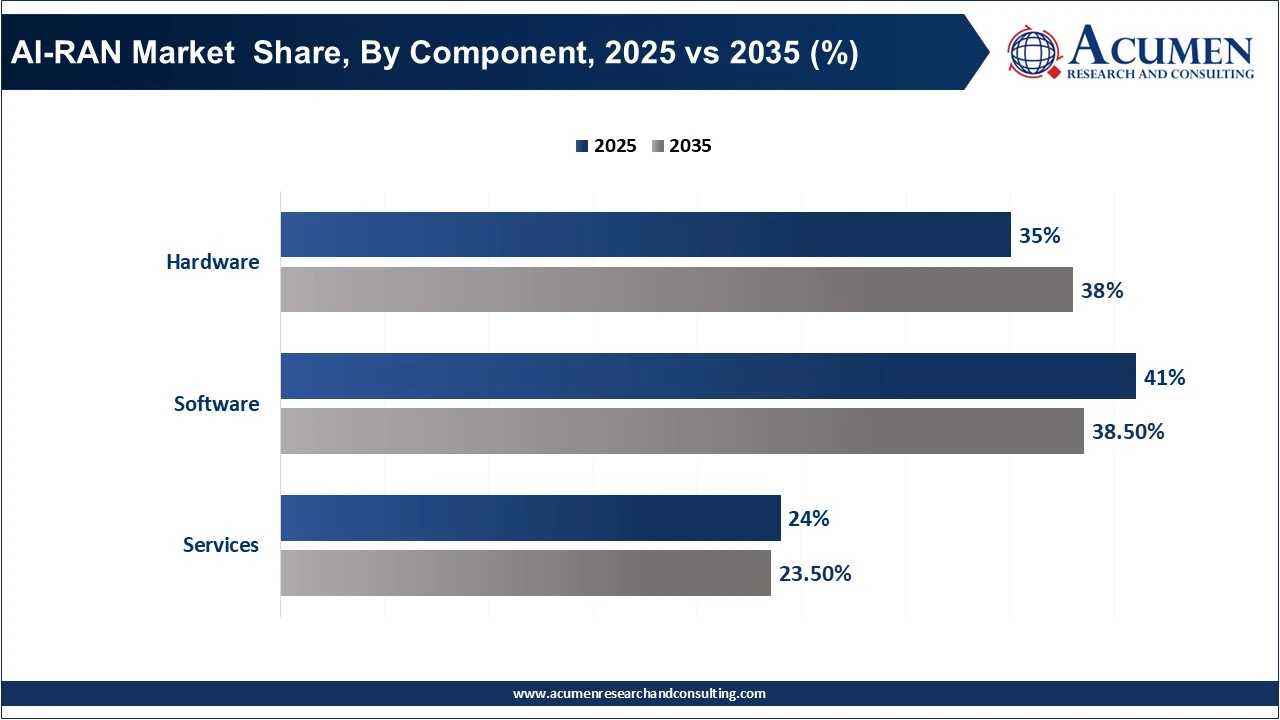
The hardware segment held 35% of market share in 2025 and will experience a significant growth rate. High-performance GPUs, AI accelerators, edge servers, and advanced chips are required for AI RAN hardware to process the massive volume of real-time data generated by telecommunications networks. The substantial increase in the number of telecommunications operators capable of deploying fifth-generation (5G) networks and the development of sixth-generation (6G) networks will require these same operators to upgrade all base stations with AI-capable hardware.
These operators are particularly driving demand for edge computing infrastructure and supporting semiconductors, which will enable low-latency processing. In addition, we expect the demand for AI-RAN hardware to increase significantly due to the growth of telecommunications networks and the increased volume of AI workloads being processed across these networks.
In 2025, on-premise deployment segment accounted for 53% of the total market share, as telecom operators prefer an on-premise deployment over utilizing clouds due to regulatory compliance requirements, strict data security and latency sensitivity. The fact that artificial intelligence radio access networks (AI-RAN) require processing a significant amount of sensitive network and user data has also played a role in preventing telecom operators from adopting public clouds. In addition to enabling increased performance and reliability, which are critical for mission-critical telecom operations.
| Deployment | Revenue Share, 2025 (%) |
| Cloud-Based | 47% |
| On-premise | 53% |
The another 47% market share was held by clod-based segment. As telecommunications operators shift to cloud-native network architecture, there will be a rapid growth of cloud-based deployments. Features such as scalability, cost optimization and rapid deployment of AI models are all contributing factors to the increasing number of cloud deployments by telecom operators. There is also a trend toward increased collaboration between telecom operators and hyperscalers (i.e., large cloud service providers) to further accelerate the transition to cloud-based network deployments. Hybrid cloud models will likely become the primary network deployment model over time.
In 2025, the open RAN held a 46% of the AI RAN market share. The open RAN architecture is seen as the most revolutionary structure in the development of AI RAN because it dismantles the traditional single-vendor ecosystem and creates new fully interoperable software-driven networks. Due to the openness of the open RAN network architecture, telecom operators can combine different hardware vendors and software vendors which leads to quicker innovation and lower deployment costs.
One of the key drivers for the increased adoption of Open RAN networks by governments in the U.S., Europe, Japan, and India is to strengthen supply chain resilience, while also decreasing their dependency on a limited supply of legacy telecommunication vendors.
| Network Architecture | Revenue Share, 2025 (%) |
| Open RAN (O-RAN) | 46% |
| vRAN (Virtual RAN) | 30% |
| Hybrid RAN | 24% |
In 2025, vRAN accounted for 30% of market share in AI-RAN market. vRAN is a shift from traditional physical networks to virtualized networks that makes use of standards-based hardware and software solutions. vRAN (Virtualized Radio Access Networks) allows operators to use common, off-the-shelf (COTS) server hardware for running the baseband functions, thereby allowing them to expand capacity on-the-fly and minimise capital expenditures on equipment. Due to COTS server architecture, network operators can upgrade the network faster with less capital investment than traditional RAN systems. By leveraging AI-based modelling systems, operators are able to identify patterns of traffic and allocate compute resources as needed, providing optimal network performance while maintaining adequate capacity during periods of peak usage.
On the other hand, the hybrid RAN segment held 24% share and it is expected to grow notably during the forecast period, as hybrid RAN is emerging as a transitional strategy for telecom operators worldwide. Multiple telecom operators operate large legacy networks that need upgrades due to cost and operational complexity. Over the next decade, hybrid deployments are seen to play significant role in creating bridge legacy systems with future AI-native telecom networks.
The telecom operators segment stood strong at 72% in 2025. Telecoms are leading the way with AI-RAN because they must adapt to the growing complexity of networks being driven by 5G, IoT, edge computing and rapidly expanding mobile data traffic; traditional management models are simply not able to scale or change fast enough for modern telecommunications models. AI-RAN offers operators ways to automate their network operations, lowers their energy usage and increases their customer service levels through real-time optimization of the network.
| End User | Revenue Share, 2025 (%) |
| Telecom Operators | 72% |
| Enterprises | 18% |
| Government & Defense | 10% |
The enterprise segment has been steadily growing with a market share of about 18% in 2025. As the use of private 5G networks is becoming more commonplace, enterprises are quickly becoming one of the fastest-growing verticals in business. Many industries, including manufacturing, logistics, mining, healthcare, and energy are now deploying private networks to provide mission-critical operations and to automate their processes.
By Component
By Deployment
By Network Architecture
By End User
By Region
Looking for discounts, bulk pricing, or custom solutions? Contact us today at [email protected]

March 2023
April 2023
December 2024
August 2023