
Edge AI Software Market Size, Share, Trends, Report 2026 To 2035
Edge AI Software Market (By Offering: Solution, Services; By Data Type: Video & Image Data, Sensor & Telemetry Data, Audio & Speech Data, Biometric Data, Mobile & Location Data, Text & Other Data; By Edge Location: Device Edge, Enterprise / Site Edge, Network / Telco Edge; By Deployment Model: On-Premises / Private Edge, Cloud-Managed Edge, Hybrid Edge; By Enterprise Size: Large Enterprises, Small & Medium Enterprises (SMEs); By Industry Vertical: IT & Telecommunications, Manufacturing, Automotive & Transportation, Healthcare & Life Sciences, Energy & Utilities, Retail & Consumer Services, Government & Public Sector, BFSI, Others) - Global Industry Analysis, Size, Share, Regional Analysis, Trends and Forecast 2026 - 2035
- Last Updated: 13 Oct 2026
- Report Code: ARC3996
- Category: ICT
Edge AI Software Market Size & Forecast 2026 to 2035
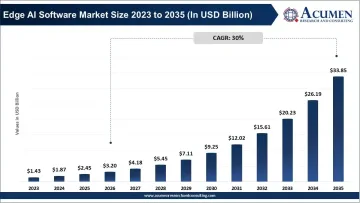
The edge AI software market size was valued at USD 2.45 billion in 2025 and is expected to reach at USD 33.85 billion by 2035; growing at a CAGR of 30% during the forecast period of 2026-2035. The edge AI software market comprises software solutions that enable artificial intelligence models to run on devices, sensors, industrial equipment, gateways, and local computing infrastructure close to where data is generated. These solutions include AI inference platforms, model optimization tools, development frameworks, device management software, and edge MLOps tools. They help organizations process data locally, make real-time decisions, reduce reliance on centralized cloud infrastructure, and support applications such as predictive maintenance, video analytics, autonomous systems, and intelligent network management.
- Base Year Market Size (2025): $2.45 billion
- Current Year Market Size (2026): $3.20 billion
- Estimated Year Market Size (2035): $33.85 billion
- Forecast Period CAGR (2026-2035): 30%
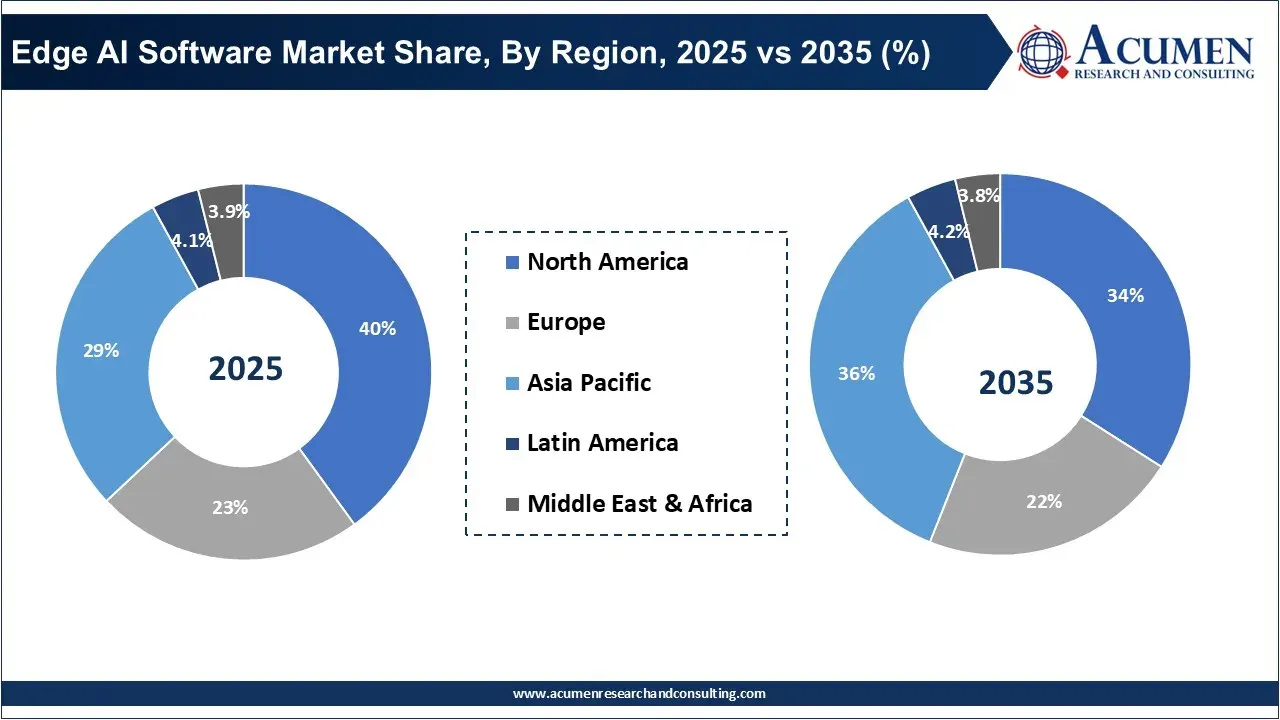
- Leading Region: North America (Revenue Share 40%)
Key Takeaways
- By region: North America dominated the edge AI software market with a 40.0% share in 2025, supported by strong AI investments, advanced computing infrastructure, and widespread adoption of edge technologies across industries.
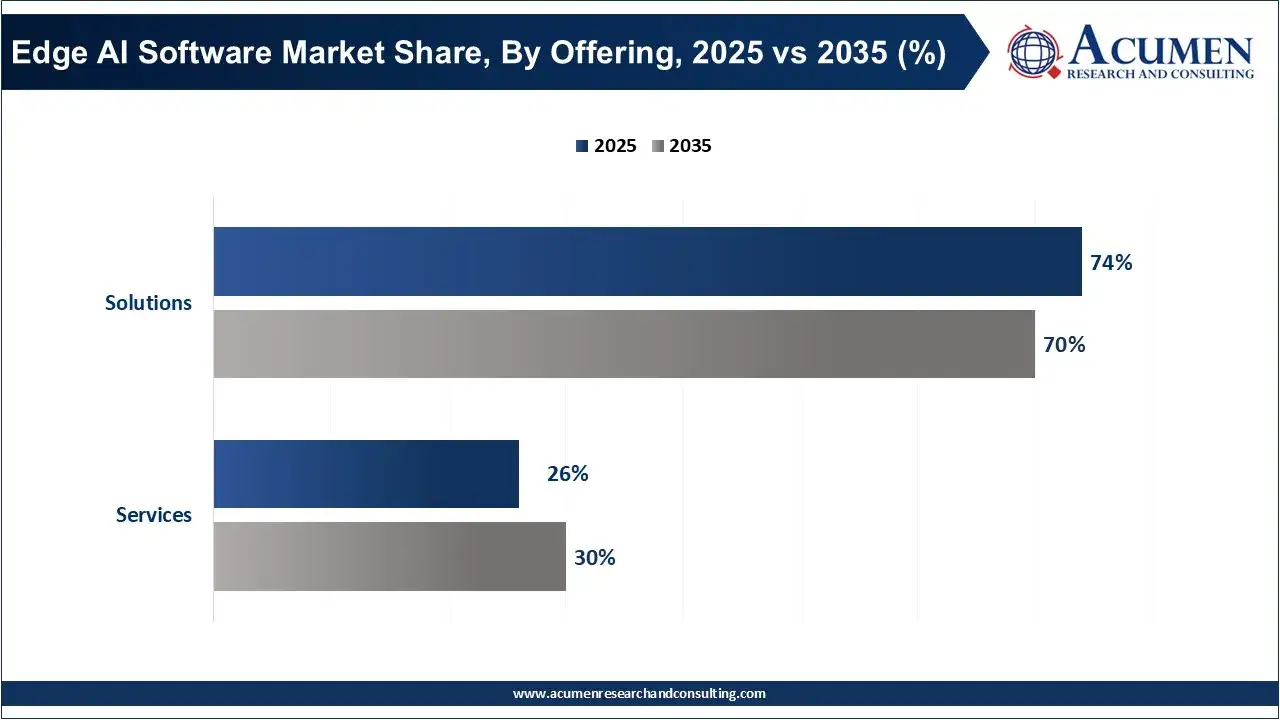
- By offering: Solutions dominated the market with a 74.0% share in 2025, driven by demand for edge AI platforms, inference software, model optimization tools, and management solutions that enable real-time data processing.
- By data type: Video and image data dominated the market with a 20.0% share in 2025, supported by increasing use of computer vision, intelligent surveillance, automated inspection, and visual analytics at the edge.
- By edge location: Device edge dominated the market with a 46.0% share in 2025, driven by the growing deployment of AI directly on connected devices, sensors, cameras, and industrial equipment for low-latency decision-making.
- By deployment model: On-premises/private edge dominated the market with a 45.0% share in 2025, supported by data security requirements, local processing needs, and greater control over sensitive workloads.
- By enterprise size: Large enterprises dominated the market with a 72.0% share in 2025, driven by their greater investment capacity, established IT infrastructure, and ability to deploy edge AI across multiple sites and operations.
- By industry vertical: IT and telecommunications dominated the market with a 23.0% share in 2025, supported by investments in network optimization, 5G infrastructure, distributed computing, and real-time AI processing.
Adoption Rate Across Enterprise Industries:
- Overall enterprise adoption: A 2025 survey of 301 U.S. CIOs found that 97% of respondents had deployed edge AI or included it on their implementation roadmap. Of these, 30% reported full deployment and 22% reported limited production deployment.
- Manufacturing: Deloitte’s 2025 smart manufacturing survey found that 29% of respondents were using AI or machine learning at the facility or network level, while 23% were piloting AI/ML applications.
- Retail: In the 2025 U.S. CIO survey, 93% of retail respondents said they had deployed some form of edge AI to improve customer experience, compared with 80% across all surveyed sectors.
- Manufacturing investment plans: 82% of manufacturing respondents in the same CIO survey planned to deploy edge AI for process acceleration within the following 12 to 24 months, compared with 68% across all sectors.
Recent Trends Shaping Enterprise Adoption
- Growing use of real-time AI inference: Enterprises are moving AI processing closer to devices and operational systems to support faster decisions in quality inspection, predictive maintenance, video analytics, and connected equipment.
- Shift toward hybrid edge-cloud architectures: Businesses are combining local processing with centralized cloud infrastructure to balance latency, scalability, model management, and data storage requirements.
- Increasing focus on model optimization: AI developers are using quantization, pruning, compression, and specialized inference runtimes to run models efficiently on devices with limited computing power and memory.
- Expansion of edge MLOps: Organizations are adopting tools for remote model deployment, version control, performance monitoring, updates, and lifecycle management across distributed devices.
- Security and data governance at the edge: Enterprises are prioritizing device authentication, encryption, access controls, and local data processing to manage cybersecurity risks across distributed environments.
Experts Analysis
According to experts at Acumen Research & Consulting, deploying AI software on edge devices enables enterprises to process data closer to its source, reducing the delays associated with sending information to centralized cloud servers. This supports real-time decision-making in applications such as industrial automation, equipment monitoring, video analytics, and connected vehicles. Local processing can also reduce bandwidth consumption and cloud data-transfer costs, while helping organizations retain sensitive information within local environments.
Edge AI Software Market Dynamics
Growth Drivers
- Model Optimization: Advances in lightweight neural networks, quantization, and hardware-aware deployment enable AI models to run within the memory, power, and processing limits of embedded devices, expanding software adoption across resource-constrained environments.
- Distributed Device Management: Enterprises operating large device fleets need software for remote deployment, model updates, performance monitoring, and security management. Centralized orchestration makes it easier to maintain consistent AI operations across geographically dispersed sites.
- Industry-Specific Applications: Demand for automated inspection, equipment anomaly detection, in-store analytics, and intelligent vehicle functions is increasing the need for specialized edge AI software tailored to operational requirements and sector-specific workflows.
Market Restraints
- Hardware Fragmentation: Differences in processors, operating systems, memory configurations, and AI accelerators complicate software portability. Developers often need hardware-specific optimization and testing, increasing deployment effort and limiting seamless implementation across mixed device environments.
- Resource Limitations: Edge devices frequently operate with restricted memory, battery capacity, processing power, and thermal headroom. These constraints can limit model complexity and require additional optimization before advanced AI applications can run reliably on-device.
- Maintenance Complexity: Updating and monitoring software across thousands of remote endpoints can require specialized tools, connectivity planning, and technical support. Organizations without mature device-management processes may struggle to maintain performance and reliability after deployment.
Market Opportunities
- Edge Generative AI: Smaller language and multimodal models create opportunities to deliver summarization, natural-language interfaces, and contextual assistance directly on devices. This can support responsive, privacy-conscious applications without sending every request to a centralized model.
- Federated Learning: Software that trains or improves models across distributed devices without routinely centralizing raw data can address privacy and data-governance requirements. This creates opportunities in healthcare, connected infrastructure, and industrial environments with sensitive datasets.
- Hybrid Edge-Cloud Platforms: Enterprises need software that distributes workloads between devices, local gateways, and cloud infrastructure according to latency, cost, and security requirements. Unified platforms can simplify deployment and create opportunities for integrated AI lifecycle management.
Market Challenges
- Cybersecurity Exposure: Distributed deployments increase the number of endpoints that attackers may target. Vendors must secure model files, device identities, communications, and remote updates while maintaining protection across environments with different levels of physical and network security.
- Performance Consistency: Edge AI software must deliver dependable results across changing lighting, temperatures, network conditions, and input data. Maintaining accuracy and response times across diverse operating environments requires continuous testing, monitoring, and model validation.
- Integration with Legacy Systems: Connecting modern AI software with established operational technology, enterprise applications, and older equipment can require custom interfaces and workflow changes. Integration difficulties can delay deployment and complicate scaling across multiple business locations.
Edge AI Software Market Regional Insights
Why did North America Dominate the Edge AI Software Market?
The North America region accounted for 40.0% of the edge AI Software market in 2025, supported by established cloud infrastructure, enterprise AI investment, and demand for real-time data processing. The region includes the United States, Canada, and other North American markets covered by the study. Its leading position reflects the presence of mature technology ecosystems and enterprise demand for edge-based analytics, automation, and distributed AI applications.
The U.S. edge AI software market is driven by strong investments in artificial intelligence, advanced computing infrastructure, and real-time data processing across industries. Demand is supported by the widespread adoption of edge computing in manufacturing, telecommunications, automotive, healthcare, and retail, where organizations seek to reduce latency, optimize bandwidth usage, and improve operational efficiency. The presence of leading technology companies, established cloud ecosystems, and ongoing development of AI chips and edge platforms further supports market growth.
Why is Asia Pacific Considered as Fastest-growing Region in Edge AI Software Market?
The Asia-Pacific region is projected to record the fastest growth, at a CAGR of 33.1% during 2026–2035, followed by Latin America at 30.3% and the Middle East & Africa at 29.6%. Growth across these markets is supported by expanding digital infrastructure, industrial automation, and the need to process data closer to connected devices. Adoption will depend on infrastructure readiness, software availability, and the ability to integrate edge AI into existing operations.
The region covers major technology and manufacturing economies, including China, Japan, South Korea, India, and other Asia-Pacific markets. Its market position reflects the need to process high volumes of sensor, image, and operational data across manufacturing, telecommunications, transportation, and consumer-device ecosystems.
Adoption is expected to increase as manufacturers, telecom operators, and technology providers deploy AI closer to data sources to improve response times and reduce reliance on continuous cloud connectivity. The pace of expansion will depend on enterprise investment, edge infrastructure availability, and the commercial readiness of software solutions.
Edge AI Software Market Segmentation Insights
Offering Insights
Solution: The solution segment accounted for 74.0% of the edge AI software market in 2025, compared with 26.0% for services. Demand for software solutions is supported by the need to develop, deploy, execute, and manage AI workloads across distributed devices and computing environments. This category includes software platforms, inference runtimes, development tools, model optimization technologies, and software for managing edge deployments. Its leading position reflects the central role of software in making AI models operational outside traditional centralized computing environments.
Within the solution category, edge AI platforms represented the largest sub-segment in 2025, at 27.0%, followed by AI runtime & inference software at 23.0% and Development tools, frameworks & SDKs at 17.0%. By 2035, AI runtime & inference software is projected to become the largest solution sub-segment, with a 27.0% share, compared with 24.0% for edge AI platforms and 13.0% for development tools. This shift is consistent with growing demand for reliable model execution on devices and edge infrastructure, although adoption will depend on hardware compatibility and inference performance.
Services: The services segment accounted for 26.0% of the market in 2025 and is projected to reach 30.0% by 2035. Demand is supported by the technical work required to integrate edge AI software with enterprise applications, connected devices, data systems, and existing IT or operational technology infrastructure. The segment includes consulting, implementation, training, maintenance, and managed services. Its projected share increase reflects the continuing need to deploy, operate, and maintain distributed AI systems beyond the initial software purchase.
Data Type Insights
Video & Image Data: The video & image data segment accounted for 20.0% of the edge AI software market in 2025, supported by demand for real-time visual inspection, video analytics, and automated monitoring. This segment includes software that processes images and video streams from cameras, machine-vision systems, and connected visual devices. Its leading position reflects the value of analyzing visual information locally, particularly in applications where sending continuous video to centralized infrastructure can increase latency, bandwidth use, and data-transfer requirements.
Sensor & Telemetry Data: The sensor & telemetry data segment accounted for 19% in 2025, supported by connected industrial equipment, Internet of Things deployments, and demand for continuous operational monitoring. It includes software that analyzes readings from sensors, machines, meters, and other connected assets to detect anomalies, assess operating conditions, and support automated decisions. Its market position reflects the need to interpret time-sensitive data close to the source, particularly in environments where delays can affect production, equipment reliability, or system performance.
Audio & Speech Data: The audio & speech data segment accounted for 17% in 2025 and is projected to maintain the same share in 2035. It includes software that processes spoken commands, audio signals, acoustic events, and voice interactions directly on devices or at nearby edge infrastructure. Demand is supported by voice-enabled interfaces, industrial audio monitoring, connected consumer devices, and applications requiring low-latency speech recognition. Local processing can also reduce the need to transmit sensitive audio recordings to centralized systems.
Edge Location Insights
Device Edge: The device edge segment accounted for 46.0% of the edge AI software market in 2025, supported by the growing use of AI-enabled devices, connected sensors, smart cameras, and embedded computing systems. It includes software that executes AI workloads directly on or very close to individual devices. Its leading position reflects the value of local inference for applications that require rapid responses, limited dependence on network connectivity, and reduced transfer of raw data to centralized infrastructure.
Enterprise / Site Edge: The enterprise / site edge segment accounted for 36.0% of the market in 2025, supported by enterprise requirements for local data processing, operational control, and integration with existing IT and operational technology systems. It includes software deployed within or close to enterprise facilities, such as factories, hospitals, retail sites, and corporate campuses. Its market position reflects demand for centralized management of local AI workloads without requiring every task to be executed on individual devices or in distant cloud infrastructure.
Deployment Model Insights
On-Premises / Private Edge: The on-premises / private edge segment accounted for 45.0% of the edge AI software market in 2025, supported by enterprise requirements for direct control over infrastructure, data handling, and operational environments. It includes edge AI software deployed and managed within private enterprise facilities or dedicated local infrastructure. Its leading position reflects demand from organizations that prioritize control over sensitive data, predictable local operations, and integration with established industrial or enterprise systems.
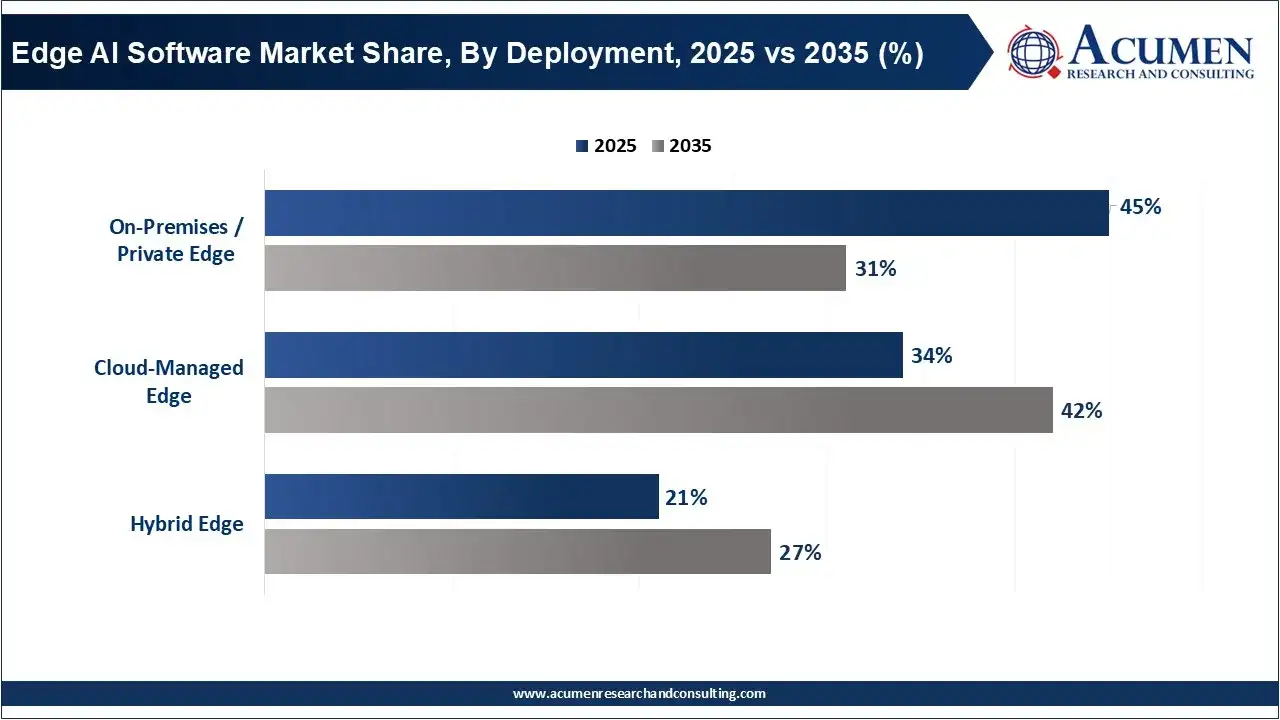
Cloud-managed Edge: The cloud-managed edge segment accounted for 34% in 2025, supported by demand for centralized oversight of distributed devices, software updates, and AI model deployment. It includes edge environments in which local AI workloads are managed through cloud-connected platforms and services. Its market position reflects the value of coordinating device fleets, monitoring performance, and maintaining software across multiple locations without requiring every management task to be handled locally.
Enterprise Size Insights
Large Enterprises: large enterprises accounted for 72.0% of the edge AI software market in 2025, supported by larger technology budgets, complex operational environments, and the need to manage AI across multiple facilities or device fleets. This segment includes organizations with substantial infrastructure, data-processing, and software requirements. Its leading position reflects the capacity of larger businesses to invest in edge AI platforms, integrate software with existing systems, and support the ongoing management of distributed deployments.
Small & Medium Enterprises (SMEs): Small & Medium Enterprises (SMEs) accounted for the remaining 28% of the market in 2025. While large enterprises benefit from greater investment capacity, SMEs may adopt edge AI software through packaged platforms, managed services, and application-specific solutions that reduce implementation complexity. Adoption across both groups will depend on the cost of deployment, access to skilled personnel, compatibility with existing systems, and the ability to demonstrate measurable operational benefits.
Industry Vertical Insights
IT & Telecommunications: The IT & Telecommunications segment accounted for 23.0% of the market in 2025, supported by network modernization, connected infrastructure, and demand for distributed data processing. It includes edge AI software used in network analytics, infrastructure monitoring, connected services, and distributed computing environments. Its leading position reflects the industry's need to process large volumes of operational data while supporting responsive services across geographically dispersed infrastructure.
Manufacturing: The manufacturing segment accounted for 18% in 2025, supported by demand for automated quality inspection, predictive maintenance, and real-time production monitoring. It includes software that analyzes machine data, visual information, and process signals across factories and industrial facilities. Its market position reflects the need to detect production issues quickly, reduce unplanned downtime, and support decisions closer to equipment and production lines.
Key Enterprise Applications and Use Cases
| Enterprise industry | Key applications and use cases |
|---|---|
| IT and Telecommunications | Network traffic optimization, AI-RAN, real-time network monitoring, edge inference, and predictive network maintenance |
| Manufacturing | Automated quality inspection, predictive maintenance, defect detection, robotics, and production-line optimization |
| Automotive and Transportation | Driver-assistance systems, autonomous driving, fleet monitoring, traffic analytics, and in-vehicle AI |
| Healthcare and Life Sciences | Medical image analysis, patient monitoring, connected medical devices, and real-time clinical alerts |
| Energy and Utilities | Equipment monitoring, grid analytics, fault detection, and AI-assisted decisions at remote energy sites |
| Retail and Consumer Services | Smart checkout, inventory monitoring, customer-flow analytics, and loss prevention |
| Government and Public Sector | Smart-city monitoring, traffic management, public infrastructure surveillance, and emergency response |
| Banking, Financial Services and Insurance (BFSI) | Edge-based identity verification, fraud detection at transaction points, and secure processing on local devices |
Recent Developments
- September 2026: Ambarella and ZEDEDA announced an integration enabling ZEDEDA’s Edge Intelligence Platform to run on Ambarella’s edge AI system-on-chips. The collaboration aims to help enterprises deploy, secure, update, and manage AI models across cameras, robots, vehicles, and industrial devices.
- September 2026: HP announced a collaboration to combine HP ZGX Fury infrastructure with Red Hat AI Factory and NVIDIA technology, enabling organizations to run and manage AI workloads closer to users, applications, machines, and data. Target applications include manufacturing inspection, local AI development, and retail operations.
Leading Companies
- NVIDIA
- Qualcomm Technologies
- Intel Corporation
- Microsoft Corporation
- Amazon Web Services (AWS)
- IBM Corporation
- Siemens AG
- NXP Semiconductors
- ZEDEDA
Segments Covered
By Offering
- Solution
- Edge AI Platforms
- AI Runtime & Inference Software
- Development Tools, Frameworks & SDKs
- AI Model Optimization & Compression Software
- Management & Orchestration Software
- Edge MLOps & Model Lifecycle Management
- Other Edge AI Solutions
- Services
- Consulting & Advisory
- Implementation, Integration & Deployment
- Training & Education
- Support & Maintenance
- Managed Edge AI Services
- Others
By Data Type
- Video & Image Data
- Sensor & Telemetry Data
- Audio & Speech Data
- Biometric Data
- Mobile & Location Data
- Text & Other Data
By Edge Location
- Device Edge
- Enterprise / Site Edge
- Network / Telco Edge
By Deployment Model
- On-Premises / Private Edge
- Cloud-Managed Edge
- Hybrid Edge
By Enterprise Size
- Large Enterprises
- Small & Medium Enterprises (SMEs)
By Industry Vertical
- IT & Telecommunications
- Manufacturing
- Automotive & Transportation
- Healthcare & Life Sciences
- Energy & Utilities
- Retail & Consumer Services
- Government & Public Sector
- Banking, Financial Services & Insurance (BFSI)
- Other Industries
By Region
- North America
- Europe
- Asia-Pacific
- Latin America
- Middle East & Africa
Looking for discounts, bulk pricing, or custom solutions? Contact us today at sales@acumenresearchandconsulting.com
Frequently Asked Questions

Related Market Research Reports
April 2026
October 2026
October 2026
September 2026
September 2026
September 2026
August 2026
August 2026