
Software-Defined AI-RAN Market Size, Share, Report 2026 to 2035
Software-Defined AI-RAN Market (By Component: Platforms, Applications, Services; By Deployment: Public Cloud, Private Cloud/On premise; By Network Architecture: Open RAN (O-RAN), vRAN (Virtual RAN), Cloud-Native RAN, Hybrid RAN; By End User: Telecom Operators, Enterprises, Government & Defense) - Global Industry Analysis, Size, Share, Regional Analysis, Trends and Forecast 2026 - 2035
- Last Updated: 14 May 2026
- Report Code: ARC3913
- Category: ICT
Software-Defined AI-RAN Market Size and Forecast 2026 - 2035
The global software-defined AI-RAN market size was valued at USD 980 million in 2025 and is estimated to surpass around USD 11,242.82 million by 2035 growing at a CAGR of 27.4% over the forecast period from 2026 to 2035. The overall increased focus on creating AI-native wireless networks across multiple industries is seen to promote the growth of software-defined AI-RAN market.
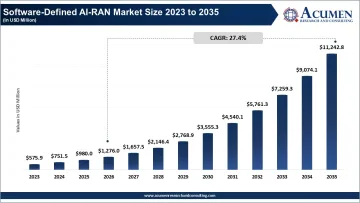
Software-Defined AI-RAN Market Report Highlights
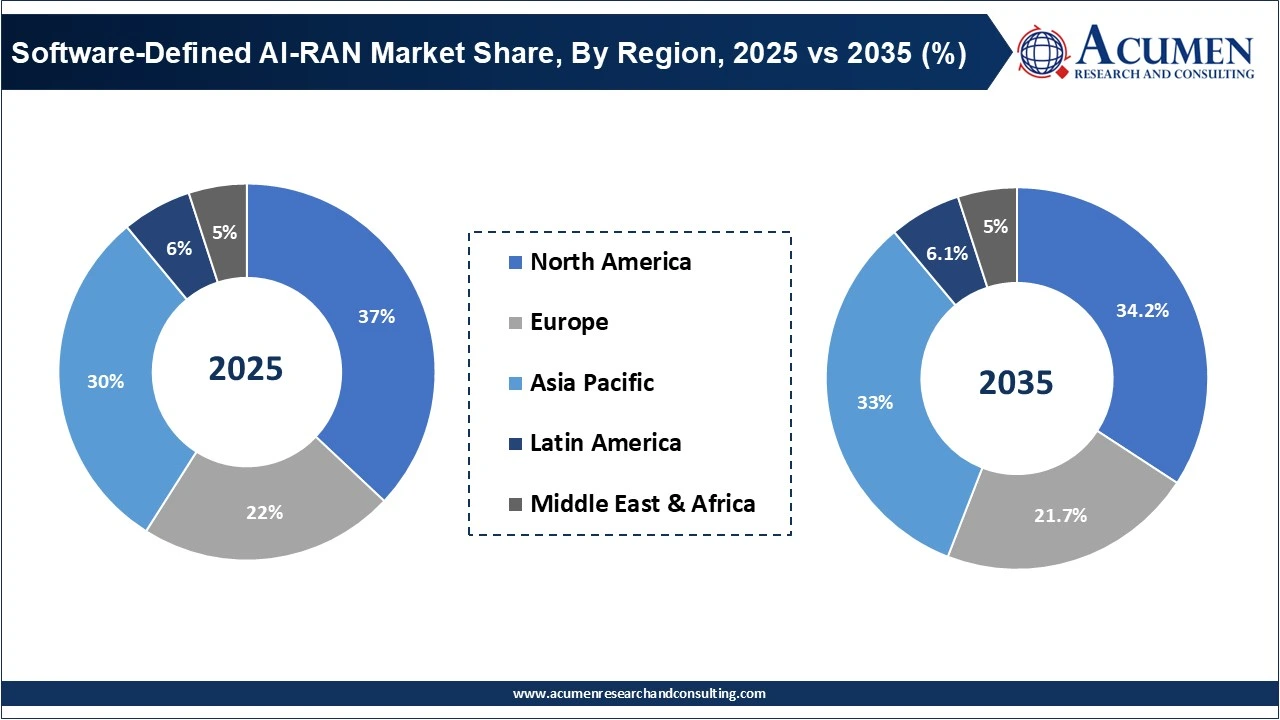
- By Region, North America dominated with 37% share due to early AI and 5G investments.
- By Region, Asia Pacific fastest growing at 28.7% CAGR driven by large-scale telecom expansion.
- By component, the platforms segment dominated with 48% share in 2025 due to rising RIC adoption and AI-driven network automation.
- By component, the applications segment is seen to grow fastest at 30% CAGR due to rising demand for AI-based network optimization use cases.
- By deployment, the private cloud/on-premise segment dominated with 63% share due to low-latency and data security needs.
- By deployment, the public cloud held 37% share due to scalability and telecom-hyperscaler partnerships.
- By network architecture, the open RAN segment dominated with 45% share driven by vendor diversification and cost reduction.
- By network architecture, the vRAN held the second largest share of 27% due to virtualization and network management.
- By end user, the telecom operators dominated with 68% share due to massive 5G traffic and automation demand.
- By end user, the enterprises held the second largest share of 22% due to private 5G and industrial IoT adoption.
What is Software-Defined AI-RAN Approach?
The software-defined AI-RAN approach refers to the transformation of the RAN from hardware –centric infrastructure into a cloud-native and AI-driven software platform. In the ecosystem, combines software-designed networking, artificial intelligence and cloud computing to create an intelligent and automated environment.
The software-defined AI-RAN market encompasses applications, services and infrastructure that enable the deployment of AI-powered RAN networks. Software-defined AI-RAN solutions are expected to experience significant growth because the complexity of 5G networks is increasing; there is growth in mobile data traffic; and telecom operators need to eliminate infrastructure related capital and operational expenses.
Software-Defined AI-RAN Market Report Scope
| Attribute | Details |
|---|---|
| Software-Defined AI-RAN Market Size in 2025 | USD 980 Million |
| Software-Defined AI-RAN Market Size in 2035 | USD 11,242.82 Million |
| Software-Defined AI-RAN Market CAGR | 27.4% |
| Analysis Period | 2023 - 2035 |
| Base Year | 2025 |
| Forecast Data | 2026 - 2035 |
| Segments Covered | By Component, By Deployment, By Network Architecture, By End User, By Region |
| Regional Scope | North America, Europe, Asia Pacific, Latin America, and Middle East & Africa |
| Key Companies Profiled | Intel Corporation, Cisco Systems, Qualcomm, NVIDIA, Microsoft, Amazon Web Services, Mavenir, Parallel Wireless, Juniper Networks, Huawei, ZTE, Samsung Electronics, Rakuten Symphony, NEC Corporation, Fujitsu |
| Report Coverage | Market Trends, Drivers, Restraints, Competitive Analysis, Player Profiling, Covid-19 Analysis, Regulation Analysis |
Software-Defined AI-RAN Market Dynamics
Driver
Rising Need for Programmable and Automated Telecom Networks
Telecom network automation with AI-driven software-defined network technologies has become a key enabler for telecommunications operators coping with increasing data volumes, latency-sensitive applications, and large numbers of connected devices on their networks. Traditional methods of managing networks will no longer be able to support network management as there are now too many variables to manage through human intervention. AI-RAN will help to automate management functions such as network configuration, optimization, and fault management using centralized orchestration and AI-enabled blind data analysis tools. Telecom operators are beginning to adopt a "network-as-code," DevOps approach to telecommunications network operations that allows for continuous deployment of software upgrades and new network functionality while avoiding the need for hardware replacement.
This is expected to reduce operating costs by 30 - 40%, enhance the operational efficiency of the overall communication network and allow faster delivery of telecommunications services. As a result of these trends, the demand for AI-enabled programmable radio network (RAN) solutions will grow significantly as telecommunications networks evolve into programmable platforms.
Restraint
Integration Complexity and Legacy Infrastructure Challenges
Many telecom operators are still using older, hardware-based systems as their primary infrastructure, which has made it very challenging and expensive to upgrade those systems. Transitioning to a cloud-native and multi-vendor RAN environment requires both a complete redesign of the existing networks and the acquisition of new skills. In addition, a substantial initial investment will be required for network discovery, design, and engineering work.
The ongoing need to achieve seamless integration across software, cloud providers, and the multi-vendor hardware ecosystem presents a significant hurdle for telecom operators as they attempt to transition to next-generation network use cases. The existing level of difficulty will likely create a delay in adoption, particularly for regions where there is a lack of technical expertise or access to capital resources.
Opportunity
Emergence of RAN Application Ecosystems and Network Monetization
The introduction of RAN application marketplaces, facilitated by open APIs and RIC platform technology, will mark one of the major changes taking place in the software-defined and AI-enabled RAN market. The move towards adopting third-party applications (xApps and/or rApps) by telecommunications operators are similar to the mobile app ecosystem, with operators being able to continue to enhance their existing network performance while also providing new services to their customers.
This is expected to create new sources of revenue for telecommunications operators due to network monetization and providing enterprise services such as private 5G networks, smart city infrastructure and industrial IoT and mission critical connectivity. Software-defined and AI-enabled RAN will allow telecommunications operators to provide their services as a network-as-a-service (NaaS), customizable network slicing and on-demand enterprise connectivity. As telecom networks continue to evolve into programmable digital platforms, there will be many opportunities for significant growth and innovation in this market.
Our Analyst View
Nokia’s Latest AI-RAN Strategy
According to Nokia's most recent view of the current state of the AI-enabled RAN ecosystem, there has been a change in the direction of the design, deployment, and optimization of Radio Access Networks (RAN). In this new perspective, Nokia stresses their goal of moving away from traditional hardware-centric infrastructure, to a software-defined, cloud-native architecture that leverages AI and automation in the RAN.
“Our analysts believe that these types of initiatives will drive competition between vendors, create opportunities for greater collaboration between cloud and semiconductor surrounding ecosystems, and create new revenue streams associated with the automation of networks, enterprise connectivity, and the development of network-as-a-service models.”
By embedding AI into the RAN stack, telecommunications operators can reduce the time it takes to innovate, automate their operations, and dynamically optimize performance, energy consumption, and capacity in real time, thereby aligning themselves to the broader industry movement towards programmable and open telecom networks.
Software-Defined AI-RAN Market Segmental Insight
Component Insight
In 2025, the platforms segment accounted for 48% of the market share, due to a shift towards RANs that are based on software platforms, platforms are playing an increasingly large role as a fundamental part of the operations of telecom operators. Telecommunications operators are making increasing use of RAN intelligent controllers, orchestration layers and automation software to create programmable/API-driven networks. RANs based on software/AI technology (i.e. AI-RANs) allow operators to continuously improve their capabilities through software upgrades rather than through the addition of expensive hardware; therefore, operators are targeting between 30 and 40% reductions in OPEX costs through automation via software. To achieve this level of reduction, the orchestration platform need to be an essential part of the overall telecom market. Applications (xApps/rApps) represent the second-largest component of the overall telco infrastructure with a 29% share in 2025.
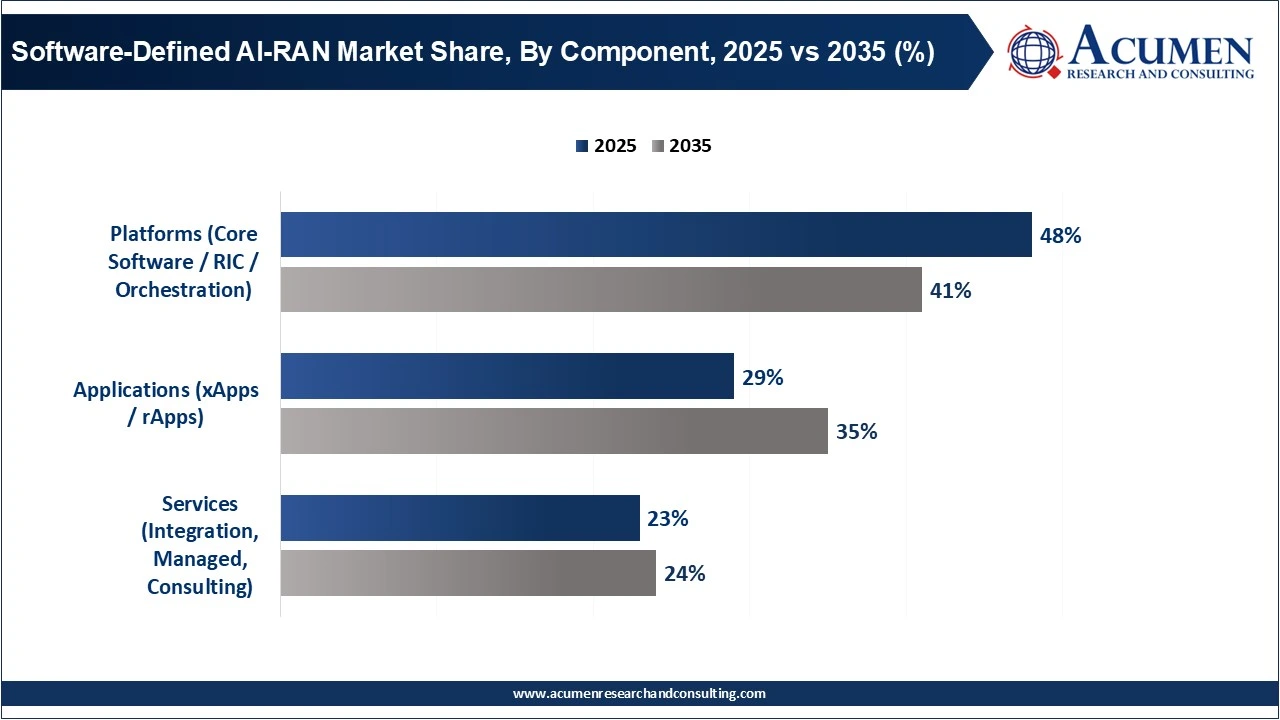
On the other hand, the applications segment will be growing at a CAGR of 30%, the fastest rate during the forecast period. The significant growth of xApps and rApps is indicative of RANs emerging as advanced application marketplaces. The software-defined nature of AI-RANs allows telecom operators, as well as third-party developers and infrastructure providers (e.g. hyperscalers), to rapidly develop and deploy modular web-based applications on an open application programming interface (API) basis, providing the ability for real-time deployment of features. The initial results of the deployment of software-based RAN applications demonstrate the ability to reduce energy usage by as much as 20 % and to increase spectral efficiency by 10 to 15 %, which creates a compelling value proposition for the deployment of innovative applications within a RAN.
Deployment Insight
In 2025, private cloud and on-premise setups led the way, holding a solid 63% share. Software-defined AI-RAN needs fast, real-time processing, extremely low latency, and tight data security. That’s why operators stick with private cloud and edge deployments. They’re building out distributed edge clouds, running containerized RAN workloads much closer to users. This move isn’t just about better performance; it means software upgrades, automation, and AI inference can all run with millisecond-level latency. Telecom networks churn out massive amounts of data, and on-premise environments give operators the control and reliability they need for critical network automation.
| Deployment | Revenue Share, 2025 (%) |
|---|---|
| Public Cloud | 37% |
| Private Cloud / On-Premise | 63% |
Meanwhile, the public cloud segment grabbed the remaining 37%. Its adoption keeps climbing as operators move toward cloud-native RAN software. Hyperscale platforms from big cloud providers deliver the kind of horsepower you need for AI model training, heavy simulations, and centralized orchestration. More telecom companies now mix and match, going hybrid or embracing multi-cloud setups. This lets them push out updates faster, roll out new services quickly, and keep their networks programmable worldwide. On top of that, it helps cut capital costs and speeds up how quickly they can innovate.
Network Architecture Insight
"In 2025, the open RAN segment carried the most significant presence in the overall market with a 45% share. O-RAN forms the basis for the software-driven, AI-based RAN (ml-RAN) due to its disaggregation, interoperability and programmable interfaces. Operators can gain flexibility to integrate RAN software by decoupling hardware and software. Multiple studies forecast that O-RAN will hold 20-25% of total installations across the globe by 2030. This growth is fueled by government programs and telecom collaborations that are pushing for open, software-driven networks.
| Network Architecture | Revenue Share, 2025 (%) |
|---|---|
| Open RAN (O-RAN) | 45% |
| vRAN (Virtual RAN) | 27% |
| Cloud-Native RAN (Non-O-RAN) | 17% |
| Hybrid RAN | 11% |
The virtual RAN segment (vRAN) has the second-largest market share with an estimated 27%. The transition from dedicated hardware to virtualized and containerized software platforms has spurred the rapid uptake of virtual RAN solutions. By leveraging virtualized network functions, operators can dynamically allocate IT resources, automate network resource management, and introduce novel functionalities through software updates. Consequently, virtualization has reduced the expenses associated with deploying new networks by 25-35%, thereby expediting the shift towards a fully software-defined telecommunications infrastructure.
End User Insight
The telecom operators segment dominated the market in 2025, grabbing a 68% share. They’re leading the charge with AI-RAN solutions, mainly because they have to keep up with the exploding 5G network traffic. Mobile data traffic worldwide is set to jump three to four times by 2030, so operators are pouring money into AI-based automation to stay ahead. AI-RAN is helping telecom companies streamline their networks, reducing outages and improving the customer experience.
| End User | Revenue Share, 2025 (%) |
|---|---|
| Telecom Operators | 68% |
| Enterprises | 22% |
| Government & Defense | 10% |
On the other hand, the enterprises segment accounted for a 22% share in 2025. The adoption of private 5G networks is on the rise, particularly in sectors such as manufacturing, logistics, healthcare, and smart city initiatives. AI-RAN lets these companies fine-tune their networks for things like robotics, autonomous vehicles, and industrial IoT, basically, any mission-critical tech. As private 5G and 6G networks expand across the globe, the enterprises will require more software-oriented AI-RAN offerings.
Software-Defined AI-RAN Market Regional Analysis
North America’s Leadership Driven by Cloud-Native RAN Innovation
In 2025, North America possessed 37% of market share and is seen to experience the fastest rate of growth, 27.2% CAGR during the forecast period. North America's overall dominance was the result of a large percentage of early adopters migrating from traditional telecommunications networks to cloud and programmable telecom networks. U.S. and Canadian carriers are quickly upgrading their aging radio access networks (RAN) from hardware-based architectures to software-based architectures which are driven by automation, orchestration and DevOps for network management.
The influence of hyperscale cloud service providers and advanced AI capabilities has also accelerated the movement toward RAN software platforms, allowing telecom service providers to deploy functions and updates through software rather than upgrading hardware using an existing foundation. Finally, with increasing investments in Open RAN and multi-vendor interoperability, operators are adopting software-defined AI-RAN due to cost savings, increased agility of the network, and faster service delivery times.
- The U.S. dominates the regional market through investments in Open RAN, cloud collaborations, and virtualized networks. Leading telecommunications companies are implementing RIC platforms and creating rApps and xApps ecosystems that provide continual network improvements and automated services.
- In addition, government-led programs foster Open RAN and stimulate domestic innovation in telecommunications, leading to a transition from hardware-based, single-vendor network infrastructure to software-based, multi-vendor network infrastructure, positioning the United States as a center for innovation in programmable RAN's worldwide.
Rapid Telecom Expansion in Asian Countries Accelerating the Shift Toward Programmable RAN
Asia Pacific is observed to grow at the fastest rate of 28.7% during the forecast period. The rate of growth is fuelled by large-scale telecom expansion and rising requirement of managing massive data traffic with the help of software-defined automated network architectures. With the largest space for mobile operators, 5G rollout and adoption of 5G orchestration, the software-defined AI-RAN market is observed to grow rapidly in Asian areas.
Governments in urban areas of major countries in Asia Pacific are investing in industrial automation, smart cities and digital transformation. This shift enables operators to deploy advanced optimized network resources, promoting the overall growth of the market. Japan on the side, carries spotlight in the market; being the emerging nation in fully-virtualized telecom networks. Major Japan-based operators have been acting as early adopters of cloud-native RAN and orchestration by creating most advanced programmable telecom ecosystem globally.
Recent News
- Linux Foundation, in March 2026 announced the launch of Open Centralized Unit Distributed Unit (OCUDU) to drive open source AI-RAN access network and to accelerate 5G and 6G deployments. The foundation plans to support documentation and testing to facilitate development of open source project.
- In November 2025, Indosat, Nokia and NVIDIA announced the launch of AI-RAN research center in Indonesia. This center promotes strategic collaboration designed to advance AI-native wireless networks and edge AI applications across the nation.
Software-Defined AI-RAN Market Top Players
- Intel Corporation
- Cisco Systems
- Qualcomm
- NVIDIA
- Microsoft
- Amazon Web Services
- Mavenir
- Parallel Wireless
- Juniper Networks
- Huawei
- ZTE
- Samsung Electronics
- Rakuten Symphony
- NEC Corporation
- Fujitsu
Market Segmentation
By Component
- Platforms (Core Software/RIC/Orchestration)
- Applications (xApps/ rApps)
- Services
By Deployment
- Public Cloud
- Private Cloud/On premise
By Network Architecture
- Open RAN (O-RAN)
- vRAN (Virtual RAN)
- Cloud-Native RAN
- Hybrid RAN
By End User
- Telecom Operators
- Enterprises
- Government & Defense
By Region
- North America
- Asia Pacific
- Europe
- Latin America
- Middle East and Africa
Looking for discounts, bulk pricing, or custom solutions? Contact us today at sales@acumenresearchandconsulting.com
Frequently Asked Questions

Other ICT Reports
February 2020
December 2020
June 2024
November 2023