
Industrial Edge Computing Market Size, Share, Growth, Report 2026 To 2035
Industrial Edge Computing Market (By Offering: Hardware, Software & Platforms, Services; By Edge Infrastructure Type: Device Edge, Equipment/Machine Edge, Site/Plant Edge, Industrial Edge Data Center; By Deployment/Ownership Model: Customer-Owned & Operated, Managed/Dedicated Edge, Edge-as-a-Service; By Enterprise Size: Large Enterprises, SMEs; By End-Use Industry: Manufacturing, Energy & Utilities, Oil & Gas, Mining & Metals, Others) - Global Industry Analysis, Size, Share, Regional Analysis, Trends and Forecast 2026 - 2035
- Last Updated: 25 Sep 2026
- Report Code: ARC3989
- Category: ICT
Industrial Edge Computing Market Size, Share, Trends
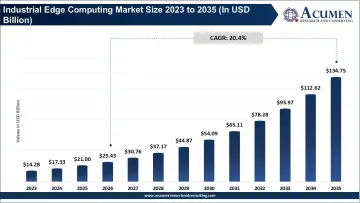
The global industrial edge computing market size was valued at USD 21 billion in 2025 and is expected to reach USD 134.75 billion by 2035; growing at a CAGR of 20.4% during the forecast period of 2026-2035. The convergence of industrial AI, IIoT, automation, private 5G, and real-time analytics is accelerating investment in edge infrastructure as manufacturers seek to process operational data closer to machines and production assets.
Report Highlights
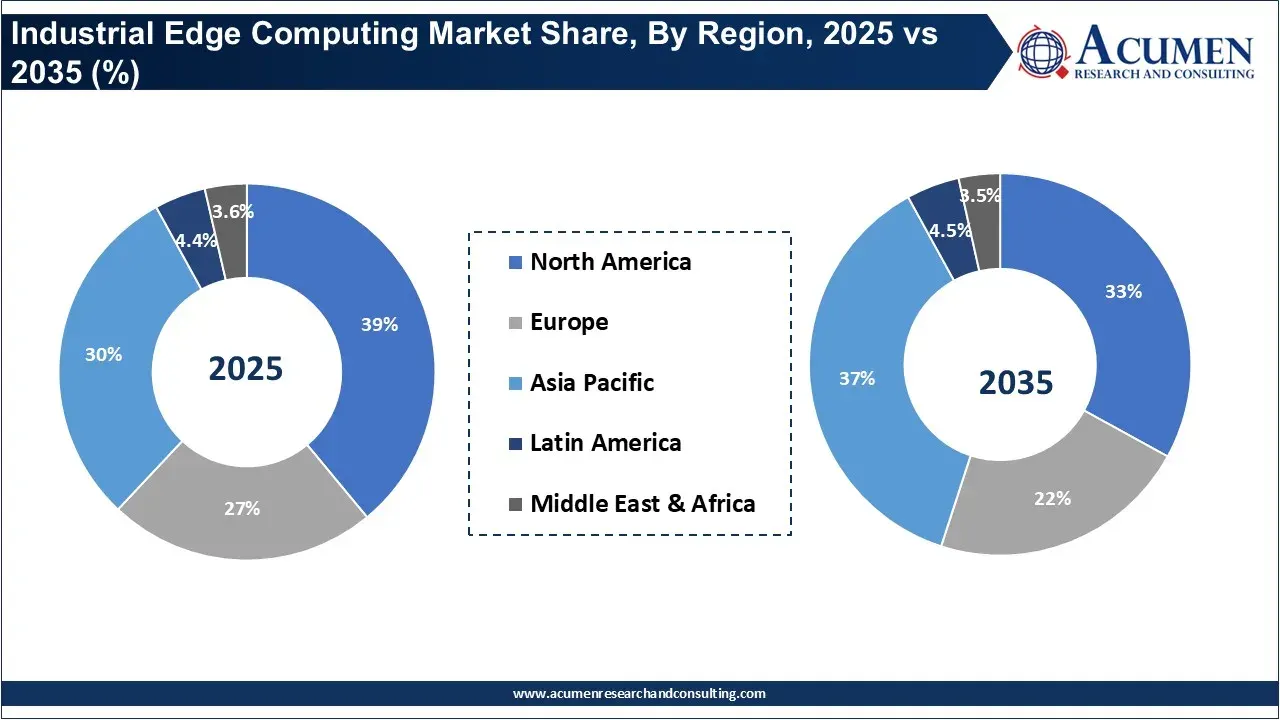
- By region, North America dominated the industrial edge computing market in 2025 with a 39% share and generated approximately $8.19 billion in revenue, supported by mature industrial automation, IoT, private wireless networks, AI infrastructure, and cloud-edge ecosystems.
- By region, Asia-Pacific is the fastest-growing regional market, with its share projected to increase from 30% in 2025 to 37% in 2035 at a 23.2% CAGR, driven by rapid industrial digitization, smart manufacturing, robotics, AI adoption, and expansion of connected production facilities.
- By offering, hardware dominated the industrial edge computing market in 2025 with a 46% share, supported by the need for edge computing systems, gateways, acceleration hardware, and industrial networking infrastructure at the physical edge.
- By offering, software & platforms is projected to become the largest category by 2035, increasing from 32% in 2025 to 39%, driven by rising requirements for edge orchestration, AI/ML workloads, analytics, security, and distributed device management.
- By edge infrastructure type, site/plant edge dominated the market in 2025 with a 39% share, supported by its ability to centralize computing, analytics, data processing, and AI workloads within industrial facilities while maintaining low-latency operations.
- By edge infrastructure type, industrial edge data center is the fastest-growing segment, with its share increasing from 15% in 2025 to 19% in 2035, driven by growing requirements for localized computing capacity for AI, machine vision, digital twins, and real-time analytics.
- By deployment/ownership model, customer-owned & operated deployments dominated the market in 2025 with a 61% share, supported by large industrial enterprises' preference for direct control over infrastructure, data, security, and operational workloads.
- By deployment/ownership model, edge-as-a-service is the fastest-growing segment, with a 29.4% CAGR from 2026 to 2035, as enterprises increasingly seek flexible access to edge infrastructure without managing hardware procurement, deployment, upgrades, and ongoing operations internally.
- By enterprise size, large enterprises dominated the industrial edge computing market in 2025 with a 72% share, supported by their larger industrial footprints, higher volumes of operational data, and greater investments in automation, IoT, cloud, and edge infrastructure.
- By end-use industry, manufacturing dominated the market in 2025 with a 42% share, driven by extensive deployment of connected machines, robotics, sensors, industrial controllers, and automated production systems requiring real-time data processing.
- By end-use industry, energy & utilities was the second-largest segment in 2025 with a 14% share, supported by the growing need for localized monitoring, fault detection, asset optimization, and real-time processing across power-generation and distribution infrastructure.
Why Is Industrial Edge Computing Becoming Critical for Modern Industrial Operations?
Industrial edge computing is becoming the new cornerstone of modern industry. In industrial settings, factories are collecting unmanageable amounts of data from sensors, equipment, robots, cameras, PLCs, and everything in between, and many applications require near real-time decisions.
- According to recent manufacturing research, while 57% of manufacturers are already deploying cloud computing and data analytics at the facility or network level, 46% are leveraging industrial internet of things (IIoT), 42% are using 5G, and 29% are implementing AI/ML at the facility or network level, with 23% piloting AI/ML.
This opens in a new window, the synergy between these technologies is helping fuel growing demand for on-site processing to enable predictive maintenance, machine-vision inspection, robotics, process optimization, digital twins, and AI inference without the requirement of repeatedly uploading runtime data to a cloud far, far away.
So as industrial AI looks beyond the art of the possible to scale toward production, edge computing is making itself a natural conduit for connectivity between industrial assets and cloud and AI-based enterprise systems.
Industrial Edge Computing Market Dynamics
Driver
Growing Adoption of Industrial AI, IoT, Automation and Real-time Analytics
Increasing adoption of industrial AI, IoT, automation and real-time data analytics is also driving increased demand for industrial edge computing as many manufacturing applications will need to process data in microseconds, rather than be transmitted to remote cloud infrastructure.
Local processing can provide benefits to applications such as machine vision, predictive maintenance, autonomous robots, quality control, digital twins and process optimisation, allowing operational decisions to be made closer to the machines and production lines.
Restraint
High Deployment Complexity, Cybersecurity Requirements, and Integration Challenges
High deployment complexity, cybersecurity requirements, and integration challenges across legacy operational technology remain major restraints for industrial edge computing adoption. Industrial facilities typically operate heterogeneous equipment, PLCs, sensors, industrial networks, and legacy control systems that must be integrated without disrupting production. Edge deployments also introduce additional computing nodes that require software updates, device management, access controls, monitoring, and security protection.
Opportunity
Expansion of Edge AI, Private 5G, Industrial Digital Twins, and Autonomous Manufacturing
Growth in edge AI, private 5G, industrial digital twins, and autonomous manufacturing provides abundant opportunities for vendors of integrated edge hardware, software, networking, orchestration and cybersecurity solutions. Governments are also increasingly funding the foundational infrastructure for these use cases.
The EU's cloud-edge programs under the European Green Deal and the IPCEI-CIS project are scaling up the development of common interoperable and secure edge infrastructure. India is developing its 5G innovation ecosystem by opening 100 5G use-case labs and programs for Industrial Automation, IoT and AI-enabled applications.
Government Initiatives
| Country/Region | Government initiative / program | Relevance to industrial edge computing |
|---|---|---|
| United States | Manufacturing USA / NIST-supported manufacturing innovation ecosystem | Government-supported manufacturing innovation centers have enabled 5G and multi-access edge computing testbeds for applications such as predictive maintenance, remote machine monitoring, autonomous robotics, and industrial IoT. |
| Germany | IPCEI on Next Generation Cloud Infrastructure and Services (IPCEI-CIS) | Germany provides a national framework for supporting cloud and edge infrastructure and services under IPCEI-CIS, helping develop distributed computing infrastructure and the cloud-edge continuum. |
| United Kingdom | 5G Innovation Regions and Industrial 5G Testbeds | Government-backed programs support advanced wireless applications in manufacturing, including connected precision manufacturing, automation, real-time data analysis, IoT, and edge computing. |
| China | 5G+ Industrial Internet and Industrial 5G Standalone Network Pilots | China is supporting standalone industrial 5G deployments incorporating edge computing, industrial Ethernet, TSN, AI networking, and real-time production applications across manufacturing, energy, transportation, and other industries. |
| India | 5G Use Case Labs and 5G Innovation Hackathon | India's Department of Telecommunications has established 100 5G use-case labs and supports development of applications involving industrial automation, IoT, AI, and other 5G-enabled technologies, creating an ecosystem for edge-enabled industrial applications. |
| European Union | Digital Decade Edge Computing Target | The EU targets 10,000 secure, climate-neutral edge nodes by 2030 and supports investment roadmaps, interoperability, cloud-edge infrastructure, and industrial data processing. |
Industrial Edge Computing Market Segmental Insights
Offering Insights
Hardware Dominates Industrial Edge Computing Demand While Software and Platforms Gain Strategic Weight
Hardware was the dominant offering type in 2025, comprising 46% of the market. Software & platforms comprising 32% and services comprising 22%. Hardware dominance is due to the need for computing systems, gateways, acceleration hardware and industrial networking equipment at the physical edge.
Thus this movement signifies that the industrial edge computing is moving out from the initial stage of infrastructure roll-out and moving toward software-defined management, analytics, AI workloads, orchestration, cybersecurity, and lifecycle services.
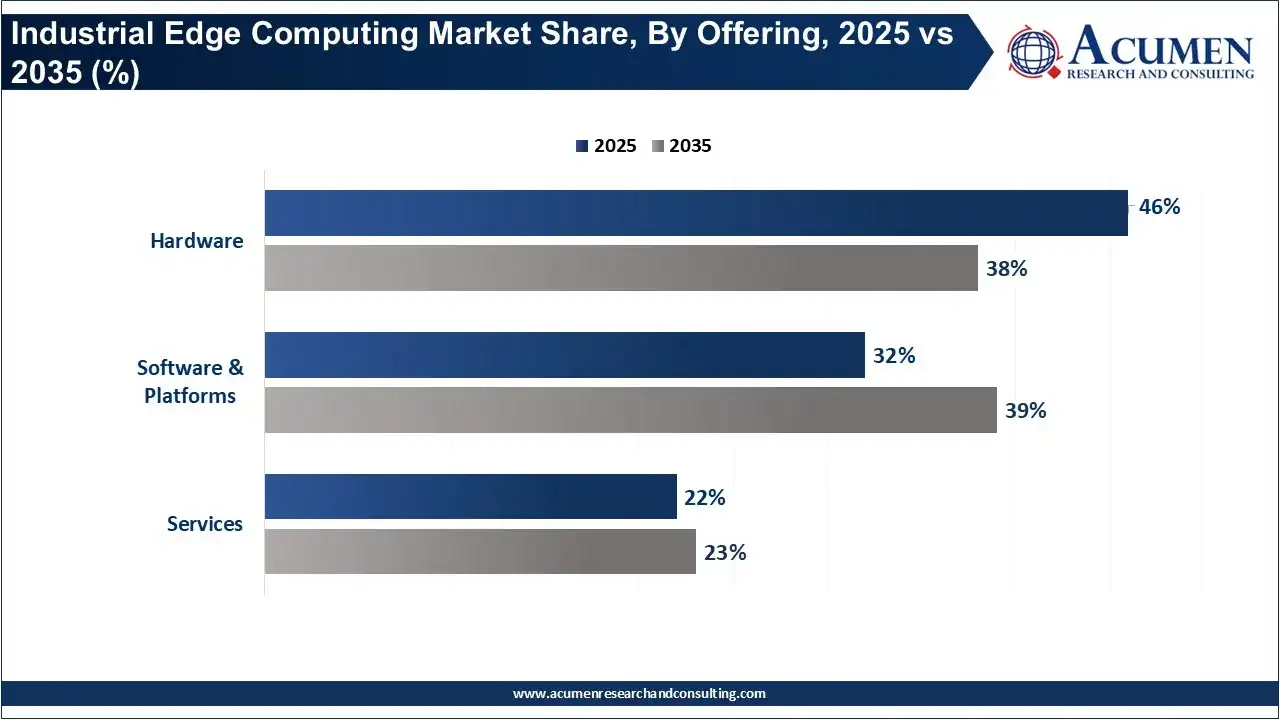
Software & platforms increase from 32% of the market in 2025 to 39% in 2035, becoming the largest offering category by the end of the forecast period. This transition reflects the growing complexity of managing distributed industrial computing environments. Enterprises operating hundreds or thousands of edge nodes require software for workload deployment, device management, analytics, AI model execution, security, orchestration, and lifecycle monitoring.
Edge Infrastructure Type Insights
Site/Plant Edge Leads Industrial Infrastructure Deployment as Computing Moves Into Production Environments
Site/plant edge makes up 39% of the market in 2025 as the dominant infrastructure type, and still represents the lion's share at 38% in 2035. Site-level infrastructure offers one central edge layer within the factory, plant, warehouse, energy facility or other industrial location. Site level offers the capability to gather information from machines and equipment, and provides enough capability for analytics, AI, operational applications and data storage, while also balancing the requirement for low latency and ease of deployment.
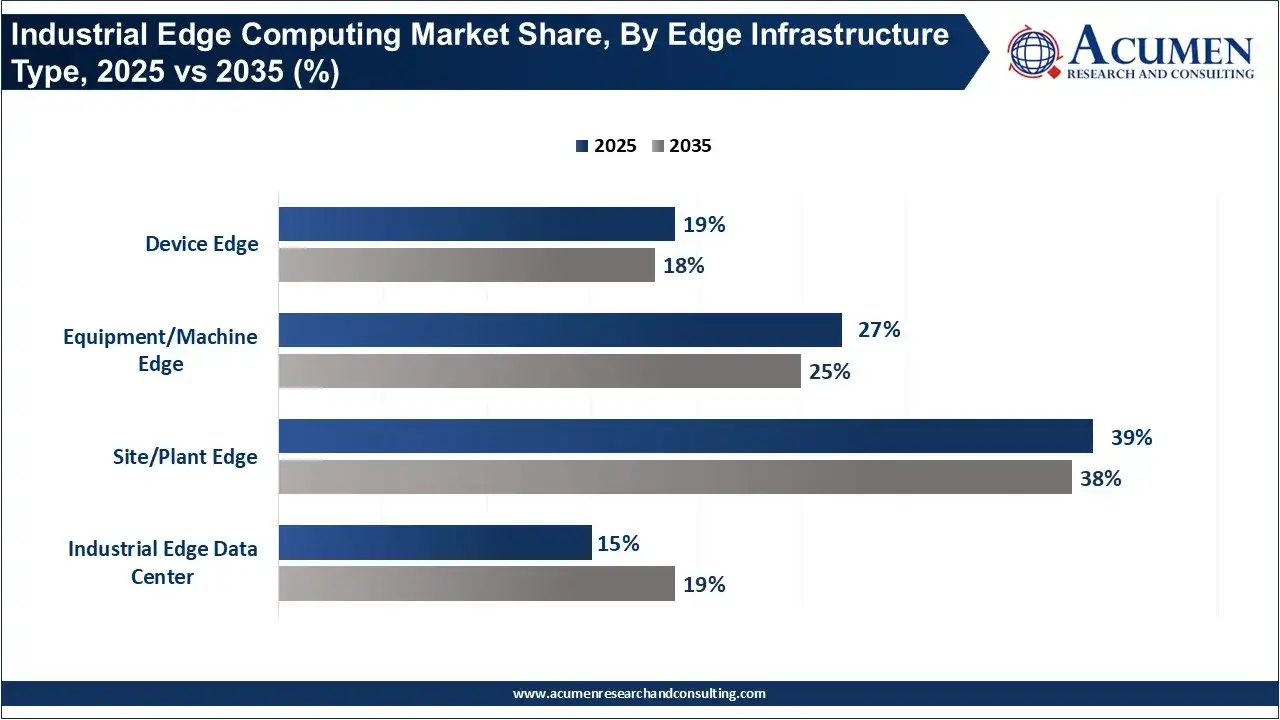
Industrial edge data centers increase from 15% in 2025 to 19% in 2035, representing the fastest-growing infrastructure category based on the supplied share trajectory. The expansion is linked to rising requirements for localized computing capacity, particularly for AI, machine vision, digital twins, real-time analytics, and other data-intensive applications. Industrial edge data centers can provide more computing and storage capacity than individual devices or machine-level systems while retaining the latency and data-localization benefits of edge architecture.
Deployment/Ownership Model Insights
Customer-Owned Infrastructure Dominates but Service-Led Edge Models Rapidly Gain Ground
Customer-owned & operated deployments made up 61% of the total installed base at 2025, versus 27% for managed/dedicated edge and 12% for edge-as-a-service. Customer-owned deployments continue to constitute the largest segment through 2035, but their percentage share falls to 45%, with managed/dedicated edge increasing to 32% and edge-as-a-service continuing to grow to 23%. This reflects the shift in the industry towards consumption-driven deployment models.
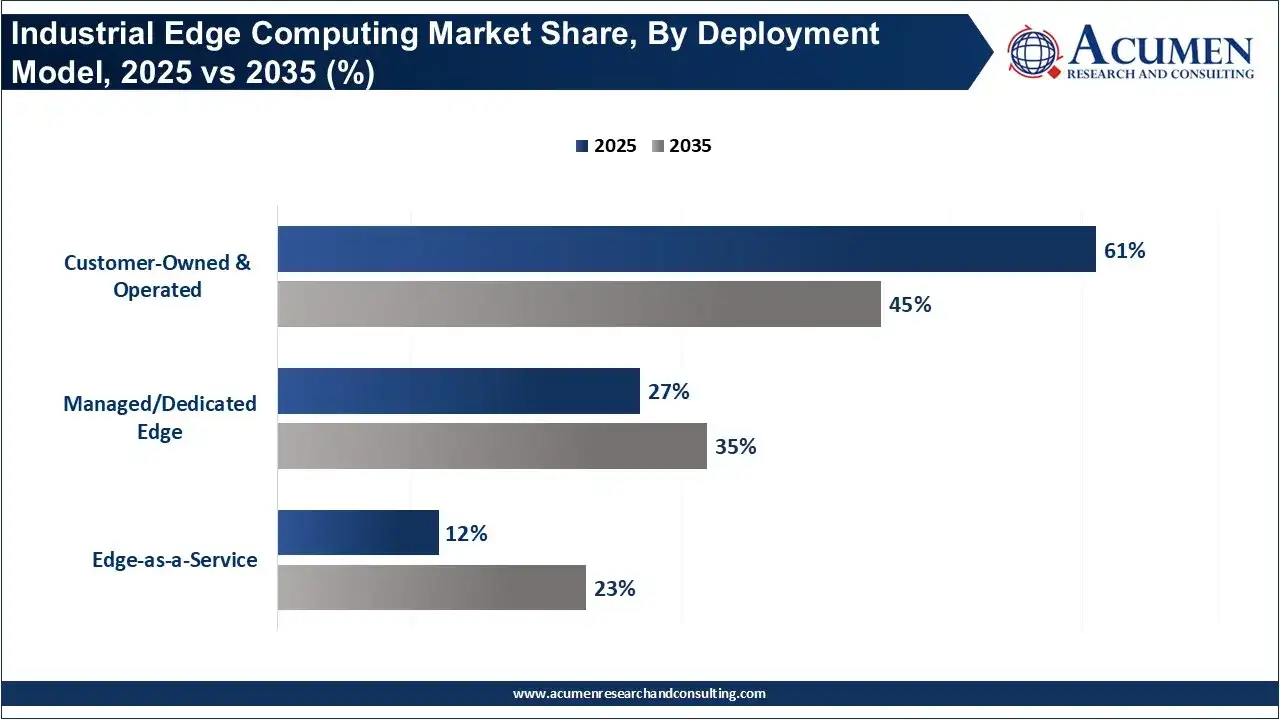
Edge-as-a-service grows from 12% in 2025 to 23% in 2035, with the market values supplying from $3.05 billion in 2026 to $30.99 billion in 2035 & CAGR of 29.4% in 2026-35. The fastest growth rate in the deployment models. Edge-as-a-service provides industrial customers with access to the edge infrastructure and applications without having to invest in the hardware (including buying, deploying, and maintaining it), managing upgrades, and operating the infrastructure.
Enterprise Size Insights
Large Enterprises Account for the Majority of Industrial Edge Deployments
Large enterprises comprised 72% of the industrial edge computing market in 2025, while SMEs made up the remaining 28%. Large enterprises have been in the lead in adoption with more extensive manufacturing operations, scattered facilities, supply chains, and large throughput of operational data. They also have the investment to fund edge infrastructure, and the integration of this infrastructure with their current IoT, automation, cloud, and enterprise technology landscape.
For large organizations, most industrial edge deployments encompass multiple use cases such as machine vision, process optimization, real-time analytics, robotics, predictive maintenance, and asset management.
Industrial Edge Computing Market Share, By Enterprise Size, 2025 (%)
| By Enterprise Size | Revenue Share, 2025 (%) |
|---|---|
| Large Enterprises | 72% |
| Small & Medium Enterprises (SMEs) | 28% |
SMEs made up 28% in 2025. Expect to see continued participation from SMEs driven by lightweight deployment models. The advent of managed edge and Edge-as-a-Service, for example, can help eliminate the high cost/complexity of deploying industrial-grade computing infrastructure.
Instead of building up large internal IT/OT teams, smaller industrial organizations could lean more heavily on vendor teams for infrastructure management, security, software patches, and analytics.
End-Use Industry Insights
Manufacturing Dominates Industrial Edge Computing Adoption Through Real-Time Production and Automation Applications
Manufacturing accounted for 42% of the total industrial edge computing market in 2025, making it the largest end-use industry, reflecting the fact that connected machines, sensors, robots, industrial controllers, production lines, and quality-control systems all create enormous volumes of time-sensitive data.
Edge computing facilitates the aggregation and analysis of this data on the factory floor to facilitate machine vision, predictive maintenance, process optimization, anomaly detection, production monitoring, and robotics.
Industrial Edge Computing Market Share, By End-Use Industry, 2025 (%)
| By End-Use Industry | Revenue Share, 2025 (%) |
|---|---|
| Manufacturing | 42% |
| Energy & Utilities | 14% |
| Oil & Gas | 12% |
| Mining & Metals | 7% |
| Transportation & Logistics | 11% |
| Construction & Infrastructure | 6% |
| Others | 8% |
Energy & utilities accounted for 14% in 2025, making it the second-largest end-use segment. Power-generation assets, transmission and distribution infrastructure, substations, renewable-energy installations, and utility networks generate continuous streams of operational data. Edge computing can process this information locally for equipment monitoring, fault detection, asset optimization, and operational visibility.
Industrial Edge Computing Market Regional Insights
North America Maintains Market Leadership as Industrial Edge Deployments Scale Across Connected Operations
North America led the market with a share of 39% in 2025, and the regional marketplace contributed approximately $8.19 billion in 2025 to the overall revenue of the worldwide industrial edge computing market. Industry leaders in the region are a good example of this stage, characterized by a higher prevalence of industrial automation, connected manufacturing, private wireless networks, industrial IoT infrastructure and cloud-edge architecture.
These companies are localizing more computing, analytics, AI inference, and control functions closer to machines and production environments to lower latency and send less data to central cloud infrastructure. The North America region already has a widespread technology ecosystem, with deployable industrial networking, cybersecurity, virtualization, AI hardware, and systems-integration capabilities.
Asia-Pacific Emerges as the Fastest-Growing Regional Market Through Industrial Digitization and Edge AI Expansion
Asia-Pacific is projected to be the fastest-growing regional market, with its share increasing from 30% in 2025 to 37% in 2035. The regional market rises from approximately $6.30 billion in 2025 to $7.63 billion in 2026, reaching $49.86 billion by 2035 at a 23.2% CAGR during 2026–2035.
Growth is supported by the region's large manufacturing base, expanding smart-factory investments, increasing deployment of industrial robots, and rapid adoption of AI-enabled inspection, predictive maintenance, machine vision, and real-time production analytics. China remains a major source of industrial automation demand, while Japan and South Korea continue to invest in highly automated production environments and advanced electronics manufacturing.
- India is also becoming increasingly relevant as manufacturers modernize factories and deploy connected production infrastructure. A key structural advantage for the region is that many new industrial facilities can incorporate edge computing into their digital architecture from the planning stage, rather than retrofitting legacy infrastructure.
Key Companies
- Siemens AG — Siemens is expanding its Industrial Edge ecosystem across automation, industrial AI, edge data centers, digital twins, and IT/OT integration, including AI-ready edge infrastructure developed with NVIDIA and Palo Alto Networks.
- Rockwell Automation, Inc. — Rockwell strengthens industrial edge deployment through solutions such as OptixEdge, which enables machine-level data processing, analytics, secure remote access, and cloud connectivity.
- IBM Corporation — IBM participates in the industrial edge market through edge computing, hybrid cloud, AI, and industrial data-management capabilities designed to bring analytics and workloads closer to operational environments.
- General Electric Company — GE contributes industrial edge capabilities through its industrial software, connected-asset, analytics, and operational technology ecosystem.
- Honeywell International Inc. — Honeywell combines industrial automation, control systems, cybersecurity, data analytics, and edge-oriented technologies across process and industrial environments.
- Microsoft Corporation — Microsoft supports industrial edge architectures through its cloud-to-edge ecosystem, enabling industrial organizations to connect operational data with Azure-based analytics, AI, and application environments.
- Cisco Systems, Inc. — Cisco contributes networking, security, connectivity, and edge infrastructure capabilities that support distributed industrial computing environments.
- Hewlett Packard Enterprise Company — HPE provides edge and hybrid-cloud infrastructure for distributed workloads, including accelerated computing and private-cloud architectures for industrial and enterprise environments.
- Dell Technologies Inc. — Dell participates through edge servers, computing infrastructure, data management, and distributed IT capabilities designed to support processing closer to industrial data sources.
- Schneider Electric SE — Schneider Electric combines industrial automation, energy management, edge infrastructure, and data-center technologies to support localized computing across industrial facilities.
Technology Acquisitions and Platform Expansion
- In March 2025, Siemens completed its acquisition of Altair Engineering for an enterprise value of approximately $10 billion. The acquisition added simulation, high-performance computing, data science, and AI capabilities to Siemens' portfolio and strengthened the Siemens Xcelerator platform, with the company positioning the combination around industrial AI and digital-twin applications.
- In June 2026, Siemens partnered with HighByte to combine Siemens Industrial Edge with HighByte's Intelligence Hub and Intelligence Center X. The collaboration focuses on connecting, contextualizing, and transforming IT and OT data to support industrial AI models, agents, and applications at scale, with HighByte Intelligence Hub also becoming available through the Siemens Industrial Edge Marketplace.
Segments Covered
By Offering
- Hardware
- Edge Computing Systems
- Edge Gateways
- Edge AI & Acceleration Hardware
- Industrial Networking Edge Hardware
- Other Industrial Edge Hardware
- Software & Platforms
- Industrial Edge Platforms & Operating Software
- Edge Data Processing & Analytics Software
- Edge AI/ML Software
- Edge Orchestration & Management Software
- Edge Security Software
- Other Industrial Edge Software
- Services
- Consulting & Architecture/Design
- Implementation & Systems Integration
- Support & Maintenance
- Managed Industrial Edge Services
- Other Services
By Edge Infrastructure Type
- Device Edge
- Equipment/Machine Edge
- Site/Plant Edge
- Industrial Edge Data Center
By Deployment/Ownership Model
- Customer-Owned & Operated
- Managed/Dedicated Edge
- Edge-as-a-Service
By Enterprise Size
- Large Enterprises
- Small & Medium Enterprises (SMEs)
By End-Use Industry
- Manufacturing
- Energy & Utilities
- Oil & Gas
- Mining & Metals
- Transportation & Logistics
- Construction & Infrastructure
- Others
By Region
- North America
- Europe
- Asia-Pacific
- Latin America
- Middle East & Africa
Looking for discounts, bulk pricing, or custom solutions? Contact us today at sales@acumenresearchandconsulting.com
Frequently Asked Questions

Related Market Research Reports
November 2023
October 2026
September 2026
December 2025
June 2026
December 2023
February 2024
May 2023