
Industrial AI Market Size, Share, Growth, Report 2026 To 2035
Industrial AI Market (By Offering: Hardware, Software, Services; By AI Technology: Predictive & Analytical AI, Vision AI, Language & Conversational AI, Generative & Foundation-Model AI, Decision Optimization & Reinforcement AI, Others; By Deployment: On-Premises, Cloud, Hybrid; By Enterprise Size: Large Enterprises, Small & Medium Enterprises (SMEs); By Industry: Manufacturing Energy & Utilities, Oil & Gas, Mining & Metals, Transportation & Logistics, Construction & Infrastructure, Others) - Global Industry Analysis, Size, Share, Regional Analysis, Trends and Forecast 2026 - 2035
- Last Updated: 29 Sep 2026
- Report Code: ARC3990
- Category: ICT
Industrial AI Market Size, Forecast Report 2026 To 2035
The global industrial AI market size was valued at USD 35 billion in 2025 and is observed to expand at USD 326.72 billion by 2035; growing at a promising CAGR of 25% during the forecast period of 2026-2035. Rising deployment of AI across manufacturing operations, predictive maintenance, quality control, robotics, and process optimization is accelerating the transition from isolated AI pilots toward connected and increasingly autonomous industrial environments.
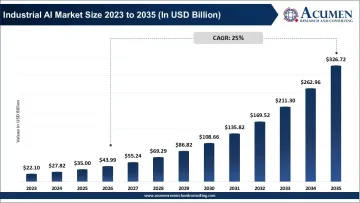
Industrial AI is evolving from analytics-oriented applications toward integrated systems capable of supporting real-time operational decisions, process optimization, predictive maintenance, quality inspection, and increasingly autonomous production. Manufacturers are combining machine learning, computer vision, generative AI, digital twins, industrial IoT, edge computing, and robotics to convert large volumes of operational data into actionable insights.
Recent evidence indicates that this transition is moving beyond experimentation, with KPMG reporting that 49% of industrial manufacturing executives already have active AI use cases delivering business value, while 68% expect to deploy AI at scale within the following 12 months.
Market Growth & Projections
- 2025 Value: $35 billion
- 2026 Value: $43.99 billion
- 2035 Forecast: $326.72 billion
- Growth Rate: 25% CAGR (2026–2035)
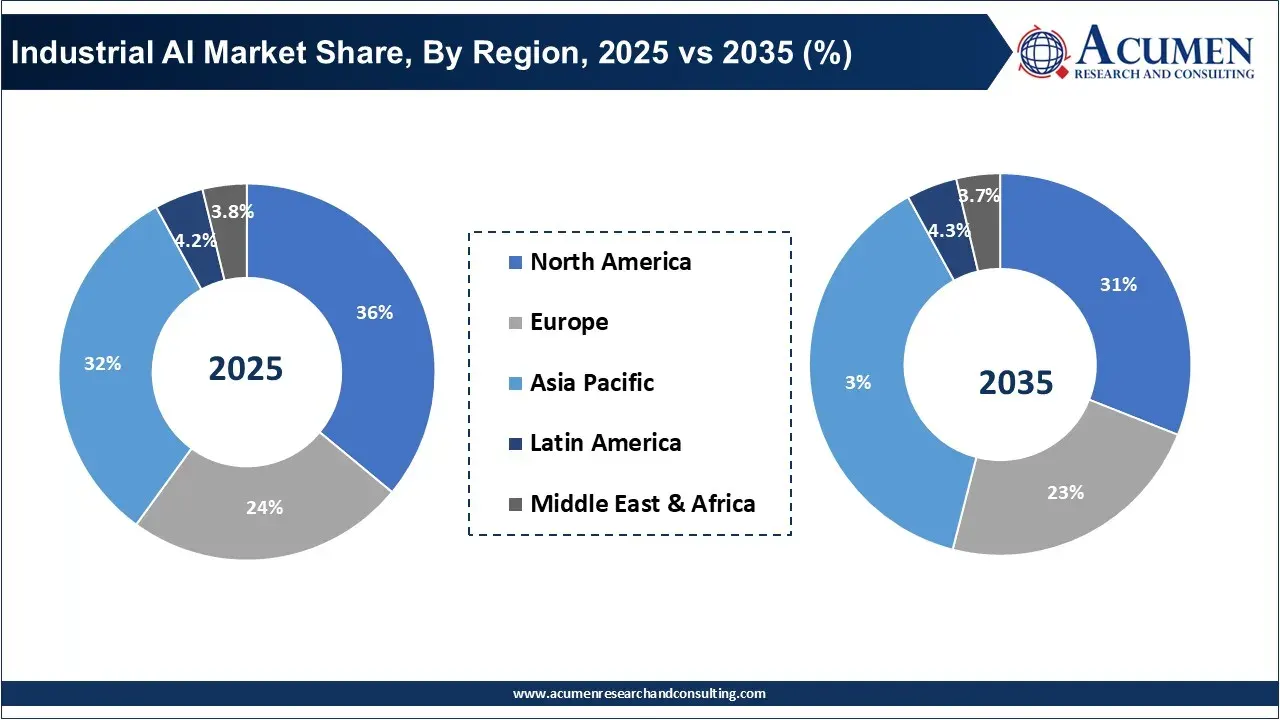
- Leading Region: North America led the market with a 36% revenue share
- Fastest Growing Rgion: Asia-Pacific witness fastest growth
Report Highlights
- By region, North America dominated the industrial AI market, supported by mature industrial automation, cloud and computing infrastructure, enterprise technology spending, and early AI adoption.
- By region, Asia-Pacific accounted for 32% of the industrial AI market in 2025 and is projected to reach 38% by 2035, with a 27.4% CAGR during 2026–2035 supported by expanding manufacturing automation and industrial digitalization.
- By offering, software dominated the industrial AI market with a 49% share in 2025 and is projected to reach 55% by 2035, supported by growing demand for AI platforms, analytics, model management, and software-defined automation.
- By offering, hardware accounted for 32% of the industrial AI market in 2025, reflecting the importance of computing, sensing, machine vision, and edge infrastructure in industrial AI deployment.
- By hardware, AI accelerators and computing hardware led with a 35% share in 2025, driven by increasing computational requirements for predictive maintenance, machine vision, robotics, real-time analytics, and generative AI.
- By AI technology, predictive and analytical AI held the leading position with a 34% share in 2025, supported by established applications in predictive maintenance, anomaly detection, production optimization, and forecasting.
- By AI technology, generative and foundation-model AI is projected to increase its share from 10% in 2025 to 19% by 2035, reflecting expanding use in engineering support, knowledge retrieval, conversational interfaces, and AI-assisted industrial workflows.
- By deployment, on-premises solutions accounted for 47% of the industrial AI market in 2025, supported by the need for low-latency processing, operational control, data security, and proximity to industrial assets.
- By deployment, hybrid deployment is projected to increase from 23% in 2025 to 32% by 2035 at a CAGR of 29.6% during 2026–2035, as enterprises combine localized processing with cloud-based training, analytics, governance, and cross-site optimization.
- By enterprise size, large enterprises represented 78% of the industrial AI market in 2025, supported by their larger asset bases, greater availability of operational data, multiple production facilities, and higher technology investment capacity.
- By enterprise size, SMEs accounted for 22% of the market in 2025, while cloud platforms, AI-as-a-service, packaged applications, and scalable edge solutions are reducing infrastructure and talent barriers to adoption.
- By industry, manufacturing dominated the industrial AI market with a 52% share in 2025, supported by highly instrumented production environments and extensive applications across process optimization, quality inspection, robotics, and predictive maintenance.
- By industry, energy and utilities held a 12% share in 2025, reflecting strong AI requirements for asset monitoring, predictive maintenance, demand forecasting, grid optimization, and anomaly detection across geographically distributed infrastructure.
Adoption Statistics
- 49% of industrial manufacturing executives surveyed by KPMG reported that their organizations already have active AI use cases delivering business value, while 68% expect AI deployment at scale within 12 months.
- 83% of manufacturers surveyed by Augury and IndustryWeek planned to increase AI investments in 2026, based on research covering 500 manufacturing leaders across U.S. and European companies.
- 29% of manufacturers in Deloitte's 2025 smart manufacturing survey reported using AI/ML at the facility or network level, while 23% were piloting AI/ML applications.
- 40% of manufacturers identified data analytics as an investment priority for the next 24 months, compared with 29% for AI, 29% for cloud computing, and 27% for IIoT.
- 54% of manufacturers reported using a data standard based on a unified data model, while 45% reported using an architecture standard for scaled smart-manufacturing deployments.
- 76% of industrial manufacturing executives identified unreliable data as a top AI risk, despite 83% saying their organizations were building strong AI data foundations.
- 80% of manufacturing executives surveyed by Deloitte planned to allocate 20% or more of their improvement budgets to smart-manufacturing initiatives.
- At JSW Cement, an AI-based vision system for packer automation expanded from 1 plant to 6 plants and achieved more than 99.96% accuracy, illustrating the scaling of AI from individual pilots into multi-site manufacturing operations.
- TE Connectivity's 2025 Industrial Technology Index found that 60% of Chinese organizations and 51% of Japanese organizations had used AI for three or more years, compared with 29% in India, 38% in Germany, and 9% in the U.S.
Adoption Rate: Country-wise Analysis
| Country | AI Adoption Indicator | Extensive AI Use | AI Use for 3+ Years | Industrial AI Adoption Context |
|---|---|---|---|---|
| Japan | 75% | 31% | 51% | Strong adoption across robotics, automotive, electronics, machinery, and precision manufacturing |
| India | 73% | 25% | 29% | Expanding adoption across automotive, pharmaceuticals, cement, electronics, and process industries |
| China | 70% | 28% | 60% | Broad deployment across smart factories, robotics, automation, and large-scale manufacturing |
| Germany | 65% | 15% | 38% | Increasing integration across automotive, machinery, industrial automation, and Industry 4.0 applications |
| United States | 62% | 15% | 9% | Growing use across advanced manufacturing, semiconductors, aerospace, automotive, and industrial software |
Market Dynamics
How are Predictive Maintenance and Asset Optimization Accelerating Industrial AI Demand?
Predictive maintenance and asset optimization are becoming major drivers of Industrial AI adoption as manufacturers seek to reduce unplanned downtime and improve equipment performance. Industrial AI systems analyze sensor readings, vibration, temperature, pressure, energy consumption, maintenance histories, and production data to identify early signs of equipment degradation. This allows maintenance teams to shift from reactive repairs toward condition-based interventions while improving asset availability and extending equipment life.
For example, AI models can detect abnormal vibration patterns in motors, pumps, or rotating machinery and alert operators before a failure interrupts production. As manufacturers deploy connected sensors, edge computing, and industrial data platforms, predictive maintenance is increasingly expanding into broader AI-driven asset optimization and production decision-making.
Driver Impact Analysis
| Impact Area | Industrial AI Impact |
|---|---|
| Downtime & Maintenance | Predictive models identify equipment anomalies early, helping manufacturers reduce unexpected failures, emergency repairs, and unnecessary maintenance activities. |
| Asset Utilization | AI analyzes machine performance, operating conditions, and production patterns to identify underutilized assets and improve equipment productivity. |
| Equipment Life & Energy Efficiency | Continuous AI-based monitoring can identify inefficient operating conditions and degradation patterns, supporting longer asset life and more efficient energy consumption. |
| AI Use-Case Expansion | Predictive maintenance infrastructure can provide the foundation for quality inspection, process optimization, anomaly detection, forecasting, and other Industrial AI applications. |
Why are Data Quality and Data Integration Major Barriers to Industrial AI Adoption?
Data quality and integration remain major barriers to Industrial AI adoption because factories often operate a mixture of modern connected equipment and legacy machines with different data formats and communication protocols. Industrial AI models require reliable, structured, and sufficiently detailed data, while manufacturing environments can contain missing records, inconsistent measurements, sensor errors, duplicated information, and fragmented historical datasets. Integration is also challenging when PLCs, SCADA, DCS, MES, ERP systems, cloud platforms, and edge devices need to exchange information across previously isolated infrastructure.
Restraint Impact Analysis
| Impact Area | Industrial AI Impact |
|---|---|
| Model Reliability | Poor-quality or incomplete datasets can reduce prediction accuracy and increase false alarms, limiting confidence in AI-generated recommendations. |
| Legacy Integration | Older industrial equipment may lack modern connectivity capabilities, requiring additional gateways, interfaces, or infrastructure before AI applications can access machine data. |
| Data Silos & Standardization | Data distributed across production, maintenance, quality, and enterprise systems can make it difficult to create unified datasets for AI model development. |
| Deployment Cost & Scalability | Data engineering, system integration, and preprocessing requirements can increase deployment costs and make it harder to replicate successful AI applications across multiple production facilities. |
Where Does Edge AI Create the Greatest Opportunity for Industrial Operations?
Edge AI creates opportunities for Industrial AI by enabling manufacturers to process and analyze operational data close to machines, production lines, sensors, and robots. Local AI inference can reduce latency, making the technology particularly relevant for machine vision, predictive maintenance, robotics, anomaly detection, and real-time process control. Edge deployment can also reduce the volume of raw data transmitted to centralized cloud infrastructure by processing information locally and sending only relevant insights or alerts.
This architecture can improve operational resilience because AI applications can continue functioning even when connectivity with centralized systems is interrupted or constrained. As industrial facilities combine edge servers, industrial PCs, AI accelerators, sensors, and connected equipment, edge AI is creating a pathway toward increasingly distributed and autonomous industrial operations.
Opportunity Impact Analysis
| Opportunity Area | Industrial AI Impact |
|---|---|
| Real-Time Predictive Maintenance | Local processing of vibration, temperature, acoustic, and equipment data enables rapid anomaly detection and maintenance alerts close to the asset. |
| Machine Vision & Robotics | Edge AI supports low-latency image analysis and robotic decision-making for defect detection, adaptive automation, and material handling. |
| Process & Worker Optimization | Real-time analysis of production parameters and visual information can support process adjustments, safety monitoring, and operational optimization. |
| Distributed Autonomous Operations | Edge infrastructure can connect AI models with sensors, machines, digital twins, and control systems, supporting increasingly decentralized and autonomous factory workflows. |
Segmental Insights
Offering Insights
2025–2035 In 2025, software held a 49% share of the industrial AI offering market, compared to 32% for hardware and 19% for services. By 2035, software's share is expected to grow to 55%, reflecting the growing significance of AI platforms, industrial applications, model management, analytics, and software-defined automation.
Industrial AI requires software that can turn operational data into insights. Sensors and compute hardware form the basis, but companies will need software platforms that can receive industrial data, integrate data from machines and enterprise systems, deploy and manage AI models, and surface insights and recommendations to operators and managers.
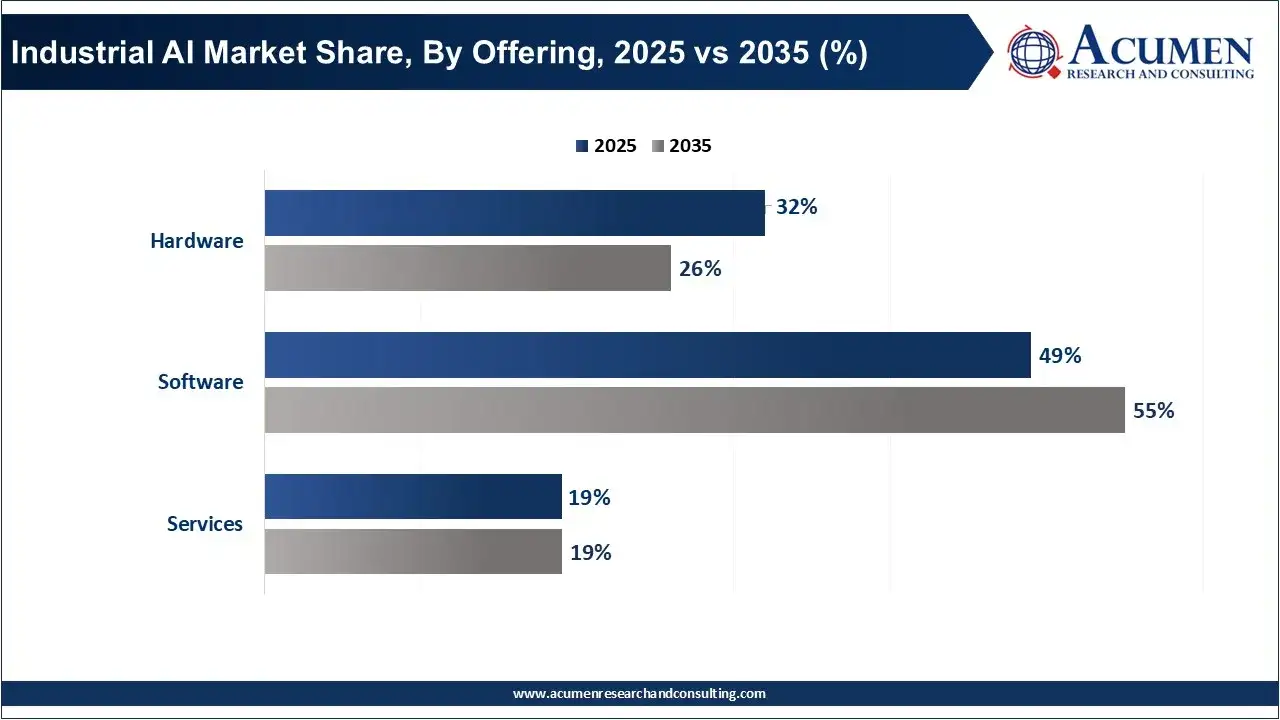
The hardware segment accounted for 32% of the industrial AI market in 2025, making it the second-largest offering category after software. Hardware forms the physical foundation of industrial AI deployment by providing the computing, processing, sensing, and machine-vision infrastructure required to collect industrial data and execute AI workloads close to operational environments.
Within the hardware segment, AI accelerators & computing hardware dominated with a 35% share in 2025, followed by industrial edge AI hardware at 25% and AI-enabled machine vision hardware at 22%. The increasing complexity of industrial AI workloads, including real-time analytics, predictive maintenance, machine vision, robotics, process optimization, and generative AI applications, is increasing the need for specialized computing infrastructure capable of processing large volumes of operational data with low latency.
AI Technology Insights
Predictive & analytical AI dominated the AI technology segment in 2025 with a 34% share, making it the largest technology category in the supplied market structure. The dominance of predictive and analytical AI reflects the immediate operational value of using historical and real-time industrial data to anticipate equipment failures, identify process abnormalities, optimize production parameters, forecast demand, and improve resource utilization.
Predictive maintenance is a particularly established industrial AI application because equipment failures can directly affect production schedules, product quality, worker safety, and operating costs. NIST identifies predictive maintenance as one of the applications through which AI is transforming manufacturing.
Generative & foundation-model AI grows to comprise 19% of the AI industry in 2035, up from 10% in 2025, the largest share increase of any of the listed AI technologies. This growth occurs as generative and foundation-model AI extends the industrial AI paradigm from numerical prediction to natural-language conversational AI, engineering support, knowledge retrieval, AI agents, automation of workflows, and multimodal industrial use cases.
Manufacturing companies have extensive technical documentation, maintenance logs, engineering data, machine data, quality records, and the accumulated knowledge of operators. Foundation models can serve as conversational interfaces to humanworkers to browse and understand this information.
Deployment Insights
In 2025, on-premises deployment led the industrial AI market with 47% of market share, whereas cloud and hybrid deployment ranked with 30% and 23%, respectively. The persistence of on-premise deployment, industrial operations tend to have a nature that makes the use of AI on premises an essential capability. From manufacturing, energy, refineries, mines, and logistics facilities, the use of AI in industrial operations generally involves close proximity to the physical assets and industrial control infrastructure.
In some applications, such as machine vision, robot control, anomaly detection, and safety-related applications, near real-time analysis is necessary. An all-on-premises or edge infrastructure can help reduce reliance on remote connectivity.
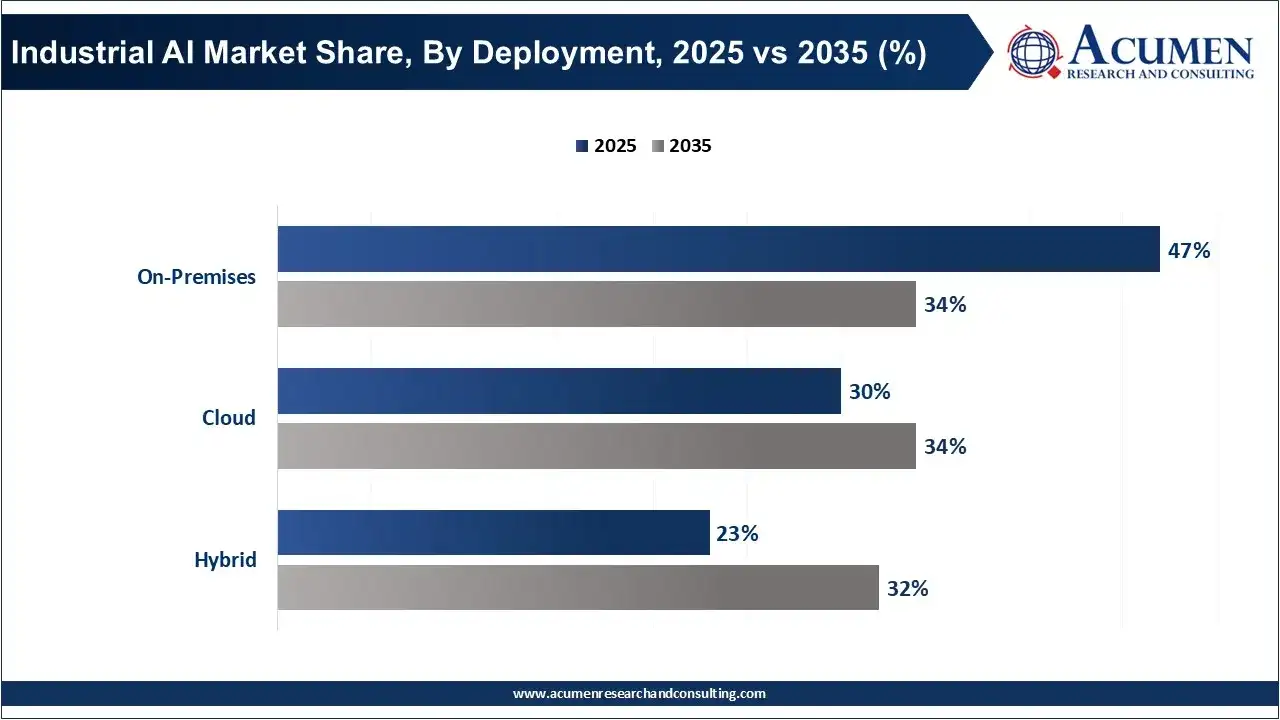
Hybrid deployment is the fastest-growing deployment type in the forecast at a CAGR of 29.6% during 2026-2035 with the increase being from 23% in 2025 to 32% in 2035. Hybrid architectures address the fundamental tension between centralized AI computing and localized industrial processing. Enterprises can keep latency-sensitive workloads at the edge or on-premises while using cloud infrastructure for model training, large-scale analytics, centralized monitoring, model management, and cross-site optimization.
This architecture becomes more popular as industrial organizations manage multiple plants. An enterprise can collect and process data on a local scale, maintaining centralized AI governance and analytics across their manufacturing landscape.
Enterprise Size Insights
In 2025, large enterprises made up 78% of the industrial AI market against 22% for SMEs. Larger enterprises have several architectural advantages. For example, they are likely to have a larger base of assets, production facilities, industrial data environments, and longer and more complex supply chains than SMEs. These factors expand the scope for AI application and provide more data for models to learn from.
Industrial AI Market Share, By Enterprise Size, 2025 (%)
| By Enterprise Size | Revenue Share, 2025 (%) |
|---|---|
| Large Enterprises | 78% |
| Small & Medium Enterprises (SMEs) | 22% |
SMEs represented the 2nd largest percentage of industrial AI market by enterprise size at 22% in 2025, following large enterprises at 78%. SME adoption of industrial AI continues to be less due to a combination of historically high cost of dedicated infrastructure and AI-optimized talent.
However, the implementation of cloud industrial AI platforms, packaged industrial AI applications, AI-as-a-service, and scalable edge computing solutions negate the necessity of heavy investments in dedicated infrastructure and in-house AI teams, offering scalable and affordable solutions comparable to those delivered by large enterprises operating across multiple plants and business functions.
Industry Insights
The manufacturing sector led the industrial AI market in 2025 with a 52% stake, followed by energy & utilities at 12%. Manufacturing is the biggest industrial AI environment for two reasons: factories are constructed as a tightly instrumented physical entity, along with processes that are repeatable, measurable quality, and collect large volumes of data.
The use cases for AI span the entire manufacturing value chain-from product design and production planning to process optimization, predictive maintenance, machine vision, robotics, quality checks, inventory management and workforce support.
Industrial AI Market Share, By Industry, 2025 (%)
| By Industry | Revenue Share, 2025 (%) |
|---|---|
| Manufacturing | 52% |
| Energy & Utilities | 12% |
| Oil & Gas | 9% |
| Mining & Metals | 6% |
| Transportation & Logistics | 8.50% |
| Construction & Infrastructure | 5% |
| Others | 7.50% |
Energy & utilities made up 12% of the market in 2025, the second largest segment shown in the supplied data. The industry makes a good use case for AI as energy infrastructure makes for geographically dispersed assets, operates on a 24/7 basis, demands sophisticated load management and requires high levels of reliability and predictive maintenance.
Industrial AI can support asset monitoring, predictive maintenance, demand forecasting, grid optimization, energy efficiency, anomaly detection, and operational decision support. These applications are particularly relevant for infrastructure where equipment failures can result in significant service disruption or operational losses.
Regional Insights
North America Dominates the Industrial AI Market as Industrial Digitization and AI Infrastructure Mature
By 2025, North America was the largest region for industrial AI, with 36% market share. North America's dominance is driven by industry's maturity in automation and other enabling technologies, high levels of enterprise technology spend, mature cloud and computing ecosystems and early adoption of AI for manufacturing, energy, logistics and other asset intensive businesses.
The maturity of the North American industrial ecosystem is especially important because industrial AI needs more than AI models. Companies also need connected equipment, industrial data, IT and OT, sensors, cybersecurity, and software that can incorporate AI into current operational processes.
- According to NIST's 2026 roadmap, data management, integration with diverse sensing and control systems, trustworthy AI, and reliable operation are key high-level needs of smart-manufacturing AI. Institutional frameworks in the U.S. are also growing to further this industrial adoption.
- In December 2025, NIST revealed investment of $20 million in centers dedicated to AI-based technology solutions for U.S. manufacturing and essential infrastructure.
- Furthermore, the agency highlighted the AI for Resilient Manufacturing Institute which has an expected federal contribution of up to $70 million over five years, with at least an equal amount from nonfederal sources.
Asia-Pacific Emerges as the Fastest-Growing Regional Industrial AI Market
Asia-Pacific represents the fastest-growing regional opportunity in the supplied dataset, with its share rising from 32% in 2025 to 38% by 2035. Its CAGR of 27.4% during 2026–2035 is also the highest among the five regional markets.
The region's growth is closely connected with the expansion of smart manufacturing, industrial automation, electronics production, semiconductor manufacturing, automotive production, robotics, and digitally connected factories. Unlike mature markets where industrial AI adoption is often centered on upgrading existing infrastructure, many Asian industrial ecosystems are simultaneously investing in automation, connected equipment, edge computing, machine vision, and AI-enabled production systems.
China, Japan, South Korea, Taiwan, India, and Southeast Asian manufacturing economies collectively create a broad industrial base for AI deployment. Industrial AI is particularly relevant where manufacturers need to increase production efficiency while managing labor constraints, quality requirements, energy consumption, and increasingly complex supply chains.
What are Governments Doing to Accelerate Industrial AI Adoption?
| Country | Government initiative / action | Industrial AI relevance |
|---|---|---|
| United States | NIST published its 2026 Roadmap on AI and Machine Learning for Smart Manufacturing, focusing on industrial data, heterogeneous sensing and control systems, trustworthy AI, digital twins, robotics, and autonomous manufacturing. | Strengthens the technical and institutional foundation required to move AI from research and pilots into reliable industrial production environments. |
| China | China launched the “AI + Manufacturing” special action, targeting by 2027 the deployment of 1,000 industrial intelligent agents, 100 high-quality industrial datasets, 500 typical application scenarios, and 1,000 benchmark enterprises. | Creates measurable targets for AI integration across production, predictive maintenance, design, quality, scheduling, and other manufacturing workflows. |
| Germany | In July 2026, Germany's government, industry, and research organizations reorganized Platform Industrie 4.0 around industrial AI, with the objective of establishing data-driven and AI-based applications as a standard across German industry by 2030. | Links industrial AI with Germany's existing Industry 4.0 ecosystem while emphasizing industrial data, digital sovereignty, and scalable AI applications. |
| Japan | METI and NEDO selected R&D themes under the GENIAC project in May 2026 for making manufacturing data AI-ready and developing robotics foundation models, with projects extending into FY2026–FY2029. | Supports the data infrastructure and robotics AI capabilities needed for autonomous industrial equipment and AI-enabled manufacturing. |
| India | The IndiaAI Mission has a government outlay of ₹10,371.92 crore and includes AI compute, foundation models, AIKosh, application development, skills, startup financing, and safe and trusted AI. By March 2026, more than 38,000 GPUs had been onboarded through the AI compute portal. | Expands affordable AI compute and domestic AI capabilities that can support industrial AI development, manufacturing applications, and AI-enabled enterprises. |
Key Companies
- Siemens AG
- NVIDIA
- Microsoft
- IBM
- Rockwell Automation
- ABB
- Schneider Electric
- Honeywell
- PTC
- Dassault Systèmes
Segments Covered
By Offering
- Hardware
- AI Accelerators & Computing Hardware
- Industrial Edge AI Hardware
- AI-Enabled Machine Vision Hardware
- AI-Enabled Sensors & Data Acquisition Hardware
- Other Industrial AI Hardware
- Software
- Industrial AI Platforms
- Packaged Industrial AI Applications
- AI Development & Model Management Software
- Other Industrial AI Software
- Services
- Consulting & Advisory Services
- Implementation & Systems Integration Services
- AI Model Development & Training Services
- Support & Maintenance Services
- Managed Industrial AI Services
- Other Services
By AI Technology
- Predictive & Analytical AI
- Vision AI
- Language & Conversational AI
- Generative & Foundation-Model AI
- Decision Optimization & Reinforcement AI
- Other Industrial AI Technologies
By Deployment
- On-Premises
- Cloud
- Hybrid
- By Enterprise Size
- Large Enterprises
- Small & Medium Enterprises (SMEs)
By Industry
- Manufacturing
- Energy & Utilities
- Oil & Gas
- Mining & Metals
- Transportation & Logistics
- Construction & Infrastructure
- Others
By Region
- North America
- Europe
- Asia-Pacific
- Latin America
- Middle East & Africa
Looking for discounts, bulk pricing, or custom solutions? Contact us today at sales@acumenresearchandconsulting.com
Frequently Asked Questions

Other ICT Reports
January 2024
November 2024
August 2026
March 2023