
AI Vehicle Inspection System Market Size, Share, Trends, Report 2026 To 2035
AI Vehicle Inspection System Market (By Component: Software, Hardware, Service; By Technology: Computer vision, Deep learning, Machine learning, Image processing, Others; By Vehicle Type: Passenger Cars, Commercial Vehicles; By Application: Damage detection, Safety inspection, Insurance claim assessment, Quality control, Others; By End User: Automotive OEMs, Fleet operators, Insurance companies, Car rental & leasing agencies, Others) - Global Industry Analysis, Size, Share, Regional Analysis, Trends and Forecast 2026 - 2035
- Last Updated: 12 Aug 2026
- Report Code: ARC3961
- Category: ICT
AI Vehicle Inspection System Market Size and Forecast 2026 To 2035
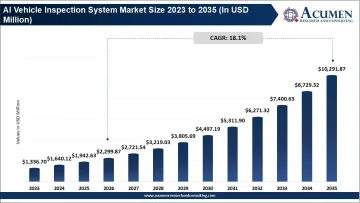
The global AI vehicle inspection system market size was valued at USD 1,942.63 million in 2025 and is projected to reach USD 10,291.87 million by 2035, expanding at a compound annual growth rate (CAGR) of 18.1% during the forecast period from 2026 to 2035. Rising adoption of AI-powered automated inspection across dealerships, insurers, fleet operators, and used-vehicle businesses is driving market growth by reducing inspection time, improving damage-detection accuracy, and standardizing vehicle-condition assessment.
Report Highlights
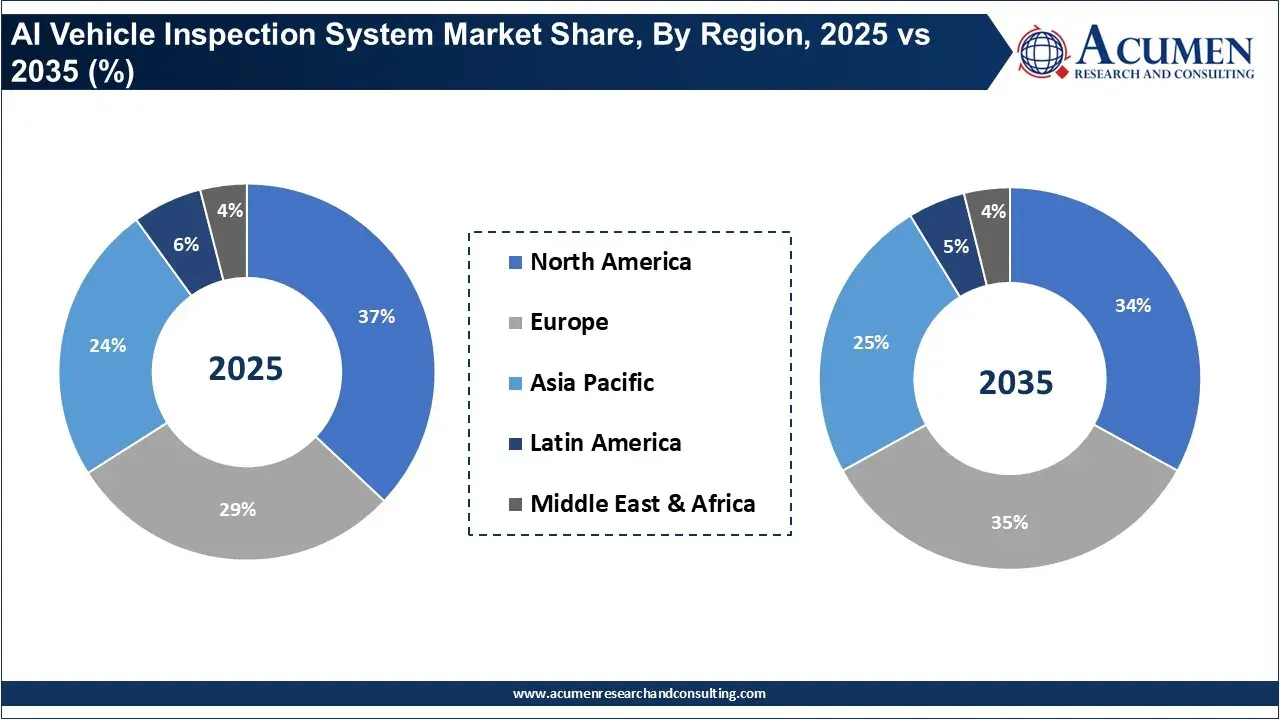
- By region, North America dominated the AI vehicle inspection system market with a 37.0% revenue share in 2025, supported by strong adoption of automotive technology, digital insurance claims, automated dealership processes, and advanced fleet-management solutions.
- By region, Asia Pacific held the second-largest share at 29.0% in 2025, driven by expanding vehicle production, rising used-vehicle transactions, growing automotive digitalization, and increasing adoption of AI-powered inspection technologies.
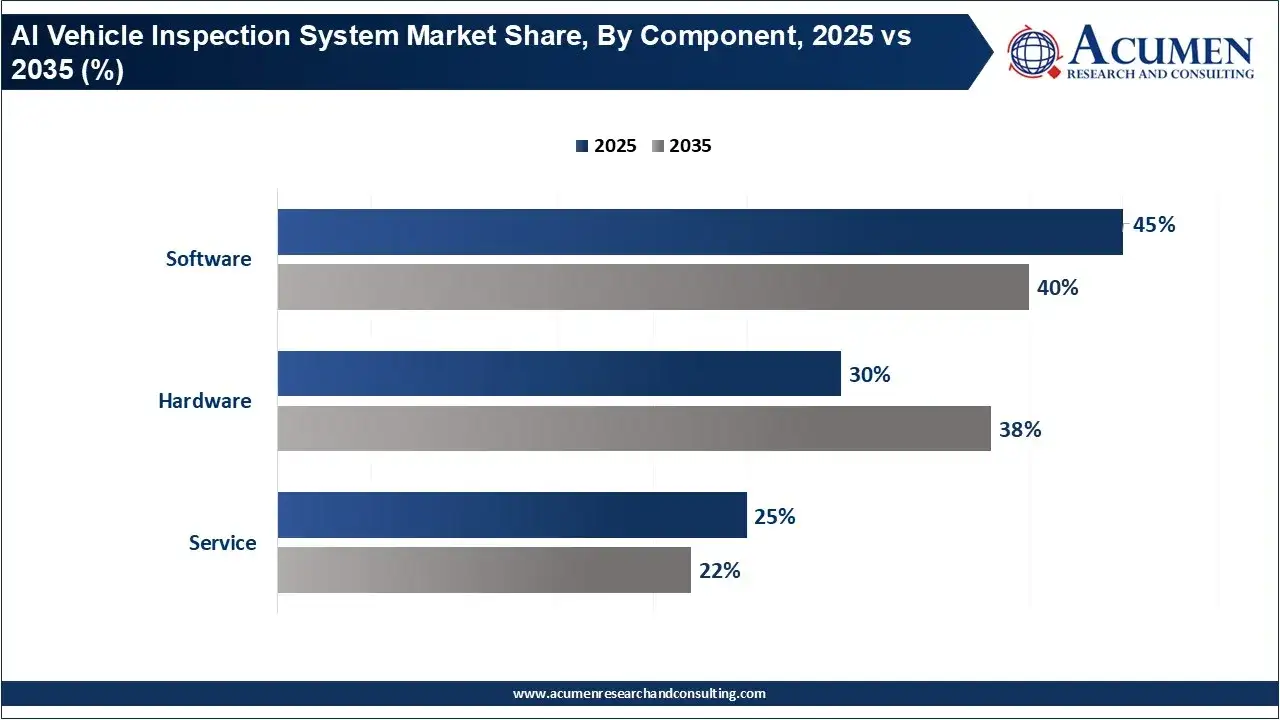
- By component, software dominated the AI vehicle inspection system market with a 45.0% revenue share in 2025, owing to growing demand for computer-vision platforms, AI damage-detection algorithms, automated reporting, and digital inspection applications.
- By component, hardware accounted for a 30.0% revenue share in 2025, supported by increasing deployment of cameras, imaging systems, sensors, scanning equipment, and automated inspection stations.
- By technology, computer vision dominated the AI vehicle inspection system market with a 40.0% revenue share in 2025, driven by its ability to identify dents, scratches, cracks, paint defects, tire conditions, and other visible vehicle abnormalities.
- By technology, deep learning held the second-largest share at 25.0% in 2025, supported by its ability to analyze large volumes of vehicle images and improve automated damage classification and inspection accuracy.
- By vehicle type, passenger cars dominated the AI vehicle inspection system market with a 64.0% revenue share in 2025, reflecting the large global passenger-vehicle parc and extensive inspection requirements across dealerships, insurance, rental, and used-car markets.
- By vehicle type, commercial vehicles accounted for a 36.0% revenue share in 2025, driven by growing inspection requirements across logistics fleets, transportation companies, commercial operators, and fleet-management providers.
- By application, damage detection dominated the AI vehicle inspection system market with a 35.0% revenue share in 2025, supported by increasing demand for automated identification of dents, scratches, cracks, paint damage, and other vehicle-condition issues.
- By application, safety inspection held the second-largest share at 23.0% in 2025, driven by stricter vehicle safety requirements and the need for faster and more standardized inspection processes.
- By end user, automotive OEMs dominated the AI vehicle inspection system market with a 38.0% revenue share in 2025, supported by increasing use of automated inspection for manufacturing quality control, vehicle delivery, certification, and defect identification.
- By end user, fleet operators accounted for a 25.0% revenue share in 2025, driven by the need to inspect large vehicle fleets efficiently, document vehicle condition, reduce manual inspection workloads, and improve maintenance and asset-management decisions.
What Is Driving the Growth of the AI Vehicle Inspection Market?
The AI vehicle inspection system market is continuously growing due to increasing demand for faster, more accurate, and standardized vehicle inspection processes across the automotive industry. Traditional manual inspections are slow, subjective, and heavily dependent on human judgment, which often leads to missed damages, disputes, and higher operational costs. As vehicle volumes increase globally, especially in used car sales, rental, and fleet operations, companies require an inspection solution that can handle high throughput without compromising accuracy.
AI-based inspection systems use computer vision and machine learning to detect even minor dents, scratches, and defects in real time, ensuring uniform inspection quality. This directly improves operational efficiency, reduces human error, and builds transparency, with maintaining the same level of accuracy and consistency of every inspection time. As a result, more dealership, rental operators, and insurance providers are adopting these systems, further supporting the rapid expansion of the market.
Another major driver supporting market growth is the rapid digital transformation of the automotive and insurance industries, combined with rising demand for automation and data-driven decision-making. Insurance companies are increasingly reducing fraud by generating objective, image-based damage reports. Similarly, automotive OEMs and fleet operators are integrating AI inspections into manufacturing lines and maintenance cycles to improve quality control and vehicle safety while lowering long-term maintenance costs.
AI Vehicle Inspection System Market Dynamics
Market Drivers
1. Adoption by Insurance Companies and Fleet Operators
Insurance providers and fleet management companies are increasingly implementing AI vehicle inspection systems to automate claims processing and vehicle monitoring. Insurance companies can instantly assess damage severity and verify claims, minimize frauds and accelerating settlement times. Fleet operators can monitor vehicle conditions regularly, improving maintenance planning and reducing downtime. The growing need for automated and reliable inspection processes boost the market, as AI systems offer faster, more objective, and cost-effective solutions compared to traditional manual inspections.
2. Increasing Adoption of Digitalized Vehicle Maintenance
The automotive industry is moving toward a data-driven ecosystem, where digitalized vehicle maintenance records play a crucial role in tracking the health and history of each asset. AI vehicle inspection systems support this trend by automatically generating digital inspection reports and integrating them into fleet management and predictive maintenance (PDM) software. This allows organization to monitor vehicle conditions continuously, reduce unplanned breakdowns, and plan maintenance more efficiently. The growing adoption of AI-based predictive maintenance becoming a proven approach, helping organizations to reduce maintenance cost, and enhances operational performance.
Market Restraints
1. Significant Capital Investment Requirements
A significant restraint for the AI vehicle inspection system market is the high upfront cost of AI vehicle inspection system. The deployment requires advanced cameras, sensor, and computing infrastructure, along with AI software integration, which can be expensive for small and medium-sized businesses. This high initial expenditure can slow adoption, especially in regions where budgets are constrained or companies are hesitant to invest in new technology. While AI systems offer long-term efficiency and accuracy benefits, their high cost can restrict adoption, particularly among smaller car rental agencies, independent dealerships, and players in emerging market.
2. Lack of Skilled Workforce for AI System Management
Another limitation of AI vehicle inspection system market is the shortage of skilled professionals capable of managing, maintaining, and interpreting AI vehicle inspection systems. Although the system automates inspection, it still requires technical expertise for software updates, AI model training, and system troubleshooting. Organizations that lack such expertise may face operational challenges, reducing confidence in deploying these solutions. This workface limitations cam slow the market's growth pace, particularly in developing regions, as companies may refer manual until trained personnel simplified AI platforms become more widely available.
Market Opportunities
1. Growth Opportunities in Emerging Automotive Markets
Emerging regions such as Asia-Pacific, Latin America, and the Middle East & Africa present significant growth opportunities for AI vehicle inspection systems. These regions are witnessing growth in vehicle ownership, expanding rental services and fleet operations, along with increasing focus on automation and operational efficiency. As awareness of the benefits of AI increase, companies are adopting this solution to improve vehicle quality, reduce maintenance costs, and speed up inspection processes. This expansion into emerging markets offers the potential for substantial revenue growth for AI inspection system market.
2. Development of AI-Driven Predictive Maintenance functionalities
AI vehicle inspection systems have been increasingly positioned as the front-end data collection point for wider predictive maintenance ecosystems. By analyzing historical inspection data alongside real-time sensor inputs, AI models can predict when a component is likely to fail, preventing unexpected breakdowns. These are an incredibly valuable function in the space of high-cost, unplanned downtime for heavy-duty logistics fleets and public transport systems. Literature on AI and robotics in predictive maintenance highlights how predictive models can automate tasks within existing production or repair schedules and optimize the entire service workflow.
Regional Insights
North America dominated the AI vehicle inspection system market with 37% share in 2025, due to its early adoption of advanced automotive technologies and strong presence of key market players. The region has a highly developed automotive ecosystem, supports by widespread use of AI, cloud computing, and digital inspection system across insurance companies, car rental agencies, automotive OEMs, and fleet operators. High labor costs and a strong focus on operational efficiency have further encourages the adoption of automated inspection systems over manual processes. In addition, supportive regulatory frameworks, high vehicle ownership rates, and continuous investments in AI-driven mobility solutions contribute to North America leading position in the global market.
U.S. AI Vehicle Inspection System Market Trends:
- AI-powered damage detection is moving into mainstream dealership workflows, particularly for vehicle appraisal, trade-in evaluation, reconditioning, and used-vehicle inspections.
- Computer vision is becoming the core inspection technology, enabling automated detection of dents, scratches, cracks, paint damage, tire conditions, and other visible defects.
- Mobile AI inspection is gaining traction, allowing dealerships, insurers, rental companies, and fleets to conduct standardized inspections using smartphones and portable imaging systems.
- Integration with vehicle-history and claims platforms is increasing, allowing AI-generated inspection results to be combined with service records, repair histories, recalls, and insurance information.
- Automated inspection is expanding across insurance claims, helping insurers accelerate damage assessment, reduce manual appraisal workloads, and improve consistency in claims processing.
- Dealerships are increasingly using AI inspection data for vehicle pricing, combining physical-condition assessments with vehicle-history information to improve appraisal and remarketing decisions.
- Real-time inspection and automated reporting are becoming important differentiators, particularly for high-volume fleet, rental, auction, and dealership operations where inspection speed directly affects vehicle turnaround.
- AI inspection is expanding beyond exterior damage, with newer systems incorporating tire, underbody, wheel, geometry, and component-level assessment capabilities.
- Cloud-connected inspection platforms are supporting centralized fleet monitoring, allowing companies with multiple locations to compare vehicle-condition data and standardize inspection procedures.
How is Asia Pacific Expanding in AI Vehicle Inspection System Market?
Asia-Pacific is the fastest growing region, seen to grow at a CAGR of 20.6% in the AI vehicle inspection system market, driven by growth in vehicle production, ownership, and fleet-based services across countries such as China, India, and Southeast Asia. The region is witnessing increasing adoption of digital technologies as automotive companies, rental serious, and logistics providers focus on automotive to improved efficiency and reduce costs. Rising awareness of AI-based inspection benefits, expanding e-commerce and delivery network, and growing investments in smart mobility solutions are accelerating market growth in Asia-Pacific. As infrastructure and digital capabilities continue to improve, the demand for AI vehicle inspection systems in this region.
Key Government Initiatives in Asia for AI Vehicle Inspection:
| Country | Government initiative / policy | Key Highlights |
|---|---|---|
| China | Intelligent Connected Vehicle (ICV) and smart transportation initiatives | Government-backed development of intelligent connected vehicles and AI-enabled transportation is expanding the ecosystem for computer vision, automated vehicle diagnostics, and digital inspection technologies. |
| Japan | Mobility Digital Transformation (DX) Strategy | Japan's strategy supports AI-powered autonomous driving, software-defined vehicles, and shared mobility platforms, creating demand for AI-based vehicle monitoring, diagnostics, and inspection. |
| South Korea | AI and autonomous-driving automotive R&D programs | Government support for autonomous-driving and intelligent-vehicle technologies is strengthening the country's automotive AI infrastructure, including computer vision and automated vehicle assessment capabilities. |
| India | IndiaAI Mission and AI adoption programs | National AI infrastructure and industry initiatives are supporting computer vision and AI applications that can be applied to automated vehicle damage detection, inspection, and automotive diagnostics. |
| Singapore | Smart mobility and autonomous-vehicle initiatives | Government-led smart-mobility programs are supporting the deployment of AI, sensors, connected-vehicle technologies, and automated transport systems, creating an enabling environment for intelligent inspection solutions. |
Segments Insights
The worldwide market for AI vehicle inspection system is split based on component, technology, vehicle type, application, end-user and geography.
Component Insights
Software segment represented the largest share of 45% in 2025 in the AI vehicle inspection market because these systems rely on proprietary algorithms and machine learning models that convert visual data into actionable and easily interpretable result. The software segmentation consists of image processing platforms, deep learning frameworks, and cloud analytics that allows the inspection data to be integrated into wider enterprise systems. The shift toward Software-as-a-Services (SaaS) model is further supporting the growth of AI vehicle inspection system market by creating long-term revenue opportunities for solution providers while offering greater flexibility to user. With SaaS-based AI vehicle inspection systems, companies can access the latest AI features and performance improvements through regular software updates without need to frequently replace or upgrade hardware.
| Component | Market Share (%) | Key Highlights |
|---|---|---|
| Software | 45% | High adoption of AI inspection software, cloud-based platforms, and data-driven analytics for accurate and scalable inspections. |
| Hardware | 30% | Growing demand for high-resolution cameras, sensors, and imaging systems to enable automated vehicle scanning. |
| Service | 25% | Increasing need for maintenance, system updates, and technical support to ensure smooth AI operations. |
Hardware held the second largest share of 30% in 2025 as AI vehicle systems requires high-quality cameras, sensors, and imaging infrastructure. The increasing adoption of automated inspection lanes, drive-through scanning systems, and mobile inspection setup is driving the demand for advanced hardware solutions. Improvements in cameras resolution, sensor accuracy, and declining hardware costs are making these systems more accessible to a wider range of users.
Technology Insights
Computers vision dominated the market with 40% share in 2025, because it forms the core of AI vehicle inspection, analyzing image to detect visible defects such as dents, scratches, and cracks. This technology enables AI vehicle inspection systems to recognize patterns, detect anomalies, and classify damage with high precision. Computers vision is widely implemented across insurance assessments, rental inspections, and manufacturing quality checks because of its proven accuracy and reliability. The increasing adoption across various application make it the leading technology driving the market.
| Technology | Market Share (%) | Key Highlights |
|---|---|---|
| Computer Vision | 40% | Widely adopted for detecting visible defects and enabling real-time image analysis across vehicles. |
| Deep Learning | 25% | Rapidly growing due to its ability to detect subtle defects and improve predictive maintenance accuracy. |
| Machine Learning | 20% | Used for pattern recognition and optimization of inspection processes. |
| Image Processing | 10% | Supports enhancement and analysis of vehicle images for accurate defect detection. |
| Others | 5% | Minor technologies complement main AI inspection processes. |
Deep learning (DL) held the second largest share of 25% in 2025 in the AI vehicle inspection system market, due to the ability for DL systems to move beyond simple pattern recognition to complex anomaly detections. Unlike standard computer vision architectures, deep learning platforms are able to learn from millions of vehicle images that allow them to identify minor damage that is easy to skip, like micro-cracks or wear of internal components of the vehicle that is difficult for standard algorithms to detect. This technology receives much interest within transportation security and potential detection of polluting or unsafe vehicles.
Vehicle Type Insights
Passenger cars dominated the AI vehicle inspection system market with 64% share in 2025, because they account for the largest share of vehicle in use globally and require frequent inspections throughout their lifecycle. These vehicles are commonly involves in services such as sales, rental, insurance assessments, and servicing, which creates a continuous needs for fast and reliable inspection solutions. AI vehicle inspection systems help dealerships, rental companies, and used car, where this platforms assess vehicle conditions accurately and consistently, reducing manual efforts and minimize disputes. The high transaction volume associated with passengers cars make this segment the leading contributor to overall market revenue.
| Vehicle Type | Market Share (%) | Key Highlights |
|---|---|---|
| Passenger Cars | 64% | Large volume of vehicles and frequent inspections drive adoption of AI systems. |
| Commercial Vehicles | 36% | Fleet expansion and logistics efficiency needs drive rapid growth. |
Commercial vehicles are the fastest growing segment, which also held 36% share in 2025 due to the rapid expansion of logistics, transportation, and fleet-based services globally. Fleet operators are increasingly adopting AI vehicle inspection systems to minimize vehicle downtime, improve maintenance planning, and ensure operational efficiency. These systems enables use to regular and automated inspections, which helping detect issues early and reduce unexpected continue to grow, further demand for AI-based inspection system for commercial vehicles is expected to increase at a strong space.
Application Insights
Damage detection is the dominated the AI vehicle inspection system market with 35% share in 2025; because identifying visible defects such as dents, scratches, and cracks is the most common and immediate inspection requirement. This detection is widely used by insurance companies, car rental agencies, and used vehicle marketplaces, where accurate damage assessment is essential for claims professing, pricing, and customer transparency. AI-based damage detection improves inspection accuracy and consistency while significantly reducing inspecting time, This efficiency advantage positions as a primary segment supporting market growth.
| Application | Market Share (%) | Key Highlights |
|---|---|---|
| Damage Detection | 35% | Core application for identifying scratches, dents, and cracks in vehicles. |
| Safety Inspection | 23% | Fastest growing due to regulatory requirements and focus on preventive maintenance. |
| Insurance Claim Assessment | 20% | Used to accelerate claims and reduce fraud in vehicle insurance. |
| Quality Control | 12% | Ensures manufacturing defects are detected and corrected. |
| Others | 10% | Includes compliance checks, resale inspections, and auxiliary services. |
Safety inspection is the fastest-growing segment, which also held 23% share in 2025; as vehicle safety regulations become stricter and organization place greater emphasis on preventing mechanical failures. AI vehicle inspection systems are increasingly used to identity safety-related issues at an early stage, supporting compliance and reducing accident risks. The growing focus on road safety, combines with the need for predictive and preventive maintenance is encouraging wider adoption of AI-powered safety inspection systems, This growing emphasis on preventive maintenance is driving the uptake of AI-powered safety inspection systems and helping accelerate market growth.
End User Insights
Automotive OEMs dominated the AI vehicle inspection system market with a share of 38% in 2025, because they integrate these system extensively into manufacturing and quality control processes. AI inspection system help OEMs detect production defects, ensure uniform quality standards, and reduce rework costs before vehicles reach the market. Their large-scale production environment and strong focus on quality assurance make OEMs the primary adopters of AI vehicle inspection technologies.
| End User | Market Share (%) | Key Highlights |
|---|---|---|
| Automotive OEMs | 38% | Dominant users for quality control and pre-delivery inspections. |
| Fleet Operators | 25% | Fastest growing due to monitoring vehicle conditions, predictive maintenance, and cost efficiency. |
| Insurance Companies | 16% | Adopted for claims assessment and fraud detection. |
| Car Rental & Leasing Agencies | 12% | Use AI inspection for quick vehicle turnaround and damage tracking. |
| Others | 9% | Includes small-scale operators and service providers. |
Fleet operators is the fastest growing segment which held 25% market share in 2025 in the market due to the increasing scale of commercial fleets used in logistics, ride-hailing, and mobility services. AI vehicle inspection systems enables fleet operators to monitor vehicle conditions efficiently, reduced maintenance costs, and improve vehicle availability. As fleet sizes continue to expand and operational efficiency become more critical, further the adoption of AI inspection system among fleet is expected to grow rapidly.
AI Vehicle Inspection System Market Key Players
- ClearQuote – Provides AI-powered vehicle inspection solutions for commercial and rental fleets, using image-based inspection to document vehicle condition and identify damage.
- FocalX – Develops AI-based vehicle inspection technology that uses computer vision to inspect vehicles, detect damage, and automate condition-assessment workflows.
- PAVE – Provides digital vehicle inspection technology that uses guided smartphone-based inspections and AI-powered damage detection for automotive businesses.
- Claim Genius – Uses computer vision and AI to automate vehicle damage assessment and accelerate insurance claims and appraisal processes.
- Spinframe – Develops automated vehicle inspection and imaging technology designed to identify vehicle damage and condition issues across automotive and mobility workflows.
- DriveX – Provides AI-based vehicle inspection and remote damage-assessment solutions, particularly for insurance, auto-glass repair, and fleet applications.
- Sygma AI – Uses deep-learning and visual-inspection technology to detect and analyze vehicle damage and generate rapid assessments for insurers, rental companies, and automotive businesses.
- CarEye (Wenn) – Offers an AI-assisted drive-through vehicle inspection system using imaging, structured light, and analytics to document vehicle exterior condition and identify damage during vehicle handovers. The company reports more than 300,000 vehicles documented monthly.
- Vumo – Uses AI and automotive imaging technology to support vehicle documentation, condition assessment, and inspection workflows.
- Pave AI / Pave – Provides AI-driven vehicle inspection and damage-assessment capabilities aimed at automating automotive inspection and claims-related processes.
Recent Developments
- June 2026 – UVeye and CARFAX launched an integration combining UVeye’s automated vehicle inspection with CARFAX service-history and recall data. The integration gives dealerships real-time vehicle-condition information alongside maintenance records and recall information, improving appraisal and damage-assessment decisions.
- April 2026 – Getac and Tchek introduced an integrated AI-powered vehicle inspection solution combining Tchek’s AI inspection capabilities with Getac’s rugged V120 laptop and F120 tablet. The solution targets used-car evaluations, end-of-lease inspections, fleet management, and smart repairs; Getac reports inspection-time reductions of up to one-third and damage-detection accuracy of up to 95%.
- In August 2025, tractable formed a strategic partnership with DCR Systems to integrate AI into collision repair intake processes, allowing repair centers to generate faster digital estimated and enhance customer experience.
- In August 2025, UVeye partnered with jaguar Land Rover North America to deploy its AI-powered vehicle insopection sysrem at major U.S seaports, enabling automated quality checks for imported vehicles and improving.
Segments Covered
By Component
- Software
- Hardware
- Service
By Technology
- Computer vision
- Deep learning
- Machine learning
- Image processing
- Others
By Vehicle Type
- Passenger Cars
- Commercial Vehicles
By Application
- Damage detection
- Safety inspection
- Insurance claim assessment
- Quality control
- Others
By End User
- Automotive OEMs
- Fleet operators
- Insurance companies
- Car rental & leasing agencies
- Others
By Region
- North America
- U.S.
- Canada
- Europe
- U.K.
- Germany
- France
- Spain
- Rest of Europe
- Asia-Pacific
- India
- Japan
- China
- Australia
- South Korea
- Rest of Asia-Pacific
- Latin America
- Brazil
- Mexico
- Rest of LATAM
- The Middle East & Africa
- South Africa
- GCC Countries
- Rest of the Middle East & Africa (ME&A)
Looking for discounts, bulk pricing, or custom solutions? Contact us today at sales@acumenresearchandconsulting.com
Frequently Asked Questions

Related Market Research Reports
October 2026
October 2026
September 2026
September 2026
August 2026
August 2026
August 2026
August 2026