
U.S. Physical AI Market Size, Share, Report 2026 to 2035
U.S. Physical AI Market (By Deployment: Cloud-based AI, On-device AI; By Component Hardware, Software, Services; By Technology: Computer Vision, Speech / Natural Language Processing (NLP), Gesture / Movement Recognition, Reinforcement Learning & Control Systems, Others; By Robot Type / Form Factor: Industrial Robots, Service Robots, Humanoids / Social Robots, Cobots, Exoskeletons / Prosthetics, Mobile Robots / Drones; By Application: Manufacturing & Automotive, Healthcare, Logistics & Warehousing, Retail & Hospitality, Defense & Security, Agriculture, Education & Research, Others) - Industry Analysis, Size, Share, Growth, Trend Analysis And Forecast 2026 To 2035
- Last Updated: 10 Aug 2026
- Report Code: ARC3959
- Category: ICT
U.S. Physical AI Market Size, Forecast 2026 to 2035
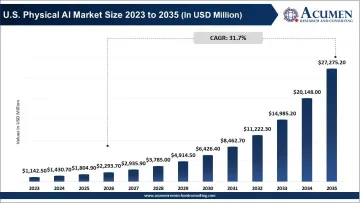
The U.S. physical AI market size was recorded at USD 1,809 million in 2025 and is estimated to surpass USD 27,275 million by 2035, reflecting a promising CAGR of 31.7% during the forecast period of 2026-2035.
Report Highlights
- By deployment, the on-device AI segment dominated the physical AI market in 2025 with a 51.5% share, driven by increasing adoption of autonomous systems requiring instant processing capabilities, reduced communication dependency, improved operational safety, and faster response times in dynamic physical environments such as factories, warehouses, and autonomous machines.
- By deployment, the cloud-based AI segment is expected to witness significant growth during the forecast period, supported by increasing utilization of cloud-based AI infrastructure for remote robot monitoring, continuous model improvement, large-scale data processing, and enterprise-wide management of connected robotic systems.
- By component, the hardware segment dominated the physical AI market in 2025 with a 56.8% share, owing to rising demand for advanced physical components including high-precision sensors, robotic arms, AI accelerators, edge computing devices, and motion-control systems required to enable machines to interact effectively with real-world environments.
- By component, the software segment emerged as the second-largest segment in 2025 with a 29.6% share, driven by the growing importance of intelligent algorithms, robotics operating systems, simulation software, and AI platforms that allow machines to learn, adapt, and execute increasingly complex tasks with greater autonomy.
- By technology, the computer vision segment dominated the physical AI market in 2025 with a 42.1% share, supported by increasing integration of cameras, LiDAR, depth sensors, and advanced image-processing technologies that enable robots to analyze surroundings, perform precision tasks, and improve autonomous navigation capabilities.
- By technology, the speech / NLP segment accounted for a 22.1% share in 2025, fueled by rising demand for conversational robotics, voice-enabled automation, and intelligent assistants that improve collaboration between humans and machines across customer-facing and workplace environments.
- By robot type / form factor, the industrial robots segment dominated the physical AI market in 2025 with a 38.3% share, attributed to the expansion of intelligent manufacturing facilities, increasing automation of repetitive industrial processes, and the integration of AI capabilities into existing robotic production systems.
- By robot type / form factor, the service robots segment held the second-largest share of 14.4% in 2025, supported by increasing commercialization of autonomous robots designed for human-centered applications including delivery services, elderly assistance, facility management, and customer interaction.
- By application, the manufacturing & automotive segment dominated the physical AI market in 2025 with a 23.0% share, driven by the transition toward flexible manufacturing, increasing adoption of autonomous production workflows, and the need for improved efficiency, quality control, and operational optimization.
- By application, the healthcare segment emerged as the second-largest application segment with an 18.0% share in 2025, supported by increasing healthcare automation requirements, advancements in medical robotics, demand for precision-based procedures, and the growing need for robotic support systems amid workforce challenges.
How Physical AI Transforming Robotics Sector in the United States?
The robotics industry in the U.S. is undergoing a revolutionary shift due to the proliferation of physical AI, which has allowed for the development of intelligently operating robots from simple programmed automation systems. Robotics adoption, the expansion across the manufacturing, logistics, defense and healthcare industries, is hastening this change.
According to the IFR, the U.S. installed an estimated 34,200 industrial robots in 2024, retaining its place as the biggest marketplace. Coupled with this burgeoning robotics uptake in the manufacturing industry, there is a shortage in the labor workforce, with a projected two million worker shortage in the U.S. manufacturing sector by the year 2030, thus demand for intelligently operating robots is ever rising.
Economic & Technological Statistics
- The U.S. held 68% of the region of industrial robots installed in the Americas in 2024. Its leadership in the region supports robot deployment and provides the foundational architecture for AI-enable robotic systems.
- The U.S. received $109.1B in private AI investment. This investment is significantly higher than that in the other major AI markets supporting the development of AI models, computing infrastructure, and physical AI technologies.
- Corporate AI investment globally was $252.3 billion U.S. took the lion's share of the private investment to support advancement of robotics, autonomous systems, and infrastructure for the development and deployment of AI.
- Investment in private generative AI was $33.9 billion globally-driving the demand for foundation models that could lead to physical AI systems like humanoid robots and autonomous machines.
- The U.S. manufacturing sector had over 12.8 million jobs; this presents a huge opportunity for the implementation of AI-powered automation, intelligent robotics and smart manufacturing.
- The U.S. manufacturing workforce is expected to lack more than 2.1 million skilled workers by 2030, driving demand for robots and AI automation systems.
Market Dynamics
Driver
Growing Demand for Autonomous Systems in Labor-Intensive Industries
Growing demand in the United States to cope with labor shortages, improve operational efficiency, and carry out complicated physical tasks automates the development of physical AI solutions, the labor scarcity in many industries has moved automation beyond simple mechanical solutions and into the realm of machines that use intelligence to adapt to a variety of working conditions.
The manufacturing sector alone employed over 12.8 million U.S. workers in 2024, while the shortages of skilled labor continue to drive companies to invest in robotics powered by AI for various activities like production, inspection and handling. In addition to these factors, growing e-commerce distribution, sophisticated logistics infrastructures, and cutting edge manufacturing plants contribute to a growing need for automated systems working 24/7.
Restraint
Limited Availability of High-Quality Physical AI Training Data
A major challenge for physical AI development is the shortage of diverse, real-world training datasets required for teaching robots to operate safely in unpredictable environments. Unlike digital AI systems that can be trained using large-scale online data, physical AI models require extensive data from robotic interactions, simulations, and real-world scenarios. Collecting this data involves significant time, infrastructure, and operational costs.
Variations in lighting, movement, object handling, human interaction, and environmental conditions make it difficult to create universally applicable AI models. This data limitation slows the development of highly reliable autonomous robots and increases dependence on expensive simulation platforms.
Opportunity
Increasing Adoption of Digital Twins and Simulation-Based Robot Development
The rapid adoption of digital twins and enhanced virtual environments now presents new opportunities to accelerate in the physical development of AI. Digital twin tech enables the replication of a factory, the operations within that facility, a product in the physical world, such as a robotic, AI enhanced, operating arm, in the virtual realm for it to learn and iterate before being piloted.
Companies are now able to develop AI more cost efficiently and safely and more rapidly than previously seen. Developments in industrial metaverse solutions as well as industrial metaverse solutions combined with high-performance compute and physics based simulation software means robots can learn at greater scale.
Segmental Insights
Deployment Insights
The on-device AI segment held a dominant 51.5% share in the U.S. physical AI market in 2025. This segment is gaining prominence as physical AI requires instant decision making abilities without reliance on cloud connectivity. Applications of industrial robotics, humanoid robotics and autonomous vehicles, among others, are executing AI processing on-device, reducing latency and enabling real-time operation.
Further improvement is witnessed in the availability of various on-board AI processors and processing capabilities, and increased reliance of firms to use on-device intelligence while adopting machine and robot learning technologies. On device processing of AI workloads has been enabling new applications for robots in, industrial, warehouse, healthcare, defense & mining segments.
The cloud-based AI segment constituted 48.5% to the U.S. physical AI market share in 2025. Increased cloud based analytics capabilities in AI and support to develop centralized robot fleet management services, robotic fleet orchestration, cloud simulation and big data analytics are the key drivers for this segment. Cloud connectivity allows firms to integrate operational data from an array of connected robots to optimize models over time, support continuous updates of robots’ algorithms and ensure efficient performance.
Component Insights
Hardware was the largest segment, holding 56.8% share in market during 2025. The dominance of the hardware segment is evident from the growing need of intelligent hardware for interactive physical AI applications. Physical AI systems require advanced sensors, computer vision cameras, LiDAR and RADAR, robotic manipulators and servo motors, AI accelerations, embed computing processors and edge devices for better environmental response and sensing.
The technology advancements in semiconductor processes, precise sensing, robotics actuators and computing hardware make robots work efficiently, reliably and energy-wise, which resulted in major contribution in hardware.
The software segment accounted for 29.6% share in U.S. physical AI market in 2025 based on deployment of several intelligent software platforms, which enables robotic hardware platforms to act as autonomous systems. Physical AI relies on perception, machine vision (MV), autonomy navigation, reinforcement learning, simulation systems and digital twin to execute and achieve several physical interaction tasks more efficiently.
Software plays a critical role in the interpretation of input signals from sensors, world model generation, state estimation, adaptation to varying environmental condition, and optimization of various performances with minimum human supervision.
Technology Insights
The 42.1% largest portion of the 2025 U.S. physical AI market belonged to computer vision. Physical AI utilizes computer vision as its core perception system, allowing machines to identify objects, read environments, quantify depth, detect anomalies, and safely operate in real-world spaces. By leveraging the integration of high-resolution, depth, and LiDAR sensors along with vision systems powered by artificial intelligence-based image processing algorithms, machines possess the vision capabilities to function autonomously.
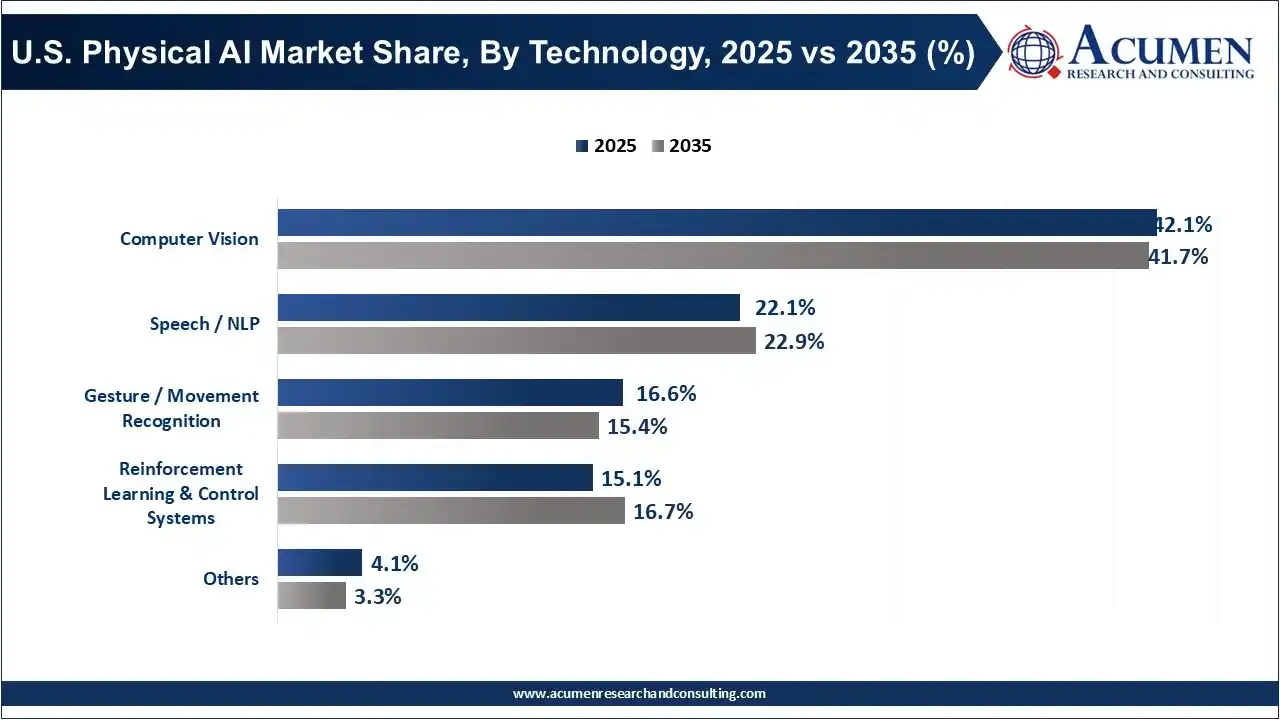
The 22.1% portion of the 2025 U.S. physical AI market was attributed to speech and natural language processing (NLP). Speech and NLP segment growth is on the rise as human-machine interaction takes a more critical role for commercial and industrial robotics applications. Speech recognition and NLP technologies enable robots to listen to commands and understand speech input, ascertain meaning, and generate natural contextually appropriate responses while collaborating with their human operators.
This can ease the need for traditional programming, making machines more versatile for customer-facing or collaboration-centric applications. Increasing usage is seen in sectors including healthcare, hospitality, retail, warehouse management, education, and personal assistance where enhanced communication greatly benefits the user and productivity.
Robot Type/Form Factor Insights
The Industrial robot segment represented 38.3% of in 2025 and accounted for the largest part of the U.S. physical AI market. The segment held its leadership through the widespread use of AI enhanced robotic systems in the automotive industry, aerospace sector, electronics segment, semiconductor manufacturing facilities and production industries.
The use of AI has seen increased use within the US manufactures for industrial robotic usage such as flexible assembly, intelligent material handling, AI supported quality control inspection, predictive maintenance and fully autonomous production optimization among the other manufacturing industries.
Service robot segment was at 14.4% of the U.S. physical AI market and had an increasing rate of deployment across healthcare sector, logistics sector, retail sector, hospitality industry, public safety sector and commercial sector. The service sector is more involved in highly dynamic and human centered environments and therefore requires advanced integration from the physical AI technologies for navigation through the system, identification of objects as well as clear and natural interaction with human interaction, that it is able to learn with its environment.
Application Insights
The manufacturing & automotive segment represented the largest application area with a 23.0% share in 2025. The dominance of this segment is driven by increasing implementation of AI-powered automation across automotive assembly plants, electronics manufacturing, aerospace production, and industrial machinery facilities. Physical AI enables manufacturers to deploy intelligent robots capable of autonomous assembly, machine vision-based inspection, predictive maintenance, digital twin simulation, and adaptive production planning.
These technologies improve manufacturing flexibility, reduce downtime, enhance product quality, and optimize operational efficiency. Growing investments in smart factories, reshoring initiatives, and advanced manufacturing technologies continue accelerating adoption of physical AI solutions throughout the U.S. industrial sector.
The healthcare segment captured 18.0% of the U.S. physical AI market in 2025, driven by expanding use of intelligent robotic technologies across hospitals, surgical centers, rehabilitation facilities, and elderly care services. Physical AI is improving healthcare delivery by enabling greater precision in robotic-assisted surgeries, autonomous patient monitoring, rehabilitation therapy, hospital logistics, and medication delivery. AI-powered robots equipped with advanced perception, navigation, and decision-making capabilities are helping healthcare providers improve clinical outcomes while reducing workload pressures.
Government Initiatives
| Initiative / Program | Key Focus | Impact on Physical AI |
|---|---|---|
| National AI Research Resource (NAIRR) Pilot | Expands researcher access to AI computing, datasets, and models | Enables development of advanced robotics, embodied AI models, and physical AI research. |
| CHIPS and Science Act | Strengthens domestic semiconductor manufacturing and R&D | Increases availability of AI processors, edge chips, and computing hardware required for physical AI systems. |
| Manufacturing USA Institutes | Supports advanced manufacturing and industrial innovation | Promotes AI-enabled robotics, smart factories, digital twins, and industrial automation technologies. |
| National Robotics Initiative (NRI) | Funds collaborative robotics and intelligent autonomous systems | Accelerates research in human-robot collaboration, autonomous robots, and AI-driven robotics platforms. |
| Department of Energy AI for Science Initiative | Develops AI infrastructure and high-performance computing | Supports robotics simulation, AI model training, and intelligent industrial applications. |
| Department of Defense Replicator Initiative | Expands deployment of autonomous systems | Encourages development of AI-powered autonomous robots, drones, and intelligent defense platforms. |
| National Institute of Standards and Technology (NIST) AI Programs | Develops AI standards and trustworthy AI frameworks | Improves interoperability, safety, and reliability of physical AI and robotics deployments. |
U.S. Physical AI Market Competitive Landscape
- NVIDIA Corporation – Expanded its physical AI ecosystem through the launch of Isaac GR00T N1 and Cosmos world foundation models in 2025 to accelerate humanoid robot development.
- Tesla, Inc. – Continued advancing Optimus humanoid robot development, expanding internal manufacturing and real-world factory testing for commercial deployment.
- Google DeepMind – Introduced Gemini Robotics and Gemini Robotics-ER, enhancing multimodal reasoning and robotic intelligence for physical AI applications.
- Microsoft Corporation – Expanded Azure AI infrastructure while strengthening partnerships with robotics developers to integrate generative AI into industrial automation.
- Amazon Robotics – Increased deployment of AI-powered warehouse robots and introduced new intelligent fulfillment technologies across U.S. logistics operations.
- Boston Dynamics – Expanded commercial deployment of Atlas, Spot, and Stretch robots across manufacturing, logistics, and warehouse automation projects.
- Figure AI – Accelerated commercialization of its humanoid robots through partnerships with leading manufacturing companies and continued large AI model integration.
- Rockwell Automation – Enhanced industrial AI capabilities by integrating machine learning, industrial software, and autonomous robotics into smart factory solutions.
- Agility Robotics – Expanded production of Digit humanoid robots while increasing pilot deployments for warehouse logistics and material handling operations.
- Symbotic Inc. – Continued expanding AI-driven warehouse automation platforms through new customer agreements with major retail and supply chain operators.
Segments Covered
By Deployment
- Cloud-based AI
- On-device AI
By Component
- Hardware
- Software
- Services
By Technology
- Computer Vision
- Speech / Natural Language Processing (NLP)
- Gesture / Movement Recognition
- Reinforcement Learning & Control Systems
- Others
By Robot Type / Form Factor
- Industrial Robots
- Service Robots
- Humanoids / Social Robots
- Cobots
- Exoskeletons / Prosthetics
- Mobile Robots / Drones
By Application
- Manufacturing & Automotive
- Healthcare
- Logistics & Warehousing
- Retail & Hospitality
- Defense & Security
- Agriculture
- Education & Research
- Others
Looking for discounts, bulk pricing, or custom solutions? Contact us today at sales@acumenresearchandconsulting.com
Frequently Asked Questions

Other ICT Reports
May 2021
August 2020
June 2026
May 2020