
Asia-Pacific Physical AI Market Size, Share, Forecast 2026 To 2035
Asia-Pacific Physical AI Market (By Deployment: Cloud-based AI, On-device AI; By Component Hardware, Software, Services; By Technology: Computer Vision, Speech / Natural Language Processing (NLP), Gesture / Movement Recognition, Reinforcement Learning & Control Systems, Others; By Robot Type / Form Factor: Industrial Robots, Service Robots, Humanoids / Social Robots, Cobots, Exoskeletons / Prosthetics, Mobile Robots / Drones; By Application: Manufacturing & Automotive, Healthcare, Logistics & Warehousing, Retail & Hospitality, Defense & Security, Agriculture, Education & Research, Others) - Industry Analysis, Size, Share, Growth, Trend Analysis And Forecast 2026 To 2035
- Last Updated: 11 Aug 2026
- Report Code: ARC3960
- Category: ICT
Asia-Pacific Physical AI Market SIze and Forecast 2026 to 2035
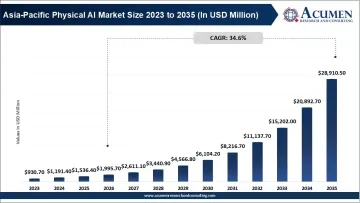
The Asia-Pacific physical AI market size was valued at USD 1,536.4 million in 2025. The market is observed to reach at USD 28,910 million by 2035 while growing at a promising CAGR of 34.6% during the forecast period 2026 to 2035. Rising industrial robot deployment is expanding the installed base for physical AI integration across Asia-Pacific; the region accounted for 74% of global industrial robot installations in 2024, with 295,000 units installed in China alone.
Key Highlights
- By country, China dominated the Asia-Pacific physical AI market with a 39.5% share in 2025, supported by 295,000 industrial robot installations in 2024 and an operational robot stock exceeding 2 million units.
- By country, Japan held the second-largest share at 23.6% in 2025, backed by 44,500 industrial robot installations and an operational stock of approximately 450,500 units in 2024.
- By deployment, on-device AI dominated the Asia-Pacific physical AI market with a 51.5% revenue share in 2025, supported by demand for low-latency processing, real-time decision-making, data privacy, and autonomous operation.
- By deployment, cloud-based AI accounted for 48.5% share in 2025 and is projected to reach 51.9% by 2035, driven by centralized AI training, robot-fleet management, simulation, digital twins, and remote diagnostics.
- By component, hardware dominated the Asia-Pacific physical AI market with a 56.8% revenue share in 2025, supported by rising demand for AI processors, sensors, cameras, LiDAR, actuators, robotic arms, controllers, and edge-computing systems.
- By component, software held the second-largest share at 29.6% in 2025 and is projected to increase to 31.8% by 2035, reflecting growing demand for autonomous-control software, computer vision, reinforcement learning, digital twins, and robot operating platforms.
- By technology, others accounted for the largest share at 50.3% in 2025, encompassing sensor fusion, localization and mapping, edge AI, multimodal models, autonomous navigation, simulation, digital twins, and other enabling technologies.
- By technology, reinforcement learning & control systems represented the second-largest individually identified segment with a 12.2% share in 2025 and is projected to reach 13.5% by 2035, driven by increasing use in humanoids, autonomous vehicles, robotic manipulation, and adaptive industrial automation.
- By robot type/form factor, industrial robots dominated with a 38.3% revenue share in 2025 and are expected to retain leadership with 37.2% by 2035, supported by extensive adoption across automotive, electronics, semiconductor, machinery, and consumer-goods manufacturing.
- By robot type/form factor, service robots held the second-largest share at 14.4% in 2025 and are projected to reach 14.9% by 2035, driven by expanding applications in healthcare, logistics, hospitality, retail, professional cleaning, and commercial services.
- By application, manufacturing & automotive dominated the Asia-Pacific physical AI market with a 24.4% share in 2025, supported by the region's large manufacturing base and increasing deployment of AI-enabled assembly, inspection, material handling, predictive maintenance, and digital-twin systems.
- By application, healthcare represented the second-largest segment with a 17.4% share in 2025 and is projected to maintain a 17.2% share by 2035, driven by increasing adoption of surgical robotics, rehabilitation systems, elderly-care robots, hospital automation, and intelligent medical devices.
How Is Asia-Pacific Building a Global Physical AI Supply Chain?
Asia-Pacific is quickly becoming the leading full supply chain stack for Physical AI through integrating robot manufacturing, silicon capabilities, precision manufacturing, AI infrastructure and massive industrial automation deployment. Japan’s expertise in industrial robots is world renowned, including enabling automation and fine manipulation.
Korean and Taiwanese firms dominate hardware across the board from silicon, electronics and computing. India and Southeast Asia are key becoming regional hubs both for manufacturing and the deployment of automation at scale. This leads to a fundamental supply chain shift, going from exporting a robotic component, to a full physical AI stack supply from chip to enterprise.
Physical AI Export Potential from Asia-Pacific
- China accounted for approximately 15% of global industrial-robot exports in 2024, making it the second-largest exporter after Japan, which held about 22%.
- China’s industrial robot production increased by more than 600% from 2016 to 2024, creating a substantially larger domestic manufacturing base capable of supporting international Physical AI exports.
- Japan's industrial-robot export ecosystem remains globally significant, with Japan accounting for approximately 22% of global industrial-robot exports in 2024, providing a strong foundation for exporting advanced robotic hardware and automation technologies.
- China's high-tech exports increased 40.7% year-on-year in July 2026, while semiconductor exports nearly doubled, demonstrating strengthening export momentum in the technology-intensive supply chains that support advanced AI and Physical AI systems.
- China's industrial robot production increased by more than 40% during the first eight months of 2025, indicating continued expansion of manufacturing capacity for globally deployable robotic systems.
Market Dynamics
Driver
Expansion of AI-Enabled Manufacturing
Intelligent manufacturing is growing quickly and making a significant demand base for physical AI all across the Asia-pacific. In 2024 alone China captured 54% share of worldwide industrial-robot installation, with installed numbers to be near 295,000 units during the year and operational stock reaching beyond 2 million units. It thus poses a great chance to augment traditional automation installations with computer vision, self-learning, predictive maintenance, AI powered decisions-making.
Restraint
Fragmented Physical AI Standards and Interoperability
Physical AI deployment remains constrained by differences in robotics architectures, communication protocols, safety requirements, AI models, data standards, and industrial automation systems. Enterprises operating across multiple Asian markets may need to integrate robots, sensors, controllers, cloud platforms, and factory-management systems from different vendors. This increases integration costs, extends deployment timelines, and can make large-scale multi-site Physical AI implementation more complex than conventional software deployment.
Opportunity
Export-Oriented Robotics and AI Manufacturing
The synergistic power of Asia-Pacific’s manufacturing capabilities, access to key components, engineering strengths, and accelerating robotics production is poised to make the region a global center of Physical AI supply. Furthermore, the opportunity is increasingly expanding from complete robotic systems to high-value components, hardware for robotic AI compute, sensors, robotics control systems, robotics simulation tools and Robotics-as-a-Service, or RaaS, in which local tech players could potentially capture greater value at various junctures of the global Physical AI value chains.
Segmental Insights
Deployment Insights
The on-device AI segment dominated the Asia-Pacific physical AI market with a 51.5% revenue share in 2025. Its leading position reflects the growing requirement for low-latency inference, real-time decision-making, data privacy, and autonomous operation in robots and intelligent machines that cannot depend continuously on remote cloud connectivity. The segment is particularly relevant to Asia-Pacific's manufacturing-heavy economies, where industrial robots, autonomous mobile robots, machine-vision systems, and AI-enabled production equipment increasingly require local processing.
China, Japan, South Korea, and Taiwan are especially important because of their large electronics, semiconductor, automotive, and robotics ecosystems. Meanwhile, India's expanding industrial automation and electronics manufacturing base is creating additional demand for edge AI systems.
Cloud-based AI accounted for the second-largest deployment share at 48.5% in 2025 and is projected to increase to 51.9% by 2035, making it the fastest-expanding deployment model in the segment. Growth is being supported by demand for centralized AI model training, robot-fleet management, digital twins, simulation, remote diagnostics, and continuous model improvement. Cloud infrastructure is particularly valuable for enterprises deploying large fleets of robots across multiple factories, warehouses, and facilities because operational data can be aggregated and analyzed centrally.
The expansion of AI infrastructure across China, Japan, South Korea, Singapore, and India is strengthening this opportunity. The shift from 48.5% in 2025 to 51.9% by 2035 represents a gain, highlighting the increasing importance of hybrid physical AI architectures combining local inference with cloud-based intelligence.
Component Insights
Hardware segment dominated Asia-Pacific physical AI market by revenue shares, a 56.8% share in 2025. Physical AI requires massive hardware with chip for AI processes, sensors, camera, LiDAR, actuators, robotic arms, motors, controllers, edge computing systems and power management components.
The market concentration on manufacturing aspect in Asia-Pacific provides a structural advantage for the component segment, with China as a hub for robotics manufacturing, Japan's strengths are in high-precision robotics and industrial automation while South Korea has semiconductor and consumer electronics infrastructure and Taiwan is advanced in semi-conductor manufacturing.
Software held the second place to Hardware in 2025 with a 29.6% market revenue share in Asia-Pacific Physical AI market and grew to 31.8% in 2035. The application requirements for robot operating systems, computer-vision software, reinforcement learning system, simulation platform, digital twin, vision-language-action system, fleet management system and autonomous control software are growing significantly and the software development forces across the Asia-Pacific.
Technology Insights
The others technology segment was Asia Pacific physical AI market size in 2025 and contributed to 50.3% market revenue of all technology segment, this segment includes other technologies except of those four individual technology as, sensor fusion, localization and mapping, planning and decision engine, EdgeAI, multimodal models, simulators, digital twins, autonomous navigation and others supporting technology.
Reinforcement learning & control Systems represented the second-largest individually identified technology segment, with a 12.2% share in 2025, rising to 13.5% by 2035. Reinforcement learning is particularly important for humanoid robots, autonomous mobile robots, robotic manipulation, industrial control, and autonomous vehicles. Asia-Pacific's expanding humanoid robotics ecosystem is strengthening demand for these technologies, while manufacturing companies are increasingly using AI-based control to improve robot flexibility and reduce manual intervention.
Robot Type/Form Factor Insights
Industrial robots held the largest market share by robot type in Asia Pacific physical AI at 38.3% and are expected to continue to do so through 2035 at 37.2%. This segment is heavily supported by the enormous scale of manufacturing facilities across Asia Pacific-especially in automobiles, electronics, semiconductor, machinery, and consumer good manufacturing. China holds the world's largest industrial robotics market and Japan and South Korea possess a high degree of automation in their manufacturing environments.
By integrating AI, industrial robots are now able to undertake more complex and sophisticated tasks with capabilities such as machine vision, adaptive control, predictive maintenance, autonomous decision-making and real-time quality inspection.
The service robots was second largest at 14.4% of Asia Pacific physical AI in 2025 and projected to reach 14.9% by 2035. Demand is expanding across healthcare, hospitality, retail, professional cleaning, delivery, education, and commercial facilities. Japan's aging population is supporting opportunities in elderly assistance and healthcare robotics, while China and South Korea are expanding service and logistics robotics alongside their broader AI ecosystems.
Application Insights
Manufacturing & automotive application segment dominated the Asia Pacific physical AI market in 2025, contributing approximately 24.4%. Physical AI are integrated into robot assembly line robots, inspection using machine vision systems, intelligent and autonomous materials handling robots, smart automated inspection and testing machines, equipment condition monitoring and predicted failures and operational efficiency improvement in factories and process plants including digital twin solutions.
The region offers massive manufacturing capability to accommodate robotic technologies with the growth of huge China manufacturing capacity, superior industrial automation technologies from Japan, advanced robotic capabilities combined with its extensive automobile and consumer electronics production in South Korea and India.
Healthcare represented the second-largest application segment with a 17.4% share in 2025 and is projected to remain significant at 17.2% in 2035. Physical AI adoption in healthcare includes surgical robotics, rehabilitation systems, hospital logistics robots, elderly-care systems, robotic assistants, and intelligent medical devices. Demographic changes are particularly important in Asia-Pacific, where aging populations and healthcare workforce pressures are increasing demand for automation. Japan is a major opportunity for elderly-care and assistive robotics, while China is expanding medical robotics and intelligent healthcare technologies.
Top Asia-Pacific Physical AI Government Initiatives
- China (Humanoid Robots Innovation Initiative) - China made human robots an emerging and strategically important emerging industry by building a fully-fledged humanoid robot innovation system and industry cluster ecosystem from core components, robot intelligence, robotic manufacture to commercialization by 2025-2027.
- Japan (AI Robots Strategy) - The “2026 AI Robots Strategy” developed by Japan aimed at accelerating the promotion of AI robots into social activities such as robotics services in multiple fields including manufacturing, logistics, healthcare, agriculture, and in services.
- South Korea (K-Humanoid Alliance) - The K-Humanoid Alliance, composed of more than 40 companies and universities, has aimed for public-private cooperation in over KRW1 trillion investment to develop humanoid robots related technologies including the humanoid AI itself, robot parts and AI chips.
- India (IndiaAI Mission) - The Indian government approved about rupees 10,371.92 crore to carry out the IndiaAI Mission with a total budget aimed to fund computation infrastructure, datasets, foundation models, startups, and research that will serve as underpinning for physical AI and robots.
- Taiwan (AI and Semiconductor Development Programs) - Taiwan has invested heavily from public and private funding in the development of advanced semiconductor technologies, AI computing, and next-generation electronics.
- Singapore (National AI and Advanced Manufacturing Initiatives) - Singapore has launched several government programs investing billions of Singapore dollars to develop and boost adoption of artificial intelligence (AI) systems, semiconductor innovation and advanced manufacturing capabilities.
Which Asian Countries Are Leading Physical AI Commercialization?
China held 39.5% of Asia-Pacific's physical AI market share in 2025 led by its extensive installed base of industrial robotics, the expanding humanoid robotics ecosystem, development of AI infrastructure in the nation's intelligent manufacturing and growing investment in AI computing power and automated technologies. China constituted more than half of total installed base of industrial robots worldwide in 2024. Hence, it has a considerable market for incorporating technologies for computer vision and AI based control.
For instance, UBTECH, Unitree Robotics, AgiBot and Fourier Intelligence are speeding up the commercialization process in intelligent factories for various uses including manufacturing as well as their deployment growth in electronics, automotives, electronics as well as logistics sector. The China’s robotics market is also strengthening its position by increasing the use of computer vision in a majority of manufacturing and industrial applications.
Japan, captured 23.6% share of Asia-Pacific physical AI market in 2025 led by its robot mature industrial base, the country's robotics capabilities and high penetration across automotive and electronic sectors. Japan's investment in various robot systems has created huge installed base for implementing new advanced automation solutions in various industry segments.
Moreover, its aging society along with increasing labour shortages are augmenting the requirement for service and healthcare robots coupled with the ongoing investments in humanoid robotics, AI for manufacturing automation, intelligent machines in logistics as well as its automotive and electronic industrial applications.
India contributed a sizeable share, accounting for 21.48% of Asia-Pacific physical AI market in 2025, with increased use in industries such as automotive, logistics and electronics that demand automation, along with the expansion of manufacturing output, the rise of AI and greater utilization of robotics throughout various sectors of the country.
While India, that achieved installation of nearly 9,100 industrial robots in 2024, represents a rising automation base, government support for AI and electronics production is stimulating development of new technologies and strengthening the local AI and robotics ecosystem. Growth investments in smart manufacturing solutions, automation for logistics, as well as for developing new robot prototypes to make the nation robot efficient is in place to bolster adoption of these technologies and solutions.
South Korea held 7.32% of Asia-Pacific physical AI market by 2025, led by its robustly automated production systems, dominant electronics manufacturers, advanced battery production, the use of its autonomous vehicles and highly integrated factory equipment and machines.
South Korea deployed close to 30,600 industrial robot systems in 2024, with installed equipment per factory workers among the highest internationally. Additionally, significant investments in semiconductors, EV technology, and AI computing have established the framework for numerous intelligent robots.
Top Companies
- Unitree Robotics
- UBTECH Robotics
- FANUC Corporation
- Yaskawa Electric Corporation
- Toyota Motor Corporation
- Samsung Electronics
- Hyundai Motor Group
- Rainbow Robotics
- Ecovacs Robotics
- Addverb Technologies
Asia-Pacific Physical AI Partnerships and M&A Tracker
- DeepSeek-Unitree Robotics DeepSeek has invested approximately $20.8 million for 2.31% in Unitree Robotics’ Shanghai IPO. Both parties are expected to explore cooperation in areas of artificial intelligence, robotics, motion control and embodied intelligence.
- Hyundai Motor Group-Boston Dynamics Hyundai is to deepen its strategic cooperation with Boston Dynamics toward building an end-to-end AI robotics value chain, from manufacturing and training to commercialization and robots-as-a-service.
- Boston Dynamics and Google DeepMind will form a strategic partnership to couple Boston Dynamics robot hardware with Google DeepMind’s robotics foundation models like Gemini Robotics in search of next generation humanoid features and smarter commercial applications.
- Hyundai-NVIDIA Hyundai Motor Group and NVIDIA are working together on their AI robotics strategy in leveraging NVIDIA’s AI compute and software strengths with Hyundai’s manufacturing, mobility and robotic ecosystem.
Segments Covered
By Deployment
- Cloud-based AI
- On-device AI
By Component
- Hardware
- Software
- Services
By Technology
- Computer Vision
- Speech / NLP
- Gesture / Movement Recognition
- Reinforcement Learning & Control Systems
- Others
By Robot Type / Form Factor
- Industrial Robots
- Service Robots
- Humanoids / Social Robots
- Cobots
- Exoskeletons / Prosthetics
- Mobile Robots / Drones
By Application
- Healthcare
- Manufacturing & Automotive
- Logistics & Warehousing
- Retail & Hospitality
- Defense & Security
- Agriculture
- Education & Research
- Others
By Country
- China
- India
- Japan
- South Korea
- Rest of APAC
Looking for discounts, bulk pricing, or custom solutions? Contact us today at sales@acumenresearchandconsulting.com
Frequently Asked Questions

Related Market Research Reports
August 2026
August 2026
July 2026
May 2026
October 2026
October 2026
October 2026
September 2026